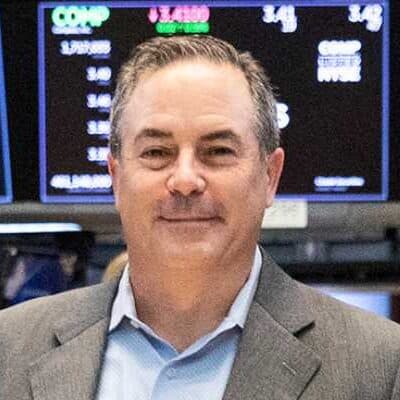
Stocks & Markets Podcast: Why Portfolio Construction Matters With Louis Llanes
Louis Llanes joins Chris Versace for a wide-ranging discussion on small-caps, AI, bank earnings, Wall Street 'gamesmanship' and Texas barbecue!
You've reached your free article limit
You've read 0 of 1 free Pro articles.
We're back with a second Stocks & Markets podcast this week, this time with The Street Pro’s Louis Llanes joining Chris Versace to talk silver, AI, and big bank earnings. The two also talk about how they handle a position that isn’t working out as expected in the short-term, and strategies they use to contend with that.
Louis also explains one aspect of systematic risk he sees in the market, and the two discuss some of the gamesmanship used by Wall Street analysts.
We close out the conversation with Louis naming the two places in Austin, Texas, that he recommends for barbecue. He also shares what his go-to barbecue item is.
More Pro Portfolio:
- We're Locking in Big Gains on This Holding Reflecting Portfolio Discipline
- Consumers Are Spent, France Hack, U.S. of Old and More Investing News
- Weekly Roundup: Portfolio Gains Ground Amid Key Data and News
Transcript
CHRIS VERSACE: Hey, folks, Chris Versace here of TheStreet Pro Portfolio. And it is time for another Stocks & Markets podcast. Now you're saying to yourself, but Chris, we had another podcast earlier this week, why are you coming at us so quickly. Well, folks, for a couple reasons. First and foremost, there's a holiday week coming up, holiday weekend coming up. We want to make sure that we don't shortchange you. I will be traveling to New York next week as well, doing some meetings, but also doing some other media appearances.
So that's some of the factors behind this quicker than usual podcast. But more importantly, we have Louis Llanes here, and we've got a lot to talk about. We're coming off of big bank earnings. Those really impressive not just quarterly results, but guidance from Taiwan Semiconductor about how it sees AI as a mega trend. So we wanted to grab Louis real quick and just chit chat about a bunch of quick things. Here we go. Louis, my friend. Thank you so much.
LOUIS LLANES: How are you? Good to be with you.
CHRIS VERSACE: It's always good to spend time with you, Louis. January 2026 starting off on a good foot for you?
LOUIS LLANES: Actually, really is. Quite a few stocks have been outperforming, had a few clunkers here and there, as we all do, but overall, it's been a pretty off to a good start.
CHRIS VERSACE: Well, you just took me in a whole different direction, Louis. So you said we all have some clunkers, and I think we have to realize that when you build a portfolio that can have 20 plus positions, sometimes it's going to take time for a position to work. Other times you might have to do some damage repair. How do you approach this?
LOUIS LLANES: Oh, this is probably the largest, most artful part of our business. The first thing I-- we touched on this the last podcast we had. Many viewers probably didn't get a chance to see it, so maybe I can just bring that up again, kind of the basics. But I really like to go back to the first principles of what is the nature of the business and what is the thesis, is that thesis still intact? If that is true, then I want to be much more forgiving. And that helps me decide what I want to add more to the position or not.
But if the situation has deteriorated, but it's a temporary deterioration and that requires a lot of judgment, then I'm not so worried. But if it's a deterioration that is structural that I'm not sure can be recovered for at least in the next year, I don't know that I want to hold the capital that long, especially if there's other opportunities. So it's really a look at, what are the opportunities now versus what I have my capital committed to. And it's a constant recycling of capital to make sure that we're putting capital where it has the best return risk opportunity. So there's a lot of judgment to that.
CHRIS VERSACE: So I agree with you, but I also think there's one other element that happens sometimes, especially in this market, where people, the attention span is so short and getting shorter it seems that-- I think that if a stock is not working, some people, they get very antsy. And what I like to do is go back and check the data, as you say, check the underlying thesis. In the fourth quarter, the calendar fourth quarter, it's not really a secret that Costco, a stock I like, a stock you like, no matter what the company did in terms of posting great comp sales numbers or whatever it was, the stock was not responding.
Lo and behold, we move into 2026, the company puts up stellar December comp sales. All of a sudden, a couple upgrades. boom, the stock is working and Costco is off to the races. So I think at times there's this perception that for one reason or another, some group of investors might think one thing, even though the data says something else, and that can be very trying.
LOUIS LLANES: Yeah, you get a lot of crosscurrents from market participants that are more macro oriented. They may just make a macro decision to sell off certain baskets of stocks that can cause these things to happen. And sometimes there's an overfocus on a certain metric that is really not key to the overall value of the company longer term. And that could give you these temporary situations. I'm looking at a company like DoorDash for example. That has been one of my clunkers, if you will. Well, there's some longer term potential there.
But there's this overfocus, in my opinion, on CapEx and the effect on CapEx to the cash flows. And I think a company like that you just have to be more patient with. Another company that I can think of right now would be like a company like Intuit. That one is not as clear to me. But you really do have to just look at the underlying thesis of your company if you're a long-term investor. Now, if you're a trader, it's a whole different animal.
CHRIS VERSACE: Oh, totally agree.
LOUIS LLANES: But as a longer term investor, especially with the type of investing that I do, managing taxes and things like that, I have to think more long term. And you really have to understand the thesis of your companies. And if you have a company-- and I do categorize types of companies that I own. If you have a company that is more speculative in nature, I do treat them differently than those that are more long-term investment grade type companies. Like, for example, Robinhood is a more speculative investment for me.
CHRIS VERSACE: Now, before we started taping, you mentioned-- and I'm going to come back to the conversation we're having but since you brought up Robinhood, you did mention that you're watching it closely and it could break support. If it does, that's a little worrisome for you.
LOUIS LLANES: Yeah, I think it's one of those things-- I have a set of companies that I like to look at that I think are related to the psychology of market participants, because we have to look at the backdrop we're in right now. Right now we're at about 22 times forward earnings. If you look at it long term statistically, long term statistically, that implies a lower below average rate of return going over the next five years. So that's the general market.
But we're in the business of picking companies that are superior. That's what we're trying to do. And that is our goal. But if you understand that backdrop, you have what professionals like to call systematic risk, which is when, if everybody decides to hit the sell button, they're going to sell the baby with the bathwater kind of a thing. So you just have to understand that. So I'd like to understand which companies are likely to be those first companies to be sold. And I think Robinhood would be one of those. So as long as that company holds support, I think that's what-- I'm just using that as one example.
CHRIS VERSACE: Sure.
LOUIS LLANES: That that's a good sign. That's showing that sentiment is strong still.
CHRIS VERSACE: Are there others like that you follow closely?
LOUIS LLANES: There are. There's some other ones. But I don't want to talk about them right now because I'm trading them. And I have to be careful about when I talk about certain things.
CHRIS VERSACE: No, that's fine. Let me ask you this then. If you can't tell us more about those, about how many are in this basket that you watch? Is it four or five? Is it a dozen?
LOUIS LLANES: As many as I happen to bump into, and then I keep them on a separate screen and I just watch them. It's one of the things-- I've been doing that forever. I learned that lesson in the dot-com. The dot-com was one of-- that bust was one of the biggest training grounds for me early in my career. So I learned a lot of lessons from that.
CHRIS VERSACE: And you still have your hair.
LOUIS LLANES: I do. I have some great hair.
[LAUGHTER]
CHRIS VERSACE: So let me get back to perception, a stock under pressure, a clunker, I think, as you called it. One of the ones that we're struggling with right now in the Pro Portfolio is ServiceNow. And the stock, if you take a look at it, you look at its RSI level, Louis, it's around 22, 23, extremely oversold. Company announced a big cybersecurity acquisition which I think is positive.
But at the same time, I think folks are concerned that AI might be eating the business. I tend to think of it this way. A lot of what I've read points to side load data in the enterprise being a headwind for AI adoption, and I think that sets up ServiceNow extremely well to help businesses walk through that and benefit from AI.
LOUIS LLANES: Yeah. That's the kind of thing that separates the men from the boys, when you have a stock that's breaking support like ServiceNow. But you have strong conviction and you have a good understanding of what's happening in the business, that's where you can make serious above average rates of return. I mean, and it's not easy to do that when you buy when you're buying them right on that. I like to see a little bit of stability in the sentiment, which means I never get the bottoms. And I tend to sell a little bit early too.
Let me just tell you a little bit about my philosophy. I believe that portfolio construction and risk management is just as important as stock selection, because constructing your portfolio overall to withstand various market environments is very, very important. And it's about having more stable of a ride for me for how I like to invest. So I might have something that you would go, oh, my gosh, that's speculative, like a Robin Hood. But it's a small size. So everything is relative to return and risk.
So a company like ServiceNow, which I have owned in the past, don't own right now, overall, from what I remember, I haven't looked at ServiceNow recently, the company has a lot going for it. So this could be one of those above average opportunities.
CHRIS VERSACE: Well, I think-- I will say this, that kind of at a minimum, when we see a stock with an RSI level, that's 22, 23, I think we can tell that any positive news has the potential to push the stock higher.
LOUIS LLANES: And the company has the balance sheet too. That's the thing. If it didn't have the balance sheet, that'd be a different issue.
CHRIS VERSACE: Yeah, so we'll see. They report later this month and we will be tracking a number of different things, including the remaining performance obligations, which in my view is kind of critical data for a company like ServiceNow. But let's move on. Big banks, interesting. Investment banking, wealth management really leading the way. We can see that Morgan Stanley, Goldman Sachs, the more traditional banks or bank big banks with-- what's the word I'm looking for a-- more traditional mix of business and including commercial banking credit cards not performing as well. What do you make of it?
LOUIS LLANES: Well, I think it's better to continue with the larger banks. And I do have a position in Morgan Stanley and JP Morgan, and I like them overall. I think longer term, I know this is a little bit off topic, but some of the, like a Progressive, which no one's really liking right now, and there's reasons why, short term. But eventually those types of companies, I think, could have better stable returns than some of the credit cards.
And the other thing from a macro perspective, there's a lot of consumer concerns there. I mean, credit quality concerns. I'm on calls all the time with different research people. And this kind of ties into private credit in my mind. I think there's a lot of concern about private credit spreads. And of course, everybody who's in that business is telling us right now that everything's hunky dory. But I'm shying away from a lot of extended or lower credit quality in pretty much anything.
CHRIS VERSACE: I was going to say, it's good until it isn't right.
LOUIS LLANES: Yeah, and what's weird about that, it always happens so rapidly, and then everybody acts so surprised.
CHRIS VERSACE: Yeah, but I think-- I mean, look, our job is to keep the ear to the ground, look for the signals, which is why we not only have our themes, but we publish on the weekends over at the Street Pro, ripped from the headlines, confirmation points and signals. And when you see things people moving away from pizza because it's too expensive, you see high earners embracing BNPL, you start to have to ask yourself questions about this. Why is this happening? So we continue to think that the consumer is going to have a tough time near term, which is why we own Costco and TJX.
LOUIS LLANES: Yeah, I mean, those are definitely more defensive in nature, make a lot of sense. Strong balance sheets, consistent earnings, cash flows. A company like Domino's Pizza that you-- I don't know if you were implying Domino's, but I do have a position in Domino's as well. Yeah, it's going to cycle more. But what's interesting is you said something that is very interesting, I kind of chuckled, because, when you think about buying pizza, you never think about that being the one that's too expensive.
CHRIS VERSACE: That's right.
LOUIS LLANES: The pizza that's too expensive. So if we're already going down to that low level, as you we're alluding to, this really shows the state that I think inflation, primarily inflation has put on the economy, because it's not-- it might be underemployment, it might be inflation or maybe a combination of the two. I'm not sure what your take is on that.
But just kind of just anecdotally, it feels like middle income America is struggling with inflation as well as even maybe below middle level America. And people that are wealthy, they tend to be doing because the stock market's been doing OK. And that's causing some unrest. And that could also-- look, we're sitting at really on the low end of consumer confidence if you look at the graph. I feel like it's going to probably revert to the mean sometime this year. And confidence can get better. I could be wrong.
CHRIS VERSACE: Well, we have supposedly better tax refunds coming that we could see perhaps some other positives, start to emerge. I will say anecdotally, I have heard of more people getting jobs lately. So that's a good sign. But at the same time, to your point about inflation, I also just read some stuff from the National Restaurant Association that menu prices in December 2025 bumped up, increasing at levels we haven't seen, I think, since 2024. So that's a little concerning to me, because it says that if food inflation at the restaurant level is going higher, people are going to continue to shift back to eating at home.
LOUIS LLANES: I'm eating more at home for two reasons. One, I get better quality. I know what I'm eating. Two, it's expensive. I mean--
CHRIS VERSACE: No, I understand what you're saying.
LOUIS LLANES: And I think a lot of people are in that category even regardless of income level. But I think at the aggregate, that really supports your thesis about a Costco or something like that, or Walmart. And the numbers have been supporting that as well. In my mind, those are investments that are better than owning bonds. They're probably not going to be the rip roaring stocks that we hear about in the headlines. But they're good solid performers. And that's the blocking and tackling necessary for as a component of a good strong portfolio in my mind.
CHRIS VERSACE: Agreed. So when we did a larger podcast, I think Jason Meshnick did a podcast takeover back in December, and people asked me, we were talking about, what are we looking for, what are we excited about for 2026, and I said, AI adoption and usage would continue to rise. And I think that would benefit a number of different chip stocks. I think I singled out NVIDIA, Marvell, and a couple others. And I think, if I remember correctly, you agreed with me. So my question to you is, if you have seen the quarterly results from Taiwan Semiconductor, what did you think?
LOUIS LLANES: Well, I thought that was awesome. I mean, I'm overweighted in that whole area across the board, and that's been good. At the end of the day-- we've always thought about this sector as being kind of cyclical. And I remember back in the day, semiconductors were kind of a new thing. It was like, wow--
CHRIS VERSACE: Careful, careful. You're dating yourself.
LOUIS LLANES: I know. I remember it was like, oh, wow. All these new mutual funds were coming out that were semiconductors, and they were so hot and on fire. I think what we have right now is a completely different environment. Just technology has expanded such that this is more of a staple. It's becoming more of a staple and less of a cyclical investment. It still has a cyclicality to it.
But right now we're in a big uptrend. And that uptrend looks like it's a pretty strong for a number of years. And I just think you just have to own the best of the cream of the crop in that area. And truthfully, it's hard to always know exactly which is the best one. So I like to go back to my quality valuation and technical components and just stay on top of that, and own them across the board that have the best features of the quality valuation and technicals.
CHRIS VERSACE: And I suppose you're trading them, so you're not going to name any of them.
LOUIS LLANES: Right now, yes. You got me at a really bad time.
CHRIS VERSACE: Well, Louis, you knew we were talking today. It's not like I just popped up on, did record at the last minute. Well, look, I'll say this. In the Pro Portfolio, folks who are listening, you know that we have NVIDIA, we have Marvell, and we have Broadcom. They're extremely tilted into the AI and data center build out. You saw my note this morning breaking down Taiwan Semiconductors earnings. So you know what we think on that.
But I will say, though, Louis, as you were talking, I chuckled because I remembered something that I said years ago. And I'll set it up this way. If you remember watching TV commercials, there was one at one point where it was for cotton, and it was along the lines of, cotton, the fabric of our lives. And about-- I don't know-- 10 years ago or something like that, I said, that used to be true.
Chips are now the fabric of our lives. And when you look around at where chips are increasingly whether it's obviously PC, smartphones, in the data center, the server racks, and all that other stuff, but cars, appliances, and elsewhere, I mean, the chip market is just very pervasive in a lot of applications. Sometimes people don't even think about-- I know we focus on AI and data center quite a bit because of this mega trend that's ahead of us. But I do think that we're going to have a lot more connected devices. That's why I'm actually positive on some of the networking companies.
LOUIS LLANES: Yeah. I don't know why I keep going back to the dot-com.
[INTERPOSING VOICES]
I think about all capital investment that happened prior to the blow up. And what we saw was a lot of money being made in those stocks and a lot of profits being made in those stocks because we needed that capital and the providers of service of goods or capital investment providers, where the money was flowing to, that was where you wanted to be. And then it slowed down and it became-- I think we're going to see something like that eventually, but we're still in this really solid trend.
And so I just think it's really easy to get sucked into that somehow. There's no cyclicality into this. What I'm more excited about actually, long term, is the net productivity that firms are getting across the board. I mean, what we can do now with AI in terms of how we rebalance portfolios, how we manage taxes is absolutely incredible. It's a huge efficiency. And clients and customers of firms are gaining benefits. They're getting better service at a lower price. And all of that's increasing the productivity of the economy. I'm actually more excited about that longer term.
Shorter term, I see where the money flows are going. And I want to have client capital put where it needs to be to take advantage of that. I guess, maybe as more of like a economist side of me, I see this as being a positive for the United States and for the world.
CHRIS VERSACE: So you're talking about productivity. And I think the precursor to that is twofold. One is adoption, where more people are using it. But I think what's even more important is the usage metrics, because adoption can flatten out at some point. But the number of applications and how we incrementally use AI through those applications, that will drive usage, that will drive network congestion, demand for data center in my-- and that that's the way that I think about it.
So think of it like the internet. So you keep mentioning bubble. And as I've said this before. When little Chris, back in his 20s, early 1990s or something like that, it was, wow, look at the internet on Netscape Navigator. You can't do anything but look at something. It was like looking at a picture. And flash forward to where we are today. And just think of all the things that we use the internet for. And then you think about the usage when it comes to streaming, for example, because video streaming takes up a tremendous amount of data, and just all the other things that we do.
So I think that over time, as more of these applications of leveraging AI come to market-- and I know some folks think like-- maybe I make a big deal out of this. But Disney partnering with OpenAI for Sora, using their characters, that has big video implications. So you start to think, OK, if we start to see the video angle really accelerate in terms of AI adoption and usage, what is that going to do? So I see a lot of similarities playing out.
LOUIS LLANES: Yeah, I'm with you 100% on that. You mentioned, just doing their existing business better. That's one thing that's happening. And then there's this whole thing, there's the strategic byproducts that happen. They're almost like flukes, where entire new industries products and services are going to be developed out of it that nobody is seeing right now. So what I like to do to find those types of companies-- and unfortunately, a lot of stuff is happening in the private markets. I wish that was not the case, but I do think right now that's what's happening.
But one thing you can do in the public markets that I found to be very effective to find those, is to not try to be a superstar, brilliant guy trying to read headlines, but simply looking at the screens of quarter over quarter, revenue growth change and then looking at momentum in the stock price. Those two things, you will find them just by looking at those two factors. You can then just look at those companies and say, what's going on there? And then you put them on your radar screen.
I found some pretty big winners in the past and even very recently, by just simply doing that, looking at revenue growth and looking at momentum and stock price, because a lot of times it's not so easy to find them just by reading a headline or reading a 10-Q or 10-K. The market itself can highlight those companies for you as they're coming about. And there's good profits that can be made from there. That's exciting. It's going to happen. I feel like it's going to happen almost with certainty.
CHRIS VERSACE: So let's shift gears again and talk about some stuff that's a little near and dear to you. I think, small-caps, international stocks and silver. And I'm curious to hear what you say on silver, because when we reconstituted and rebalanced the EPS diplomats model that we use in the Portfolio, we actually picked up a silver name, Pan American silver. So I'm curious to hear what you have to say.
LOUIS LLANES: Yeah. Well, I mean, it's hard to predict precious metals. I think there's a macro play. And then there's also what's beautiful about silver is you have this industrial use. And silver came off-- I wrote an article about this about a year ago. Silver was undervalued relative to gold. And so just on the catch up, we had that catch up move, that added a lot of momentum. And now if you look at over the last year, you see that silver has way outperformed gold. That's been an excellent trade. And I always size these positions relative to volatility. Overall, I have less of silver.
But now for me, that means I need to be paring it back. And people always kind of like, why are you selling gold? Why are you selling silver? Well, it's portfolio construction. And I still believe in silver, I think, longer term. There's macro things that could really affect silver's price as well. But I expect silver to have some sharp drops here because we've had that exponential move. And some people think it's the moves over. I don't think the move is over for a couple of reasons. One is more geopolitical, and the other is that there is some industrial use there.
CHRIS VERSACE: So this is kind of similar yet different. I was just doing some reading, getting this weekend signals together, and I came across something about another rare, I guess not element, but a rare item-- diamonds, and how their use in quantum computing.
LOUIS LLANES: Wow. That's an area I don't know much about.
CHRIS VERSACE: Well, I don't either. But, if you think about how the diamond industry has really been under pressure of late because of man-made diamonds, this could actually turn things on its head potentially. So just something to think about. What about small-cap stocks, Louis?
LOUIS LLANES: Well, if you look at the group of small-cap stocks, Russell 2000, and you lift the cover and look underneath the hood, it's like a lot of companies that don't make any money. And then there's some that do. And a lot of this I think is driven by the secondary industrial plays from AI. A lot that's part of that. Some of it's banking. You get a lot of banks in there. So I don't like to say small-cap in general. I think there are some--
CHRIS VERSACE: Back up. How are you defining small-cap? Because what small-cap was when I first got into the business in the early '90s, very different than it is now. So small-cap at that time was like 500 million and under market cap. That's not the case anymore.
LOUIS LLANES: No, I always do it by percentiles. So basically I screen out all the companies that are trading in the US. And then say, OK, how many of them are liquids. So I look at what is the average volume times the current price. So it's like dollar volume. And then I take the top 90th percentile right. And get rid of the small guys, really small guys. And then basically, I break them into percentiles. So for me, so the large cap is the top 70%, and then it's 20 and 10.
So my screens aren't going to tightly fit into like a Morningstar screen or like so it's more like, where's the market at Today That always kind of throw things off. But in the end, the size of the company does have a direct correlation to its volatility just statistically. But I'm just trying to find businesses in the smaller cap area that have some longer term teeth to it. Unfortunately, the game has changed. And I keep saying this, but a lot of the good stuff that we used to see in the public markets, man, they're just coming later into the marketplace. They're coming in later stage. They're in, they're wrapped up in those private investments.
CHRIS VERSACE: So with that in mind, are there any IPOs that you're looking forward to this year?
LOUIS LLANES: I don't have any IPOs that I've been looking at. I have not really focused in on buying IPOs. Generally what I like to do is I like to look at them after they've been trading for a year or so. Oh, unless you're meaning from IPOs coming out of the private, is that what you mean, like private investments that we have?
CHRIS VERSACE: Yeah.
LOUIS LLANES: So I was on a call yesterday, actually, with one of the funds that we have money placed in, and there was a lot of complaints going on about how some certain stocks were going to go public. And there's rumors about it that maybe they won't. So I'm not going to really comment too much on that. I don't really know.
Just one caution for those investors out there who are buying these funds that are invested in venture or growth type private capital, be careful about taxes, because when some of these-- if you come in later, like this one particular fund had double digit returns three years in, a very solid returns last three years, some of those are going to go public. And if you come in now, you might get stuck with a gain that you didn't earn and pay taxes on it.
CHRIS VERSACE: Yikes.
LOUIS LLANES: Stay away from that.
CHRIS VERSACE: Not good. Not good. Well, I'm expecting a pretty good first half of the year for IPOs. We'll see middle of the year if SpaceX does come to market like folks are thinking. But to me that just circles back to a name that we both own, Louis. I think we said this, Morgan Stanley.
LOUIS LLANES: Yeah.
CHRIS VERSACE: So I continue to be positive on Morgan Stanley. I just like that mix of business that they have, their ability to continue to grow the wealth management business, compete with you, so to speak, but really, really continue to recognize the operating leverage tied to the IPO market, or I should say investment banking, which of course, is IPOs, secondaries, M&A, and a few other things that we'll throw in there like fairness opinions and such.
LOUIS LLANES: Yeah, I like the whole area. I think Goldman will also fall in that category as well. But Morgan Stanley is the stock I have a position in. And I would say, it meets more of the criteria, and I think there is-- I agree with you. There's more operating leverage there potential. And the stock was not priced in as much optimistically as some of the other names. And so that's good. And some of the analysts I think are not fully on board yet. Most of them are, but some of them are seeing downside, I noticed. So if they start upgrading that, you could see some move up.
CHRIS VERSACE: You know what's funny about that is, having come from that world, there are a certain group of analysts that are always bullish. And there are others that just, in order to get noticed, because it can be a crowded field depending on the stock that you're talking about and the number of analysts that follow it. There are some that purposely take a contrarian view just to be noticed and called upon by institutional investors. What's the bear case?
I hate to say it, but having lived through it, there's a lot of games that go on in that. Another one is, I'm not recommending the stock therefore, I will keep my earnings estimates high, too high so I can say the company did not beat my expectations, reinforces my neutral stance. It's just games. Just games. And I think when you get on the other side of the table and you're actually investing, running a portfolio, you realize that this is just games. Mickey Mouse nonsense is what I would call it.
LOUIS LLANES: And the numbers actually support the Mickey Mouse factor. I mean, if you look at the data, like all the academic research on the value of price targets, for example, there's no alpha, there's no excess return in looking at the current price versus what the average analyst says it should go to, whatever that price target is. There's no value there. Although there has been some studies showing that if the analyst has historically been more accurate, that there is a little bit of value in just watching those analysts that have been better at predicting.
So I like to focus in on-- trying to understand who is actually has some insight into a particular company. But I don't spend a ton of time looking at what analysts are saying. I like to read what analysts are saying to support logic and to understand, they're doing a lot of work. You want to hear what they're saying, but you gotta at the end of the day, in my opinion, as a manager was putting capital at risk, you got to say, what do I think is-- I like that song-- there's a song called Put Your Money on Me. You got to start believing in yourself and your own judgment because-- yeah.
CHRIS VERSACE: Yeah, I totally agree. So you use that, quote, "research," because some of it is pretty thin these days from a content perspective, you treat it as an input. And ultimately you look across your inputs, your signals, everything. And as the man on the wall, the captain of the ship, it is your job to make the decision. Good, when it works out, and you got to own it when it doesn't work out.
LOUIS LLANES: I mean, if I can say this, I believe that markets aren't perfectly efficient, but I do believe that they're humbling. Prices overshoot on the optimism and fear. So I like to use systematic signals like your valuation metrics, trends, relative strength to improve timing of entries and exits and things like that. But I'm really trying to reduce my personal behavioral errors as an investment manager so that I'm trading more consistently.
And that I have found over time works better than trying to chase headlines, just listen to the-- I like to think probabilistic, in other words. Evaluate the range of expected return and risk scenarios at a particular investment can have. And is this worth a bet? Is this worth part of our hard-earned capital? And then how much, based on a few different factors, what is the return versus risk, and how does this correlate relative to my other investments? If you stay in that disciplined way of probabilistic thinking, you're likely to have better outcomes than just trying to chase hot dots or chase headlines and things like that.
CHRIS VERSACE: Totally agree. I always sit there and I kind of game out the scenarios. And as new information becomes available, you kind of re-rate their probabilities. That's the way I--
LOUIS LLANES: 100%. Excellent, excellent.
CHRIS VERSACE: By the way, Louis, before we get out of here, a, thank you for coming and spending some time with us today. B, congratulations. I understand that you have joined me in unloading a home. Is that right?
LOUIS LLANES: Yes, yes, the house is gone. So there's a part of me that's a little sad because I lived there for about 12 years. But there's another side that's happy. Now that I'm in Austin, it almost feels more legitimate. I have a driver's license in Texas now. I'm an Austin guy.
CHRIS VERSACE: The only thing I would say to that is you must be conflicted because you said you're eating at home more and you're not obviously eating all that barbecue.
LOUIS LLANES: Well, I do make exceptions. And I do make exceptions for the barbecue. And hopefully sometime you can head our way and we can hit some good barbecue.
CHRIS VERSACE: I would love that. So for folks that are listening that might be going to Austin or live in Austin what are your go to barbecue joints? Give me one, give me two.
LOUIS LLANES: Yeah, well, I mean, for me, I like Franklin's, I like Black's. I would say those are my two favorite.
CHRIS VERSACE: Franklin's and Black's. And when we go to Franklin's, what do we get?
LOUIS LLANES: I mean have to have the brisket.
CHRIS VERSACE: Brisket, OK.
LOUIS LLANES: Yeah I mean, that's a must do. And if you want if you're trying to be healthier, maybe get the turkey.
CHRIS VERSACE: If you live there, I could understand the argument for trying to be healthy. But if I'm going to Austin, I'm rolling up my sleeves, and you're going to be like, Chris, take it easy. You got brisket all over your face.
LOUIS LLANES: Yeah, I'm expecting you to have some barbecue sauce on, have some stuff on your face. It's really nice. I mean, that's the one thing about Texas. I have to say, the barbecue is incredible here, and there's so many different spots. It's hard to pick.
CHRIS VERSACE: The funny thing about barbecue is it's regional too. And I don't mean necessarily in Texas, but if you go through Virginia, the Carolinas and in, there is vinegar-based barbecue, there's mustard-based barbecue, and a few others. So it's--
LOUIS LLANES: Oh, yeah. Like the ribs in Nashville. Oh, my gosh. Or if you go to Kansas City. So yeah, I mean, I like all different. I'm an equal opportunity barbecue guy. But it in general, I prefer the Texas Style.
CHRIS VERSACE: All right, all right. All this talk about barbecue, Louis, it just reminds me, I gotta get to the gym. That's all I can say.
LOUIS LLANES: Yeah, me too. I am hitting the gym today, so that'll be good.
CHRIS VERSACE: Awesome, awesome.
LOUIS LLANES: Keep strong.
CHRIS VERSACE: Excellent. right. Well, I work out so I can eat, little secret. Anyway, thank you so much for joining us. Folks, that is our latest episode of the Stocks & Markets podcast. We'll be back shortly before you know it with a fresh episode. Thanks for tuning in.
LOUIS LLANES: All right.