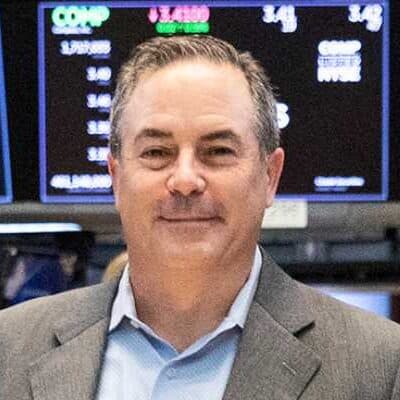
Stocks & Markets Podcast: Uranium, SMRs, and Eagle Nuclear Energy's Opportunity
Chris and Eagle CEO Mark Mukhija discuss the importance of nuclear power amid today's energy crunch, Eagle’s uranium asset, SMR technology and more.
You've reached your free article limit
You've read 0 of 1 free Pro articles.
In this edition of the Stocks & Markets podcast, Chris Versace is joined by Mark Mukhija, CEO of Eagle Nuclear Energy (NUCL) , to discuss nuclear energy’s role in solving the energy shortage ahead of us.
During the conversation, Mark discusses Eagle’s uranium asset, estimated to be 37 million pounds compared to the 2.8 million pounds produced in the United States in 2024 and 2025 combined. The backdrop for that is the U.S. government’s target to take domestic nuclear energy capacity from 100 GW in 2024 to 400 GW by 2050. That effort is joined by 31 other countries to triple nuclear energy capacity by 2050. As that race heats up, we lay out key hurdles to watch for Eagle over the coming several quarters.
Chris and Mark also discuss the outlook for small modular reactors (SMR), including Eagle’s offerings in the space. Mark shares his view on the timetable for SMR deployment, including what could speed it up. Mark also explains the difference between new nuclear reactors and those from decades ago, why robotics is the unexpected tailwind for the energy pain point, and why uranium is at the intersection of our energy pain point and scarce resource thematics.
Disclosure: TheStreet Pro Portfolio has no position in the shares of Eagle Nuclear Energy (NUCL). This conversation is provided for informational purposes only and shall in no event be construed as an offer to sell or a solicitation of an offer to buy any securities. The information described herein is taken from sources that we believe to be reliable, but the accuracy and completeness of such information are not guaranteed by us. The opinions expressed herein may be given only such weight as opinions warrant. The opinions offered in connection with this content are subject to change without notice. The opinions made known to you in connection with this content are not exclusive to you and may have been previously or subsequently discussed in other media. Comments made known to you in connection with the content: (a) may not be suitable for you; (b) do not take into account your particular investment objectives, financial situation, or needs; and (c) are not intended to provide investment advice or recommendations appropriate for you. TheStreet Pro was compensated by a third party to conduct this interview. Before making any investment or trade, consider whether it is suitable for you and consider seeking advice from your own financial or investment adviser.
At the time of publication, TheStreet Pro Portfolio has no positions in any securities mentioned.
Transcript
CHRIS VERSACE: Hey, folks. Chris Versace here, and it is time for another episode of The Stocks & Markets Podcast, where we dig deep into what's going on in the markets and talk about stocks.
This time around, very excited. We have an exciting company joining us today on the topic -- rather timely, I think -- about nuclear energy and uranium. We've known that there's been a lot of questions about what we refer to as the electricity pain point, given the rise of AI and data center construction.
But we also know that there are other aspects pressuring, let's just say, "the grid." We are seeing more companies start to suss out potential solutions in nuclear. And with me today to talk about this, and how his company is positioned, is Mark Mukhija of Eagle Nuclear Energy. Mark, thank you so much for joining me.
MARK MUKHIJA: Hey, Chris. Nice to be here.
CHRIS VERSACE: Excellent. So Mark, before we get started, tell me a little bit about your background. How did you come to Eagle? What attracted you to the opportunity?
MARK MUKHIJA: Yeah, so my background is in mining engineering, so I have my professional designation. I started my career with BHP in Australia, so that's where I got my technical and operational foundation. From there, I spent some time in underground and open pit diamonds, and then a few years in energy coal.
And then in 2016, I moved into the mining technology sector. So this was a company that was using AI, machine learning, and computer vision around making mining safer and more productive. Now, they saw that I worked in Australia, and they shipped me back out there. So I was running Asia-Pacific.
CHRIS VERSACE: [LAUGHS]
MARK MUKHIJA: Yeah, I was running Asia-Pacific for them for five years, and got the tech deployed at some of the biggest mining companies in the world. And I got to see just how important innovation was-- not just for the mining industry, but every industry. So it helped shape my conviction that clean power, reliable energy, and advanced technology, they all converge in that nuclear space. So I wanted to be a part of that, and that led to the creation of Eagle Energy in late 2023.
CHRIS VERSACE: Now, you said "the creation." It says that the company's been around a little over three years. How did it get started, and how is it positioned differently today, compared to when you were first starting out?
MARK MUKHIJA: So as I mentioned, we saw this wave coming-- the AI data centers, cryptocurrencies, humanoid robotics-- and they're going to require a lot more power. And the grid is simply tapped out today, and the only way that you're going to address that is through nuclear. And I have some friends and founders that are in the capital markets industry, and we always wanted to be a part of the nuclear story. And I believe we got in at the right time to find a great uranium asset, paired with SMR technology, to build this integrated nuclear company that Eagle is.
CHRIS VERSACE: All right, so let's break those two things down. You talked about the asset that you have. I assume you're talking about uranium. Correct me if I'm wrong.
So let's talk on that for a second. Where did that come from? What's the lead time to tap that? How long will that last? And then let's talk about that SMR technology.
MARK MUKHIJA: Sure. So as I mentioned, we wanted to get involved in the nuclear space, and everything nuclear starts with uranium. But it had to be an American asset. We wanted it to be a part of the national security and energy dependence movement that's happening in the United States.
So we were looking at assets in the United States of size and scale, and we came across the Aurora Uranium Deposit, which was held by an Australian company. We had talks with them, and we were able to come to an agreement to get the largest mineable, measured and indicated uranium deposit in the United States. So on an unconstrained basis, there's 50 million pounds there. And then when you put a technical report on it, S-K 1300 compliant technical report summary, there's about 37 million pounds that has a reasonable probability of economic extraction right now, under current prices. And that could be a 14+ year mine life there.
CHRIS VERSACE: So you're sitting on top of this asset. And I'm just wondering-- and I don't expect you to have the answer-- but as we think about how people are viewing your company, and more importantly, the shares, I'm wondering how much value is being placed to that asset, given the size and the life cycle for it, versus the other side of the business. But that's something we can talk about later. I'm getting, as I tend to do, a little ahead of myself.
MARK MUKHIJA: Yeah, no worries. Just to answer that on a high level, our priority is that uranium asset. And the SMR technology, it's great, but it's more of our call option on the nuclear future. We know that that flagship uranium asset is tech agnostic. It doesn't matter if it's going into a traditional reactor or some of these other advanced small modular reactors. So we know that is our priority, given the importance of uranium to the nation.
CHRIS VERSACE: OK, that makes a lot of sense to me. So let's talk about where you are, in terms of monetizing that asset.
MARK MUKHIJA: Yeah, so it's still in advanced exploration. Our baseline estimate to begin production is the early 2030s, and there's a few steps that need to happen first. Such as, we're kicking off a technical work program this summer, which is going to give us information on metallurgy, hydrogeology and rock mechanics, along with some further exploration drilling which could enhance the size of the resource. Because you know you'll get more information on parts of the deposit that doesn't have drill holes right now.
And then that information feeds into the pre-feasibility study, which will take a year to complete once we start it. So perhaps you're looking at Q3, Q4 of next year when it will be completed. And then from there, it's into construction and design, depending that everything gets financed and approved on the permitting side of things, which we'll be doing in parallel with that work program-- so going through the permitting process, as well.
CHRIS VERSACE: So on the one hand, some folks, especially the folks who are very long-term focused and bullish on the nuclear opportunity, they would say, OK, I have a known timeline over the next few years. I can track certain hurdles to that. Great.
Some other folks would turn around and say, interesting. But this seems to suggest that there's not going to be a lot of revenue in the next one, two, maybe three years. If that's the case, how is the company capitalized, and how do you plan on having enough capital to get to that 2029, 2030 timeframe?
MARK MUKHIJA: We were a de-SPAC transaction. And as a part of our de-SPAC, we got $30 million from a singular institutional investor. And we also had $5 million stay in trust at the SPAC. So net of fees, we have about $31 million in the bank right now, and that should last us for a couple of years. And then what we'll do with that money is start that work program, as I mentioned, do the engineering study, and do the permitting parts that we can begin now. So that should give us a couple of years to do that.
And it's the mining industry. So as long as we can show that we're doing what we're saying we're going to do and hitting our milestones and executing, we believe that there'll be an opportunity for us to go back to the market, let's say, a year from now, and raise more capital, just based on how important uranium is to the country. Now, the United States only has 1% of the global reserves in the world. So it's incredibly important to get every single pound of American uranium out of the ground.
CHRIS VERSACE: I would have to imagine, given what you just said, that there could have been, or could be in the coming quarters, folks who are seeing your progress and saying, we need this resource. This could be a M&A opportunity for us.
MARK MUKHIJA: Absolutely. Or it could be for us to look around and say, there's an opportunity for us to take a look, as well. Chris, when we were looking at this asset, we looked at multiple other assets, as well, in the United States, and we do believe there is a consolidation opportunity. So perhaps we are the ones that are doing the M&A.
CHRIS VERSACE: I like the bulls up. I like it.
MARK MUKHIJA: And look, we know our priority is to just de-risk this asset as much as possible, be it through work programs, be it through engineering studies, be it through permitting.
CHRIS VERSACE: So that's one side. Let's talk about this call option that you referred to as SMR, or small modular reactors. There's a lot talk about this. There's a lot of money, I'll say, being thrown at this, including some of those big hyperscalers that have made various announcements in investments in nuclear power.
What's the reality? Where are we with SMR? When does it really start to happen?
MARK MUKHIJA: For us or for the industry?
CHRIS VERSACE: Let's take for the industry first, and then you can tell me about you guys, because I get the sense it might be a little different.
MARK MUKHIJA: So for the industry itself, we are seeing a lot of good work happen. We could be seeing first of a kind reactors come to the market 2029, 2030-- so the end of the decade. So I'm in the belief of there's going to be multiple players in that field at different sizes.
So you'll have the microreactors which might have a few players. In the 50 megawatt zone, you'll have a few players there, and then into the larger 100 to 300 megawatt players. So I do believe it's a necessity to have the SMRs, just simply because of the incremental power demand that's coming. I do think there's a huge opportunity in extending current traditional reactors and doing upgrades on that end. Essentially, Chris, what I'm getting at is that we're going to need all the power we can get.
CHRIS VERSACE: Well, yes. So do you see more mothballed reactors coming back online? I understand there's a lot of challenges with that, given the way some of them might have been decommissioned-- the use of concrete, for example, and other things?
MARK MUKHIJA: I think that is the lowest hanging fruit we do have in bringing more capacity online, is just evaluating what can we turn back on, what can we extend, what can we already use that we have. And I know that the DOE is doing a great job of making funds available for that. You just have to look back to the executive orders that came out in 2025 around that, wanting to add 5 gigawatts to existing reactors. You want to have 10 gigawatts of new reactors by 2030. You want to quadruple nuclear by 2050. So you can see, it's essentially all hands on deck when it comes to everything nuclear. And simply, we have to do it to remain competitive.
CHRIS VERSACE: So we talk a lot about the US's need for nuclear power, the need to tap the modest reserves that it has on the uranium front. But what about from international perspective, particularly, say, with SMR? Are we likely to see those solutions come on stream earlier there than in the US, do you think?
MARK MUKHIJA: Potentially. We do see the push globally for nuclear, as well. We had 31 countries sign up to triple their nuclear by 2050. So the push is definitely on.
You can see it with China, just with the amount of reactors they have under construction and what they plan to be building. It's immense. And China doesn't produce much uranium, so it's going to become a lot more competitive to get the uranium that is already out there. Now, China is aiming to build over 200 reactors in the next 15 years.
CHRIS VERSACE: And I just have to think about what we've seen in March, and now early April -- the US, Iran, let's just say, conflict. A lot of uncertainty, obviously. But it has highlighted the nature of oil supply, demand, constraints. The rumblings are that we're already starting to see, the influence rekindle demand for EVs. I have to imagine from your perspective you see it as a sharp reminder about why, ultimately, we need more nuclear power.
MARK MUKHIJA: Absolutely. And this was before my time, but in the '70s when there was the energy crisis then, it led to a five-fold increase in nuclear investment. Could potentially be the same thing happening this time around. You've got 20% of the world's oil essentially at a standstill right now. And it shows these countries around the world that rely on it that we need to smarten up here and become energy independent, and the best way to do that is through nuclear power.
CHRIS VERSACE: Now, why not other forms of "clean energy"-- wind, solar? Each one has its drawbacks. Do you ultimately see the consistent need for power focusing the need for a solution that's nuclear-based, over some of these others that they provide incremental power, some would say, at the edges, but not really addressing the real issue?
MARK MUKHIJA: Well for nuclear, it's that reliable baseload power. Just simply look at the capacity factor. 92% capacity factor being a measure of maximum power output. So nuclear is 92%, wind is 35%, solar is 25%. So the sun's not always going to shine and the wind's not always going to be blowing. And if it's the big tech companies out there that need the power, you better believe it can deliver when they need it.
CHRIS VERSACE: Yeah, I would say the math doesn't lie. It's kind of simple. So as you sit here, the tailwind appears to be blowing pretty hard for nuclear. You guys are positioned for that in a couple of different ways.
Let's talk a little bit more on the SMR front. What separates you guys from the competitive herd? What's your go to market strategy here? And are you seeing interest from some of these big hyperscalers, or others out there, these neo clouds and the like?
MARK MUKHIJA: Yeah, I think the biggest differentiation we have is that we have access to the fuel supply-- the raw uranium upstream. And then when this technology was presented to us, it was simply too good to pass by. It's been around since the 2010s.
The inventor's got 40 years of experience, 400 authored papers. His work has been cited 9,000 times. So it really was a great tech. And it is that fully portable, walk away safe, liquid metal cooled, fast reactor. These can be factory mass assembled, shipped to site.
And there's actually two designs in it-- a 3.3mw microreactor and a 33 megawatt small modular reactor. And that microdesign, 3.3mw at full power, it can go for six years without any kind of refueling or intervention. But if you dial that back into the low power setting, let's say, 0.3mw, it can still power 300 homes. That thing can operate for 92 years without any intervention. You can bury it underground and forget about it. So think about that for remote communities, off-grid applications, all those kind of applications that we can use it for, and it becomes a really compelling case to use this type of technology instead of diesel generators and things of that nature.
CHRIS VERSACE: That's fascinating, because I think a lot of folks are really focused in on electric utility capital spending. They're focused in on AI data center, and some other things that are really driving it. But it's interesting when we talk about the edge of the grid, so to speak, like you just did. I don't think a lot of people are seeing that, and what that potential solution is for, again, say, certain aspects of electric utility spending. Fascinating.
MARK MUKHIJA: And you can use it in areas that don't have water, as well. You can use open air Brayton cycles. Or think of all the coal mines that have shut down around the country. They have all the lines in place. You can throw small modular reactors there and rekindle the region, in terms of jobs and power. So there's a lot of opportunity that the country should be looking at here. What we can do with all types of small modular reactors, not just our design.
CHRIS VERSACE: So when you're watching the competitive landscape and the growing acceptance of this, from an industry perspective, are there things that you're watching that could accelerate the timeline for SMRs? And at the same time, is there anything on the horizon that could potentially push out the timing for SMRs?
MARK MUKHIJA: Yeah, I think investment can always move things forward, along with the regulation, as well. We're already starting to see that with the NRC bringing in different codes to make it faster to get permits and licenses to operate these SMRs. And then again, if we start seeing more investment from big tech coming into SMR companies, I think that could accelerate it.
They're already taking matters into their own hands in securing their energy supply. We've seen PPAs with Constellation, with the Crane Clean Energy Center with the Illinois reactor, as well with Meta. So they are taking matters into their own hands.
And then I guess what could slow down the industry is, let's say they try to go too quickly, and something happened where they're cutting a corner and there's some kind of incident. These Gen 4 reactors, they can't melt down like your old school Chernobyl style anyways. But it's something you need to be mindful of as an industry to prevent anything from happening, because we don't need that type of attention on what we're doing.
CHRIS VERSACE: Totally agree. And just for folks who are maybe fixated on-- and I will date myself-- Three Mile Island, for example, or you just mentioned Chernobyl, you said that these Gen 4 reactors are different. How is it that they're different? What should give folks comfort that, yes, these are far safer than what we saw in the past?
MARK MUKHIJA: Well, simply because the technology has evolved so far from now. So it's 40 years ago when you had the Chernobyl incident, and even longer for Three Mile Island, so technology has evolved quite a bit. So with these Gen 4 reactors, they're passively cooled and they can just shut down and cool down. And there's not much enriched fuel in these reactors, anyways.
So it's just a scale thing and a technological thing, where you're not going to see those incidences. And there's so many inherent safety methodologies built into it, such as auxiliary powers is something that some of these reactors have, and ours does especially, where even if there was a mass power outage like there was in Fukushima, they're still power to the reactor where it will safely shut down and cool off without any kind of issues happening.
CHRIS VERSACE: So for the layperson who's concerned about nuclear power, you would say that the risks today are far, far less than they were 30, 40 years ago?
MARK MUKHIJA: Absolutely.
CHRIS VERSACE: OK. What other catalysts can you see, Mark, from an investor perspective, as you're looking for more investment, says, not only is the company hitting its timelines, it's surpassing what was expected. Is there any hurdles that people should be looking for as they track Eagle's progress?
MARK MUKHIJA: Yeah, I would definitely say, we touched on it earlier, the M&A opportunity. If we start acquiring other assets, and simply as we start moving through the engineering studies, the drilling and the permitting process, we're getting a lot of administrative support. And I think that's only going to continue as we realize just how much power we're going to need to remain competitive.
It's a national security energy independence thing right now. And if another nation has more power than us, they could have better AI and better models. And we simply can't be in a position where that's the case.
CHRIS VERSACE: Understood. Talk to me a little bit about the team. You said the company was created about three years ago. How have you fleshed out the team?
And I think you also alluded to the person that's behind the SMR technology as being extremely well positioned within the industry. Just give us a little more about the team. Because really, given the opportunity and the timeline that spans more than a few quarters, the management team is very important.
MARK MUKHIJA: Yeah, for sure. It starts with the boots on the ground, and we have our very strong VP operations-- that's a professional geologist. He's ran mining companies in the past, has banking experience. So he brings that ability to put our work program together, in terms of who's going to be the drillers, who's going to do the engineering studies, where are we going to drill, how are we going to get the most traction for the work that we're going to do?
We've hired a permitting firm called SLR that's put two other projects in our County on the fast 41 program, which you might recall, is a part of that March 2025 executive order around boosting domestic mineral production. So these guys have the playbook of how to get onto that dashboard, and how to potentially accelerate what we're doing, knowing the region that we're operating in. We have a head of licensing that's got 27 years of nuclear experience-- 20 years of that is with Entergy. So knowing all of our activities will have a NRC lens on it gives us a lot of comfort, as well, plus the numerous consultants that we have on board.
Plus, we're hiring. We're looking for great people to be a part of our story and our journey. We want to move quickly. We want to do things the right way. So we're always looking for talent.
CHRIS VERSACE: Are you having a tough time finding the talent that you need, Mark?
MARK MUKHIJA: I think it's an industry-wide thing, finding the right people-- especially in nuclear, because we lost a lot of that expertise over the last few decades. But I think when the story is compelling enough, people want to be involved. And we do get a lot of inbound requests of people wanting to understand what we're up to, and that's what we want to be a part of. We want to be a part of re-onshoring nuclear energy.
CHRIS VERSACE: And then we talked a little bit about the microreactors as a solution for some areas that perhaps not everybody's thinking about. Obviously, people are talking about AI and data center. But from your perspective, is there any driver of the demand for nuclear power that folks are not thinking about, not focused on, not clued in on, some extra added tailwind that gets overlooked?
MARK MUKHIJA: Absolutely, and it's humanoid robotics. If Elon gets his way, there'll be more robots than people.
CHRIS VERSACE: Wait, wait, wait, wait. Elon not Jensen?
MARK MUKHIJA: Both of them.
CHRIS VERSACE: OK.
MARK MUKHIJA: Both of them -- big tech, let's say. The whole electrification automation industry, our grid's tapped out today. You start adding that into the mix, the power models, I don't think any of them are correct. I think we're going to need a heck of a lot more power than even those models are saying, and especially when you add in the potential of what other nations are doing. And if we are constrained by power, our models are not going to be as strong as other nations. So as I mentioned at the top of the call, we need as much power as we can possibly get, and nuclear is going to have to play such a huge part in that to get to where we need to go.
CHRIS VERSACE: I would take that comment that you just made about robotics and say the same thing for AI and data center capacity, because of the explosion that we're going to see for data creation consumption and the use of those robotics.
MARK MUKHIJA: Absolutely.
CHRIS VERSACE: And all that does is it brings another tailwind in the power that we need for nuclear from AI and data center.
MARK MUKHIJA: 100%. These models are constantly evolving and improving, so that requires a lot of compute. Plus, computational capacity always goes up, there's quantum computing that's just around the corner, as well. So there's a lot of catalysts, let's say, for power demand coming.
CHRIS VERSACE: A lot of reasons to be bullish, no question. Let's flip it though. I would be remiss if I didn't say, Mark, what is it that keeps you awake at night -- not from an industry perspective, but more of a company perspective that you, as the man in the big seat, you need to keep your eye on?
MARK MUKHIJA: I would just say making sure we do things the right way, in terms of permitting. So make sure we get all of that in hand. Because we know in this country, it takes a long time to get mines from discovery to production. And a lot of that time is in the permitting side of things. So we want to make sure we dot our I's and cross our T's, and get all of that done correctly, and try to get this in hand as fast as we can, while doing it in the right way.
CHRIS VERSACE: And for the person that may not be as familiar with it, permitting generally takes how long?
MARK MUKHIJA: It could take us anywhere from five to seven years. But we are seeing that condense, especially with things like the Fast 41 program, accelerated environmental reviews. And just given the importance of these critical minerals, we're starting to see it in different areas. In terms of defense applications and power generation, I do feel that we've gotten a big wake up call on the geopolitical landscape of how important it is to have our own resources out of the ground and processed on home soil. Because I think it's a different world than 10, 15, 20 years ago.
CHRIS VERSACE: I totally agree with you on that-- and on several fronts. Not just the geopolitical front, but the technological front, as well. All right, Mark, before we get out of here, is there anything that we didn't talk about that we should?
MARK MUKHIJA: Yeah, I just want to highlight the importance of nuclear power to the nation. 20% of the nation's electricity still comes from nuclear power. And, those 94 reactors that we have in the country, they consume 50 pounds million of uranium per year.
In 2024, the nation only produced 677,000 pounds. And in 2025, it was 2.1 million pounds. So you can see that it's not enough. And half of that comes from Canada and Australia, but the other half is Russia, is Pakistan, and Kazakhstan. And if Russia and China and India continue to do their build out, there's going to be less and less of that uranium available to the United States. And I just want to highlight how important each pound of American uranium is.
CHRIS VERSACE: That, I think, crystallizes the scarce resource opportunity, Mark.
MARK MUKHIJA: Yeah, definitely.
CHRIS VERSACE: Excellent. Well, Mark, thank you so much for joining me today. A lot to think about. And for folks who want to continue to follow the story, what's the best place for them to go?
MARK MUKHIJA: So we're listed on the NASDAQ under the ticker NUCL. Our website is Eaglenuclear.com, and you can follow us on LinkedIn or X under Eagle Nuclear.
CHRIS VERSACE: Excellent. Mark, thank you so much for joining me today. And I want to reserve the right to call you back in, call it the next few quarters, to get an update on where you guys stand. This power issue, this electrical pain point that we talk about, is indeed a very big issue, and one that we're tracking extremely closely. So thank you for everything today.
MARK MUKHIJA: Thanks for having me, Chris.
CHRIS VERSACE: Anytime. And folks, that is the latest episode of The Stocks & Markets Podcast. We'll be back with a fresh episode before you know it.