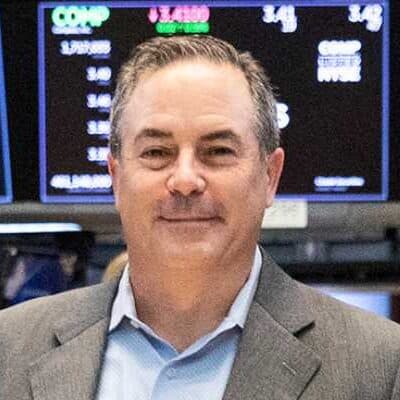
Stocks & Markets Podcast: Overbought and Staying That Way?
Bob Lang and Chris Versace discuss why the market’s momentum could continue, breadth vs. overbought indicators, market seasonality, and stock favorites.
You've reached your free article limit
You've read 0 of 1 free Pro articles.
On this episode of TheStreet’s Stocks & Markets podcast, Bob Lang returns to chat with Chris Versace about the market’s September performance, and why he sees the market momentum continuing as we enter the final quarter of the year.
The two discuss the market’s current overbought condition, with Bob explaining why it’s important to focus on the market’s expanding breadth. Bob tells which indicators he uses to determine market breadth, and why he thinks small-cap stocks are a positive tell for the market.
We ask Bob which stocks he prefers heading into the final quarter of the year: Walmart WMT or Amazon AMZN? American Express AXP or Visa V? Nvidia NVDA or…?
Bob also has some exciting news about fresh content he’ll be bringing to TheStreet Pro in the coming weeks.
Transcript
Chris Versace
Hey Chris Versace here. Welcome back to the Stocks & Markets podcast at TheStreet. This is the podcast where we talk about, well, you guessed it, stocks and markets and what's moving them. Joining me is a return guest, an old friend of mine and someone who I collaborate with quite, quite, often with, of course, talking about Bob Lang.
Bob Lang does a great job looking at the technicals for the pro portfolio. And I'm happy to say that you can not only catch Bob's musings, over at the Pro, site, but you can increasingly catch him on a growing array of financial programing, whether it's Schwab, Yahoo Finance, or some of the other great shows that are out there.
Bob, as always, my friend, a great conversation is about to be at. Thank you.
Bob Lang
Great to be with you, Chris. And I'd be careful of using the word the phrase old common, old Friend. I'm not that old.
Chris Versace
I know, I know, I'm a little bit older than you, but I'm not that, well.
Look, Bob, at the end of the day, all that matters is we've known each other for a long time. And, you have more time on this planet than I do. Both qualify as old. I'm sticking with it.
Bob Lang
Indeed. Indeed it. It's great to be with all of you. Today, talking a little bit about markets and trading and, you know, the last time we were together, Chris, and, there was a lot of volatility, a lot of market, in uncertainty. And, you know, the volatility, gets priced in as we talk about the VIX.
And I don't want to jump jump ahead here. But certainly you know we're having a market that's showing a lot less volatility these days a lot more complacency. And you know it's just one of those things that right around the corner is era. As the year comes to a close, we could see a little bit of that volatility start to pick up.
Chris Versace
Well, that was a pretty good preview, Bob. And I appreciate you doing that. But you know, as we're sitting here the last full week of trading of September, typically September is a well it's one of the worst months of the year from a stock price performance, at least historically speaking. We are not seeing that so far. I think we can chalk that up to economic data that's been better than expected.
The Fed, you know, surprising to some extent by telegraphing one more potential rate cut this year than the market was looking for. But, you know, I got to ask you, Bob, we've had the strong run. The market now is based on RSI levels or relative strength index levels. It's overbought. So where do we go from here in your opinion.
Bob Lang
I think Chris, traders and investors forgets that the market is a discounting mechanism that discounts news and discounts prices and earnings out into the future. And I think when most people see a reaction of the market and investors and traders to certain news events, let's call it the Fed or let's call it or it's earnings or or maybe it's some tariff news.
And when you see the reaction to that and it's not, what the typical response would be, you have to look out into the future that says that the investors and traders are seeing something out forward four, six, eight, ten months out down the road. That is going to be much more significant to what's happening today in the markets than what the news is presenting today.
So I think it's important to to understand that the market is a forward looking mechanism. It's not perfect, it's close to perfect, but it's certainly one tool that we could use to see how well the economy is doing and how, growth is doing down the road.
Chris Versace
All right. So let let's take that into account and I'll do it this way. You know, the market has moved, you know, substantially higher. We've been setting new records talking about the S&P 500 in particular and the market multiple has gotten stretched. And you know, the last I looked at earlier this week, it was approaching 25 times, current year consensus EPS numbers.
And last year in 2024 it peaked at 25.1. So, you know, you would argue that we're pretty close to the top if we're not at the top from a multiple expansion perspective. If so, that argues then that we need to see more earnings growth. And that could be one of the things that you're talking about, the market, maybe just given the time of the year and starting to think about, oh, how strong could the back half of the year be?
What's the prognosis for 2026? Is that are you starting to see folks focus more on 2026?
Bob Lang
Yes, I do, I and I think that 2026 and even out to 2027 press is is an important, marker to to take a look at. Because when you look at 26, I think, you did say that the, Sp500 is trading at about 25 times current earnings, but you would also see that, the markets are trading at about 22.5 times 26 earnings.
So it you know, while that multiples still seems rather high today that multiple out in 2026 which we know of course is going to be adjusted eventually to upwards or downwards based on the trend in in earnings. We know that that 22 times earnings is really not all that expensive. When you go out a year from now and, in 2026.
So especially with with a favorable, Federal Reserve right now, which is likely going to be cutting rates, probably, I'm going to say four, four more times between now and next September. So we're going to have much easier. Who's your policy. We're going to see, fixed income investments starting to become a lot more attractive and in kind that that's going to relate to better pricing and better action in the stock market.
Chris Versace
Now, Bob, you know how I am a bloodhound with those consensus EPS numbers for the S&P 500. And you've heard me rail over the years that we've known each other. How for some mythical reason, as we sit here, you know, September, October, the initial expectation for the forward year, in this case, 2026 EPS growth tends to be at least 10%, if not higher.
As we sit here today, it's around 13%, which is a big uptick from, you know, what we're seeing in 2025. And you just said it could be is your policy on the monetary side that helps stimulate the economy? I think everybody would like that. But, you know, there are certain pockets, pockets, scuse me, of the market that we're not really seeing demand pick up yet.
Housing, for example, right now, if we look at a lot of the, commodity prices that are tied to housing under pressure, we're seeing companies like Sherwin Williams actually say that they are rescinding 401 K payments because of the weakness in the housing market. And, and the like. Are you a little more optimistic about housing as we move into 2026 than I might be?
Bob Lang
Yeah, certainly. If, it's long interest rates, start continue to head down. They've been they've been lower. Just a few months ago we were at about 6%. Now we're close to, you know, 5.5% and and and going lower. So I think that that is going to be a huge catalyst for the housing market. It is certainly going to be a catalyst for the banks and and maybe for, for homeowners to refinance some of these higher interest rates that they've had to, had to absorb or eat for the past 2 or 3 years to buy, to get into a new house.
So, look, I mean, if you're sitting there with the 7% mortgage press and you and you have a chance to refinance, sit down, maybe next year down to four, you're going to do that. Absolutely. Every, every day of the week and twice on Sunday. So I think that that sort of catalyst is going to be it's going to be huge.
I do think that, inventory levels for housing and real estate continue to be low. And, that is going to be a also going to be a catalyst for some of these companies like Lennar and Toll Brothers, who have actually forecasted more inventory coming out into the out years. Talking to 27, 28, going down the road.
So I do think that the prospects for housing are going to be real strong. I, I do understand what you said about, commodity prices, lumber prices are our heavy, copper prices are high aluminum and steel and, and a lot of, inputs that are used for, for building houses. Our, are up as well, too, and not showing any signs of going down.
Look at look at gold. Look at, silver. Those things are, hitting new all time. Well, silver. Not all time highs. Real close to at gold. All time highs. It's signaling that inflation is here to stay and it's not slowing down.
Chris Versace
Well, we certainly saw that in the, September flash PMI report. Another wave of concern about tariffs and rising input prices. But Bob I think would kind of jumped out to me in that report was that, companies are having a much tougher time passing along some of these fresher price increases. This this could kind of result in some more tamer inflation numbers, kind of help maybe move the fed along.
As you were talking about earlier. We'll have to wait and see on that front. But I wanted to talk a little bit more about market seasonality because, you know, you know, September, as I mentioned, tends to be kind of a weak month, historically speaking. But October, November, December kind of that year and sprint, correct me if I'm wrong, it tends to be one of, if not the seasonally strongest time of the year for the market.
Bob Lang
It certainly does, especially if the first nine months of the year are real strong, as it were this year. Chris. And, you know, we're seeing not just strength in large caps, but also strength in the small caps. The small cap Russell 2000 has actually led the markets for the past two and a halmonths to the upside.
It is actually up close to 9% this year. When you look back in in the early part of April, Chris, the Russell 2000 was down about 27% for the year. So it's made an enormous comeback since the lows in the early part of, of April. And when the small caps are leading, Chris, that tends to lead the rest of the market higher, regardless of whether it's the mag seven or it's I TOC or quantum or whatever the talk may be.
These small cap stocks, are huge leaders when it comes to the rest of the market. Whether it's to the upside or the downside. And right now the market's bullish. We've we did actually profile the IWM press. You remember on the weekly roundup last week, it was an important chart to take a look at. And we noted that, the candlesticks which we tend to follow the color or blue and on the go, no go composite of indicators that tells us that the market is bullish and, and that has been bullish on the WMM for months and months.
And listen, you know what? We're as a trend follower. As a momentum follower I'm going to go with what the market is telling me what to do. And if the market is bullish I'm going to stay bullish.
Chris Versace
Yeah. So how do you balance that then with as I said when we first started talking, if you look at just the relative strength index levels, you know S&P 500 Nasdaq Composite well over 70. How do you so how do you sit there and say I can hold my nose and continue? You know, with the positive momentum. And as you do that, is there anything that you're kind of watching out for some oscillators or something else.
Bob Lang
Yeah, it's not easy. But remember something, overbought is simply a condition. It's not a signal. And what does that mean. That means that it it is an observation that the markets are overbought or oversold. And they could stay that way for a very long period of time. We've seen stocks in this market defy gravity and and stay up for a long period of time.
And and anybody who wants to step in front of a freight train be my guest because that thing is going to run you over, in a, in a in a big way. It's a when you got a freight train coming at you at 175 miles an hour. Chris, you're you're not going to stop it. And that's what this market is doing, and it's making fools of people who are trying to top them, who call the top in the market and say, that's enough.
They just get run over day after day after day, and eventually they're going to be right. But you know what? This isn't a game where we're it's all about the boy who cried wolf. What it's all about. It's about identifying the trend and staying with that trend for as long as it, as long as it goes. Now, to answer your question about what am I looking for to see a shift in that and that trend?
Well, you know what? We're going to we're going to see price action become really poor. And and we're going to see heavy volume moves to the downside. We're going to see lots of characteristics. There is a there's nothing magical about it. You know, when people are selling on higher volume. Well that's big institutions saying I'm going to take my money off the table. I'm going to chips off the table. I might move on.
Chris Versace
Right, right. But to the extent that we have a September that bucks the trend, does that change your outlook for October, November, December and any any particular reason why or why not?
Bob Lang
Not not in the way that most people think that, you know, that we're calling tops here and we're going to come down and test much, much lower levels. I think that, you know, I hate I hate to say it, you know, that the 200 day moving average is a safe place to, find support, but it it usually is.
I don't think we're going to come down that that far. I think, with the strong markets that we've had so far, Chris, in nearly nine months of 2025, I think people are going to want to jump on board. People are have missed out. Is that FOMO fear of missing out that people are concerned about and worried about nursing, other people making money.
We're seeing the S&P 500 up 13% after being down 20 at the beginning of April. Its enormous move over the past, five and a half months. But still, I think people really want to get on board here. And that is going to be your support. Let's call it a put option underneath the market here by the rest of the crowd who is not in there.
That wall of worry has been a pie for a long time. Chris, what does the wall of worry, the wall of worries where people, say to themselves, oh, well, I can't get into the market. It's gone up too far. I'm just going to sit back and wait. And meanwhile they continue to watch the market go up and up and up without them.
And that wall of worry just continues to get high until people just throw in the towel and say, that's it, I'm done. I got to get back in the market. Usually that's the wrong point in time to do it.
But still, you know, I think as long as the momentum stays strong and it's bullish, we're going to go higher.
Chris Versace
So let's talk about where we could go then. Right. So we've had some you know Wall Street strategists recently bump up their S&P 500 price targets. I think the most recent was Wells Fargo taking it to 6800. And I think there's some others that are out there. I might have seen one close to 7000, but so let's just game it out.
Right. So let's say that the fed does deliver more cuts than the market expects because the economy is, you know, slowing the job market is a little more concerning. But inflation not as bad. We maybe see a little pickup in housing activity. The I continue to be strong reshoring happens. We see some deregulation. Investment banking activity continues.
Whether it's IPOs or M&A is where does Bob Lang see the market potentially heading past 68 160 900.
Bob Lang
Well I think it all depends on on on where money flows are at. And and also the sentiment can sentiment continues to be bullish. There really is no call on calling a spot where where people are going to unload because we I mean, we we've flew right through a lot of people talked about 6500 Chris, a couple months ago saying, okay, but that's going to be an area where we're going to find a lot of resistance.
We went through it like a hot knife through butter. Right. There was no resistance at all. So if you're if it now if you're going to say, oh well now it's going to be 7000. Well that's a round number. We could we can slice right through that thing. I like like a hot line. Also like was like a hot knife through butter again.
And just continue to go up. So it's really hard to pinpoint an area or a spot where we think the market's going to turn down. I think we just have to look for clues in the volume and the price action, and some of the indicators that tell us where, where it seems like, people are the investors are exhausted and not really willing to put new capital to work.
Chris Versace
Okay. So let me let me come at it slightly differently. Right. So we tend to think about, you know, the S&P 500 the market. But as you and I have talked about, you know, many many times when we look at the constituents, the big, you know, constituents that are the Mag seven accounting for a significant percentage, if we start to see sentiment, turn on those names, if we start to see those names being, you know, overextended, overheated and starting to, you know, roll over from price action or something like that.
Is that a is that a warning sign for you?
Bob Lang
Well, we've seen lately and I referenced the small caps is that has caused what's called a broadening out of the rally. What is a broadening out of the rally. It means that a lot more groups and sectors are participating, and not just a small concentration of of of stocks that are driving the action of the market. We saw that last year and and, and a little bit towards the end of 2023, where it was just a small group of names.
It was the Mag seven and a few other names that were really driving all the action. And everything else was was in a bear market back then. Certainly back in 23, 24, we saw a few more stocks starting to to add to the action. But this year has been interesting, especially since April. Chris, where is it again? I've referenced the small cap stocks and that is a broadening out of the of the market rally.
So when you see days where the markets are down but the breadth is up 2 to 1, that's the reason why we have that. That strong breath is because of the small cap stocks that are outperforming and catching, investors money to, to invest in that in those areas. So it's to answer your question, I don't necessarily think that if people stop investing in the Nvidias and the Microsofts in the Apples of the world, in the Mag Seven stocks and Tesla's that it's going to have a negative effect on the market because that money that's coming out of those stocks,
Chris, is going to find itself in another home, probably in small cap stocks, maybe the mid-cap stock, but it's going to find themselves in a new spot but still in the market.
Chris Versace
All right. And Bob, you just talked quite a bit about market breadth. What what's the go to indicator for you to really track that.
Bob Lang
Well so market breadth I look at the oscillators with specifically the McClung oscillator, which is simply a and a raw look of the, advanced decliners. So it's just it's just basically looking at it not from price action, but number of issues that are advancing versus declining. And and that is certainly an interesting point of view from for for most people, most people just tend to take a look at the price action alone in isolation.
But using using oscillators gives us a good I could feel an idea of where the momentum of the of the stock market is at at any certain, point in time. So the McLain oscillators, which have been around for 55 years, Sherman and Marion McClellan came out and and invented these, tools that have been, you know, stood the test of time, certainly since, since they came out.
And really give us it gives us a good view, a good snapshot of where the market is at a certain point in time.
Chris Versace
All right. So, Bob, as we get ready to swan song the September quarter and head into the final push for the year, are there any areas that you were warming up to in any particular sectors?
You already mentioned small caps, obviously, that that's a wide array, but any anything more granular that you can share.
Bob Lang
So I think the banks, Chris, are a really good spot. And and I know we have, Bank of America and Morgan Stanley in the, in the Portfolio and those those have been stellar names, especially Morgan Stanley new all time high just recently. And and I think that these, these stocks have much more runway left to go to the end of the year, especially with a favorable fed and favorable monetary policy.
And you've got some deregulation coming up very, very soon. That's going to be extremely helpful for them. It's going to act as a tailwind for their earnings. I'm also like, Chris, I like private equity names. Names like Apollo Cargo, Carlyle KG, KKR is a good one. Blackstone and then Blackrock to a lesser extent. And then if you look at the peripheral of of periphery of the private equity press, you know, you still have Goldman Sachs and Morgan Stanley representing some of those names as well too.
So I think that that group right there along with the banks and maybe some of the regional banks as well, too, are going to be huge top performers into the end of this year.
Chris Versace
What's the so the banks I get right. Again, we do have two in the portfolio. But the angle for private equity, are you just thinking it's because the, the investment level of investment banking activity remains robust and they're monetizing their portfolio? Is that is that the thought?
Bob Lang
That's one thought. And then also, they benefit from lower interest rates. So the lower interest rate environment is going to be extremely helpful for, for leverage purposes. You know, a lot of these companies are like, Carlyle and Blackstone well-capitalized. So they don't need to borrow too much money. But if they do and they see an opportunity to, to add to their portfolios, they can do that. And then also, the investment banking, community and environment is strong, as you said.
Bringing companies out to, to market out public is going to be a huge homerun for some of these companies as well, too. So, this is the this is a private equity when they invest in some of these smaller companies, certainly in the early part of the, of the cycle, here is where this is the payoff for them.
At the end of the day, they get in at such a low cost press and then it the, the reward at the end of the day is to bring that company public in, to be able to have an ability to sell off some of that stock.
Chris Versace
Well, you know, it's funny, I think with private equity, what people tend to forget is it's it's a different type of investment portfolio. And in order to go out and raise the next portfolio or the next fund, they have to deliver returns to existing shareholders so they can build their track record. You know, it just makes it easier for them to go gather more assets and drive their own fees higher.
It's, you know, it's one of those things. All right, Bob, I want to hit 1 or 2 more things, and then we're going to talk about something new that you might be doing. But before we get to that, just just a couple questions again, kind of tying into the end of the year, would you favor through the end of the year Walmart or Amazon? Which one?
Bob Lang
Boy, that's a tough one, isn't it? Yeah, it is, but I, you know, I, I, I was I well first of all I'd love to have them both right.
Chris Versace
Yeah. But but you can't but you can.
Bob Lang
You pretty much cover all the bases with both of them. I think at this point in time, I'd like to have Amazon. It's a little bit more diversified than Walmart. And I'm just I'm not speaking from the, shopping experience. Right. The shopping experience because they Walmart's online shopping experiences is actually very, very good too. And the delivery as well too, is almost matching up with, with Amazon.
But I, I would say that some of the things that Amazon's getting into, like the the NFL and they're getting into other sports as well too. I think the studio portion of Amazon is a very underrated asset that they have, and I think that they're going to start, really monetizing that. And the,
Amazon Prime membership much more valuable than anything that the Walmart has, even a Walmart with their, again, with their delivery, service.
And you can sign up for that. It's rather it's rather inexpensive. You just don't get the same things that you do with Amazon Prime that you do with the Walmart, membership. So, I think that that is a slight edge to Amazon though. You know, I again, I'm going to go back to what I said earlier.
I would love to have them both.
Chris Versace
All right. All right. What about, you know, we tend, you know, that there tends to be a lot of Consumer shopping in the last quarter of the year, the holidays, you know, also, you know, holiday meals and such. What do you think? American Express visa?
Bob Lang
American Express? Absolutely. Because it's in the Portfolio.
Chris Versace
Hahahahahahahaha I thought you were going to say because you don't want to leave home without it.
Bob Lang
I like I like what American Express has done here with raising prices, at the right time. I know a lot of people have balked at that, but I think that's what they give you. In terms of benefits, is, is is second to none. I have a, as a, as a, Chase, fan.
I like, I have the Chase Sapphire card, and that price is actually going up this year as well, too. And they've been increasing the benefits. But when I, you know, compare apples to oranges here with the, apples to apples, I'm sorry, with, Chase Sapphire with the American Express card. I think the American Express card foreign outweighs the benefits of that of the Chase Sapphire.
And, I, I think you can really make that pay off in a big way. And I think most people, if they do it right, do it well. And I think the, travel portion for American Express is huge. I think I want to say that the last, call today, I Chris, in July, they talked about the growth and the strength in their travel business.
And I think that's something that we can look forward to in 2026.
Chris Versace
Totally agree. I will also say that, you know, they're very different businesses between American Express and Visa, right? Visa. It's really tied to transaction volumes. American Express about 70% of their pretax income comes from membership card fees. So they've continued to grow that, the number of cards in force. And as you're talking about the, refresh of the platinum card, I mean, if you look at the number of benefits that they're stacking in for a $200 price increase, I mean, it is off the charts, I think.
I think some people have tallied it and for that annual membership, if you use everything, you get like $3,500 plus in terms of benefits, makes it a no brainer to me.
Last one, Bob, and this one will be controversial, but I'll also give you your choice in Nvidia against any other chip company out there.
Bob Lang
I like Nvidia, a lot here, but the problem is, is that, I think they're priced all the way out for at least two years, at least round it out to 2027, maybe 2028 with their price. So I think that, the, the potential outperformance is just not there anymore. It could happen in 2023. In 2024, stock went bananas. And it, it rewarded shareholders. I, I they're an innovative company, don't get me wrong. But I think there's other companies out there like a Broadcom or perhaps American Semiconductor, AMC, maybe even AMD might be able to catch up a little bit.
I'm not an Intel fan. I wouldn't I wouldn't trust them. But I think any other I do I think that, Nvidia is going to underperform this year. No, I think they're going to perform extremely well. I just think that they're better companies out there that are going to perform better, not better companies than Nvidia, but better performing companies.
Their stocks are going to do much better than, than Nvidia. I think that, Celestica is another company, a semiconductor company that's going to do well. CLS is the symbol, and, and again, Broadcom is another one. Avgo is one that I think that that has a lot of runway left too.
Chris Versace
All right. All right. Now Bob, I don't want to spoil anything but my understanding is that you might have some news to share about, some things you might be contributing to. The Street Pro site.
Bob Lang
A spoiler alert, right? So, Yeah. So, I've been talking with some of the, management team, about adding some new content, for readers and, since they know my background is not just technical analysis, but also with options. I have a company called Explosive Options dot net and, a service over there.
So, in the past, Chris, I've written some articles about options and options trading and basics of options. And, we're going to start very, very soon talking about, some option trade ideas for, for the readers. And I'm very excited to share some of my thoughts with all of all of them. And, in addition, I think, having a good understanding of options trading is absolutely essential.
And I have some good content that I've put out over the years, some good evergreen content, some stuff that, that is, that's live today that, that I've written maybe five, ten years ago that I'm going to be sharing with the, with the real money crowd as well to, to learn about trading options because, as, Warren Buffett once said, derivatives are like the weapons of financial destruction.
If you if you're not careful, you can get you can get hurt real badly. And, I think that there are some ways to do it where, it can be a benign options trader, or you can be an aggressive one at the same time. Trying to, achieve better returns for your, for your, portfolio than the, than the market.
And I think that you can do it in a very safe and and secure way, but, certainly I think options, give people an advantage. I know you've traded options in the past, and you've done.
Chris Versace
Yeah, I know I have, I have you've done really well. But you're, you're you're you're much more adept at this than than I am. You know, I was, arguably probably doing a little more than dabbling, but but from your perspective, Bob, what's, you know, there's a lot of moving pieces to options. You really have to watch it. But what's the 1 or 2 most common mistakes that you see new options folks make?
Bob Lang
Well, I think, it's it's managing risk. Chris. I think people don't really understand how to manage risk properly. And, they think that, most people think that, they, they can hit a home run every single time they, they step up to the plate and they're using a baseball analogy. And who tries to hit home run?
I don't think anybody know everything. Even baseball players try to swing for the fences. And whenever they step up to the plate, I think option traders have to have to have the same mindset. You have to go and try and hit singles and doubles and all those, more singles and doubles kind of add up to, you can score a lot of runs by keeping, keeping your, your players on base.
So, I think it's managing risk is, is the important part. And a lot of people, they, I've, I've come across many of them over the years, Chris. They, they go all in, they trade with too much size. They don't take their money off the table. They don't cash in their wins. They don't, manage their losses properly.
And it all ends up being a recipe for disaster because you have to follow some rules and you have to follow some protocol here in order to, to to make money in the options market. Because believe me, there's there's nobody is going to forgive you for making a mistake. You're just going to lose money and you're going to have to, learn from it.
Chris Versace
Excellent, excellent. Bob, I think I, I as was as well as everybody else listening to the podcast is going to look forward to that content. It sounds like it's going to be very exciting and I really can't wait to see it get started.
Bob Lang
Looking forward to sharing it with everyone.
Chris Versace
Excellent, excellent. Bob, before we get out of here, any parting thoughts as we wrap up the month of September?
Bob Lang
Well, as we wrap up the month of September, wishing everyone L'Shana Tova to have a happy, happy New Year for all of our, Jewish people in the tribe. You too Chris, L'Shana Tova wishing you a year of goodness. And, as we head into the end of the month and a quarter.
Chris, it's going to be interesting to see how we finish up, because we are up for the fourth for the third quarter here.
Reflecting some really good positive trends. And I think the, I want to say that, it's interesting how the stock market is up this third quarter, and the GDP estimate is somewhat close to 3% for the third quarter. Is that about right?
Chris Versace
As we as we sit here today, depending on how you're looking at Atlanta Fed GDP now is around three, a little over 3%. New York Fed I think is still around 21.
Bob Lang
Yeah. So I mean you know we're looking for a real positive quarter. We'll see those first numbers Chris coming out towards the the third end of the third week of October, the first estimate and earnings season coming up in a couple more weeks. It's going to be real fascinating, being real interesting to, to see what these, what these companies have to say as we, and the, and the year for sure.
Chris Versace
But, Bob, that just means you'll have to be back during the fourth quarter so we can wrap it all up. And with that, folks, that is Bob Lang. Check out all his content over at TheStreet Pro, both, technical analysis for the portfolio. And you heard it straight from the man himself. Soon. Some nice options, content as well.
As far as the podcast goes, folks, that's our episode for this week. Thank you so much for tuning in. We'll be back before you know.
More Pro Portfolio:
- We're Calling Up This Aging Population Play After Fed Policy Shift
- Koreans Turn to Ralph Lauren; AI for the Elderly & More Investing News
- Weekly Roundup: Portfolio Accelerates as Market Continues to Defy Seasonality
At the time of publication, TheStreet Pro Portfolio was long WMT, AMZ, AXP and NVDA.