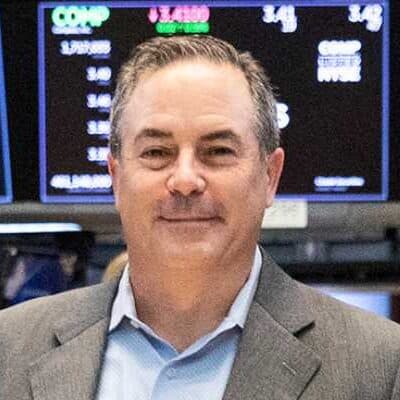
Stocks & Markets Podcast: Fighting Cancer With GT Biopharma CEO
Chris Versace and Michael Breen discuss cancer therapy innovations in the $600 billion biopharmaceutical drug cancer market.
You've reached your free article limit
You've read 0 of 1 free Pro articles.
In this episode of the Stocks & Markets podcast, we chat with Michael Breen, CEO of GT Biopharma (GTBP) to learn more about the biopharmaceutical drug cancer market, which is expected to reach $600 billion by 2034. Existing cancer treatments include surgery, chemotherapy, and radiation, but companies are looking for new therapies to treat the cancer market more humanely.
Breen explains how GT Biopharma is leveraging its Trike technology platform to target multiple cancers, including pancreatic, ovarian, lung, breast, and prostate. We also review the current phase of GT Biopharma's trials, what’s next, and why companies such as Merck (MRK) , Novartis (NVS) , and Sanofi (SNY) have biopharma companies on their M&A radar.
Breen also shares how he came to become CEO of GT Biopharma, a path that began with his becoming an investor and then a board member.
Links for listeners looking to learn more about GT Biopharma:
Disclosure: TheStreet Pro Portfolio has no position in the shares of GT Biopharma (GTBP). This conversation is provided for informational purposes only and shall in no event be construed as an offer to sell or a solicitation of an offer to buy any securities. The information described herein is taken from sources that we believe to be reliable, but the accuracy and completeness of such information are not guaranteed by us. The opinions expressed herein may be given only such weight as opinions warrant. The opinions offered in connection with this content are subject to change without notice. The opinions made known to you in connection with this content are not exclusive to you and may have been previously or subsequently discussed in other media. Comments made known to you in connection with the content: (a) may not be suitable for you; (b) do not take into account your particular investment objectives, financial situation, or needs; and (c) are not intended to provide investment advice or recommendations appropriate for you. TheStreet was compensated by a third party to conduct this interview. Before making any investment or trade, consider whether it is suitable for you and consider seeking advice from your own financial or investment adviser.
Transcript
CHRIS VERSACE
Welcome to the latest Stocks and Markets podcast. I'm your host Chris Versace, TheStreet Pro Portfolio manager. And today we're talking about biopharmaceutical drugs targeting cancers.
Kind of a new topic for us. And some of the end markets that we'll be talking about for these cancer fighting drugs are acute. I hope I get this right. Lymphocytic. Lymphocytic. Excuse me. Leukemia, non-Hodgkin's lymphoma, acute myeloid leukemia, and multiple solid tumors. Now, you might be asking yourself, Chris, why? Why are we talking about this today?
Well, the simple reason, folks, is that the biopharmaceutical drug cancer market is expected to be a growth one, going from some figures of around 225, million dollars in 2024 to significantly higher figures over the next decade.
What are some of the drivers behind this? Well, we've talked about some of them before, increasing incidence of cancer advances and personalized medicine and immunotherapy, and of course, a strategy that is near and dear to our heart of the CRO portfolio, the aging population, to help us break this all down and understand it a little bit better is Michael Breen, Chairman and CEO of a clinical stage immuno-oncology company, GTE Biopharma, which happens to trade on the Nasdaq under the ticker symbol GTBE.
Michael, welcome to the podcast.
MICHAEL BREEN
Hey, Chris. Delighted to be here. Thank you for inviting me. And, looking forward to talking to you and kind of educating some of your viewers with regard to the space.
CHRIS VERSACE
Excellent, excellent. Well, with that, Michael, let's let's jump right into the space first, and then we'll get a little more granular on, GT and how it's positioned, why it's positioned, those sort of things. So I guess just right off the bat when a lot of folks here, you know, biopharma, I think the immediate question that springs to mind is, well, you know, I I've heard about the pharmaceutical industry.
How is this different? Help us set the stage.
MICHAEL BREEN
So the biopharma industry is obviously, as you can imagine, a very broad church. It's a huge industry. There's the kind of the the companies, the pharmaceutical companies at the end who invariably buy up companies like us because we're in the research, business. And if we are lucky enough, which I'm very much hoping we will be to find some sort of, solution or remedy, call it what you will, which is a ultimately a more humane cure for cancer than the the big pharmaceutical business will come along and say, we'd either like to license your product or we'd like to invest in your business, or we'd like to license your I would like to purchase your entire business. But, in terms of there are a number of different, limbs to this. You've got, the, the companies like Novartis, Merck, Sanofi, and, you know, you're talking companies that have net asset values in the, you know, 130, $150 billion. And these companies, they it's their business to ensure that they are ahead of the curve.
So they are constantly on the lookout for companies that look like either they're they're they're finding something of interest in terms of their clinical trials. And they want to get in early stage because the earlier they get in, the cheaper invariably it is in terms of the ultimate price that they pay. So, as I said, we're a clinical stage oncology company. So we're currently conducting a phase one trial for blood cancer, specifically for AML and MDS. We're doing that with our second generation molecule. We did it in 2021. We had very good results for what we know referred to as our first generation molecule. And the way that the phase one clinical trial, first in human, dosing goes is that the FDA are very prescriptive.
So they will say you need to start the dose level extremely low. We want to make sure that the drug that you've got is safe first and foremost. And then you're allowed to escalate as you move through the cohorts, cohorts being, you know, one, two, three patients. And as you get up through the cohorts, then your the dose level that you actually, either infuse or inject in the patient sometimes, we'll get so for example, in the one that we're doing currently we have we're told we could only start 1.25 micrograms per kilogram of body weight per day. But when we get to cohort seven, the dose level will be 100 micrograms per kilogram per day. So you can see immediately between cohort one and cohort seven that it goes almost, 100 fold.
CHRIS VERSACE
Right? Right. Significant ramp.
MICHAEL BREEN
Significant ramp.
So that's kind of how I would describe the space. But but from the perspective of someone who's in clinical research, oncology and how what we're doing and why we're doing it and how we will likely be viewed by Big Pharma.
CHRIS VERSACE
Okay. So you're in, GT is a research company effectively, and you're developing certain IP, in the biopharma space that, as you mentioned, could be licensed, company could be sold. So it's
important for your success that you go through the, you know, trial and approval process, essentially meeting the requirements laid forth by certain regulatory bodies.
Yes.
MICHAEL BREEN
That's correct. Yes. And specifically the FDA, the Food and Drug Administration.
CHRIS VERSACE
Okay. Okay. So typically, you know, when we hear about these sorts of things, there's, you know, you've already started to develop the molecules that you're working on. I imagine you're
working on other molecule molecules. You mentioned your initial and now your second. So as you sit here today without giving too much away obviously, or are you already at work on your third or fourth generation or more molecules?
MICHAEL BREEN
So that's that's a very insightful question, Chris. So as I said, we're now in our what we've described as our second generation molecule. So I'll just set the stage in relation to what, what the differences are between first generation and second generation. So the second generation molecule has a number of different and significant improvements. So the first thing I'm going to say is we're it involves, we known, and we have incorporated what we call nano body technology. And the best and easiest way to describe this, so that your viewers can easily, immediately understand is it's tiny, tiny fragments, which means it's much easier for it to bind on to the cancer cell. And in doing so, it gives it significantly greater binding affinity. So it's going to latch on and stay latched on to the cancer cell, which is obviously significantly important with regard to its ability to kill it, because it needs to stay latched on to kill it.
The second thing I'm going to say is it also incorporates, in addition to the nanobody technology, it also incorporates what we call camelid technology. And that, believe it or not, Chris is taken from the the genesis of it is from the immune systems of llamas, alpacas and camels. And the really the reason why that's involved is because if you think about it, llamas, alpacas and camels exist in incredibly harsh environments and therefore, unsurprisingly, they have incredibly robust immune systems. So that is the main benefit. And and the thing that it does significantly is it assists with the persistence, the proliferation of the what we call the natural killer cells of the body.
So what our technology does is it takes the body's own natural killer cells, so are otherwise known as white blood cells. And then, and the the phrase I'm going to use is it turbochargers them. So it assists with activation proliferation and persistence. So what happens when someone has cancer is something has gone wrong in their own natural immune system. There's some sort of problem with it. It's either a problem with the white blood cells activating and or a problem with their proliferation, so that there's sufficient in number to overwhelm and kill all of the cancer cells.
And even if you have those two things, you still have to have the third thing, which is persistence. So it needs to the count. The natural killer cells or white blood cells need to stay around long enough to kill and keep killing the cancer so that all of the cancer is 100% eradicated.
So I've explained nano body technology, camelid technology. And what is that result in that results in our second generation molecule being somewhere between 10 and 40 fold more potent than the first generation.
CHRIS VERSACE
So, so. And when you you let me just ask you, Michael. So when you were mentioning the ramp from, stage one through stage seven with the amount of micrograms that were being given, is that change at all, given that greater potency that you just mentioned?
MICHAEL BREEN
Again, you're very perceptive. So if we look at what happened with the first generation, trial, molecule, the starting dose was five micrograms per kilogram of body weight per day for the first cohort. And because we told the agency, the FDA, that this second generation molecule is significantly more potent, right. Of course. Of course, they told us first thing they said was, quite, quite, you know, reasonably, you're going to have to dial back way back the starting dose.
So the starting dose for the second generation molecule is only 1.25 micrograms per kilogram of body weight per day. So, and the, the, the top dose for the, for the trial in 2021, in first generation that got all the way to 150 micrograms per kilogram, of body weight per day. But for this second generation molecule, the the the top dose is going to be 100 micrograms.
So you can already see the FDA have completely changed with their attitude with regard to how much drug we can give these first, in human patients because of the significant increase in potency of our drug.
CHRIS VERSACE
Go ahead.
MICHAEL BREEN
I was just going to finish the question. So you asked me about, what other candidates we have, whatever the drugs we have in our plot and our plot and our pipeline. So the other significant thing that I'd like to explain is that our molecule is what we call platform technology. And what I mean by that. So let me let me just first of all explain our molecule is what we call a trike. So it's a tri specific killer engager. The killer obviously refers to the natural killer cells. The engager is it's an engage. It engages with the natural killer cells. And it's tri specific, meaning it's got three functional parts to the molecule. It's got we call a CD 16 receptor. It's got a, what we often refer to as our secret source, interleukin 15. And it's a camelid interleukin 15. And obviously I've already explained the significance and significant benefits of the camelid technology. And then it's got what we call a binder. And when I say binder, it means that, depending on what drug we lottery, what cancer are, we want our drug to kill. We to cherry pick the binder that we think is going to, be most effective and bind on to the cancer cell, hence the reference to nanobody technology.
So let me explain that further. In relation to blood cancer, the binder is CD 33. If we want to pivot and say instead of blood cancer, we want to do a trial for solid tumors, which I'll explain more about later. The the binder that we would toward the target is b7, h3, which pretty much most solid tumors highly express.
So and then for autoimmune disease, which we're also developing, the target is CD 19. So the two main constituent parts remain the same, which is the CD 16 receptor and the camelid IL interleukin 15. And we just switch out the binder. So the main benefits of this one is it's obviously easier to replicate, and manufacture because you're only changing one constituent functional part of the drug.
And the second one is the hopefully that if we demonstrate to the FDA that with that, first of all our drug is safe, and secondly, that there is efficacy, then one is reasonably hopeful that the FDA's attitude with regard to the speed with which we can, move through the various phases of trial they will be more comfortable with. So that is the significant benefit.
And then the third thing I'm going to highlight commercially is if you look at any of and I was talking about big Pharma earlier, if you look at the way that Big Pharma approaches and reacts to companies like ours that have platform technology, I'll give you one example. Gilead purchased Kite Pharma, which had platform technology. They paid $8 billion for it. And the fact that they had platform technology, in my opinion, was significant with regard to how they valued the company.
CHRIS VERSACE
Okay. Okay. Well, let me you threw quite a bit, Michael, in that answer, that let let me let let me just back you up and just ask a couple of questions if I can. So you mentioned that, blood cancer, solid, solid tumors and autoimmune disease, when, when we look at the overall, you know, I hate to use this word basket of various cancers out there and other ailments. What what was it about these three or their families, I should say, that attracted GT, to target those?
MICHAEL BREEN
So I, I threw those. I just to be clear, because they are, our next targets in terms of the direction of the company, but we do just to be also equally clear, we do also have a rich and deep pipeline of other candidates, which I haven't mentioned because, I thought it was it was most appropriate to mention the ones that are nearer term in terms of submitting investigational new drug applications with the FDA.
CHRIS VERSACE
Let me let me see if I can help you there. So if you were to say based on, what you're doing with what you did with molecule one and doing with molecule two, roughly, you know, of the addressable cancer market, if there's a way to think of it that way, is that 30%, 40%. And then you can you have these other solutions that might take you to what other percentage of the addressable market.
MICHAEL BREEN
So, by the way, Chris, that's exactly how I look at it, because ultimately, ultimately, we're a Nasdaq listed company and we are a business and but but more than that, we are a company trying to find a cure for cancer. And it's not it's not as simple as, yes, we do want to find a cure for cancer, but we want to find a more humane cure for cancer, because at the moment, if you analyze if anyone is unfortunate enough to get cancer, at the moment, the solutions that you're given are are solutions have been around since just after the Second World War. So around for the last 80 years, and the solutions are going to be one of one of three. Or if you're just super unlucky, two are all three.
The first one is obviously surgery, where they take a scalpel to you and think they're going to cut out the cancer. But of course, the cancer, because it's moving around your blood system could have spread.
The second one is they're going to poison your blood with chemotherapy, and you're going to feel incredibly sick, which also, ironically, by the way, I think a lot of people don't actually realize this. The chemotherapy kills your natural killer cells. So the chemotherapy wipes out your blood cells. So the net result of that is when you're being given chemotherapy and for some considerable time after you're given chemotherapy, they tell you not to go out and not to mix with anyone who might be ill because your immune system has been wiped out.
And then the third thing, of course, is really radiotherapy, which is burning your flesh. So our our molecule is a protein. It can be given depending on which cancer we're targeting. It can be given by IV infusion. So intravenous infusion or we can in in relation to the solid tumor trial, which we're hoping to start next year. It'll be from subcutaneous injection.
So it's it's so much more humane. And then in relation to your point with regard to the size of the market, so we're obviously currently conducting a first in human trial for blood cancer. That market that's a difficult cancer to, to, to find a solution for by the way. But but we're more than hopeful that we've got something very interesting.
But the, the the main place in terms of the cancers that are most prolific are the solid tumor cancers. And we're going to be filing an investigational new drug application with the FDA either later by the end of this year or certainly, early part of January 2026. And we're hoping that that trial will start in the first half of 2026.
And we are going to target all of the main, most prolific solid tumors. So when I talk about those, I'm talking about bladder cancer, pancreatic cancer, ovarian cancer, lung cancer, head and neck cancer, and of course breast cancer and prostate cancer. Now breast cancer and prostate cancer. I don't know whether, you know, this affect 1 in 8 women for breast cancer and 1 in 8 men for, prostate cancer. And that's obviously worldwide, the entire world population. And it is estimated that the solid tumor market, in terms of value worldwide per annum is something of the order between $280 and $400 billion per per annum.
And the order immune space is estimated to be of the, order of $115 to $120 billion per annum. So in terms of what we're targeting, we're targeting the the biggest, most prolific cancers with a humane drug, which is a protein which doesn't involve cutting, doesn't involve poisoning, doesn't involve burning, which we believe is the way forward that the science and healthcare has been crying out for for the last 80 years.
CHRIS VERSACE
Okay, so Michael, I think that's wonderful. And obviously, you know, as a humanistic perspective, we we want to see that happen. But, you know, when we think about this big opportunity that you're talking about, these pain points that you mentioned, which we've all kind of, you know, seen unfortunately, in, in various lives, surgery, chemotherapy, radiation.
What what sets GTE Biopharma apart from others that are trying to do this?
MICHAEL BREEN
So that's a very interesting question. There are a number of companies who have been trying to find solutions, and a lot of, I'm sure a lot of your, your followers and viewers are aware of the T-cell technology. And, T-cell technology has been making some, inroads with regard to finding a cure for cancer. But ultimately it's, it's complicated.
It's complicated because you basically have to take the cells out of the body first. You then basically reprogram, reprogram them in a, test tube or petri dish, and then you've got to put them back in again. It's it's so it's complicated from that perspective that in and also makes it extremely expensive. Somewhere between $750,000 and $1 million per patient.
And the third thing is it also has its problems with regard to toxicity. Now, at the moment, from what we've seen in our trials, our drug does not have any problems with toxicity on our drug is significantly more cost effective because in our trial, our cost of dosing patients in our trials, because it's it's a protein and because it's easier to manufacture.
And it's also, doesn't suffer from any toxicity issues. And it can be given either by intravenous, I.V. infusion or subcutaneous injection. It's somewhere of the order of $90,000 to $120,000 per patient, and I'm sure will not escape you and your viewers. Notice that if it's more cost effective, it'll be very a much better received by health insurers.
CHRIS VERSACE
Know without a doubt. Without a doubt. Especially if you know that's the dosage and the treatment. You know, if the amount of side effects or after effects are far less, I think that makes it more palatable all the way around. And and Michael, talk to me a little bit about the the genesis of this technology, because I know that through my readings, getting ready for our conversation, you guys, there are 2 or 3 things that are pretty interesting.
One is, the relationship you have with the University of Minnesota. And then there's also Dr. Jeffrey Miller, who's from the University of Minnesota, to just help us explain that relationship and how it kind of, lays the groundwork for the work that you're doing.
MICHAEL BREEN
Of course. Happy to. So the first thing I'm going to say is, our company has an exclusive worldwide license with the University of Minnesota with regard to its science and research. We have a sponsored research agreement with the university. And, we pay the university a very reasonable license fee in relation to when we commercialize the technology.
And the reason we have this relationship with the University of Minnesota is because having done our research, we deliberately targeted someone who we regarded as, a leading key opinion leader in this space of NK cell engager technology. And as you've identified, his name is Dr. Jeffrey Miller. He's a professor of hematology at the University of Minnesota. He's director of the Masonic Cancer Center there, and he's got 170 peer reviewed publications.
He is a stellar scientist, and he has been in this space for 25 years. He speaks all around the world with regard to his research and technology. And, as I say, he is regarded as being one of the leader lead people in this particular space.
And that's why we thought it was appropriate that we would go after him in his technology. And he is also a very pleased to say he's been involved in the company since day one, and he is currently the consulting senior medical director of our company. So he, you know, I speak to Dr. Miller every day, sometimes seven days a week.
But, he's very involved in our company, and, we're very proud and delighted to have him involved.
CHRIS VERSACE
Now, you just said something that really jumped out at me, Michael. You said that he speaks all around the world, you know, and so far, we've only really talked about GT Biopharma in the sense of the U.S. market. Yes. Are there opportunities outside the U.S. and just given, you know, what we've all heard about the FDA compared to, what drugs are available outside the U.S.?
Are there perhaps opportunities, maybe even greater opportunities, quicker opportunities for GT Biopharma outside the U.S.?
MICHAEL BREEN
So I'm really glad you asked me that, Chris. So, you know, obviously all countries kind of think of themselves first and, and, and how it works for them and, and rightly so. But, unfortunately, a cancer is, is a worldwide disease that affects everyone. It doesn't matter, you know, whether you're from Australia or Singapore or or America or wherever, and therefore it is very much, appropriate that we are looking and exploring, having relationships with other clinical trials centers around the world.
I'll just give you one example. So, for example, in Australia, if you conduct a clinical trial, you get paid back for every dollar that you invest, you get paid back a high percentage. I think it's somewhere between $0.25 and $0.50 in the dollar from the Australian government for what you've invested. So they the Australia is, is incredibly proactive in that regard.
As are some of the Southeast Asian countries. And of course, there's all of Europe. And my background is I was a, mergers and acquisitions, attorney, senior partner at a global law practice with, you know, 50 offices around the world and 4,000 employees and a turnover of $1 billion. I come at this very much from a perspective of commercialization of what we have.
And the most important thing I'd say to you is the intellectual property. And I am absolutely on top of, as you would expect, ensuring that the intellectual property is completely and properly buttoned down and ensuring that we have patents, applied for, all of our all around the world. So all of the countries where the big markets are, you know, Japan, Australia, Korea, China, all or Europe. Europe's a very easy one because you get one patent for the whole of Europe. It's, it's it's much more effective. But, the market is enormous. And with regard to trial, when you start to move through the different phases of trial and you open it and you start expanding the trial to ensure that it is safe and effective, then we will most definitely be looking at other hospitals, whether it's it's in Europe, the UK, or indeed Australia or Japan, with regard to being able to demonstrate, that it works in and in those places, and that then gives you a window into those markets, of course, because if you're able to demonstrate to the government and to the the population that you've conducted a trial in their country and it was successful and it was safe, there's so much more receptive to that. And of course, if there's an added benefit that you get some rebate from the Australian government, then that's just an added bonus.
CHRIS VERSACE
So let let's talk about the future. And, you know, for folks who are listening in or you know, their interest is being piqued, let's talk about some upcoming, you know, hurdles, signposts, you know, things to watch for. So you're you're moving down the trial path, you know, you you've already identified it's, you know, one through seven. What's the timing like for the next stage?
And, you know, as you do that, what's the timing perhaps for some of these other, end markets that you're targeting, you've already mentioned, for example, solid tumors, 20, 26, anything else, 2027 2028.
MICHAEL BREEN
So, the, the the near term, medium term catalysts, that any investor should consider. The first one is we're halfway through our phase one, first in human trial for our second generation blood cancer molecule. We, start dosing, cohort four, which is patients seven and eight, this week and next week. The it's a it's significant in that cohort three was the dose level was five micrograms per kilogram.
And the cohort four is ten. So it's literally double what cohort three was. So we are of a mind that we will start to see some some interesting things happening. Ten and 25 micrograms per kilogram. When I say interesting, we we achieved blast bone marrow blast reductions in our first generation molecule of between 33% and 65%. And given that it's more potent, we are hopeful that we will see something better than that. So that and that they. Sorry.
CHRIS VERSACE
And as you're going through that is there, you know, not not being as steeped in the weeds as you are on this, is there a is there a magical tipping point that folks are looking for that kind of signifies? Boy, this this is what we're looking for.
MICHAEL BREEN
Very much so what you're looking for specifically is what they call a, dose limiting toxicity level. So it's effectively what I describe as to make it, more user friendly. The law of diminishing returns. So if we give patient, let's say we give a patient 25 micrograms per kilogram and they, they achieve, reduction in bone marrow blast, kind of 75%, and then we step it up to 50 micrograms, and then they only achieve 50%, bone marrow blast reductions.
Then you can say to yourself, the sweet spot is 25 micrograms, not 50, but you might give them go up to 100, and then they might get a fever because it's basically, too much for their body to withstand. And remember that the people that we're dosing the patients were dosing are already very, very sick people. You know, they have, a life limiting cancer.
So, that's kind of the sweet spot with regard to the whole, rationale for how high you have different cohorts, a different, dose levels in a trial. And that is what you're trying to achieve in terms of working out what is the sweet spot for the best, most effective dose level. And it's not it's not, you know, as it signs it's not simply a question of more drug is always better.
Sometimes it becomes more counterproductive. And that's what we're trying to find out.
CHRIS VERSACE
And then what's what's the hurdle to move on to. You know, phase two. Phase three.
MICHAEL BREEN
So it's not it's not necessarily what I would describe as a hurdle. So just going back to, if I may, to, to the first generation molecule, we were pretty much ready to move straight into phase two after the phase one trial. And in fact, I also highlight to you, Chris, that in that we got, what we called orphan drug status, which is kind of shorthand for the FDA, would be very receptive to helping if we wanted to accelerate it through the, the, phase, the different phase trials.
So from phase two to phase three or, or maybe even phase two, straight to phase two B, and in relation to your question specifically, what we'll be looking for from a phase one trial generally is the phase one trial is just generally about safety. So it doesn't harm the patient. But we with regard to what we've seen for the first generation molecule and what we're hoping to see in the second generation, we we believe we will see some degree of efficacy in some what they call signal with.
And that signal would be a significant reduction in bone marrow blast cones for blood cancer. So if we get that, then it's obviously a business decision that it's it's a sufficient signal and sufficient efficacy to justify, merit. Moving to phase two in the expansion of the trial to more patients and the greater cost. But but when I say greater cost, as explained earlier, our cost is nowhere near what it cost for T cell trials.
It's, it's it's really very cost effective. So those are the sorts of things that we would be looking for. And then if I were to, to pivot and talk about a little bit about the solid tumor basket trial, I'm going to what that might look like in 2026. As I said it, we're going to be going after all of the big solid tumors.
So just to recap, prostate, breast, ovarian, lung cancer, head and neck, bladder and pancreatic, if we see a signal just in one of those, then I can tell you categorically we'll be moving from phase one as quickly as we can to phase two, because the size of that market and commercializing the drug, I mean, you really would have hit the jackpot if that's what we get.
So and similarly for autoimmune disease also obviously, that'll be in 2027.
CHRIS VERSACE
But let me so. Thinking about that. You mentioned earlier that you're a business. So when we think about the progress from phase one to phase two and further down the line, you know, typically these big companies that you mentioned earlier, whether it's, you know, Gilead, Merck, Novartis, where do they tend to look at companies for their M&A pipeline?
Is it from phase one to phase two, phase two to phase three? What what lands you on their radar screen?
MICHAEL BREEN
So that is an excellent question. It depends. So different. So those sorts of big big pharma companies are constantly looking, reviewing, looking at press releases and seeing what sort of press releases we're putting out. Are we demonstrating any sort of efficacy. And then they may, you know, put a toe in the water and they may say, we'd like to make a small investment in you.
But when I say small investment in big pharma terms, small investment is never small, of course. And ideally, what you'd want to do is you'd want to get them to fund the trial. So, so they obviously if they want to de-risk it, they'll say, oh, well, we'll wait until we'll wait until you get the phase three. The problem with waiting for phase three is twofold.
The first one, most importantly, is one of their competitors may step in and do a deal with with with you and beat them to the punch, as it were, in terms of having a relationship with a company like ours. And they don't they don't ever want to do that. They have a whole they have teams and teams of business development, people who are constantly looking at, research and technology companies like ours, and they don't want to be frozen out because their competitor has already taken a position or entered into a relationship or agreed a license arrangement or whatever.
But the second thing is significantly also, the later they leave it, the more they're going to pay. So it's a trade off. It's a trade off between risk. You de-risk it, that's fine. But you're going to pay a whole bunch more money by waiting, by delaying. So a lot of companies, depending on their the company that it is and their appetite, they will look to step in and, and then of course they can kind of reach an accommodation with a company like ours by saying we'll put in X million dollars today.
There's, we're not going to get necessarily any, any specific right or license to that. But what we would like to happen is that if it looks like you're getting somewhere, we'd like you to come out and talk to us first. It can be a once over.
CHRIS VERSACE
Right of first refusal.
MICHAEL BREEN
It was I was just going to say it can a can be a right, a formal contractual right at first refusal. But equally it can simply be we have an understanding. We like you, you like you like us, and you know that we're receptive. We like your technology. So why wouldn't you come and talk to us first? It depends on, you know, I depends on how much they pay upfront.
First, if we begin to think and to find a point on it, if if it if they pay us a, a material amount of dollars, then yes, it'll be a contractual formal right of first refusal. If they don't, if they, you know, they, they, they only want to put in, I don't know, ten, $20 million, $30 million. Then it would be something, shall I say, looser.
CHRIS VERSACE
Correct. I get it, I get it. You know, Michael, the thing I didn't ask you it as I'm kind of listening back to our conversation, what attracted you to GT Biopharma? Because you mentioned that you were in a global, you know, M&A law practice? Yeah, obviously. Obviously, you've seen a lot of different things out there. What what was it about, you know, this opportunity that spoke to you.
MICHAEL BREEN
So I'm really glad you asked me that question. So I got to a stage in my career where, the way it works is you in, law firms are really unusual places to work, but, if you're successful, you get asked to become a partner. If you're continue to be successfully asked to become an equity partner, and then you get involved in what is either called lock step or the escalator, and you move up the escalator and then you stay on what they call a plateau partner.
This the this the absolute senior most, most senior level. And then you're only allowed to be there for a certain number of years. And then you have to get to the point where you start to descend the escalator. Yeah. And rather than descend the escalator, which didn't really wasn't.
And I sat on the management board of the firm, so I'd actually been involved in these expansion and the running of the firm as a business, which was one of the things most definitely attracted me to it.
I then stepped away from that, and I went into, private banking. I was, one of my clients asked me to become the managing director of of a of, Luxe, Dutch private bank that was listed on the Luxembourg Stock Exchange. And I, we doubled the size of that bank within three years, and we sold it to, BNP Paribas.
And also I sat on the boards of a whole bunch of different companies and funds and hedge funds, and I actually came across in my role with the director of one of my funds, I came across GT Biopharma, and I did. I was all good attorneys should do. I get all of my due diligence on the science, Dr. Miller and I actually invested my own hard earned dollars into the company back in 2017.
Having done that research and then when the company was coming to up list onto Nasdaq in 2021, they approached me and said, we would like you to join the board because the bank wants the banker assisting us with the Up less than they want. The right sort of people on the board is independent directors, and I was already on the board of other public companies, so I joined the board.
Fast forward from February 21st to November 2021. They then said to me, Michael, we really appreciate your input. We'd like you to become the chairman and the executive chairman of the board. I said, sure, I've already invested in the company. So, I'm all in, as it were, and then and then and so that was November 21st. And then in March 22nd, they said, you know, Michael, you're really doing a great job. You're actively involved. We couldn't we couldn't be happier with with all of your input. You're pretty much doing the job anyway. So we'd like you to become the CEO. And that's that's how it happened. So it wasn't like I kind of looked I applied I it in my resume and applied for the job. It kind of just...
CHRIS VERSACE
Oh, no, but I, I, I think it's important because, you know, what you essentially said was, you know, you put your money where your mouth is.
MICHAEL BREEN
Yeah. Yeah. And I have not. I have not sold a single share. In fact, over the years I've bought more shares.
CHRIS VERSACE
Excellent, excellent. Well, Michael, I have to say it's a fascinating story. And I think one that's going to have, you know, a lot of legs and I think it's going to give us reasons to come back and revisit, GT Biopharma with you in the coming months. Coming quarters.
But, you know, before we get out of here today, Michael, is there anything that we didn't talk about that we should?
MICHAEL BREEN
I think maybe there's there's there's one there's one final piece of the jigsaw that I would just that that is, is highly relevant that I, that I would add and that is to remind people that, obviously the, the biopharma space in 2021 was red hot. It was a completely different market than it is today. And what I'm going to say is we had one drug candidate.
We're conducting a phase one trial in blood cancer for what we now refer to as our first generation molecule.
Halfway through 2021, our stock had gone from $5.50 on up listing to an intraday height of $19.73. And it had gone market cap had gone to $550 million. Today, our market cap is sort of below $10 million and our stock price. So and we have we have a second generation molecule. We have a whole bunch of candidates in the in our pipeline. We have some very interesting tech. Interesting and better technology. I would just say I think it's worth bearing that in mind in terms of any anyone is doing due diligence on our company and is looking to were and where we have the potential to get to. And I think that is relevant.
CHRIS VERSACE
Fair enough, fair enough. Well, that's that gives us another reason to revisit down the line Michael.
MICHAEL BREEN
Thank you Chris. Appreciate it.
CHRIS VERSACE
One one last thing, Michael, for folks who want to know more about GT Biopharma, what's what's the best place to go? The website, you know, the investor relations presentation where working at all be found.
MICHAEL BREEN
So it's pretty much, we've done a lot of work on the website. It's all on the website currently.
There are a bunch of videos on the website. There's a video with Dr. Miller who explains in very simplistic layman's terms how the science works. It's very, very user friendly. For people who are not scientific, there's a very there's a really excellent corporate presentation, slide deck of about 25 slides, which again, is very simplistic and easy to understand.
And obviously all of our press releases are also on our corporate details of our, our firm are there. So, that's most definitely the best place.
CHRIS VERSACE
Excellent, excellent. And we'll, we'll make sure in the notes below, the podcast and the text that we provide, the links to the website and the Investor Relations page.
MICHAEL BREEN
Great. Thank you.
CHRIS VERSACE
Awesome. Thank you. Thank you so much, Michael, for, helping us to understand, you know, biopharma and how GT Biopharma is situated. Folks, that's the end of today's episode for the Stocks & Markets podcast. We'll be back with a fresh episode before you know it.