Sunday Soup: Psychology of Money, the Perfect Toothbrush, Bill Murray and Rolex
These are the articles, streaming ideas, and books that caught our attention this week.
You've reached your free article limit
You've read 0 of 1 free Pro articles.
If you’re like us and need a break from this past week’s PMI and employment reports and something to take your mind off the market after trading hours, we’ve got you covered. From the journey to making the perfect toothbrush, to philosophical thoughts that lead to a happier life, to Bill Murray taking the Hot Ones challenge it's all here. Plus, a deep dive into Rolex and the watch industry as only the folks from Acquired can do.
If you have a recommendation to share, we’d love to hear about it in the Comments section below.
Now enjoy this latest offering of Sunday Soup.
Articles 📰
What People Get Wrong About Cortisol, the ‘Stress Hormone’
"High cortisol isn’t a health concern for most people, despite claims you may have seen online. Wellness influencers blame cortisol for a host of ailments, including bloating, fatigue, irritability and overly “puffy” faces and waists.
"But these claims stem from a vast oversimplification — and at times misrepresentation — of how our bodies work. In fact, the moniker “stress hormone” for cortisol is a bit misleading."
The Quest to Make the Perfect Toothbrush
"Jiménez, 60, has been at it for 23 years. If you’ve ever used a Colgate toothbrush, chances are he had a hand in designing it. He has 239 patents, most of them toothbrush-related.
"Over the years, he’s observed some trends. Blue is the most popular toothbrush color. Some people don’t brush on weekends. Even though dental hygienists recommend smaller brush heads, Americans usually choose the biggest one. And they’re always after something new.
"His latest project is based on a conclusion that young adults are looking for more minimalist designs and a more soothing experience."
OXO Fought Back Against the Black Spatula Panic. People Defected Anyway
"The first headlines were unambiguous: 'Throw Out Your Black Plastic Spatula. It’s probably leaching chemicals into your cooking oil,' wrote the Atlantic in late October. Six weeks later, the New York Times softened the tone in a wellness column: 'Do I Really Need to Throw Out My Black Plastic Spatula?' Last month, R&D World weighed in with its own take: 'Pull those black plastic spatulas out of the trash,' it said, dubbing the recent media hype 'black spatulageddon.'
"There’s perhaps no US brand with more at stake in this debate than OXO."
The More Senior Your Job Title, the More You Need to Keep a Journal
"For leaders assuming the CEO title for the first time, taking time to learn and think translates into early successes. But the problem is there’s little time to do either. Information comes at them more quickly, more people than ever before demand their time, and they’re told that the myriad decisions piled in front of them are all important."
The Importance of Imagining Future Success
"'Seeing is believing' and 'you gotta see it to be it' are phrases commonly encountered in many aspects of life. These phrases hit on the idea that visualizing something is critical to achieving or becoming that something. Related practice of mental visualization imagery and physical skills, especially in the context of sport psychology, clearly shows benefits on performance. But does this kind of imagery affect self-efficacy, and does that provide confidence and stress resilience?"
The Ultimate German Philosophy for a Happier Life
"Hegel is probably best known today for his teleological belief that human history tends toward progress and is guided rationally by Geist, or 'spirit,' a quasi-supernatural force for good. He taught that this progress is slowly achieved through the operation of the 'dialectic.' According to this concept, a grand conversation occurs in three parts—thesis, antithesis, and synthesis—in which one side presents an argument (thesis), another side gives an opposing viewpoint (antithesis), and all of this results in a resolution (synthesis) that involves more nuanced understanding of the issues. This rational reconciliation of differences thus leads to advances—in other words, progress."
What We’re Streaming 📺📲
Acquired: Rolex: The Complete History and Strategy
Hot Ones With Bill Murray
The Reading List 📖📚
The Psychology of Money: Timeless Lessons on Wealth, Greed, and Happiness by Morgan Housel
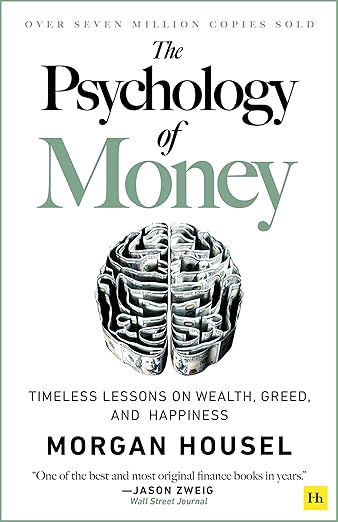
"Doing well with money isn’t necessarily about what you know. It’s about how you behave. And behavior is hard to teach, even to really smart people.
"Money―investing, personal finance, and business decisions―is typically taught as a math-based field, where data and formulas tell us exactly what to do. But in the real world people don’t make financial decisions on a spreadsheet. They make them at the dinner table, or in a meeting room, where personal history, your own unique view of the world, ego, pride, marketing, and odd incentives are scrambled together.
"In The Psychology of Money, award-winning author Morgan Housel shares 19 short stories exploring the different ways people think about money and teaches you how to make better sense of one of life’s most important topics."