New Waste Management Price Target After Shortfall
Management may be lowballing current quarter diesel prices.
You've reached your free article limit
You've read 0 of 1 free Pro articles.
Following on our initial comments about Q3 2026 results for Waste Management (WM), after digesting the company’s earnings call, we’ve identified that of the missed $0.13 per share in EPS for the quarter, roughly $0.12 per share was attributed to a $63 million year-over-year jump in risk management costs.
Management attributed it to a negative actuarial adjustment that followed six straight quarters of favorable variances, higher cost estimates on a few large loss claims, and a tough comparison against a prior-year insurance recovery. It stressed that the charge was largely an out-of-period adjustment unrelated to safety performance and is not expected to have an outsized impact going forward.
Excluding that estimated $0.12 per share impact, Waste still missed the quarter’s consensus forecasts by $0.01 per share. And that appears largely to be a timing issue. We say that because fuel was a 40-basis-point margin headwind as diesel hit record highs. But as management clarified on the earnings call, energy surcharge lags by roughly one month. The team assumes fourth-quarter diesel near $5.50 a gallon, about 40% above a year ago, and expects the surcharge program to recover both direct both direct fuel and the third-party cost inflation now showing up.
But when we look at current diesel prices near $6.35 per gallon and the risk that they could go higher should fighting resume between the U.S. and Iran following the mid-term elections, we have to question Waste’s $5.50 per gallon assumption. We also have to consider that as long and arduous as October has been, we are not yet even at the halfway point of the current quarter. We will need to pay close attention to oil, diesel and related prices in the second half of Q34 2026. As we saw in September, while oil prices climbed to recent highs by mid-September, the fall in the second half left them little changed for the month.
For now, we’ll keep our Two rating on WM shares and assess our next move based how energy prices develop in the coming weeks. If we do see a fall in oil prices, subject to timing, that one month lag in fuel surcharges could become a bottom-line benefit.
We expect Wall Street to trim fourth-quarter and full-year 2026 EPS forecasts modestly, from the current $2.08 and $8.09 consensus, given the Q3 shortfall, persistent fuel pressure and management commentary pointing operating EBITDA toward the lower end of its $8.15 billion to $8.25 billion range. Cuts to 2027 estimates are likely to be more limited as Healthcare Solutions synergies, renewable natural gas plant rollover and landfill pricing provide identifiable growth drivers independent of the macro backdrop.
After trimming back the Portfolio’s position at $240.02 on Monday, we’re open to building the position back at more favorable prices. We’ll first want those EPS revisions to be reflected in the stock and price targets. We’ll nudge our WM target to $255 from $265, but subject to what we see in energy prices in the coming weeks and the impact on Waste’s bottom line, we may have further revisions to share.
As we consider adding back WM shares, we’ll want to be mindful of the technical setup. We’ll also want to keep an eye on the shares relative to mid-October gap we see in the stock chart. With several items to watch, we’ll maintain our Two rating on WM shares.
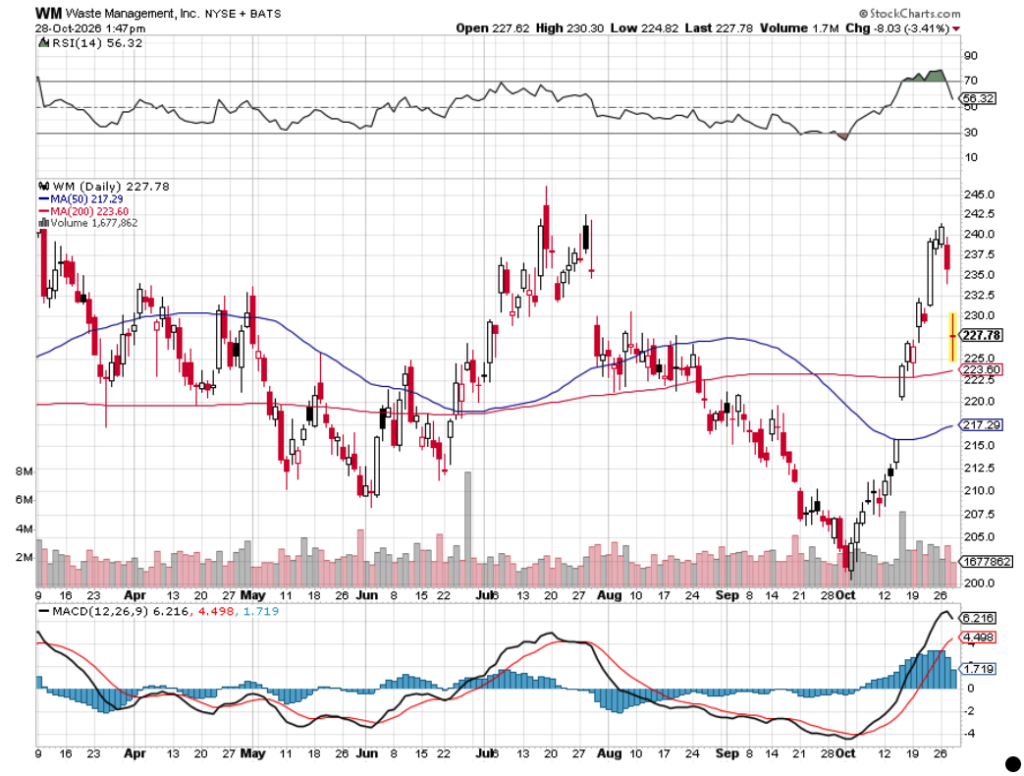
In Terms of Q3 2026…
Operationally, the company delivered a solid quarter, with revenue up 6.3% and operating EBITDA up 5.8%, as every operating segment grew. In Collection and Disposal, core price came in at 5.8% and yield at 3.4% despite the fuel headwind, and the favorable price-to-cost spread added 40 basis points of underlying margin. Volume was modestly negative, reflecting intentional residential shedding that is narrowing (down 2.6% in the quarter versus 3.5% year to date), softer small-business formation, and construction and demolition volume down roughly 4.5% year to date on weak housing.
Tuck-in acquisitions for the core waste business remain a priority, with $239 million closed through nine months, another $140 million expected in the fourth quarter and a signed $250 million deal slated for early 2027. Over time, these bolt-on acquisitions should be a source of margin and cash flow improvement.
Healthcare Solutions turned a corner, posting its first year-over-year revenue gain since the acquisition (up 3.7%) and a 33% jump in operating EBITDA, with nearly 500 basis points of margin expansion. Year-end targets for both were reached a quarter early with core price rising 5.5% and SG&A falling to 15.2% of revenue as billing normalized and manual processes were removed. The company now expects to reach its synergy target around mid-2027, ahead of plan, and sees room to push the segment’s SG&A below 15%.
Cash Generation Is the Standout
Free cash flow topped $3 billion through nine months, up more than 42%, on 12% higher operating cash flow and 17% lower capital spending as the sustainability investment program winds down. Management calls 2026 a year of harvest, and more than 90% of free cash flow has gone back to shareholders through $1.58 billion in share repurchases and $1.14 billion in dividends, while leverage of 2.92 times remains within the 2.5-to-3-times target. Incoming CEO John Morris, who will succeed Jim Fish in early January 2027, said shareholder returns remain a priority alongside a more aggressive pace of solid waste tuck-ins now that Healthcare Solutions is on solid footing. That suggests no major strategic shifts under Morris. In terms of buyback activity next year, we’ll likely have to wait until Waste completes its current $2 billion authorization, which is expected to happen in the current quarter.
More Pro Portfolio
- Adding to 2 Holdings After Earnings, PMI Updates
- Tracking 49 Signals Across 11 Portfolio Investment Themes
- Weekly Roundup: Renewed AI Concerns Weigh on the Market and Portfolio
At the time of publication, TheStreet Pro was long WM