Latest Consumer AI Adoption Data Shapes Our Thinking on Key Holdings
While a clear killer application has yet to emerge, shopping is a potential contender.
You've reached your free article limit
You've read 0 of 1 free Pro articles.
While we wait for Nvidia NVDA and Marvell MRVL to report their latest quarterly results after the market close on Wednesday and Thursday, respectively, we wanted to check in on AI adoption with the consumer.
We’ve discussed multiple times and shared many signals about AI adoption in the enterprise and professional services areas. The latest from Bain & Company finds that Generative AI is now a business staple, with 95% of companies in the U.S. using it, up 12 percentage points compared to this time last year. But what matters more is the growing number of use cases inside those institutions. That’s what keeps us bullish on the likes of ServiceNow NOW and Axon AXON.
Given the importance of the consumer on overall economic activity, it’s worth seeing if the consumer is embracing AI as well.
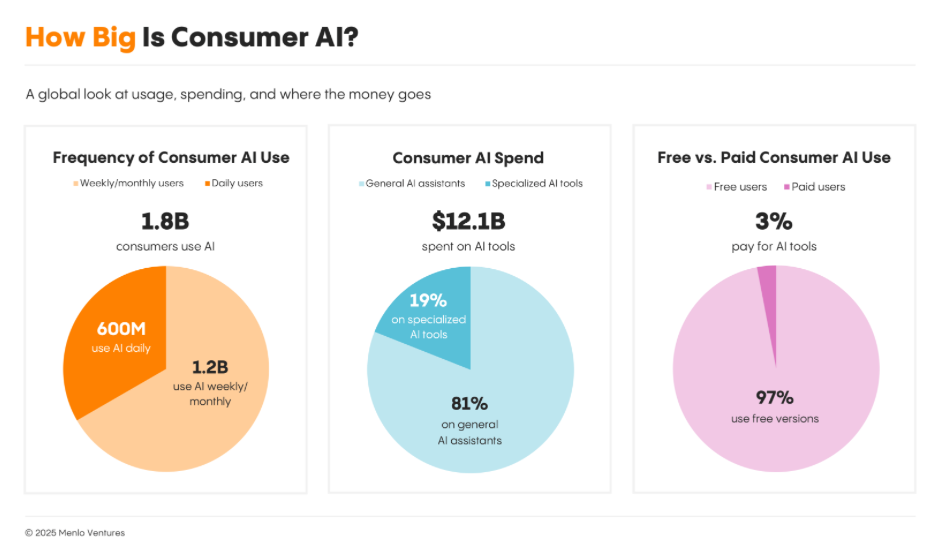
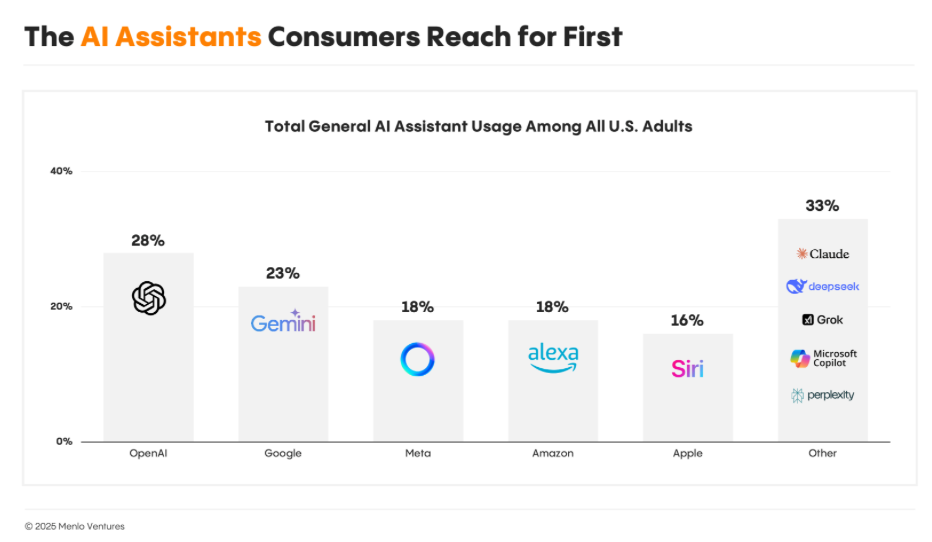
Data from Menlo Ventures finds that roughly 1.8 billion consumer are using AI on either a weekly or monthly basis and the AI assistants they reach for the most come as little surprise — ChatGPT, Google’s GOOGL Gemini as it weaves that into Search and its Android ecosystems, META across its various platforms, and Amazon’s AMZN Rufus shopping tool and Alexa. What is a little surprising is Apple’s AAPL Siri rounding out the top five, but that likely reflects the install base of Apple’s devices.
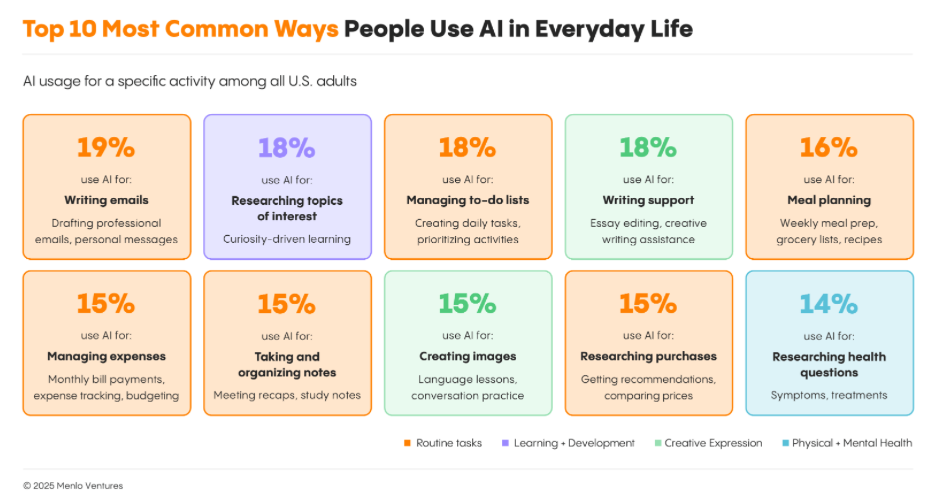
What’s also interesting is that, among those consumers using AI each week or month, it doesn’t appear that a killer application has emerged just yet. Email helped spur the adoption of the BlackBerry, while messaging, the full-blown internet and the app ecosystems did the same for smartphones, especially the iPhone. However, when we look at the above diagram, even though more than half of U.S. adults report using AI, not one activity sees more than one in five relying on it. Even the most common use — writing emails — tops out at just 19%.
This could tie to where we are in the AI adoption cycle, but it could also have something to do with the vast majority of folks using free AI tools. Score one for Google integrating Gemini into Search, bolstering our view about the company being well-positioned to train its models.
One area that we are watching closely as it relates to consumer adoption of AI is shopping. Data from Bloomreach found that more than 45% of 46.2% of respondents believe an AI shopping assistant would offer more honest advice about an outfit than a friend. Data from Sensor Tower shows year-over-year gains in AI-assisted web searches in the U.S., and with Amazon rolling its Rufus shopping tool out to more countries, we suspect those gains will continue.
Some other interesting stats from Bloomreach’s findings:
- 76.8% of shoppers say an AI shopping assistant helped them decide to purchase an item faster (ha-hem, Amazon)
- 51.3% want AI to help them book their actual flights and/or accommodations
- 44.5% would be interested in letting an AI assistant handle payment and checkout
Connecting the Dots
Aggregating the above, we can surmise that consumer AI adoption is unfolding, and odds are it will continue to as training for the underlying models continues and as more AI-capable consumer devices — smartphones, PCs and tablets — are sold. Later this week, we’ll be hearing from HP HPQ and Dell DELL about their expectations for the AI PC market in 2H 2025. Given our position in Qualcomm QCOM, our ears will be finely tuned to what they say.
Recently, Google unveiled its newest family of Pixel smartphones, with Gemini as a focus, and one that showcases its role in the Android ecosystem. In addition to Apple unveiling its newest iPhone in September, Meta is holding its next Meta Connect event on September 17 to 18, with Mark Zuckerberg set to deliver a keynote address on September 17.
Expectations are that Meta will introduce its new smart glasses at the event. These are expected to be a step up on a few fronts, including price, compared to Meta’s Ray-Ban and Oakley smart glasses. And let’s remember that Google is working on its own smart glasses in partnership with eyewear brands Gentle Monster and Warby Parker, with the goal of making them an ever-present AI assistant.
Our thinking has been that consumer adoption of AI will be a factor in driving network capacity utilization, and paired with AI adoption in the enterprise, will lead to rising capital spending levels. If you’re thinking we saw this before with the adoption of the internet and then the mobile internet, you’d be correct.
In June, Cisco CSCO shared that 97% of IT leaders see modernized networks as critical to deploying AI, IoT and cloud, with 91% increasing network investment. That’s part of the play for us with Marvell and its Enterprise Networking and Carrier Infrastructure segments.
More Pro Portfolio
- New TJX Price Target After Reminder of Tariff Protections
- We're Calling This Ad Name Up to the Bullpen, With a Caveat
- Weekly Roundup: Weekly Roundup: Portfolio Advances as Powell Leaves Rate Cut Door Open
At the time of publication, TheStreet Pro Portfolio was long NVDA, MRVL, NOW, AXON, GOOGL, META, AMZN, APPL and QCOM.