Growing Consumer Anxiety Explains Our Thinking on These Two Positions
Plus, here's what we’re tracking for the Portfolio’s payment processing play.
You've reached your free article limit
You've read 0 of 1 free Pro articles.
Consumers are getting worried.
That was the message found in today's New York Fed Survey of Consumer Expectations for February. If we were long traditional retailers, the report would be a concerning one, but the differentiated business models at Costco COST and Amazon AMZN are well positioned to capture consumer spending at times like this.
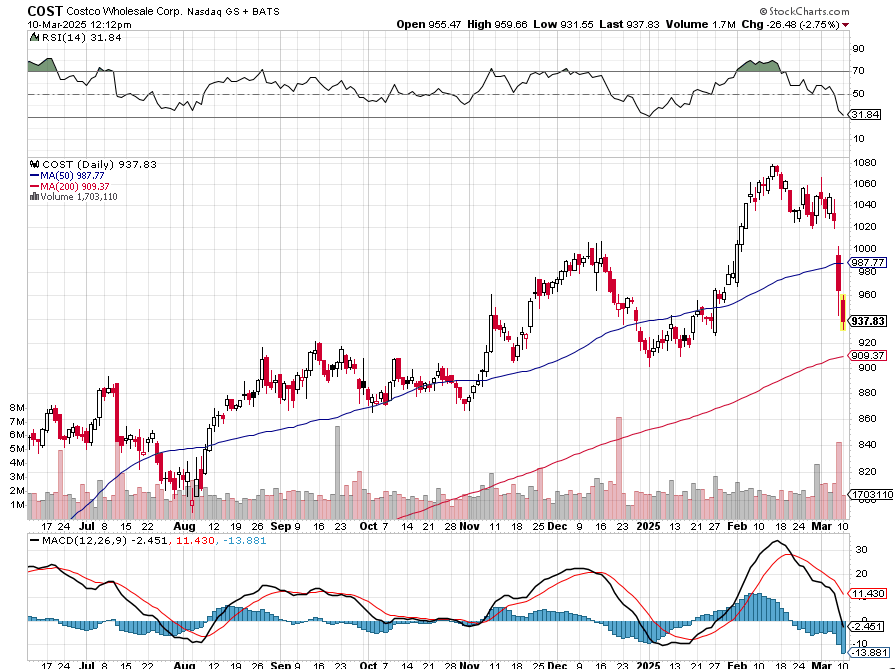
Last Thursday, we shared that if COST shares drift back to the 50-day moving average near $988, that would be a nice pickup point, but a more compelling one would be closer to $960.
With Monday's resumption of market pressure, COST shares have moved below that level but, as we explained in today’s video, there are few reasons to get aggressive just yet. We will continue to watch its technicals and should it become oversold and the MACD trend turn up, that would be an opportune time to upgrade the shares to a One rating and potentially pick up some shares.
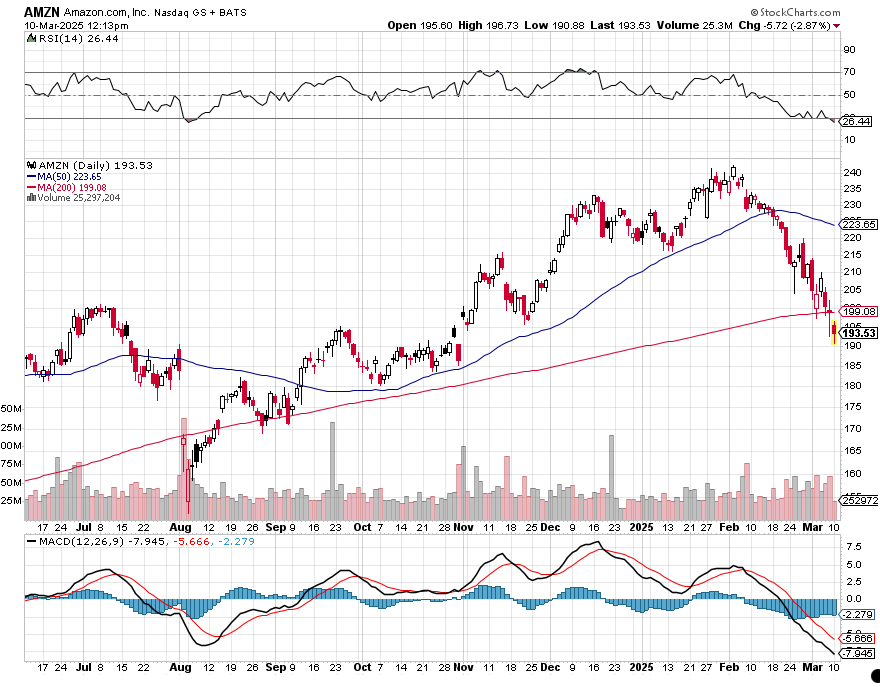
Turning to Amazon, those shares are oversold, and as we can see in the chart below, their relative strength index is below 27. Like our comment above for COST shares, given the inflation data coming at us over the next few days, the smarter move for those underweight AMZN shares relative to the Portfolio is to wait until the market has put a firm bottom in. A few upside dollars might be lost, but that’s far better than being head faked in an anxiety-filled market.
So, what did the NY Fed’s Survey of Consumer Expectations find in February?
Median inflation expectations increased by 0.1% to 3.1% at the one-year horizon and were unchanged at 3.0% at the three-year and five-year horizons.
Consumers' year-ahead expectations about their households' financial situations deteriorated considerably in February. The share of households expecting a worse financial situation one year from now rose to 27.4%, its highest level since November 2023.
Mean unemployment expectations — or the mean probability that the U.S. unemployment rate will be higher one year from now — jumped up by 5.4% to 39.4%, its highest reading since September 2023.
The average perceived probability of missing a minimum debt payment over the next three months increased by 1.3 percentage points to 14.6%, its highest level since April 2020.
That last one has us revisiting the Portfolio’s position in Mastercard MA shares. Our view has been that so long as job growth and wage gains continue, consumer spending would likely hold up. However, recent comments about a “period of transition” for the economy and rising layoffs are pushing back on the data we saw in the February Employment Report.
We’ll have more to say on MA shares as we dig into tomorrow’s JOLTs Job Cuts report and the next few weekly jobless claims.
More Pro Portfolio
- We're Adding More Shares of These 5 Portfolio Holdings
- Weekly Roundup: Here's Our Game Plan as We Focus on Our Updated Shopping List
- Big Spenders Vs. Cash-Strapped Shoppers, AI, Hacks and Other News for Investing
At the time of publication, TheStreet Pro Portfolio was long COST, AMZN and MA.