Gaming Out 4 Scenarios for a Sustained Market Rebound After Trump's Tariff News
Here’s our near-term plan for the TheStreet Pro Portfolio as we look at potential catalysts and possibilities.
You've reached your free article limit
You've read 0 of 1 free Pro articles.
Global markets are reacting to larger-than-expected Trump reciprocal tariffs announced Wednesday and the start of tariffs on autos and auto parts. While markets are still absorbing yesterday’s announcement, our concern remains focused on potential responses from tariff-slapped countries and companies as well as the reformulation of earnings expectations by market participants.
In full, more than 180 countries and territories are subject to President Trump's announced tariffs, with reciprocal rates on ~90 countries set to become effective on April 9, while a baseline across-the-board tax of 10% to all imports to the U.S. begins on April 5.
Early this morning, we are already seeing responses being formulated. Volvo CEO Håkan Samuelsson said the company “will have to increase the number of cars we build in the U.S. and surely move another model to that factory.” Mercedes Benz Group AG is considering shifting production of another vehicle model to the U.S. and also reportedly considering cutting sales of lower-margin imports.
After being hit with 30% tariffs, South Africa is reportedly seeking to negotiate a new “bilateral and mutually beneficial trade agreement” and India’s Department of Commerce is also “carefully examining the implications.” U.K. Prime Minister Keir Starmer of Britain said negotiations toward a trade deal with the U.S. would continue and did not suggest any immediate retaliation.
Others, however, are at least verbally pushing back on the tariffs and our thinking is the coming days could either lead to new trade deals or actions that could escalate a trade war. Prime Minister Pedro Sánchez of Spain has challenged the Trump administration’s argument that the latest tariffs are “reciprocal.” Denmark’s industry minister, Morten Bodskov, said the country was ready to “stand firm” in response to Trump’s tariffs. Taiwan’s government condemned the tariffs as unreasonable and said it would lodge a strong protest with the U.S. trade representative. European Commission President Ursula von der Leyen responded to the tariffs announcement by saying the European Union is preparing further countermeasures against U.S. tariffs if negotiations fail.
We’ve discussed in recent days how all of this uncertainty, along with slowing consumer spending, business uncertainty, and other factors, are poised to weigh on June-quarter guidance. Developments in the last 24 hours haven’t changed that, and more likely have raised the odds that companies take an even more conservative approach. If you think this sounds like more market volatility ahead, we are inclined to agree with you.
Gaming Out Catalysts for a Market Rebound
The question to ponder then is what could lead the market to rebound in a sustained manner.
As of now, we see four possibilities:
1. Trump and other countries negotiate trade deals that render yesterday’s reciprocal tariffs mute.
Possible and we’ll know more on this front in the coming days.
2. March-quarter earnings season surprises to the upside.
Most likely a low probability and given the factors we’ve discussed of late, concerns for the June-quarter and revised 2025 guidance remain.
3. Trump delivers on tax cuts.
TBD.
4. The Fed cuts interest rates.
The odds of that are at least questionable given recent inflation data and the potential for tariffs to stoke those figures higher. UBS is out with the following: "Simple back-of-envelope calculations suggest a permanent implementation of the full set of proposed tariffs would see inflation rise to around 5% as prices adjust to the higher costs of imports." That's not directionally not good for rate cuts.
But let’s remember the Fed has a dual mandate and that means paying close attention to the upcoming monthly Employment Reports. While ADP’s March Employment Change Report surprised to the upside yesterday, it only reflects the private sector. This morning, the March Challenger Gray Job Cuts report showed a 60% jump in planned layoffs to 275,020, the highest level since March 2020 when the economy was slamming into the first wave of the pandemic. Tallying job cuts reported by Challenger for Q1 2025, we find just under 500,000 cuts were announced, the highest since Q1 2009.
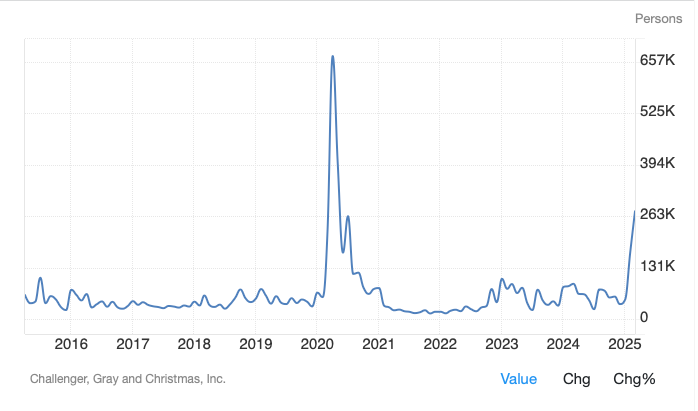
We see that adding to consumer angst and another headwind for spending as are the headlines we’re seeing today in response to Trump’s reciprocal tariffs.
Going one layer deeper into the March Challenger Job Cuts report, we find that “Job cut announcements were dominated last month by DOGE plans to eliminate positions in the federal government. It would have otherwise been a fairly quiet month for layoffs." That suggests we are likely to see a sharp pick-up in public sector job losses in Friday’s March Employment compared to the 11,000 added in February.
As of Thursday morning, the market consensus for the March Employment Report is 140,000 jobs, down from 151,000 in February. If the public sector job losses recorded in the March report result in a much weaker than expected jobs print for the month, the question will be whether the Fed looks through that and focuses on private sector job growth. Or not.
We’ll have a much better sense of this after this morning’s March Services PMI data from ISM and tomorrow’s March Employment Report.
Our Plan for the Portfolio
As the market absorbs the latest developments, we’re going to sit on the sidelines, at least for Thursday morning, but more likely the entire day. There will be the temptation to “buy the dip” and pick up some shares on the extreme cheap, but as we’ve outlined above, hurdles remain.
We’ll continue to update our thinking as trade developments unfold, but we will continue to follow the data and be on the lookout for earnings pre-announcements.
At the time of publication, TheStreet Pro Portfolio had no positions in any securities mentioned.