Bank of America Sets New Microsoft Price Target, Prompting Reset
What we would look to see in MSFT shares to pick up more for the Portfolio.
You've reached your free article limit
You've read 0 of 1 free Pro articles.
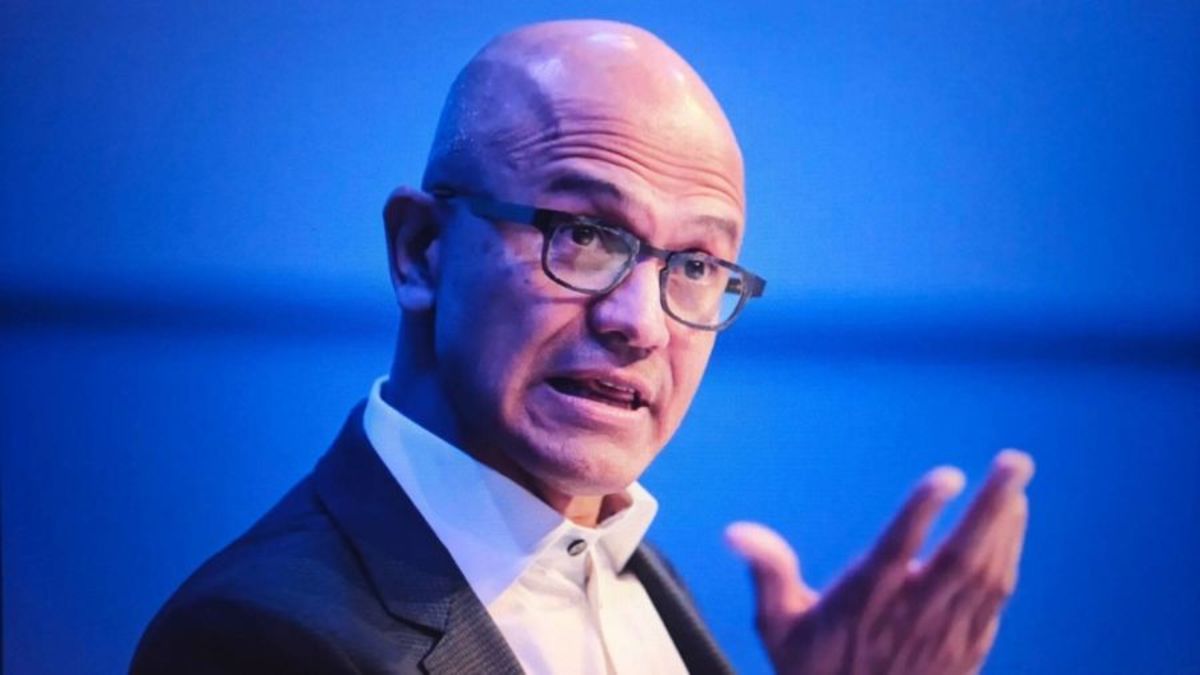 Satya Nadella Microsoft
While we wait to see what happens next with potential U.S.-Iran negotiations after it appears Iran rejected a 15-point U.S. truce proposal and set out five conditions of its own for ending the war, let’s catch up on what Bank of America recently had to say about Microsoft (MSFT) shares.
BofA on Microsoft
Microsoft was in focus on Tuesday as Bank of America reinstated coverage on the tech giant with a Buy rating and $500 price target. In doing so, BofA noted that its price target is:
"…supported by durable multi-year growth across cloud and AI. Microsoft’s advantage lies in its ability to capitalize on AI across both infrastructure and applications: Its Azure cloud infrastructure platform provides the compute and data foundation for enterprise AI workloads, while Microsoft’s primary software products, 365, Dynamics, Github, and Windows, embed into everyday tasks that drive attach and consumption."
The crux of BofA’s argument hinges on the following:
"…we expect revenue to grow 15-17% in the next three years. This will be led by 24-28% growth in Intelligent Cloud as AI workloads scale. We estimate gross margins will compress 340bps from FY24-FY28 amid elevated compute and data center costs, but think Microsoft can sustain 46%+ operating margins from FY26-FY28, supported by its high-margin software business and disciplined expense management."
We agree with BofA’s cost assessment and would note Microsoft’s operating margins have landed in the 46% to 48% range over the last several quarters, while its top line has been in that 16% to 18% range. But, as we think about potential top-line growth, let’s think about Microsoft’s Azure backlog, which stood at $625 billion exiting 2025. As we’ve pointed out in the recent past and BofA raises as well, the key question is: How quickly can Microsoft turn that contracted demand into revenue?
As we’ve come to see, supply is the bottleneck — or, as we like to say, the pain point — not demand, which is why we recently added shares of Applied Materials (AMAT) back to the Pro Portfolio. We’ve also seen Amazon (AMZN) , Meta (META) and others make large multiyear partnerships with key companies to lock in needed capacity. Measured against chip demand guidance from Nvidia (NVDA) , Broadcom (AVGO) and others, reaffirms our view the issue remains one of capacity, not demand.
In addition to expecting some continued margin pressure as Microsoft ramps cloud capacity, BofA also sees Microsoft’s capex rising further compared to historic levels, keeping a lid on free cash flow generation. We would say this is rather reasonable thinking, given expectations for overall AI and data center industry construction over the coming years.
What it could do, however, is limit the size of future dividend increases, at least until Microsoft’s capex spend returns to more normalized levels. Annualizing Microsoft’s December 2025 quarterly capex spend of $37.5 billion implies an annual run rate of about $150 billion.
Our Thoughts on BofA's Position
Arguably, many of these factors are already known and have been a part of what’s weighed on MSFT shares, which are currently trading at around 18x expected consensus EPS of $20.50 in calendar year 2027, up from $17.71 in 2026. The last time we saw Microsoft at such a PE multiple levels was back in 2016, when its business was far more exposed to its Personal Computing business. Back then, that segment was about 44% of total revenue, with Intelligent Cloud at 27% and Productivity & Business Solutions at 29%. That mix today is more like for 43% Productivity & Business Solutions, 38% Intelligent Cloud and 19% Personal Computing.
In terms of the MSFT shares, they are approaching levels last seen in April to May 2025, when the market was contending with Liberation Day questions and fallout. The current RSI of about 27.60 points to an oversold condition, but even after BofA’s coverage reinstatement and $500 price target, the shares traded off.
Where we are coming out is that the shares are below our $385 panic point, but the current share price is certainly tempting. However, for us to commit more capital to the position, we would want to see the shares become a bit more oversold, a condition that would suggest a compelling risk-to-reward setup. It would also suggest that any good news would trigger some short covering, and on that note, as of March 13, roughly 79.8 million MSFT shares were short per data published by Nasdaq. That’s the highest level in the last 12 months and equates to about 2.5 days to cover.
While we track the shares and their RSI level closely, we’ll go ahead and reset our MSFT price target to match BofA’s $500 target. In doing so, we’re applying a more measured valuation to reflect industry capacity constraints and time to monetize that massive backlog. When that pace of monetization begins to accelerate, driving margins and earnings higher, we will review our price target as needed.
Related: Emerging Market Selloff Shows Flashes of 2008 Financial Crisis
More Pro Portfolio
- Exiting 1 Position, Buying 4 More as Trump's Iran Update Sparks Market Whiplash
- We're Tracking 21 Portfolio Signals Across 9 of Our Investing Themes
- Weekly Roundup: Sharpening Our Pencils for More Market Tests Ahead
At the time of publication, TheStreet Pro Portfolio was long MSFT, AMAT, AMZN, META, NVDA and AVGO.