What to Expect When Tariffs Take Effect on Liberation Day
With Liberation Day nearing, let's take a look at how the tariffs are going to impact the auto industry. This is a roundup of TheStreet's best writing on the topic from this week.
You've reached your free article limit
You've read 0 of 1 free Pro articles.
Tariffs
The big news this week was tariffs.
The bad news was that we’re gonna have them.
The good news is that we got some clarity on the details.
Next Wednesday is so-called Liberation Day, the day that tariffs go into effect. Personally, I’m shopping for a new car and don’t feel in any way liberated by tariffs. In fact, while writing this, I just received a message from a local car dealer that the price of a car I'm interested in was just raised by 2.5%. A sign of things to come?
But my shopping habits are not Washington's goal here. The administration hopes the tariffs will have a long-term positive impact on the economy. Whatever happens, this is the hand we’re dealt with, and, as investors, the only thing that matters is the market impact.
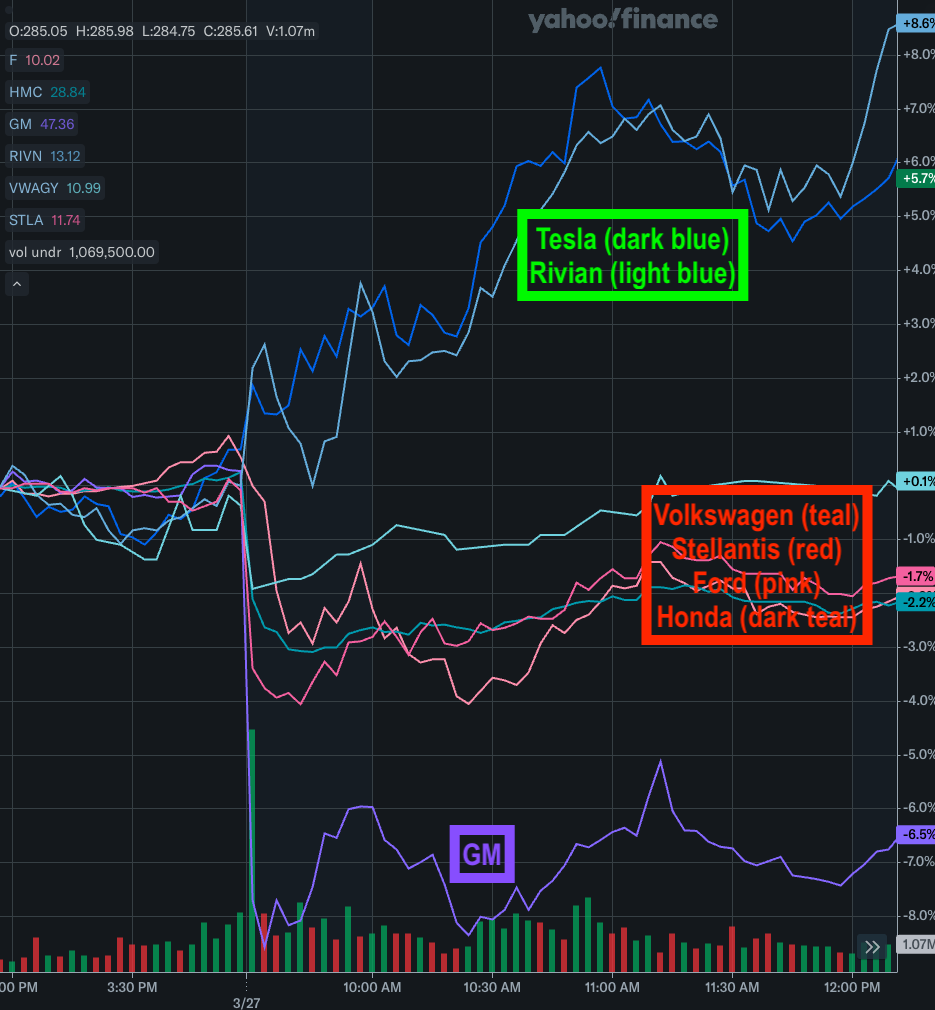
Late Wednesday evening, the Trump administration announced that cars built outside of the US would be subject to 25% tariffs beginning on April 3rd. This news hit most of the industry very hard. GM GM opened more than 8% lower. In fact, it’s now about 17% lower than when Trump took office.
That seems funny, given that GM is an American car company. But they make only about half of their cars in the US.
You know who did well? Of course, you do. Tesla TSLA did well. Its shares opened about 2% higher on the news. It still remains to be seen whether the Musk/Trump connection will help or hurt the company and Tesla investors. Shares gained as much as 94% following the election but are now about even. Sales are down sharply as current customers boycott Musk's actions within DOGE.
US EV maker, Rivian RIVN also did well. In fact, it’s outperformed Tesla since the election. Rivian makes its trucks out of a plant in Illinois and its shares are up over 20% since Trump took office. That makes me happy not so much because I’m a shareholder (very small!) but because Rivian lent me a truck for a week and I loved it. Everything about it was better than the Tesla I've owned since 2019.
The other major auto manufacturers were down, though not as much as GM. I found Honda’s decline to be interesting because it actually makes many of its cars in the US. And more of their parts are made here than possibly any other auto manufacturer. I guess it’s a case of throwing out the baby with the bath water.
The chart below is an intraday chart showing the decline at the opening of trading Thursday, through about midday. It shows clearly the assumed winners and losers of the upcoming tariffs. Tesla and Rivian will be shielded. Everybody else is in trouble.
Tariff Coverage Across TheStreet and TheStreet Pro
Both TheStreet and TheStreet Pro offered good coverage of the event and I thought it would be helpful to use this week’s article as a summary of our coverage.
Martin Baccardax on TheStreet
Over on TheStreet, Martin Baccardax is required reading. As a former bond trader, he has a great understanding of markets. Unlike a former bond trader, he also has a way with words!
In Top analyst overhauls GM, Ford stock price targets amid tariff risk, Martin referenced the White House’ fact sheet that stated the tariffs are designed to “end unfair trade practices that jeopardize US national security.”
A few things to know from Martins article include:
- Had the tariffs been implemented in 2024, 8 million out of 16 million cars sold in the US would have been effected.
- GM and Ford build the bulk of their cars in the US, but they use parts from outside of the country.
- Expect to pay $5-10,000 more for a new car
Charley Blaine on TheStreet
TheStreet’s Charley Blaine covered the tariffs in Trump auto tariffs: a ‘hurricane-like headwind’
His key points include:
- Wedbush Securities analysts call this a “hurricane-like headwind” for the industry
- Tariffs begin at 12:01am on April 3 and by no later than May 3, with no end date.
- Trump said that the tariffs would be “net neutral or maybe good” for Tesla.
- European automakers are the most vulnerable.
Samuel O'Brient on TheStreet
While not directly focused on tariffs, TheStreet’s Samuel O’Brient looked at important news Rivian shared on Wednesday. In Rivian ventures away from cars, heads down an unexpected avenue,
Things to know:
- Rivian spinning off its mobility arm called Also
- Also plans to build smaller, lightweight EVs
- Also started as an internal R&D effort to see if Rivian’s best in class software could power smaller vehicles
Alex Frew McMillan on TheStreet Pro
Moving on to TheStreet Pro contributors, Alex Frew McMillan examined the impact of tariffs on Asian manufacturers in Explaining China Stocks’ Surprise Reaction to Trump Auto Tariff’s News.
Alex tells us:
- The expected drop in Asian markets didn’t materialize. They rose on the news!
- Tariffs will hit Japanese and Korean automakers. Chinese manufacturers already have 100% tariffs.
- CATL, the largest maker of EV batteries globally, just became listed in Hong Kong and can now be purchased by international investors
Rev Shark on TheStreet Pro
James “Rev Shark” DePorre looked at the tariffs from the standpoint of a trader. In Will Trump’s Auto Tariffs Trigger a Trade War, Rev tells us:
- The European response could see this become a full-blown trade war.
- Reciprocal tariffs could combine to be 40-50% and hit nearly half of all US vehicles
- The stock market is correcting, and corrections precede recession 50% of the time.
Chris Versace on TheStreet Pro
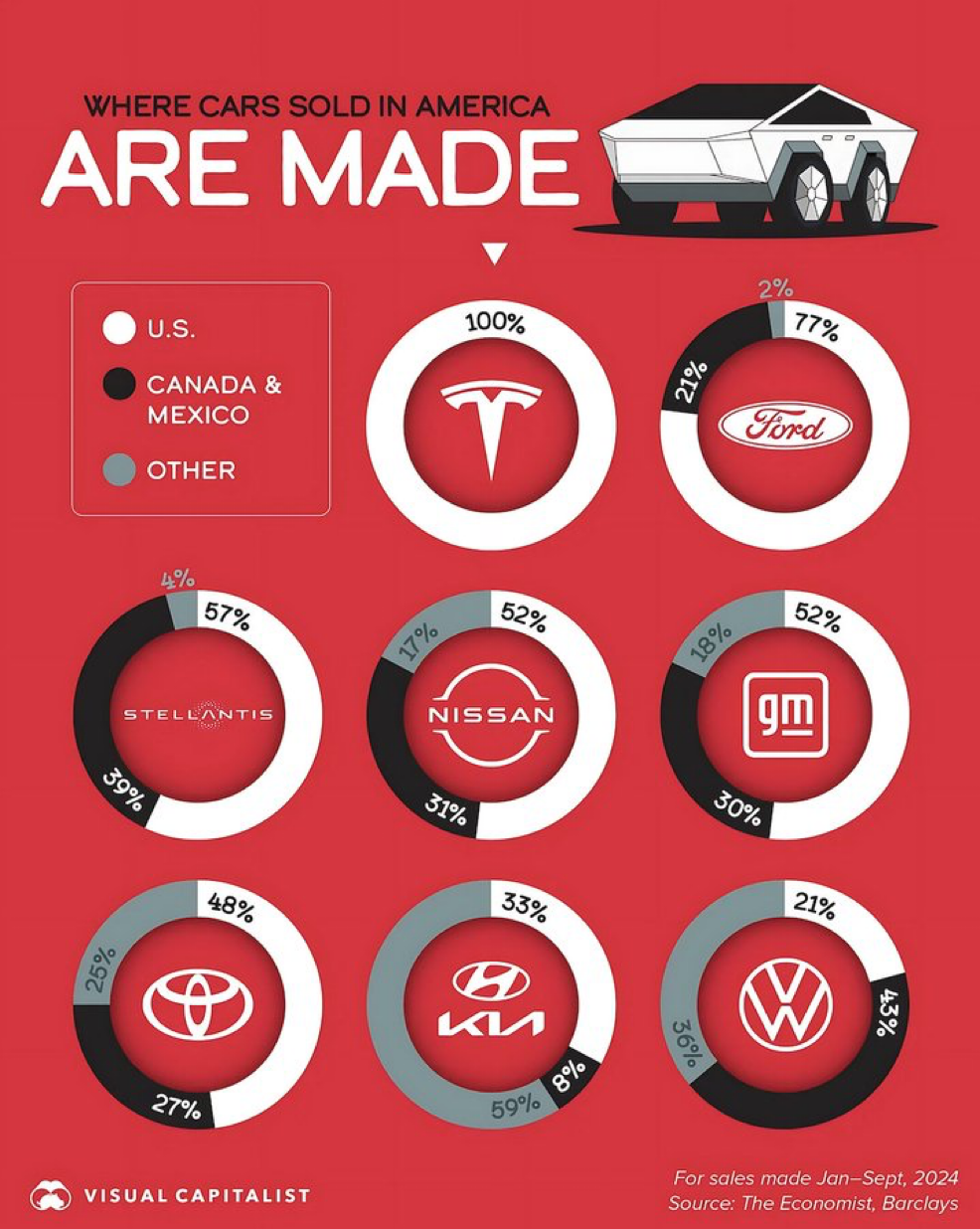
Our Portfolio Manager over at TheStreet Pro’s Portfolio is Chris Versace. Chris Versace offered the great graphic below in the article Updating Our Portfolio Game Plan as Auto Tariffs Mean More Uncertainty.
What you should know:
- In principle, Chris is in favor of car companies building more cars in the US because it will increase jobs here.
- But this will play out over years and not weeks.
- It will have significant impact to the economy and markets.
Bret Jensen on TheStreet Pro
I’ve saved the Bret (Jensen) for last. His Friday piece was titled Evolving Tariff Policy Has Benefits, but Changes Are Pushing Investors to Sidelines.
Bret tells us:
- Benefits from globalization included increased corporate profit margins and low prices for consumers
- Drawbacks include the decimation of small towns and US manufacturing as well as elongated supply chains
- Tariffs are now central to Trump’s policies and have led to some early wins, like Hyundai’s additional allocation of $21b to US factories.
- Uncertainty could lead to near-term economic contraction
- Investors should be patient
At the time of publication, Meshnick owned shares in Rivian.