War on the Way? Jobs Roar, Software and Financials Reel, Charting the S&P 500
Rumble, rumble. Strong jobs, shaken software names, and now a second U.S. carrier is likely headed to the Middle East.
You've reached your free article limit
You've read 0 of 1 free Pro articles.
On Tuesday of this week, President Donald Trump told reporters that he was considering sending a second carrier group to the CENTCOM (Central Command: Middle East) region as a precaution in case negotiations with Iran failed. On Wednesday, it appeared, according to the Wall Street Journal, that the Department of Defense/War has ordered that carrier strike group to deploy. The group will likely be pulled from the U.S. East Coast areas of operations.
The USS George H W Bush has been involved in training exercises of late off of the Virginia coast near Norfolk and would be the logical choice both in terms of preparation and probably in logistical terms as well. The USS Abraham Lincoln is already in position should the need arise. This will be the first time since early 2025 that the U.S. has had two carrier groups in that specific area.
The president has been quoted as saying, “You have to get in position. We have plenty of time. If you remember Venezuela, we waited around for a while. And we’re in no rush. We have very good talks going with Iran.”
Each carrier group usually includes a flagship or aircraft carrier, a destroyer squadron (three guided missile destroyers), two nuclear-powered submarines, logistics and supply ships and up to 90 fighter aircraft. Each group may or may not also include an expeditionary strike group carrying up to 2,200 Marines.
January Job Creation Roars
Seemingly out of nowhere and certainly not in line with recent labor market-related data-points, January Non-Farm Payrolls hit the tape on Wednesday at an increase of 130,000 positions. This was well above expectations for only about 70,000.
There were downward revisions made to the prior two months of just 17,000 (less than usual), leaving the number at a net gain of 113,000. That number is pulled from the BLS Establishment Survey. The BLS Household Survey was even stronger, showing an almost unbelievable increase of 528,000 employed persons for the month of January and a decrease of 141,000 unemployed persons. For those interested, I covered this release in depth here on TheStreet Pro on Wednesday morning.
The Unemployment Rate, which is drawn from that Household Survey, improved in January, dropping from 4.4% in November, to 4.3% despite the fact that participation increased. That really does enhance the unexpected strength in this release. Participation improved from 62.4% in December to 62.5%. The net number of individuals working part-time in January increased by 225,000 individuals. This is rather huge in its implications.
If we use the net NFP print of 113,000 for job creation, that adds up to a loss of 112,000 full-time jobs for the month. If we use the 528,000 print for job creation, then 303,000 full-time jobs were created during the month.
That would be simply unreal. With the underemployment rate dropping from 8.4% to an even 8% and understanding that the BLS has been consistently inaccurate in the past, one would have to believe that the positive print for full-time job gains is closer to what might be considered actual.
Marketplace
The strong January employment report had a negative impact on financial markets, at least at the headline level, as this was seen as potentially pushing out expectations for short-term rate cuts. Once again, the air that was let out of the tires, primarily came out of software stocks and the financials. These have been the recent targets when the markets have decided to roll over.
There was some light selling across U.S. Treasuries as the probabilities for any rate cut prior to June was all but erased. The 10-Year Note paid 4.18% (+3 bps) by day's end, while the 2-Year Note yielded 3.52% (+6 bps).
Just an aside... the U.S. Treasury Department "raffled" off $42 billion worth of new 10-Year paper on Wednesday afternoon and that auction did not go very well. As demand from abroad contracted, dealers were stuck with a 13.54% slice of the pie, their largest portion since this past summer.
Equities were "weakish" but really nowhere nearly as weak as the financial media pretended they were. The S&P 500 essentially closed unchanged as the Nasdaq Composite gave up 0.16%. Heck, the Nasdaq 100 actually gained 0.29%. Small-to mid-cap stocks closed down small. The story was really the selling of financials and software and the purchase of certain cyclicals as well as semiconductors.
Breadth
On Wednesday, seven of the 11 S&P sector SPDR ETFs closed the day in the green, led by Energy (XLE) , the Staples (XLP) and Materials (XLB) . The Financials (XLF) led the losers as banks and investment services were roasted for a second straight session. An interesting tale was told within Tech (XLK) , which was up small overall.
The Philadelphia Semiconductor Index gained 2.28%, led by memory as SanDisk (SNDK) ran 10.7% and Micron (MU) gained 9.9%. However, the Dow Jones U.S. Software Index was beaten for a loss of 2.42%. Those losses were paced by Unity Software (U) and Lyft (LYFT) . Those two stocks were taken to the woodshed and slapped around for an ugly 26% and 17%, respectively.
Despite what was described as headline losses, winners beat losers by roughly 7 to 6 at the NYSE, while losers beat winners by about 5 to 3 at the Nasdaq. Interestingly, advancing volume took a majority share of composite trade across listings at both exchanges yet again, which has become the norm.
Trading volume popped significantly on Wednesday in response to the January jobs data. On a day-over-day basis, aggregate trading across Nasdaq listings increased 16.6% and by 10.4% across NYSE listings.
Did anything change, technically? Take a look...
The Chart
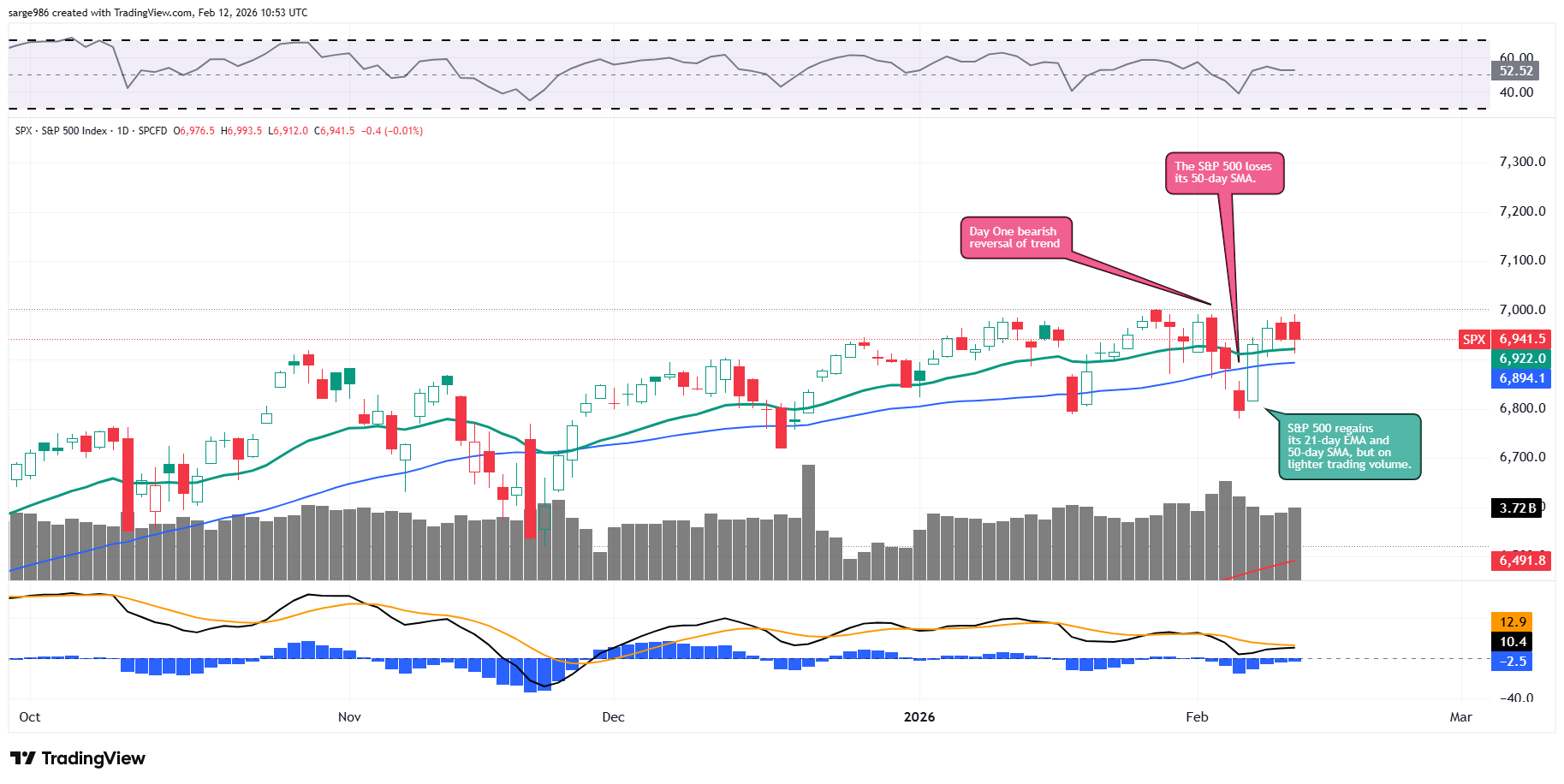
Note that despite two straight "red candle" days, the S&P 500 has, since regaining its key moving averages last Friday, found support at its 21-day simple moving average (SMA) every single day this week. That implies that the swing crowd has been buying dips daily and not permitting the 50-day SMA to even be tested.
Given the trading volume on Wednesday, anecdotally at least, I would think that at least a few professional managers stepped up and competed with the swing crowd on Wednesday. If I am right about that, there will be a positive carry-over into Thursday morning.
Let us rock.
Rumble, Rumble
Just witnessed the launch of a United States Space Force Vulcan rocket a couple of minutes ago. That was not SpaceX, by the way. This launch was executed by the United Launch Alliance.
I love that rumble. So very reminiscent of columns of tanks moving in the distance. The ULA, for those that care, is a joint venture between Lockheed Martin (LMT) and Boeing (BA) .
Twinkle, twinkle, little star,
How I wonder what you are!
Up above the world so high,
Like a diamond in the sky.
- Jane Taylor (1806)
Economics (All Times Eastern)
08:30 - Initial Jobless Claims (Weekly): Expecting 227K, Last 231K.
08:30 - Continuing Claims (Weekly): Last 1.844M.
10:00 - Existing Home Sales (Jan): Expecting 4.23M, Last 4.35M SAAR.
10:30 - Natural Gas Inventories (Weekly): Last -360B cf.
13:00 - Thirty-Year Bond Auction: $25B.
The Fed (All Times Eastern)
19:05 - Speaker: Reserve Board Gov. Stephen Miran.
Today's Earnings Highlights (Consensus EPS Expectations)
Before the Open: (BAX) (.54), (ZTS) (1.40)
After the Close: (ABNB) (.65), (AMAT) (2.21), (DKNG) (.15), (PINS) (.67), (ROKU) (.28), (TWLO) (1.23)
At the time of publication, Guilfoyle had no positions in any securities mentioned.