Wall Street, Mike Wilson's Calling!
Let's look at the call by the famed Morgan Stanley strategist, why stocks roared back from Friday's selloff and how Sarge fave Palantir crushed the quarter.
You've reached your free article limit
You've read 0 of 1 free Pro articles.
They were out in force on Monday. A group of Wall Street's better-known prognosticators, in separate musings, all warned investors that an equity market pullback could be near in response to last week's macroeconomic data. That data told a cautionary tale as reaccelerating consumer-level inflation ran into a labor market that had "suddenly" hit stall speed three months ago. Cross this data with historically high equity market valuations and the ingredients are in place for some reallocation of capital.
Coming out of the weekend, Morgan Stanley strategist Mike Wilson wrote that he now sees a correction of up to 10% this quarter as consumers and multinational corporations adjust to Pres. Trump's tariffs. Wilson wrote, "Over the last couple of weeks, we have noted that investors should expect a modest pullback in the third quarter." Remember, Wilson famously called for a down year for stocks in 2022 (but has had a very spotty track record since). He had been bullish this year,
Julian Emanuel's team at Evercore sees that same imminent selloff, but his view is for something a little more severe, perhaps a decline of as much as 15%. Lastly, Deutsche Bank's team, which is led by Parag Thatte, wrote that a small drawdown across U.S. equity markets is now overdue, especially considering the tear that stocks have been on since April.
For Real?
These strategists saw this coming correction, which they anticipate, not as a doomsday event, but more as a potential for opportunity. Wilson curtly wrote, "We're buyers of dips." Emanuel made sure that his followers understood that this long-term bull market in equities was still intact, even advising his readers to stay invested through any coming volatility. Emanuel notably emphasized staying invested in companies benefiting from the rise of generative AI. Lastly, Thatte made a point of noting that historically, the S&P 500 suffered pullbacks of about 3% every one-and-a-half to two months and has suffered more serious drawdowns of 5% or more every three to four months.
I am probably far more prone to trade any coming volatility than these strategists might be as by the nature of their employment, they very likely have little skin in the game that they personally manage. That said, I do agree that markets could be due for some profit-taking and trade headlines, the potential for compressed margins, sagging economic activity and geopolitical concerns may very well be the catalysts. That said, while I also agree that while trading the market around core positions is fine that going forward, I disagree that elevated valuation could be the "why" behind any sustained selloff.
Valuations are elevated for four reasons: Lower taxes, less regulation, expected lower interest rates and increased productivity (on a per employee basis) driven by artificial intelligence. That last item, by the way, while a net negative for aggregate corporate demand for labor, will in my opinion, apply a persistently disinflationary or maybe at some point even deflationary force upon the U.S. and then global economic environments.
Chutes and Ladders
On Monday, U.S. equity markets absolutely roared back from a harsh selloff on Friday. On Friday, the algorithms that run price discovery in 2025 sold stocks en masse because of a recessionary looking labor report that was really three consecutive recessionary looking labor reports at once. On Monday, those same algorithms bought the market hand over fist because now the Fed will likely have to cut short-term interest rates in six weeks.
The real reason for the game of "Chutes and Ladders" is that these algorithms are designed to force price overshoot and create market inefficiencies. I know that we are never going back to the glorious days of blacksmiths and dinosaurs. I get it. But clearly markets were run more efficiently and were far less prone to ridiculousness when you had a bunch of ethnic kids (from Brooklyn, Queens and Staten Island) in colored jackets (who grew up playing stickball) stabbing each other with sewing pins and fighting over Spanish pieces of eight in what amounted to chaotic mosh pits. Those markets created a fairer method for price discovery and were in fact, more efficient. I'll say that until I'm blue in the face.
Marketplace
On Monday, Treasury debt securities added to their tremendous gains on Friday, By day's end, the U.S. Ten-Year Note paid just 4.2%, down 3 basis points for the session. Readers may recall that the U.S. Ten-Year yielded 4.4% as recently as Friday morning ahead of the BLS July jobs report. The Three-Month T-Bill has paid as little as 4.22% overnight.
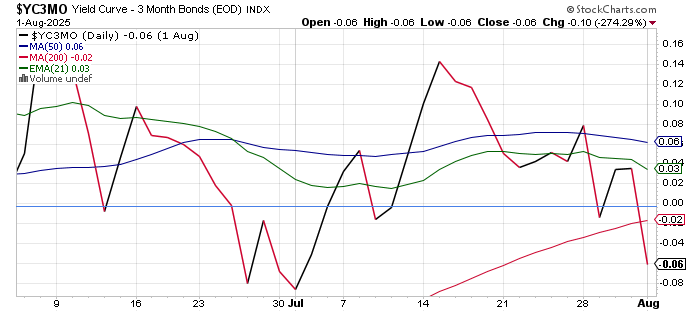
Yes, the all-important spread between the yields of the U.S. Ten-Year Note and U.S. Three-Month T-Bill is inverted for the second time in about 30 days. This spread is, for the new kids, the most accurate predictor of economic contraction that we economists have in our toolkits.
Equities did in fact roar on Monday. The S&P 500 took back 1.47% as the Nasdaq Composite ran 1.95%. Small caps joined the fun, with the Russell 2000 screaming 2,1% higher and the S&P 600 popping for a gain of 1.59%. The Dow Jones U.S. Semiconductor Index had quite the day, gaining 3.05%, led by Nvidia NVDA and KLA Corp KLAC. Those two stocks were up 3.62% and 3.27% respectively. Advanced Micro Devices AMD, a core Sarge-name, was up 2.96% on Monday and will report this afternoon.
Ten of the 11 S&P sector SPDR ETFs closed out the day in the green, led higher by the growthy sectors. Technology XLK and Communication Services XLC placed first and second on the daily performance tables for the session. Energy XLE proved to be the day's only loser. Now it gets interesting....
Winners beat losers at the NYSE by a 9-to-2 margin and by about 3 to 1 at the Nasdaq. Advancing volume took a 79.2% share of composite NYSE-listed trade and a 78.9% share of composite Nasdaq-listed activity. Rock & roll, right? Not so fast, my friends. Aggregate trading volume was down 16.9% on a day-over-day basis across NYSE names and down 23.9% on a day-over-day basis across Nasdaq-names. Trade tailed off sharply across the membership of the S&P 500 as well.
The experienced traders among you know what that means. No meme-stock trading? Well, yes, but more importantly, this means that professional managers did not chase the Monday rally. There was not a lot of conviction in the day's activity.
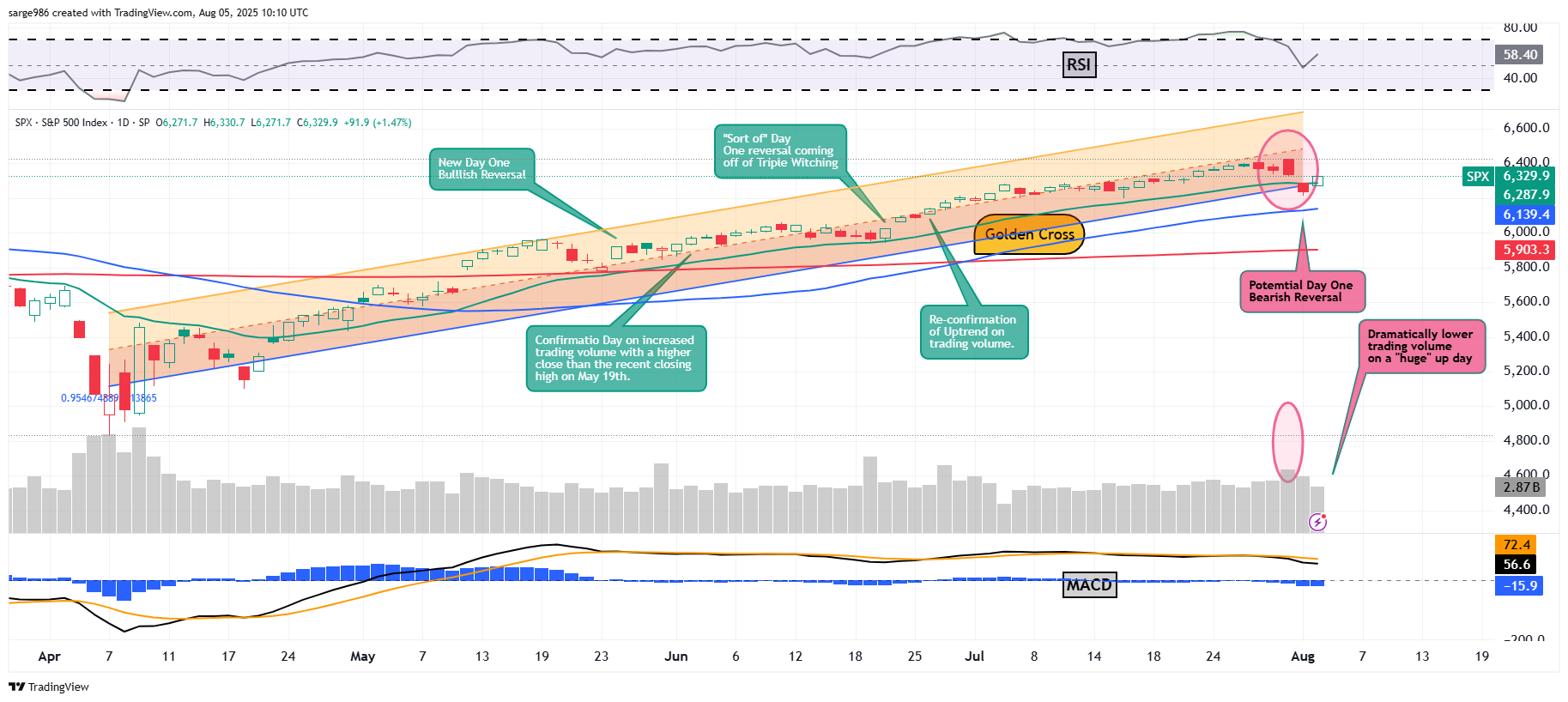
Readers will see that while up sharply for the session, the S&P 500 came nowhere near recapturing where it has traded as recently as Thursday. You'll also see the lower trading volume. Yes, this very much looks like the "pause" we spoke about twenty-four hours ago. Should we now see a down day on increased trading volume, we will have a confirmed, bearish change of trend. Then Mike Wilson and Julian Emanuel will get their corrections and end up looking pretty smart.
News: India, Intel and Palantir
- India is claiming to have been unfairly "targeted" by the United States and the European Union over that nation's imports of Russian crude oil. Pres. Trump is threatening India with substantially higher tariffs while accusing that same nation of purchasing discounted Russian oil and then reselling that at market prices.
- Overnight, Fitch Ratings downgraded Intel's INTC long-term issuer default rating and senior unsecured ratings from BBB+ to BBB. In the release, Fitch wrote "Credit metrics remain weak and will require both stronger end markets and successful product ramps, along with net debt reduction over the next 12-24 months, to return EBITDA leverage to levels consistent with the ratings."
- Long-time Sarge and "Stocks Under $10" core holding Palantir Technologies PLTR absolutely ripped the cover off of the ball on Monday night, reporting a very impressive second quarter. The company generated its first $1 billion quarter. Remember, on Liz Claman's show at Fox Business last year when I said that PLTR was the one stock that I was buying for future generations of Guilfoyles? I see the stock up 5.33% overnight. At that last sale, the stock is now up 2,544% from where we initiated it for the SU $10 portfolio. Ooh Freakin' Rah.
Economics
(All Times Eastern)
08:30 - Balance of Trade (Jun): Last $-71.5B.
08:55 - Redbook (Weekly): Last 4.9% y/y.
09:45 - S&P Global Services PMI (Jul-F): Flashed 55.2.
10:00 - ISM Non-Manufacturing Index (Jul): Expecting 51.5, Last 50.8.
4:30 p.m. - API Oil Inventories (Weekly): Last +1.539M.
The Fed
(All Times Eastern)
No public appearances scheduled.
Today's Earnings Highlights
(Consensus EPS Expectations)
Before the Open: ADM (.80), CAT (4.90), CMI (5.21), DUK (1.17), DD (1.06), LMND (-.76), PFE (.57), ZTS (1.61)
After the Close: AMD (.48), AMGN (5.28), SWKS (1.24)
At the time of publication, Guilfoyle was long AMD, NVDA, PLTR equity.