Vietnamese Stocks Not Sold on Trump's Trade 'Deal'
As the July 9 deadline looms for nations to agree higher U.S. tariffs, just about all the details remain unsettled, which leaves Asian markets grasping for direction.
You've reached your free article limit
You've read 0 of 1 free Pro articles.
Investors in Asia may be basking in the reflected glow of record highs for U.S. stocks. But there’s been scant response to the trickle of trade pacts struck on tariffs so far, and Asian markets are not pricing the agreements as “deals.”
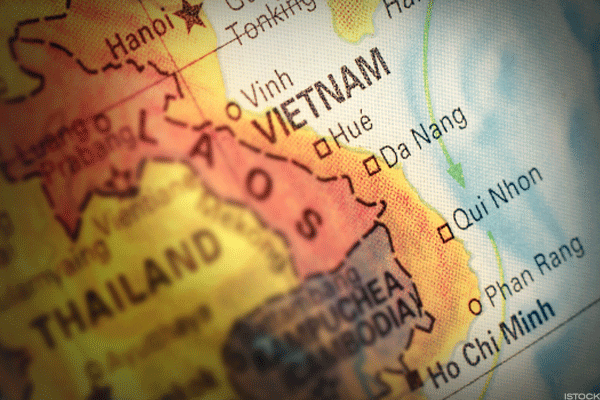
Consider that the response to the U.S. trade deal with Vietnam has been to see stocks sell off slightly. The VN Index in Ho Chi Minh dipped 0.2% while the HNX Index in Hanoi lost 0.3%.
It is not the sort of rapturous response you’d expect if the U.S. trade deal has brought closure to tensions over Viet trade. Stocks had started the day higher but Vietnamese investors chose to “sell on the news,” snapping a four-day winning streak for Viet stocks.
Asian Markets Hold Their Ground
Asian markets are unsure what to make of the July 9 tariff deadline. U.S. Pres. Donald Trump has threatened to unilaterally lay down heightened tariff terms for nations that don’t strike an agreement. But the complex nature of trade talks and the lack of U.S. trade negotiators to take part suggest it’s likely the date – coming 90 days after the initial threat of far-higher unilateral U.S. tariffs in Trump’s April 2 presentation on the Rose Garden lawn – will be pushed back once again.
Stocks in South Korea (up 29.9%) and Hong Kong (up 22.7%) have been Asia’s top performers this year, as I’ve noted in recent columns. Other Asian markets are decidedly mixed and lacking for direction. Tokyo’s Topix, for instance, is up just 2.6% and the blue-chip heavy Nikkei 225 is only just in positive territory, up 1.2% in 2025. Some smaller markets such as the Philippines and Malaysia are even posting losses this year.
I don’t often write about the small Vietnamese stock markets. But with Japanese negotiators leaving Washington empty handed after seven rounds of talks and no sign of the long-promised trade deals with allies like India and South Korea, it and China are the first Asian nations to agree anything on trade with the White House.
Is the Viet 'Deal' a Steal?
It is not clear that any trade agreement will be a good deal. Trump promised on social media that Vietnam would face a 20% tariff on goods sold into the United States, and a 40% tariff on transshipments through Vietnam from a third nation. As usual, Trump mistakenly insists that Vietnam will pay the tariffs when they will be borne by the U.S. recipient at customs.
Vietnam has been a popular choice for relocating factories for companies pursuing a “China+1” strategy, as well as a popular transshipment point for Chinese goods to be re-exported to the rest of the world. So the U.S. trade deal attempts to curb any re-exports out of China – officially.
Companies will therefore attempt to do enough work on a product for it to qualify as “made in Vietnam,” or to obscure the China origins of any goods. The transshipment tax is good in theory but hard to track and capture in practice. There are rules on how much of a product must originate from a nation for it to be considered “made” there that vary by the type of goods.
Vietnam was threatened with a 46% tariff on the initial Rose Garden chart, one of the highest rates in the world. Only Southeast Asian peers Laos (48%), Cambodia (49%) and China (54%) came off worse.
Far Higher Tariffs Than Before
So to agree a deal that’s less than half the threatened rate could be considered a win. It looks far more like a loss, though, when you consider that prior to this whole episode, Vietnam was charging a trade-weighted tariff of 5.5%, while the United States was charging 2.2%.
Vietnamese stocks have moved higher this year, with the Ho Chi Minh index up 9.1% in 2025. But most of the recent ground gained has just reclaimed losses in early April, after Vietnam’s markets had a solid start to the year.
Last year, the United States was second behind only China as a destination for Vietnamese goods. Vietnam ranked sixth as a source of imports into the United States, a total of $136.6 billion for 2024 that was up 19.3% over the prior year, led by electronics and machinery, then clothing. But Vietnam took only $13.1 billion in U.S. imports. The low incomes in Vietnam and elsewhere in Southeast Asia result in high trade deficits with wealthy trade partners like the United States.
Vietnam has agreed to open its market to U.S. imports that the Hanoi government had previously blocked. It should “provide preferential market access” for farm goods such as chicken, pork and beef, as well as other goods that aren’t yet specified the deal.
This would be the third trade “deal” agreed by the Trump administration. The deal with the United Kingdom lowered U.S. import duties on 100,000 British cars to 10% from 27.5%, and waived a 10% tariff on engines and aircraft parts. But it largely left in place a minimum 10% tariff faced by Britain, which has a small trade surplus with the United States.
Scant Details So Far
Full details of the China trade framework haven’t been shared or finalized. It appears China is agreeing to supply rare-earth minerals, while the United States has reportedly lifted licensing requirements for chip-design software sales in China.
Even on Vietnam and China, then, the text of the trade agreement hardly seems agreed. These "done" deals are very much still in the works. What's more, none of the trade deals would constitute what we’d normally consider a free-trade agreement, with full details of improved access for most if not all goods.
As July 9 looms, it looks increasingly likely that the fine print on trade will have to wait. I would expect another extension on tariffs for most nations, extending the period of uncertainty and disruption for export suppliers and import customers alike.
At the time of publication, Alex Frew McMillan had no position in any security mentioned.