Trump's 'Biggest of All Deals'
Trump strikes a trade agreement with Europe, S&P 500 and Nasdaq Composite finish the week with fresh highs, and brace for the data and earnings deluge.
You've reached your free article limit
You've read 0 of 1 free Pro articles.
“MY STYLE of deal-making is quite simple and straightforward. I aim very high, and then I just keep pushing and pushing and pushing to get what I'm after.”
- 'The Art of the Deal,' Donald J. Trump (1987)
"It's a very powerful deal, it's a very big deal, it's the biggest of all deals."
- U.S. Pres. Donald J. Trump, July 27, 2025
"It's a good deal, it's a huge deal."
- European Commission Pres. Ursula von der Leyen
Sunday Afternoon
Just a few days ago, Pres. Trump had told the media that there was just a 50/50 chance that the United States and European Union would reach a framework for a trade deal. Brussels had been known to be preparing for a potential trade war, setting up a potential response should the two sides not come to some kind of an agreement by the president's Aug. 1 deadline.
The two sat side by side. Presidents Donald Trump and Ursula von der Leyen, respectively of the United States and European Commission had indeed come to an agreement and they told the world on Sunday afternoon. Pres. Trump has informed interested parties that the U.S. would set a baseline tariff of 15% on imports from the European Union, which as a block, is the largest trading partner the U.S. has. The two parties, on average, exchange more than $5 billion worth of goods and services every single day.
The 15% rate will include European automobiles. There will also be a 15% tariff on U.S. exports to the E.U. But certain categories of products will be exempt from any tariff at all moving in either direction such as aircraft, aircraft parts, semiconductor equipment, chemicals, pharmaceuticals and agricultural goods. The 15% tariff will not be an add-on to any existing tariffs, but will become the going rate, as it was for the huge deal agreed to with Japan just last week.
As part of this deal, in an effort to further level the playing field, the E.U. has, according to Pres. Trump, agreed to purchase $750 billion worth of U.S. energy goods such as crude and natural gas, as well as an additional $600 billion worth of investment into the U.S. above current levels. The energy purchases are seen as something of a shot against Russia, while one might expect that a significant portion of the $600 billion would be spent on defense.
There's More
The U.S. and China are currently facing an Aug. 12 deadline to expand upon a preliminary deal reached in June after negotiations had begun in May. That deal brought tariffs between the two nations down from triple-digit levels and re-opened the lines of trade. Senior U.S. and Chinese officials will meet in Stockholm this morning to renew those negotiations.
The June deal restored the sale of rare earth minerals and magnets from China to the U.S. and the sale of advanced but not too advanced AI-capable chips designed by Nvidia NVDA and Advanced Micro Devices AMD to Chinese customers. These talks, led on the U.S. side by Treasury Sec. Scott Bessent and on the Chinese side by Vice Premier He Lifeng will focus upon broader and longer-standing issues.
No one is really expecting China to stop flooding world markets with cheap goods or to fully open their domestic economy to non-Chinese competition. No one is really expecting the U.S. to drastically alter its multi-layered tariffs on Chinese imports. Positions will be taken on these issues and negative headlines are a possibility. That could provoke the algorithms that control price discovery in 2025 across financial markets, creating some inefficiency. Don't fall for momentum overshoot that's been forced by algorithms.
All we really expect from these talks is to hear that the two sides have worked out another extension and that groundwork has been laid for Pres. Trump and Xi to meet in the future. Anything more would be gravy. Anything less would be trouble.
Last Week...
The S&P 500 and Nasdaq Composite both finished the week past at fresh all-time highs, which has become a regular thing of late. Most of our major to mid-major equity indices posted winning weeks, with the exception of the Philadelphia Semiconductor Index. That index gave up 1.5% for the week, weighed down by Texas Instruments TXN. Interestingly, the very similar, but differently weighted Dow Jones U.S. Semiconductor Index managed a gain of 0.09% for the week, supported by a 6% run made by the above-mentioned AMD.
Last week was active from an earnings' perspective, but less so from a macroeconomic perspective. At the headline level, Alphabet GOOGL did a better job of impressing investors than did Tesla TSLA, while June durable goods orders and more specifically core capital goods orders dropped sharply on a month-over-month basis.
It was the news cycle that dominated the flow of capital over the past five trading sessions. Pres. Trump announced on Tuesday evening what was then a "huge" trade deal with Japan in which that nation would invest what was at that time an impressive $550 billion in the U.S. It really is incredible that no prior U.S. administration had ever even tried to leverage access to the U.S. consumer as a means toward trying to level global playing fields before. Really, what on earth were those guys thinking?
On Wednesday, the president delivered remarks and signed several executive orders at an AI summit in Washington, D.C. His focus was on providing an environment for the U.S. to lead in AI and the export of artificial intelligence as well.
Lastly, the president visited Federal Reserve headquarters on Friday and after some initial awkward banter, appeared to take a little something off of his fastball concerning Fed Chair Jerome Powell. He even called Powell a "good man." Some sugar ahead of the FOMC meeting this week? We'll find out.
Weekly Numbers
What the major to mid-major U.S. equity indexes did last week as both announced and anticipated trade deals replaced what had been trade tensions:
- The S&P 500 gained 0.4% on Friday and 1.46% for the week.
- The Nasdaq Composite gained just 0.24% on Friday and 1.02% for the week.
- The Nasdaq 100 added 0.23% on Friday and 0.9% for the week.
- The Russell 2000 also added 0.4% on Friday and 0.94% for the week.
- The S&P Smallcap 600 tacked on 0.57% on Friday and 0.92% for the week.
- The S&P Midcap 400 popped for 0.91% on Friday and 1.47% for the week.
- The Dow Transports ran 1.13% on Friday and soared 3.17% for the week.
- The Philly Semis gained just 0.03% on Friday but lost 1.51% for the week.
- The KBW Bank Index gained 0.63% on Friday and a nifty 1.64% for the week.
On Friday, eight of the 11 S&P sector SPDR exchange-traded funds closed out the session in the green, led higher by the Materials XLB and Industrials XLI. Communication Services XLC led the losers and the REITs XLRE closed unchanged. For the week, all eleven S&P sector SPDR ETFs traded higher, led by Health Care XLV and the Materials. Technology XLK placed eleventh for the week, but still added 0.4%.
Valuation
Using data provided by FactSet, the S&P 500 went into this weekend trading at 22.4 times forward looking earnings, up from 22.2 times the week prior. This is well above the five-year average of 19.9 times and the ten-year average of 18.4 times for the index. The S&P 500 is also trading at 27.9-times trailing earnings, up from 27.6-times last week. This is also well above the five-year and ten-year averages of 25-times and 22.5-times respectively.
Q2 Earnings
Second quarter earnings season is now in full swing. According to FactSet, for the second quarter, with 34% of S&P 500 member companies having already reported, 80% of member companies have beaten earnings expectations, while 80% have also surprised the street on revenue generation.
Consensus for SPX-wide year-over-year earnings growth is currently at 6.4%, which is up from 5.6% last week. Q2 revenue growth is now seen at growth of 5%, up from 4.4%. For the second quarter, Communication Services are projected to lead the way, having grown earnings a whopping 34%, followed by Tech at 16.7%. Four sectors are still projected to have suffered a year-over-year contraction in earnings, easily led lower by Energy (-24%).
For the full calendar year of 2025, Wall Street sees S&P 500 earnings growth at 9.6%, up from 9.3%. Expectations for full year revenue growth are now at 5.3%, up from 5.1% the week prior.
The GDP Game
The Bureau of Economic Analysis will post its first estimate for second-quarter gross domestic product growth this Wednesday. Coming off of Q1 print of -0.5% (q/q, SAAR), consensus up and down Wall Street appears to be for growth of about 2.4%. My own model shows 2.5%. Last week, the Atlanta Fed left the GDPNow model for the second quarter unrevised at 2.4%. Atlanta will produce a final nowcast on Tuesday morning.
Among other regional central bank district branches running close to real-time GDP models, the New York Fed's estimate for second-quarter growth now stands at 1.68%, down from 1.71%, while the Cleveland Fed's model for the second quarter still stands at growth of 1.97%. As I have written, this estimate has not moved in over a month.
The St. Louis Fed also took their estimate for Q2 GDP higher from growth of 1.64% to growth of 1.73%. Clearly, though moving in different directions, these models are still converging towards a sloppy consensus. Does it concern me that I have the highest estimate here? As long as I make money, I can handle being incorrect.
Fed Funds Futures
The next FOMC policy decision looms as soon as this Wednesday, July 30. This morning, I see that Fed Funds Futures trading in Chicago are pricing in a 97% probability for no changes to be made to interest rate policy this Wednesday. At last glance, a 60% likelihood for a quarter-percentage point rate cut is being priced in for the next policy meeting on Sept. 17. A 58% probability is being priced in for a second quarter-percentage point rate cut at any point this calendar year.
The Chart...
The chart of the S&P 500 did not evolve much last week. In short, the breakout continued despite that the daily Moving Average Convergence Divergence for the index has not appeared to be all that friendly to the bulls. The 21-day exponential moving average and the lower trendline of our Raff Regression model continue to run together. This makes for a line of potential support still guiding markets running above two other such lines, the 50-day and 200-day simple moving averages. The path of least resistance, as mentioned in this column a week ago, remains to the upside.
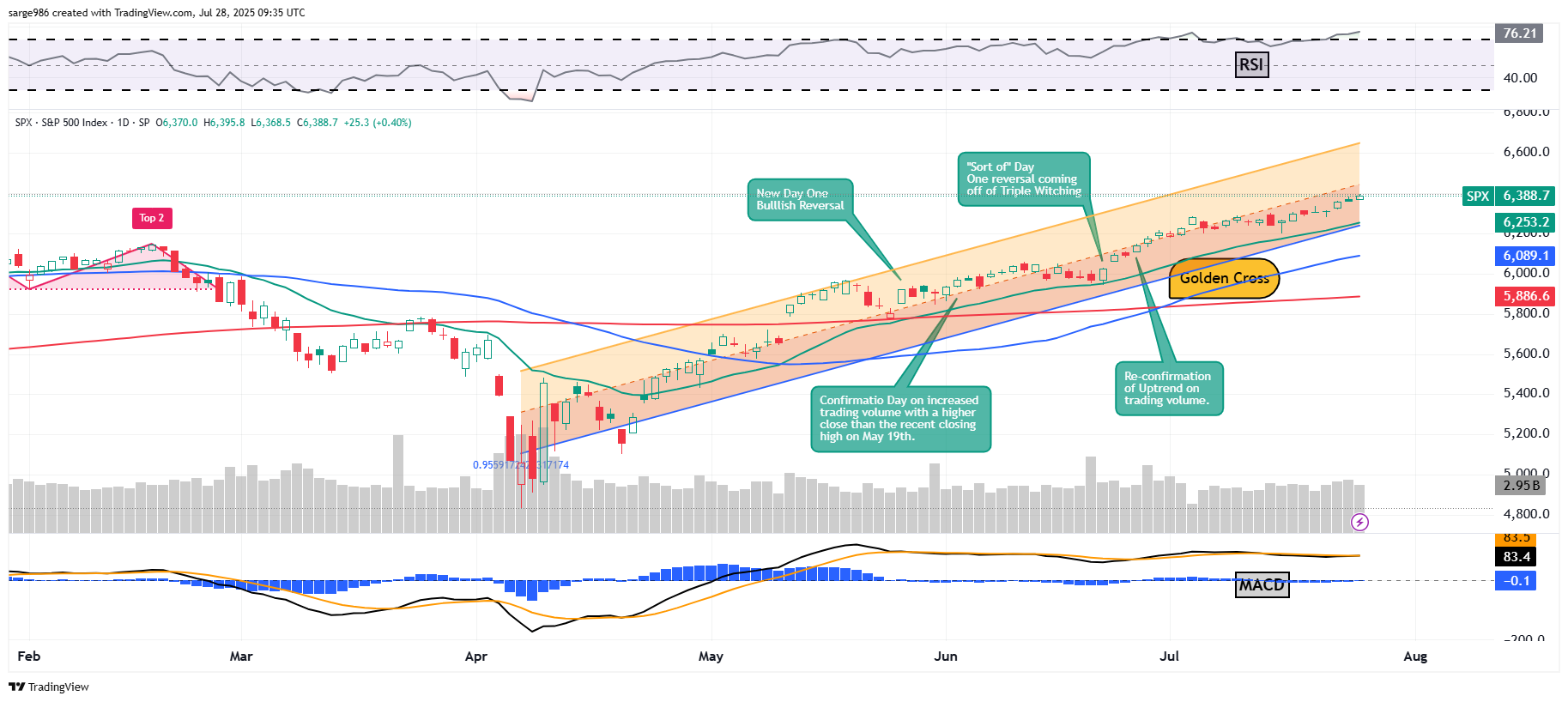
Above the chart, readers will see that the reading for Relative Strength is now in technically overbought territory. That's a change from a week ago. Below the chart, as alluded to above, there is potential for some trouble. Readers will see that within the daily MACD of the S&P 500; the histogram of the 9-day exponential moving average has improved but remains below the zero-bound. The 12-day and 26-day EMAs are both well above the zero-bound, but with the 26-Day line ever so slightly above the 12-day line. With a decisively net long portfolio, I would prefer to see those lines flip and with a rally on Monday that could happen.
What's Ahead?
We've got a lot of wood to cut this week, even with the U.S / E.U. trade deal already out of the way. This is going to be a very busy week as we wind down July and open up the month of August this Friday. This will be an FOMC / Jobs data-focused week, with a ton of quarterly earnings results tossed in. Summer sure does go by quickly, doesn't it?
The domestic macroeconomic calendar accelerates again this week after last week's slow pace. This morning will be quiet, then we'll get going. On Tuesday morning, home prices will be in focus as the Case-Shiller and Federal Housing Finance Agency June HPIs hit the tape. In addition, the Conference Board will release its Consumer Confidence survey for July and the Bureau of Labor Statistics will publish its JOLTs job openings data for June. On Wednesday, we'll get our first look at second-quarter GDP from the Bureau of Economic Analysis just after the ADP Employment Report for July private sector job creation crosses the tape.
Thursday will put inflation back in focus as personal consumption expenditure prices for July will be packed in the BEA report on personal income and outlays for the month. The weekly report on state-level initial jobless claims will also come into focus as that number has, contrary to professional opinion, been decreasing of late.
Finally, on Friday, the BLS will post the results of the twin employment-focused surveys for July. As always, non-farm payrolls will be the headline number, but there will also be enough focus upon both participation and wage growth. The Institute for Supply Management will release its Manufacturing PMI for July on Friday as well. In addition to that, the University of Michigan will revise its monthly survey results for consumer sentiment and inflation expectations.
The Federal Reserve remains in their media blackout period until this Wednesday afternoon. The FOMC will start a two-day policy meeting on Tuesday and then publish their official policy statement at 2 p.m. ET on Wednesday afternoon. Fed Chair Jerome Powell's press conference will be held a half hour later. Often, trading volume can be rather light going into this event and then very heavy coming out. I do not have any other Fed speakers on my radar for the week, but I would guess that by Friday, that will change. There will be no update made to the quarterly FOMC economic projections at this meeting.
Just as a heads up, because if you play this game, there is a good chance that you are a statistics nerd and it's usually not too difficult to find stat nerds who also love baseball. The 2025 Major league trade deadline is this Thursday at 6 p.m. ET.
Pres. Trump's trade deadline lands the very next day, Friday. This is when those nations that have not taken Pres. Trump seriously end up in a tough situation. That's when the higher tariffs mentioned in the letters sent to the heads of state of nations around the globe will be implemented. The president and Commerce Secretary Howard Lutnick have both said that negotiations may continue or even begin, but extensions will not be granted at this time.
The earnings calendar will be extremely active this week. There are almost too many interesting companies reporting this week to list here, but we'll name those corporate releases that we see as the most interesting or impactful. This afternoon, we'll hear from Nucor NUE and Waste Management WM. On Tuesday morning, Merck MRK, Procter & Gamble PG and Spotify SPOT reported to be followed by Starbucks SBUX and Visa V on Tuesday afternoon.
On Wednesday morning, GE healthcare GEHC and Hershey HSY will ho the tape ahead of the opening bell, followed by Ford Motor F, Lam Research LRCX, Meta Platforms META, Microsoft MSFT and Robinhood HOOD after the close. Thursday morning, we'll hear from Bristol-Myers Squibb BMY and CVS Health CVS, followed by Amazon AMZN, Apple AAPL and KLA Corp KLAC later on. Finally, on Friday morning, both Chevron CVX and Exxon Mobil XOM will post their numbers.
Economics
(All Times Eastern)
10:30 - Dallas Fed Manufacturing Index (Jul): Expecting -6, Last -12.7.
3:00 p.m. - Treasury Refunding Financing Estimates.
The Fed
(All Times Eastern)
Fed Blackout Period.
Today's Earnings Highlights
(Consensus EPS Expectations)
Before the Open: EPD (.64)
After the Close: CDNS (1.56), NUE (2.64), WM (1.89), WHR (1.74)
At the time of publication, Guilfoyle was long NVDA, AMD, F, LRCX, MSFT equity.