Trump Vows 'Big One' in Iran Attack, Amazon Hit, but Don't Panic Now
Here's what my gut tells me as the Middle East war continues, my take on the S&P chart, and what ... could change my views.
You've reached your free article limit
You've read 0 of 1 free Pro articles.
Invictus
Out of the night that covers me
Black as the pit from pole to pole,
I thank whatever gods may be
For my unconquerable soul.
In the fell clutch of circumstance
I have not winced nor cried aloud.
Under the bludgeonings of chance
My head is bloody, but unbowed.
Beyond this place of wrath and tears
Looms but the Horror of the shade,
And yet the menace of the years
Finds and shall find me unafraid.
It matters not how strait the gate,
How charged with punishments the scroll,
I am the master of my fate,
I am the captain of my soul.
- William Ernest Henley, 1888
Reality
Wasn't Monday grand? At least for equities? Despite that U.S. Treasury debt securities suffered a tremendous selloff that more or less reversed that particular safe-haven trade, equities rallied off of a weak open and had a rather decent session. So much for Monday. Asian stocks traded sharply lower overnight. Then European stocks opened in the hole.
A repeat of the overnight session into Monday morning? Not exactly. Sure, global equity market softness has led directly into profound weakness across U.S. equity index futures markets, but Treasuries have continued to find sellers. The potential for a prolonged, or at least longer than expected energy shock have rattled investors as the war in the Middle East has broadened.
As the U.S. and Israeli attacks on the regime in Iran have probably gone about as well, from their perspective, as could possibly be expected (near total air superiority, complete loss of the Iranian Navy), Iranian forces have remained persistent in their efforts to launch against Israel, U.S. and allied bases and on their neighbors in the region. The focus of the Iranian military's offensive strikes has been on everything and anything, from military targets to population centers to the region's energy infrastructure.
On Monday, Iran targeted Qatar's liquefied natural gas facility in Ras Laffan. Additionally, Saudi Aramco's Ras Tanura refinery had been hit by a military drone, creating a fire that forced the closure of that facility. Moving on from the energy space, but still in Saudi Arabia, the U.S. embassy in Riyadh was hit by two drones early on Tuesday morning, creating what was termed as a limited fire.
That embassy has warned Americans in Saudi Arabia to "shelter in place." On top of that, the U.S. State Department has urged Americans in 14 Middle Eastern nations to "depart now," even as thousands of flights have been cancelled. Unfortunately, six U.S. military personnel have now been killed in action since the start of this war on Saturday. But wait, there's more.
'The Big One'
In a Monday interview with CNN's Jake Tapper, Pres. Trump said, "We haven't even started hitting them hard."
The president added, "The big wave hasn't even happened. The big one is coming soon."
With those words said, the U.S. appears poised to send additional military forces to the CENTCOM region as soon as Tuesday. In a Monday press briefing, Joint Chiefs Chairman USAF Gen. Dan Caine said, "And the flow of forces continues today. In fact, Cooper will receive additional forces even today."
Cooper would be USN Admiral Brad Cooper, the current U.S. CENTCOM commander.
Amazon Hit
Amazon's (AMZN) Amazon Web Services said late on Monday that two data centers in the UAE (United Arab Emirates) and a corporate facility in Bahrain had been hit by drone strikes. The company stated, “These strikes have caused structural damage, disrupted power delivery to our infrastructure, and in some cases required fire suppression activities that resulted in additional water damage.”
Amazon has announced that it’s working to quickly restore service in the area, but it expects recovery to be prolonged “given the nature of the physical damage involved.” The company said it would update the situation as new information becomes available. While repairs to the data centers are underway, AWS is also working to restore data access and service availability in all affected regions.
Marketplace
The equity market rally, coming off of Monday morning's lows, did have something of an awkward feel to it. The risks away from the arena of the geopolitical continue to accumulate. The situations concerning private credit, AI disruption and demand for labor are not going away. Now add this increased risk around security, trade and energy. Is the Strait of Hormuz open? If so, who would risk traversing it right now? That narrow passage, on a daily average, witnesses a rough 35% of all seaborne crude oil transport.
The seemingly all-day rally off of the lows left U.S. equities close to where they went out on Friday afternoon. The S&P 500 closed up very small (+0.04%) as the Nasdaq Composite gained 0.36%. The Russell 2000 was the out-performer for the day at +0.9%. Of all the mid-major to major U.S. equity indexes, only the Dow Industrials closed out the day in the red (-0.15%) and that was just barely.
That said, seven of the 11 S&P sector SPDR exchange-traded funds closed out the session in the red. Although after what had been another strong ISM Manufacturing survey for February, three of the four bottom slots on the daily performance table were occupied by defensive (not to be confused with defense) type sectors. Energy (XLE) obviously led the way followed by the Industrials (XLI) . Within the Industrials, the Dow Jones U.S. Defense Index ran 3.41% as the Dow Jones U.S. Aerospace Index gained 2.03%. Why these two indices have never been merged, I have no idea.
Winners beat losers by a rough five-to-four margin at the NYSE and by just a smidgen at the Nasdaq. Advancing volume took a majority share of composite listed volume at both exchanges, but aggregate trade tailed off on a day over day basis. Volume was off 13.1% across Nasdaq-listings and down 8.8% across NYSE-listings. That makes the chart both interesting and confusing. Take a look.
The Chart
We, or maybe I, had decided that Friday had been a "day one" bearish move due to the spike in trading volume. Monday's activity presented as a green candle that took out the high of the day on Friday. That normally negates a "day one." But in this case, the downward move started on Thursday, even if the volume did not pop until Friday. Does that mean that the high of the day on Monday had to take out the high of the day on Thursday in order to negate the "day one?" Maybe.
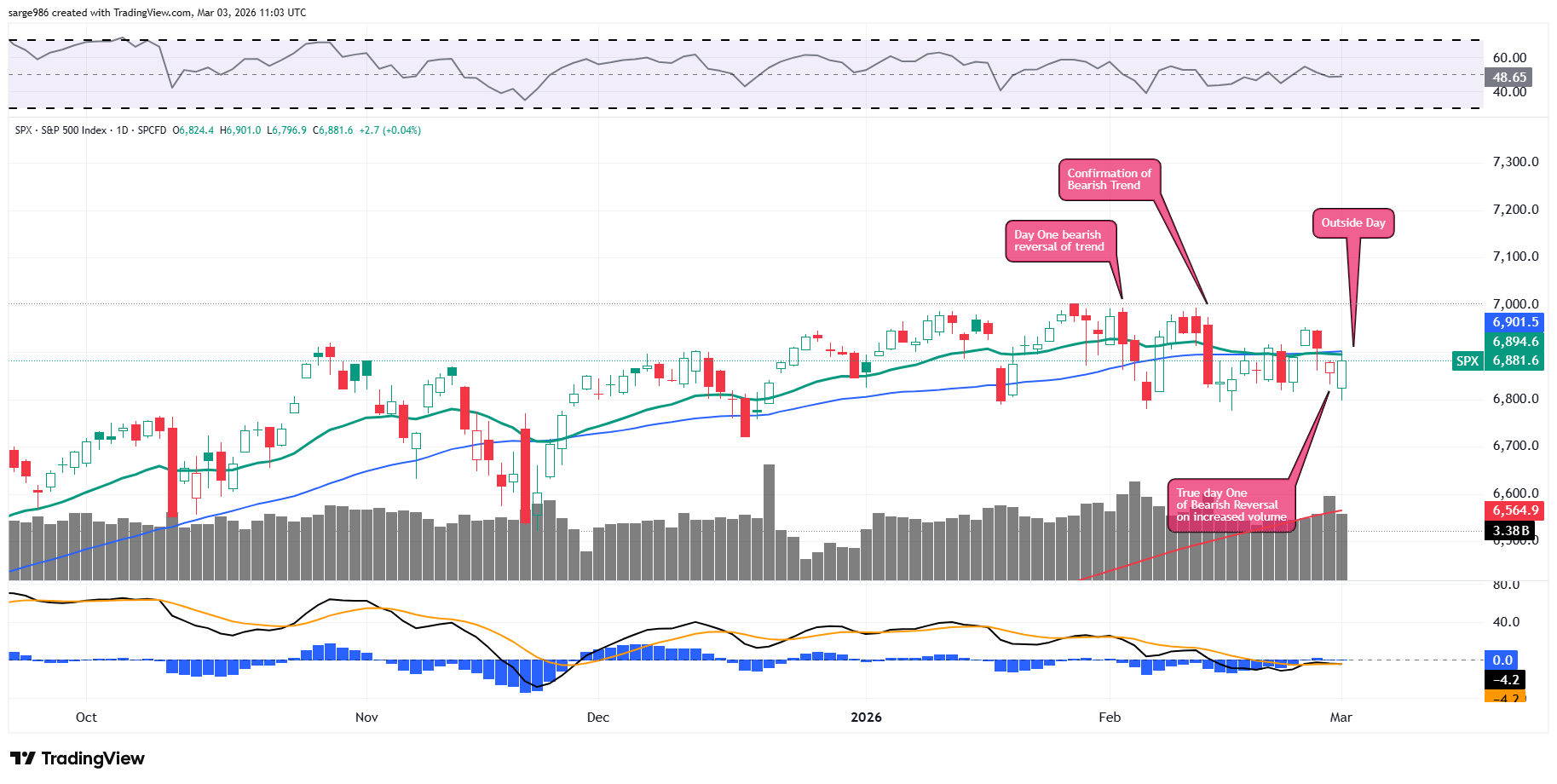
Making matters even more interesting, Monday was an "Outside Day." That means that the day's activity completely enveloped the activity of the day prior and is a sure sign of at least a short-term spike of increased volatility. Lastly, if Tuesday presents as a high-volume selloff, which is very possible now at zero dark-thirty in the morning, does that make Monday a "necessary pause" if one recognizes Thursday as the start of the "Day One?" You see where my brain goes when it's just me and the man in the darkened window?
What Markets Need on Tuesday (or Soon)
- It would be nice if there were signs of any degradation in the Iranian military's ability to return fire or to hit civilian populations and locations key to global commerce / energy infrastructure.
- It would also be nice if there were to be some kind of estimate on what the removal of inexpensive oil from both Venezuela and Iran does to the Chinese economy. There is a legitimate chance that these two actions have as much to do with China as they do Iran or Venezuela. That would be some high-level 4-D chess played by this administration, while everyone else was playing checkers if that were the case.
- New York Fed President John Williams and Minneapolis Fed President Neel Kashkari will both speak publicly on Tuesday. Both vote on policy for 2026. It would help if both sounded flexible in regard to the trajectory for the rest of this year on the targeting for short-term interest rates.
My Instinct?
My gut tells me that this is the wrong time to panic. Not that stocks cannot go lower, but that this may be a bottoming process that ends close to the 6,500 level on the S&P 500. I could be wrong, but I'm probably going to slide back into something of a mild risk-on mode as markets get pounded this morning.
What could go wrong? The appearance of a "black swan" at this, the worst time. Iran was known. That was not a black swan. A significant terrorist attack on U.S. soil would be a black swan. As what's left of the regime in Iran grows desperate, this will be a growing concern.
Economics
(All Times Eastern)
08:55 - Redbook (Weekly): Last 6.7% y/y.
4:30 - API Oil Inventories (Weekly): Last +11.4M.
The Fed
(All Times Eastern)
09:55 - Speaker: New York Fed Pres. John Williams.
11:55 - Speaker: Minneapolis Fed Pres. Neel Kashkari.
Today's Earnings Highlights (Consensus EPS Expectations)
Before the Open: (AZO) (27.41), (BBY) (2.47), (TGT) (2.15)
After the Close: (BOX) (.34), (CRWD) (1.10), (ROST) (1.90)
At the time of publication, Guilfoyle was long CRWD, AMZN equity.