Trump Tugs at Greenland and Shakes Up Wall St.
As new tariff plan announced, Europe goes into crisis mode; here's my battle strategy. Also, let's preview the week ahead and chart the market.
You've reached your free article limit
You've read 0 of 1 free Pro articles.
Every once in a while, the ugly stick pokes its head out and does its best to put a dent into investors' portfolios and retirement accounts. This is going to be one of those days, as the market opens after a three-day weekend. European equities are trading lower for a second consecutive day alongside U.S. equity index futures that are currently trading at a sharp discount to Friday evening's prices.
Gold and especially silver, have provided some safe haven for investors as the selloff expands and now includes U.S. Treasury debt securities as European bond traders show displeasure in what they have seen over the weekend. Bitcoin and other cryptocurrencies are not reacting well in this environment.
What to do? Helmet, two sources of water, clean socks, gas mask on the hip and full battle rattle. That goes without saying. Your long-term investments and your personal wealth are going to get slapped around pretty hard this morning. One also has to seek opportunity when opportunity knocks. Is it knocking now? Opportunity always knocks. Prices will be dislocated early on Tuesday. That's really all we need to know.
I have no idea whether this "sudden" bout with increased volatility lasts a couple of days or lasts a month. The U.S. president clearly has some goals in mind that many disagree with. In the past, these actions have produced short-term problems for investors that turned into tremendous opportunities for traders and even for investors as well, if they were patient. No guarantees. We know that.
Yet, we turn on the machines and play the game anyway, right? Because this is what we do. Not only when it's easy. Heck, anybody can make a living when it's easy. Anyone can last in an interpersonal relationship when it's easy. It's when it gets tough that one finds him or herself. It's when it gets tough that one finds increased ability and a higher capacity for learning and situational awareness. So, let's go. We'll hold hands if you're scared. That's okay, but let's still get after it.
What Happened?
On Saturday, in a post to social media, U.S. Pres. Donald Trump announced his plan to impose tariffs of 10% on Feb. 1 on all goods imported from Denmark, Norway, Sweden, France, Germany, the Netherlands, Finland and the U.K. The president added that these tariffs would be increased to 25% in June and continue until a deal was reached that would permit the U.S. the "complete and total purchase of Greenland."
The post, while not out of left field as President Trump is known for an aggressive first move when trying to negotiate anything, does put Greenland at the center of the news cycle. The move also threatens, even if only in theory, trade deals struck with the European Union and the United Kingdom at a minimum and perhaps even the existence of the NATO military alliance more broadly.
By Sunday, all of Europe was in crisis-mode and E.U. ambassadors held talks to consider how to respond to the president's implied tariffs. The executive arm of the European Union announced a short while later that there would be retaliatory tariffs on more than $100 billion worth of goods imported from the U.S. as soon as February 7. This is a move that had been put on hold during 2025 trade negotiations.
Tuesday Morning
The Wall Street Journal is reporting that Treasury Sec. Scott Bessent said that Pres. Trump is looking at Greenland as a "strategic asset for the United States." Bessent added, "We are not going to outsource our hemispheric security to anyone else. When asked about Europe's retaliatory response, Bessent said flatly... 'I think it would be very unwise."
Remember, the U.S. president is set to deliver what is now undoubtedly the headline event at Davos 2026 when he speaks on Wednesday at 8:30 a.m. ET. The president had originally been expected to speak on housing market reform, overall affordability and the "Board of Peace" initiative concerning Gaza. He'll now have to put Greenland front and center and markets will undoubtedly move as he speaks, led by high-speed keyword reading algorithms.
(Don't Fear) The Reaper
All of our times have come
Here, but now they're gone
Seasons don't fear the Reaper
Nor do the wind, the sun, or the rain
Come on, baby
(Don't fear the Reaper), Baby take my hand
(Don't fear the Reaper), We'll be able to fly
(Don't fear the Reaper), Baby, I'm your man
- Donald Roeser (Blue Oyster Cult), 1976
Your Orders...
We never panic. Let's remember that. As we defend our exposed net-long positions as best we can and seek out new opportunities, these are our general orders. Now, go, think about what you do on this day and be unafraid...
- Understand... Everything is done for a reason that can be explained. Be intentional in your actions. No "deer in the headlights" garbage. You're an adult. Deliberate movement in stressful situations reduces error.
- Identify... Avenues of attack, areas of weakness, perceived threats, and just as importantly, targets of opportunity. Know what you're doing.
- Adapt... To all changed environments. Become what is required when and where it is required. There is no excuse for rigidity. Flexibility and agility will win this fight. If the box won't open, use your noodle.
- Overcome... Find a way. All day. Every day. In the face of even persistent failure, find within thyself consistent resilience. You've got this, dudes. People are counting on you. Now show me some guts.
- Carry On... No victory. No defeat. Continue with your mission. Like you've been here before. Slow is smooth. Smooth is fast. Smooth is unfazed.
The Week That Was...
Equities more or less moved sideways for the week past, despite having to traverse a number of distinct catalysts. Fourth-quarter earnings reporting season kicked off in earnest with the large banks turning in a mixed performance. Results from investment banks like Morgan Stanley (MS) and Goldman Sachs (GS) clearly were better received than those of money-center banks such as JP Morgan (JPM) and Wells Fargo (WFC) .
Interestingly, the rotation into smaller caps out of AI and growth stocks appeared to continue to some degree. However, this did not come at the expense of the semiconductors that did well overall after Taiwan Semiconductor (TSM) posted a strong quarter. Advanced Micro Devices (AMD) led the group for the week at +14.1%.
On the macro side, December consumer price index landed on the cool side of expectations (unless you read Market Recon, then you knew), leading a long parade of positive looking economic data-points. Looking over the list, we see that November Retail sales were hot, as was December Industrial Production. In addition, initial jobless claims continued to dwindle as the regional manufacturing surveys for January released by both the New York and Philadelphia Feds pleasantly surprised.
Precious metals continued to soar, especially silver, as demand heated up for U.S. Treasury debt securities at auction. Lastly, several Fed officials made pitiful attempts at getting their last public words in ahead of the central bank's media blackout period prior to the Jan. 28 policy decision.
Amid all of that news flow, this is how equity markets performed over the past week...
- The S&P 500 lost just 0.06% on Friday and just 0.38% for the week.
- The Nasdaq Composite also gave up just 0.06% on Friday but 0.66% for the week.
- The Nasdaq 100 gave back 0.07% on Friday and 0.92% on the week.
- The Russell 2000 gained just 0.12% on Friday and a nifty 2.04% for the week.
- The S&P Small Cap 600 gave up 0.33% on Friday but gained 1.69% for the week.
- The S&P Midcap 400 lost 0.31% on Friday but gained 1.33% over the week.
- The Dow Transports surrendered 0.76% on Friday but still added 0.33% for the week.
- The Philly Semis soared 1.15% higher on Friday and 3.78% for the week.
- The KBW Bank Index lost 0.4% on Friday and 1.65% for the week.
On Friday, five of the eleven S&P sector SPDR ETFs closed out the session in the green, led by the REITs (XLRE) and followed by three cyclical sectors. Communication services (XLC) placed last for the session.
For the week, six of the 11 S&P sector SPDR ETFs traded higher, with the REITs and staples (XLP) out in front as some investors positioned themselves defensively going into the holiday weekend. Communication services and for obvious reasons, the financials (XLF) struggled.
The Chart
Do we have a problem? Not necessarily, but check this out. Below is an updated chart with the ascending triangle pattern that I had drawn up for you still imposed upon the recent action. An ascending triangle, I will remind readers, is a pattern of bullish trend continuance. A potential problem could be that instead of producing a breakout, out of that triangle, the S&P 500 has edges higher, gradually, using that recent pivot as support.
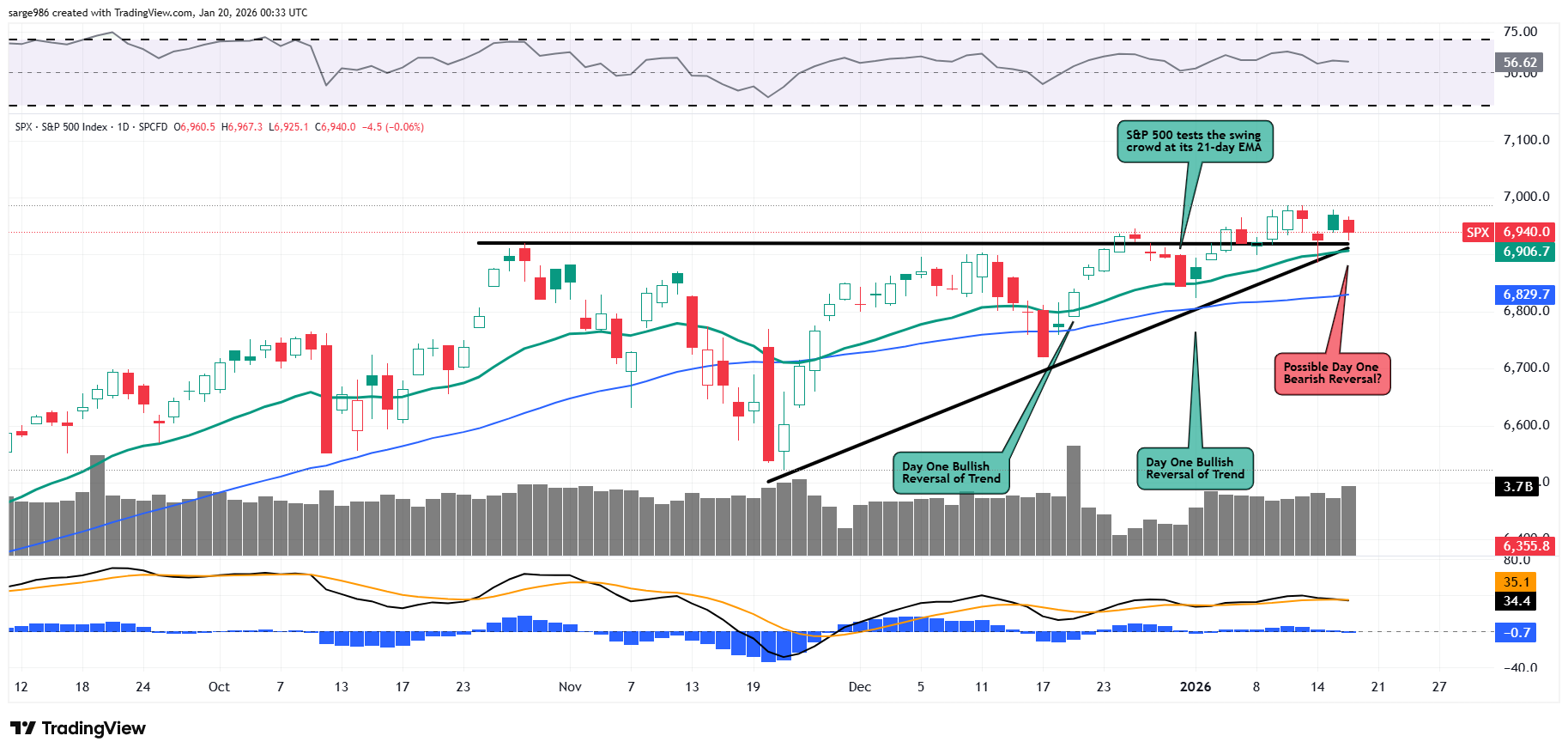
Readers can see that we really no longer have an ascending triangle at all. The pattern has evolved into a rising wedge....
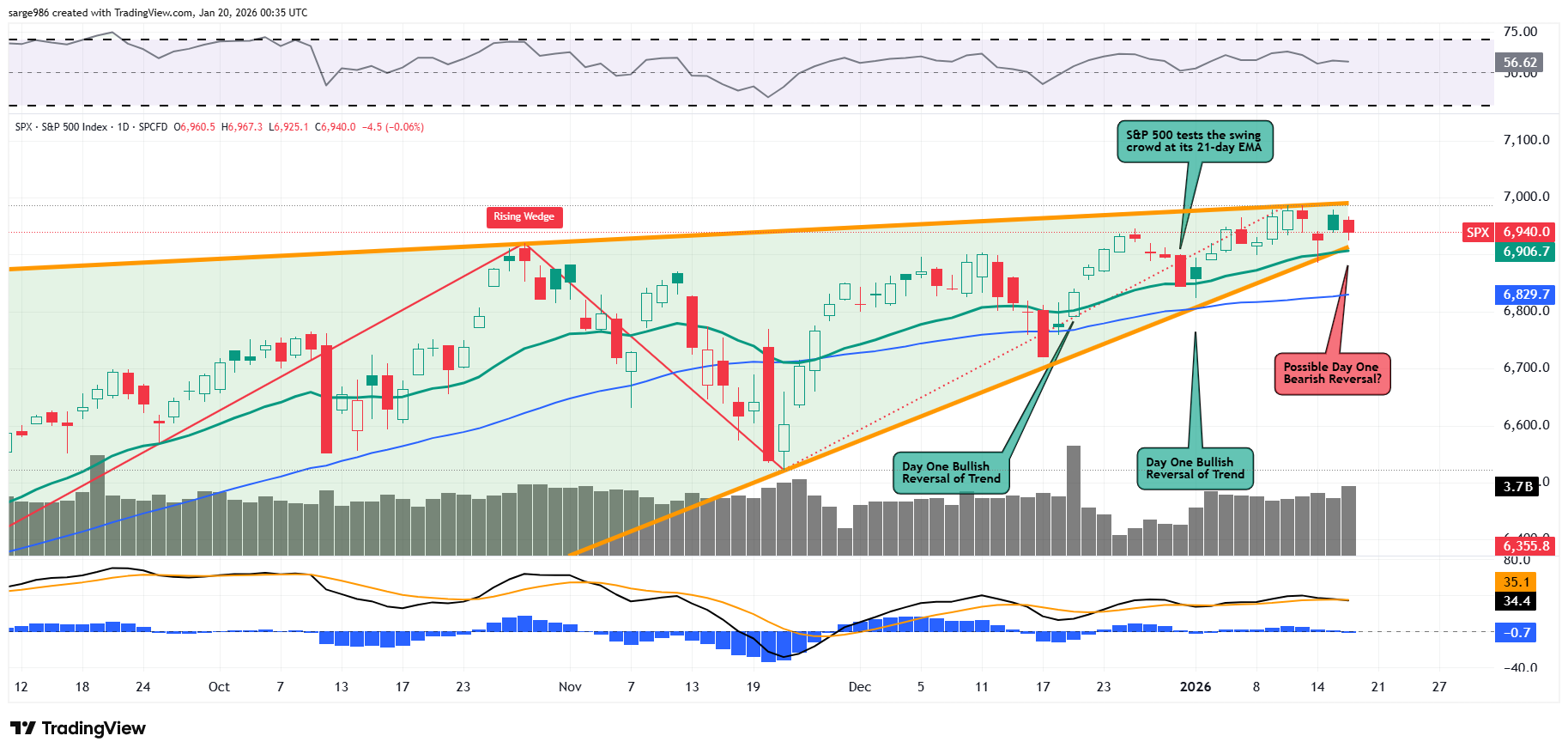
Now, what are rising wedges? You in the back. That's right, they are patterns of bearish reversal. Relative strength is still OK, but look at Friday's candle. No, Friday was not a true "day one" bearish reversal of trend because advancing volume trounced declining volume across Nasdaq-listed names on Friday, but the day wasn't positive.
Look below the chart now, at the daily moving average convergence divergence. The histogram of the 9-day exponential moving average has dropped below zero. That's short-term bearish. Additionally, the 12-day- EMA has dropped below the 26-day EMA. That's a little more serious. Technically, the market set up for some early week pain this week.
Earnings
As of Jan. 16, according to FactSet, for the fourth quarter, Wall Street is projecting year over year earnings growth for the S&P 500 of 8.2%, down from 8.3% last week. Wall Street also sees revenue growth of 7.8%, up from 7.7%, a week ago. With 7% of the S&P 500, 79% of S&P 500 member firms have reported earnings beats while 67% have beaten consensus on revenue generation. For the full year (2025), the street now sees earnings growth of 12.4% (unchanged from last week) on revenue growth of 7.2%, up from 7.0%.
At the moment, technology, at earnings growth of 25.9%, is the only sector projected to experience double-digit bottom-line growth for the fourth quarter. Presently, four sectors, up from three (Discretionaries, Energy and the Industrials) are projected to suffer a year over year earnings contraction as health care has joined this negative club.
Valuation
Still using data provided by FactSet, the S&P 500 ended last week trading at 22.2-times twelve months' forward-looking earnings, unchanged from a week ago. This is well above the five-year average of 20.0-times for the index as well as well above its ten-year average of 18.8-times.
The S&P 500 also ended last week trading at 28.4-times trailing 12 months' earnings, down from 28.5-times last week. That also stands well above the five-year (25.0-times) and ten-year (23.0-times) averages for the index.
Nine of the 11 sectors are still trading above their five-year average valuations, led by Consumer discretionaries (29.3-times) and tech (26.2 times). Only the utilities (at 18.0 times) and the REITs (at 17.6-times) are not historically overvalued relative to their five-year averages.
The GDP Game
Last week, the Atlanta Fed revised their GDPNow model's estimate for Q4 economic growth up to 5.3% from 35.1% (q/q, SAAR) after November Retail sales and December existing home sales printed at better levels than expected. Among other regional central bank district branches running close to real-time Q4 GDP models, the New York Fed revised their estimate up to growth of 2.71% from 2.62%.
The Cleveland Fed again left their model unrevised at growth of 2.85%. However, the St. Louis Fed, which has missed the mark quite badly on a regular basis in 2025, revised their Q4 model upward from -0.34% to -0.07%. St. Louis remains the outlier.
Fed Funds Futures
Fed Funds futures trading in Chicago are now pricing in just a 5% probability for a quarter-point rate cut on Jan. 28 when the FOMC next meets on policy, in line with last week at this time. As we all know by now, the FOMC will look different in 2026 as Boston, Chicago, St. Louis and Kansas City have lost policy voting rights as part of the Fed's regular annual rotation. Cleveland, Philadelphia, Dallas and Minneapolis have now gained policy voting rights for the coming year. At present, there are now 50-basis points worth of additional rate cuts fully priced in (58% chance, down from 67%) for all of calendar 2026.
On The Docket...
The week ahead will again be quite active. We won't have the Fed, but we will have the freak show in Davos. Earnings season will continue.
.... The Federal Reserve is now in its media blackout period ahead of the policy decision set for a week from Wednesday. At least that's one distraction traders and investors will not have to deal with this week.
.... That said, this is the week that the World Economic Forum holds its annual show of global arrogance. The rest of us usually get to roll our eyes while the financial media fawns over a collection of self-congratulatory elitists. However, this time around there may be some actual headline makers that traders and investors actually give two darns about.
On the corporate side, chief executives will represent Nvidia (NVDA) , Microsoft (MSFT) , Salesforce (CRM) , PepsiCo (PEP) , JP Morgan Chase, and Goldman Sachs. Pres. Trump will headline a collection of global leaders that include Mark Carney (Canada), Emmanuel Macron (France), Friedreich Merz (Germany) and European Commission President Ursula von der Leyen.
.... The macroeconomic calendar will be moderately active later this week. PCE Prices, Personal income and Personal Spending for the months of October and November will cross the tape on Thursday. On Friday morning, S&P Global will release their flash PMIs for January as the University of Michigan releases its revised survey results for January Consumer Sentiment and Inflation Expectations.
.... The earnings calendar will be somewhat active this week. This morning, 3M (MMM) will bat leadoff in the morning followed by Netflix (NFLX) after the closing bell. Tomorrow, we'll hear from Halliburton (HAL) and Johnson & Johnson (JNJ) ahead of the open. Thursday will bring results from Abbott Labs (ABT) , and Procter & Gamble (PG) followed by Intel (INTC) . Friday morning, Comerica (CMA) and SLB (SLB) will step to the plate.
Economics
(All Times Eastern)
08:15 - ADP Employment Change (Weekly): Last 11.75K.
16:30 - API Oil Inventories (Weekly): Last +5.27MM.
The Fed
(All Times Eastern)
Fed Blackout Period.
Today's Earnings Highlights (Consensus EPS Expectations)
Before the Open: (MMM) (1.80), (DHI) (1.92), (FAST) (.26), (USB) (1.19)
After the Close: (NFLX) (.55), (UAL) (2.94)
At the time of publication, Guilfoyle was long JPM, TSM, AMD, NVDA, HAL, INTC equity.