Trading Against the Machine
Amid the volatility, you've got to learn to 'ambush' the market. Also, let's check the latest in tariffs, Marvell and Taiwan Semi, my Crowdstrike trade, inflation and more.
You've reached your free article limit
You've read 0 of 1 free Pro articles.
U.S. stocks opened on weakness on Tuesday morning. Stocks then sold off some more and then rallied off of those lows in a rally that lasted a rough five hours, only to sell off sharply over the final hour of the day's regular trading session. Oddly, stocks rallied over the final seven or eight minutes of the day. That "outside" day that I showed readers in this column 24 hours ago proved to be quite telling. I know: Humans no longer have much control over the process of price discovery and the whole idea behind electronic trade is to try to force algorithmic overshoot.
Those of us "humans" who still trade these markets no longer react to incoming demand and supply at a centralized point of sale, but rather... are forced to understand technical analysis for the simple reason that there are two things written into these codes and trading algorithms that stand out. One, "keyword" reading trading algorithms can not only read the headlines in real-time and trade on them in microseconds, racing ahead of not just humans but older, slower algorithms, but these algorithms can read orders created by those other algorithms "in the pipes." Yes, the future is not only here but also has been here. This is postmodern.
Second, and this is an advantage for the likes of you and I, is that these codes and algorithms are written by those who have charts and patterns interpreted for them by those doing traditional technical analysis. What does that mean? It means that in the short-term to medium-term, understanding basic pattern recognition is more important than ever. While macroeconomics, and policy both fiscal and monetary in nature, largely decide which way the bus will move, and basic corporate fundamentals still have a say in how far that bus can go, technical analysis is how these algorithms decide where the bus stops are.
What we, as the last humans in this "bloodsport" can and must do, is be better at recognizing where these bus stops are than are those who interpret charts and pattern recognition for those who actually write code and trading algorithms. So, face the wind, my friends. Our only choice is to beat those who would take what's ours and do it in a market model that has been intentionally redesigned to favor those with the fastest if not the smartest technology. Ambush becomes the weapon of choice. Rather than react, because we are slow as humans, lay in wait, for those who may no longer even know we exist to do what and go where... we expect. Always faithful.
Note This...
Readers will see the precision of the support that the S&P 500 found at its 200-day simple moving average on Tuesday coming off of Monday's "outside day."
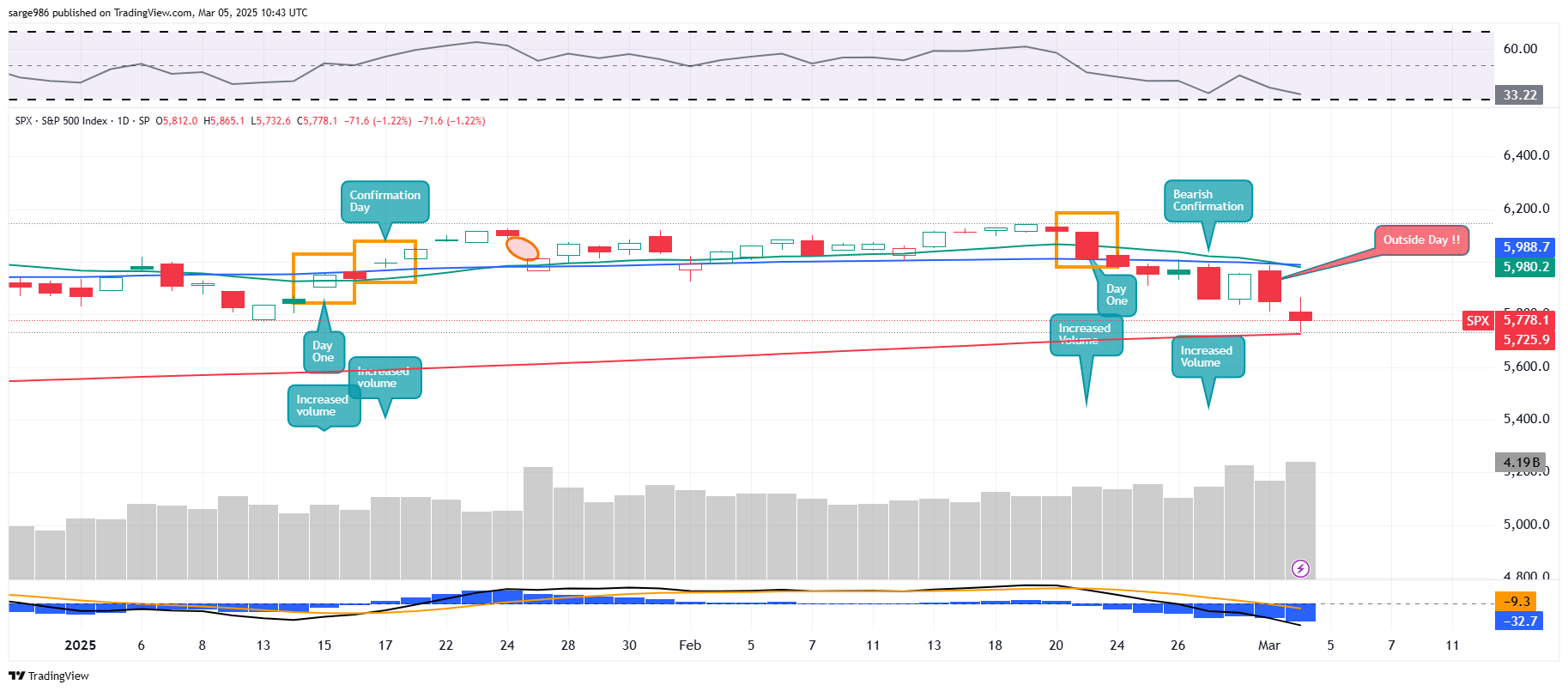
This is what massed algorithms written by people who think similarly do, when the analysis for those individuals is done by other folks who have all been taught using the same techniques. So, slap on some mud, cover your teeth, cover your ears, cover anything that makes you look human. Mask your scent. Animal urine on your boots will usually take care of that. Then wait. Don't move a muscle. Wait... for targets of opportunity.
Marketplace
On Tuesday, markets were rattled by the implementation of 25% tariffs on Canadian and Mexican exports to the U.S. as well as a doubling of the tariff on Chinese goods to 20%. Both Ottawa and Beijing responded immediately. Mexico indicated that a response was likely coming by the weekend, but that there was a preference to keep negotiating.
Treasury debt securities, which have been in demand throughout this volatile period, sold off late in the regular Tuesday session. The yield for the U.S. Ten-Year Note went out on Tuesday afternoon at 4.22% after trading as low as 4.12% during the day. The Two-Year Note paid 3.99% by day's end after paying as little as 3.86% during the day. As the zero-dark hours roll on by Wednesday morning, I see those two yields at 4.24% and 3.98% respectively.
Turning to stocks, the S&P 500 gave up 1.22% on Tuesday, while the Nasdaq Composite gave back 0.35%. These two "major" equity indexes were down 2% and 2.1% respectively shortly after the opening bells rang in New York. The Nasdaq Composite closed Tuesday's regular session down 5.31% year to date and at its daily low was down 9.5% from it's all-time high in mid-December. That left the Nasdaq Composite just short of what the financial media refers to as a technical correction. Actual practitioners already understand that what markets are going through is a correction.
Interestingly, although most equity indexes reflecting large cap or small cap performance closed out the day in the red, the Philadelphia Semiconductor Index, which may be the most important "mid-major" index in our universe, closed up 0.64% on the day, led by Taiwan Semiconductor TSM and Marvell Technology MRVL. Just an FYI: MRVL has closed lower for seven consecutive weeks coming into this week and will report quarterly numbers this evening.
Breadth
Under the surface, all 11 S&P sector SPDR ETFs closed out the day in the red, led lower by the Financials XLF at -3.52%. Why is that? For one, the yield curve is flattening, which compresses net interest margin. That's the bread and butter for traditional bankers. Secondly, as the economic data softens and GDP projections wobble, this puts more risk in the extension of new credit as well as creating risk around credit already extended. Reduced economic activity will also slow down the investment banking calendar, which is where the gravy is in finance. Technology XLK came the closest to posting a winning session at -0.08%, supported somewhat by the already mentioned semiconductors.
Losers beat winners by nearly a 7-to-2 margin at the NYSE and by a rough 5 to 3 at the Nasdaq. Advancing volume took just a 25.7% share of composite NYSE-listed trading volume, but interestingly, on the strength of those semiconductor stocks, a surprising 50.7% share of composite Nasdaq-listed activity. Trading volume expanded on a day over day basis across the marketplace, but that majority share of advancing volume across Nasdaq-domiciled names may have indicated waning conviction.
Deal Maker?
On Tuesday evening, well ahead of the president's "State of the Union" address, Secretary of Commerce Howard Lutnick appeared on Fox Business and said, "I think (President Trump) is going to work something out with them."
Lutnick added, "And we're going to probably be announcing that tomorrow (Wednesday). So somewhere in the middle will likely be the outcome - the President moving with the Canadians and Mexicans." This Is why equity index futures markets have been strong overnight.
Trading
I told you folks on Tuesday that I had sold a chunk of my long position in CrowdStrike Holdings CRWD ahead of last night's earnings release. That was a prudent move that appears to have worked out. I did not sell all of it. Maybe that was not so bright. I also have not added overnight. We'll see how bright that was.
Inflation About to Slow?
We all know that for January, the consumer price index printed at growth of 3% and had printed higher each month in succession as inflation had accelerated again from its low (2.4%) back in September. By all accounts, this trend will reverse for February when that data is released on March 12. The Cleveland Fed's model for February now stands at growth of 2.83%, with projections for March at growth of 2.47%.
Hedgeye Macro, who are my "hired" team of economists as I no longer do all of the staff work myself, are running models for both months that are maybe slightly above the Cleveland Fed's models, but in line both with the numbers and certainly with the reversal of trend. The Fed may actually get a chance to cut short-term interest rates this spring if the economy does slow down as is now expected.
While the New York Fed's model currently shows an increase in Q1 gross domestic product over Q4, the Atlanta Fed, Cleveland Fed, St' Louis Fed, and Hedgeye models all show slowing activity to varying degrees. Atlanta is at this time, the outlier as the only one reflecting an oncoming outright economic contraction.
Economics (All Times Eastern)
07:00 - MBA 30 Year Mortgage Rate (Weekly): Last 6.88%.
07:00 - MBA Mortgage Applications (Weekly): Last -1.2% w/w.
08:15 - ADP Employment Report (Feb): Expecting 142K, Last 183K.
09:45 - S&P Global Services PMI (Feb-F): Flashed 49.7.
10:00 - ISM Non-Manufacturing Index (Feb): Expecting 53.0, Last 52.8.
10:00 - Factory Orders (Jan): Expecting 1.5% m/m, Last -0.9% m/m.
10:30 - Oil Inventories (Weekly): Last -2.332M.
10:30 - Gasoline Stocks (Weekly): Last +369K.
The Fed (All Times Eastern)
2:00 - Beige Book.
Today's Earnings Highlights (Consensus EPS Expectations)
Before the Open: ANF (3.55), FL (.72), THO (.07)
After the Close: MRVL (.59), MDB (.67), VSCO (2.30), ZS (.69)
At the time of publication, Guilfoyle was long CRWD equity.