This 'Jobs' Number Is Usually Ignored. Now It's Cause for Concern
Challenger, Gray & Christmas dumps some coal on the market as the S&P's chart causes worry about the 50-day simple moving average.
You've reached your free article limit
You've read 0 of 1 free Pro articles.
Most months, the announcement made by the firm Challenger, Gray & Christmas goes unnoticed. This is often a lumpy number. This is known as a volatile series. Without the ongoing government shutdown, there would be other labor market data to rely on, and markets would look to those numbers for confirmation. The thing is that this series reflects, on a monthly basis, the total number of job cuts announced by U.S. employers. There is no follow-through. Initial Jobless Claims are compiled on a weekly basis, at the state level and are reliant upon the newly unemployed to actually file.
This totals announcements only. If a company announces layoffs of 10,000 workers in coming months, this is where it shows up. If that company ends up laying off more or less than 10,000 people, that matters not to this series. Nonetheless, it's never a good thing when large companies announce large job cuts and it was not a good thing for the stock market on Thursday. Fears of a coming recessionary economic environment worked their way into stock prices on Thursday.
For October, the Challenger, Gray & Christmas report showed "announced" job cuts across the U.S. of 153,074, up from 55,597 for the year-ago comparison. That's a year-over-year increase of 175.3% and made for the worst October in 20 years. Year to date, "announced" job cuts now total 1,099,500, up 44% from 761,358 for 2024 after 10 months. The underlying concern is not just that these announced job losses are course corrections being made by employers that over-hired coming out of the pandemic era, but that this might be the dawn of the impact of artificial intelligence on the broader demand for labor.
Was Thursday an overreaction? Could be. September saw a drop in year-over-year announcements. In March, however, the series experienced a 204% increase that came after a 103% increase for February. June was nasty and resulted in a 140% increase in announced layoffs. One could say that there is a growing trend among employers to "get skinny."
We saw that coming out of the Great Financial Crisis. Interestingly, while the corporate urge to get skinny put labor markets in a "recessionary-like" condition that lasted from 2008 all the way into 2016, the improved profit margins and the sustained easing (ZIRP - zero interest rate policy) of monetary policy did produce a very strong financial marketplace that was not at all reflective of overall economic weakness.
Marketplace
There was an intense rally across U.S. Treasury debt securities on Thursday to go along with the equity market selloff. That could be an indication of some expectation for lower short-term interest rates going forward. The U.S. Ten-Year Note paid 4.09% by day's end, down 7 basis points. I do see some overnight selling pressure in this market as equity index futures rally modestly.
On Thursday, the S&P 500 gave up 1.12% as the Nasdaq Composite surrendered an alarming 1.9%. The Philadelphia Semiconductor Index was pummeled for a loss of 2.39% as Taiwan Semiconductor (TSM) started informing major clients of coming price hikes for its more advanced products. This directly impacts both Nvidia (NVDA) and Advanced Micro Devices (AMD) , both of whom traded sharply lower on that news.
Breadth
Nine of the 11 S&P sector SPDR ETFs traded lower on Thursday, led in the wrong direction by the Discretionaries (XLY) and Tech (XLK) . Both of those funds gave up more than 2% for the session. Energy (XLE) and Health Care (XLV) somehow escaped the carnage. If there was one bright note it was that defensive type sectors did not outperform cyclicals overall, which is something one might expect with fears of a pre-recessionary environment spreading across the trading and investing communities.
Losers beat winners on Thursday by a rough 2 to 1 at the NYSE and by about 8 to 3 at the Nasdaq. Advancing volume took a 39.2% share of composite NYSE-listed volume for the day and a 37.8% share of composite Nasdaq-listed trade. Now, this is going to be "nasty." Aggregate trading volume increased by 10.6% on a day over day basis across Nasdaq-listings, increased by 1,9% across NYSE-listings and increased across the membership of the S&P 500.
Yes, Thursday was a "Day One" bearish reversal of trend. Now, we look for a pause of at least one day and then a Confirmation Day. What that means is that we don't know for sure that we have a sustainable reversal of trend, but that also moderately positive performance by stocks on Friday does not get us out of the proverbial woods.
The Chart
Readers will see that on Thursday, the S&P 500 posted a sharply negative day that tested not only the lower trend line of our more than seven-month long Raff Regression model but also came close enough to make us have to worry about the 50-day simple moving average. The S&P 500 has not traded below its 50-day simple moving average since very late April.
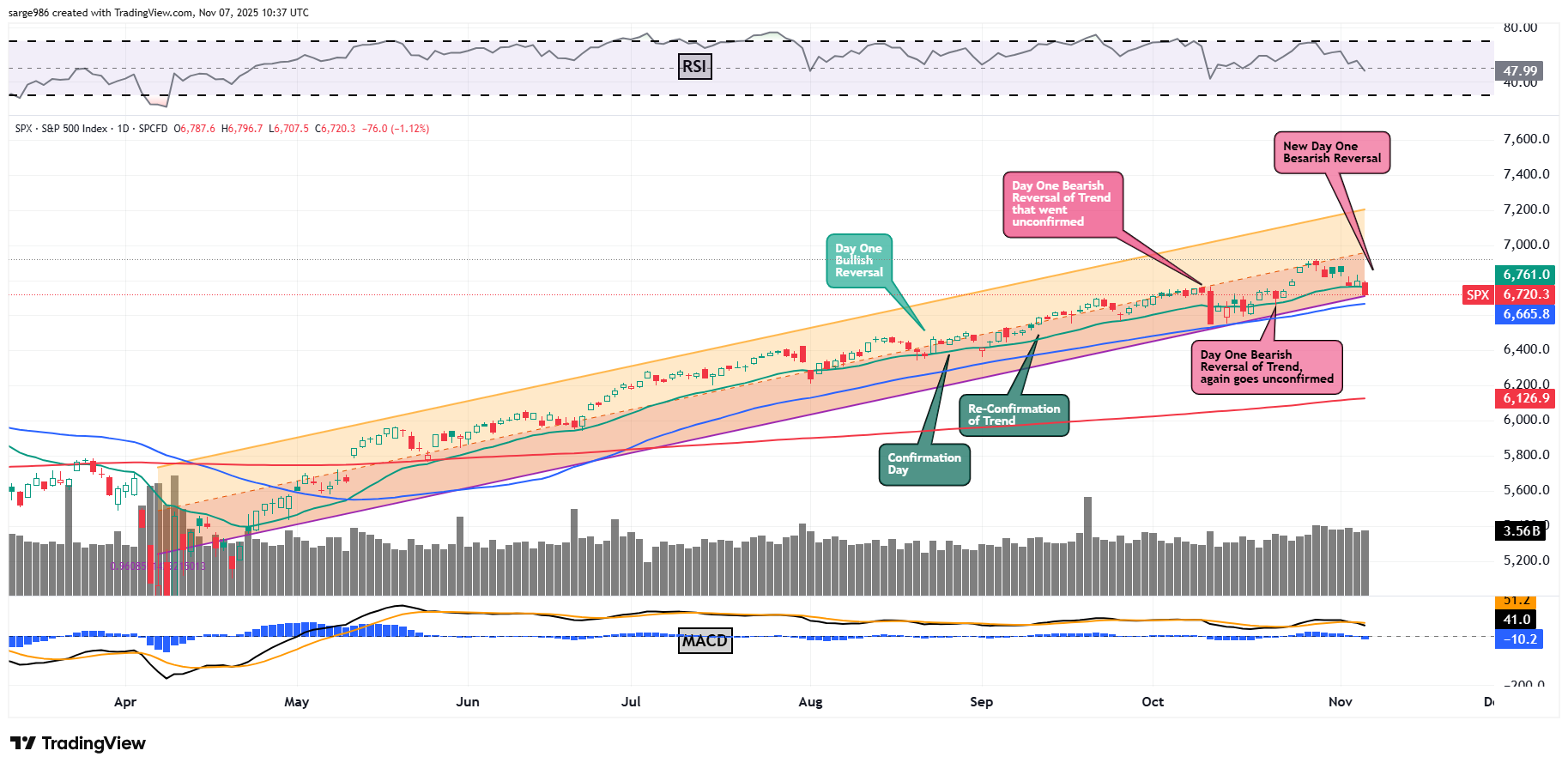
Relative Strength for the index has moved down into neutral territory for the first time in more than three weeks, while the Moving Average Convergence Divergence has returned to a more bearish posture. Within that indicator not only did the histogram of the 9-day Exponential Moving Average move below zero, which is a short-term bearish signal, but the 12-day Exponential Moving Average moved below the 26-day Exponential Moving Average. Though both of those lines remain above zero, that could be potentially problematic.
On Stablecoins
Fed Gov. Christopher Waller, who is a front runner to replace current Fed Chair Jerome Powell in that role this spring, spoke on "Central Banking and the Future of Payments." Waller covered the growing significance and potential benefits of stablecoins from Ottawa, Canada:
"The biggest thing it does in my view is it introduces competition into the payment space."
Waller went on to mention that stablecoins will push private firms and central banks to modernize their systems. Waller did not mention it, but I think the greatest benefit will be that stablecoins, in their attempt to maintain parallel value to the U.S. dollar, will be forced to hold short-term U.S. Treasury debt securities, which will put downward pressure on interest rates. That could be hugely beneficial and take some pressure off of the Federal Open Market Committee if labor markets continue to deteriorate.
Dunce Cap Award...
Completely oblivious to those deteriorating labor markets, Cleveland Fed Pres. Beth Hammack spoke from New York and said:
"After last week's meeting, I see monetary policy as barely restrictive, if at all, and it's not obvious to me that monetary policy should do more at this time."
Hammack later added, "I do not currently put high odds on a labor market downturn."
I honestly don't know how some of these people find their way into impactful, policy-making positions. Unfortunately for all of us, Cleveland has policy voting rights in 2026.
St. Louis Fed Gets It
St. Louis Fed Pres Alberto Musalem spoke on Thursday as well. Musalem said:
"In terms of levels, I estimate that we have currently about 50 to 75 basis points of insurance (to go) with respect to (the) labor market to make sure we keep it near full employment."
Unfortunately, for all of us, St. Louis had policy voting rights in 2025, so Musalem will vote in December, but then not again until 2028.
News
- Tesla (TSLA) shareholders voted on Thursday in favor of a $1 trillion compensation package for CEO Elon Musk. The vote was confirmed at Tesla's shareholder meeting. Musk, to get paid the full amount, must deliver on a series of targets that would expand upon Tesla's market value, revive its auto business, and build out the "robotaxi" and robotics businesses. It's a lot, but Musk will have to sweat to get there.
- Judge John McConnell ordered the Trump administration to fully fund the SNAP food-assistance program for November by Friday (today). McConnell said that the administration had violated the order that he issued last week requiring the government to tap emergency funding to get this done.
- On that note, Republican senators are set to pass on Friday, a 15th clean continuing resolution bill this morning that since the shutdown began that would reopen the government. For a 15th consecutive vote, the bill is expected to fall short of the required 60 votes needed to pass. Only three Democratic party senators have, to this date, crossed the aisle to try to get the government reopened. Let's all hope the Republican senators do not vote to end the filibuster as I believe this would be a strategic error going forward.
- Early on Friday morning, "The Information" is reporting that the federal government will not permit Nvidia to sell its latest scaled-down AI chip to Chinese customers. The new B30A CPU is based on Nvidia's Blackwell architecture and is supposed to be more powerful than the H20 that was built on the Hopper architecture.
Economics
(All Times Eastern)
10:00 - U of M Consumer Sentiment (Nov-adv): Expecting 53.5, Last 53.6.
10:00 - U of M One-Year Inflation Expectations (Nov-adv): Expecting 4.6%, Last 4.6%.
10:00 - U of M Five-Year Inflation Expectations (Nov-adv): Expecting 3.9%, Last 3.9%.
1:00 p.m. - Baker Hughes Total Rig Count (Weekly): Last 546.
1:00 p.m. - Baker Hughes Oil Rig Count (Weekly): Last 414.
The Fed
(All Times Eastern)
03:00 - Speaker: New York Fed Pres. John Williams.
07:00 - Speaker: Federal Reserve Vice Chair Philip Jefferson.
3:00 p.m. - Speaker: Reserve Board Gov. Stephen Miran.
Today's Earnings Highlights
(Consensus EPS Expectations)
Before the Open: (DUK) (1.75), (ENB) (.51), (WEN) (.20)
At the time of publication, Guilfoyle was long NVDA, AMD equity.