This Is No Time for a 'What, Me Worry?' Investing Strategy
Markets overnight are acting as if the worst is over, but Iran has hypersonic missiles and the fighting rages on with the future of energy supplies in question. Also, check out a concerning chart, and military contractors are up.
You've reached your free article limit
You've read 0 of 1 free Pro articles.
Last Thursday night (if you live in North America), Israel launched a series of highly calculated, well informed, surgical strikes on Iranian military leadership. Several generals, including the commander in chief of the Iranian armed forces and the commander of the Islamic Republican Guard, were taken off the board. Nuclear scientists were eliminated. Supposedly the entire upper echelon of the Iranian Air Force was lured to a meeting and also taken out. From a military perspective, the first night of Israel's sudden campaign against Iran's offensive and nuclear capabilities went about as well as Israel could have hoped for.
Iran's military was slow to get up off of the canvas, but get up off of the canvas they did. While the Israeli Air Force continued their attacks on Iranian military targets, Iranian drones and ballistic missiles were fired into Israeli territory by the hundreds. The barrage was kept up pretty much all weekend. Israel's famed "Iron Dome" does make for excellent defense against both rockets and short-range munitions. That much is true.
Against ballistic missiles? The Iron Dome is much less effective. Against hypersonic missiles? As I have told readers before, hypersonic missiles are currently indefensible. The U.S. has had delays and troubles for years in getting their hypersonic weapons program off of the ground. Readers know that for literally years, I have warned that both Russia and China were ahead of the U.S. in hypersonic technology and that this needed to become a Department of Defense priority. Over the weekend, Israeli civilian populations ended up on the receiving end of these weapons, while the Israeli Air Force kept up their offensive. There were reports on Sunday of a minor earthquake in the vicinity of Iran's Fordow nuclear plant. There were also reports of residents attempting to flee the Iranian capital city of Tehran.
Hypersonic Help?
So, how is Iran able to use hypersonic weapons in an offensive capacity? Obviously, the nation had help in either design or supply from somebody else. Fortunately for Israel and perhaps for everyone in the region, it appears that these weapons are being conserved. Maybe Iran does not have them in abundance. Iran does have an abundance of ballistic missiles, though. The Israeli Air Force, the Jordanian military, the U.S. Navy and U.S. Army have been successful in shooting most of those down. But it just takes one, as we saw over the weekend, to destroy a neighborhood.
Clearly, work has to be done, and defense spending has to be focused on prioritizing the development of defensive hypersonic weapons. The leading contractors working on this high-level interception capability would be Lockheed Martin LMT though they have hit some bumps in the road, as well as Northrop Grumman NOC, and RTX RTX, which is the old Raytheon Technologies. GE Aerospace GE has been working with these contractors on air-breathing, high-Mach hypersonic propulsion technologies.
Markets
Very interestingly, at zero-dark thirty on Monday morning, financial markets are behaving as if the worst is over, though we have not seen anything reported in the media that would have us seeing a quick resolution to the conflict between Israel and Iran. Asian equities are trading higher, European equities are opening in the green and U.S. equity index futures are trading higher as well despite having briefly traded lower on Sunday evening. Supposed safe-haven type assets are showing some weakness as well. U.S. Treasury debt securities and gold are trading lower as we traverse the wee hours. WTI Crude is suddenly showing some weakness on top of all of that.
I still think this is a time to maintain a healthy allocation within one's portfolio toward aerospace and defense names. With the S&P 500 down 1.13% and the Nasdaq Composite down 1.3% on Friday, the Dow Jones U.S. Defense Index was up 2.39%, led by Elbit Systems ESLT, which is a name I gave you on Friday morning. Elbit is an Israeli-based defense contractor specializing in unmanned aircraft and unmanned surface vessels as well as intelligence and cyber systems. Following ESLT were Northrop Grumman, Lockheed Martin and L3Harris LHX. Those three stocks were up 3.94%, 3.66% and 2.64% respectively. RTX was up 3.34%, but for some bizarre reason, is not included in that index.
The Energy sector was the hottest sector across U.S. equity markets on Friday as WTI Crude prices spiked 8.1%. Given that the Israeli Air Force had begun targeting Iranian energy related assets over the weekend and given Iran's role as a major producer of crude and its proximity to other key oil exporters, and the Strait of Hormuz, this morning's softness in oil prices does seem odd. Should the Iranian military try to close the Strait of Hormuz to commercial maritime traffic, that could hamper the transport of 33% of the world's liquified natural gas and about 25% of its oil.
The Week Past
Interestingly, the S&P 500 and Nasdaq Composite both traded at their highest levels since Feb. 20 last week. That was before these hostilities erupted in the Middle East and the negativity across U.S. markets on Friday was enough to take all major and mid-major indexes lower for the week. There had been good news earlier in the week that had taken U.S. stocks higher.
For starters, On Wednesday, Pres. Trump declared that a new trade deal with China was all but "done." All that was needed was "final approval. Additionally, while there was not much in the way of earnings and not a lot of macro, what macro there was, was key. Both consumer prices and producer prices for May hit the tape at cooler levels than anticipated last week, surprising many who had expected the first impacts of the president's tariffs to start showing up in the data.
Not only were the impacts of tariffs not evident in the May numbers on inflation, but both the NFIB Small Business Optimism Survey for May and the preliminary Consumer Sentiment survey (tallied by the University of Michigan) for June showed sharply more optimism across the board than they had a month earlier. In addition, the University of Michigan survey showed a drastic reduction in forward looking inflation expectations.
The Numbers
What the major to mid-major US equity indexes did last week as a number of short winning streaks were put to an end.
- The S&P 500 gave up 1.13% on Friday but just 0.39% for the week.
- The Nasdaq Composite gave back 1.3% but just 0.63% for the week.
- The Nasdaq 100 gave back 1.29% but just 0.6% for the week.
- The Russell 2000 lost 1.85% on Friday and 1.49% for the week.
- The S&P SmallCap 600 surrendered 1.93% on Friday and 1.35% for the week.
- The S&P MidCap 400 gave up 1.58% on Friday and 1.46% for the week.
- The Dow Transports lost 1.51% on Friday and 1.29% for the week.
- The Philly Semiconductors were hit for 2.61% on Friday, losing 1.49% for the week.
- The KBW Bank Index was tagged for 2.12% on Friday and 2.61% for the week.
On Friday, ten of the 11 S&P sector SPDR ETFs closed out the session in the red, led lower by the Financials XLF at -2.04% and followed by Technology XLK at -1.4%. Only Energy XLE, as mentioned above, closed in the green at +1.74%.
For the week, five of the 11 S&P sector SPDR ETFs actually traded higher, led again by Energy and followed by Technology. Energy was up a whopping 5.62% for the week. The Financials gave up 2.57% for the week, easily placing that group in last place over the five-day period.
Earnings
Second-quarter earnings season is still about a month away. According to FactSet, for the second quarter, consensus for S&P 500 earnings growth for the S&P 500 is currently at 4.9%, which is steady for a few weeks now, but down from 9.1% about two months ago. Q2 revenue growth is still seen at growth of 4.1%, down from 4.6% over that same time frame.
For the second quarter, communication services are projected to have grown earnings a whopping 29.4%, followed by Tech at +15.9%. Four sectors are currently projected to have suffered a year over year contraction in earnings, easily led lower by energy (-26.1%).
For the full calendar year of 2025, Wall Street now sees S&P 500 earnings growth at 9.0%, down from 11.3% about two months ago. Expectations for full year revenue growth have fallen from 5.4% to 5.0% over that same period.
The GDP Game
Last week, the Atlanta Fed left their GDPNow model for the second unrevised at growth of 3.8% (q/q, SAAR). There is still no estimate for Q2 GDP ex-the gold trade at this time, nor do I expect that there will be one for the period. Among other regional central bank district branches running close to real-time GDP models, the New York Fed's estimate for Q2 growth now stands at 2.34%, up from 2.33%, while the Cleveland Fed still sees Q2 growth of 1.97%. I think they may be asleep. That estimate has not budged in weeks.
The St. Louis Fed revised its estimate for Q2 GDP growth lower from 1.59% down to 1.46%. As readers can see, there is nothing even remotely close to a consensus view across the regional Federal Reserve Q2 GDP models available to us. Where is my trusted Hedgeye Nowcast Model?
They are the only ones, I might add, that have been consistently close, not just on GDP, but also on inflation, which is why I pay them. After literally nailing the BEA estimate for Q1 GDP, Hedgeye's model for the second quarter is now running just above 1.7%.
The Chart
Remember this chart?
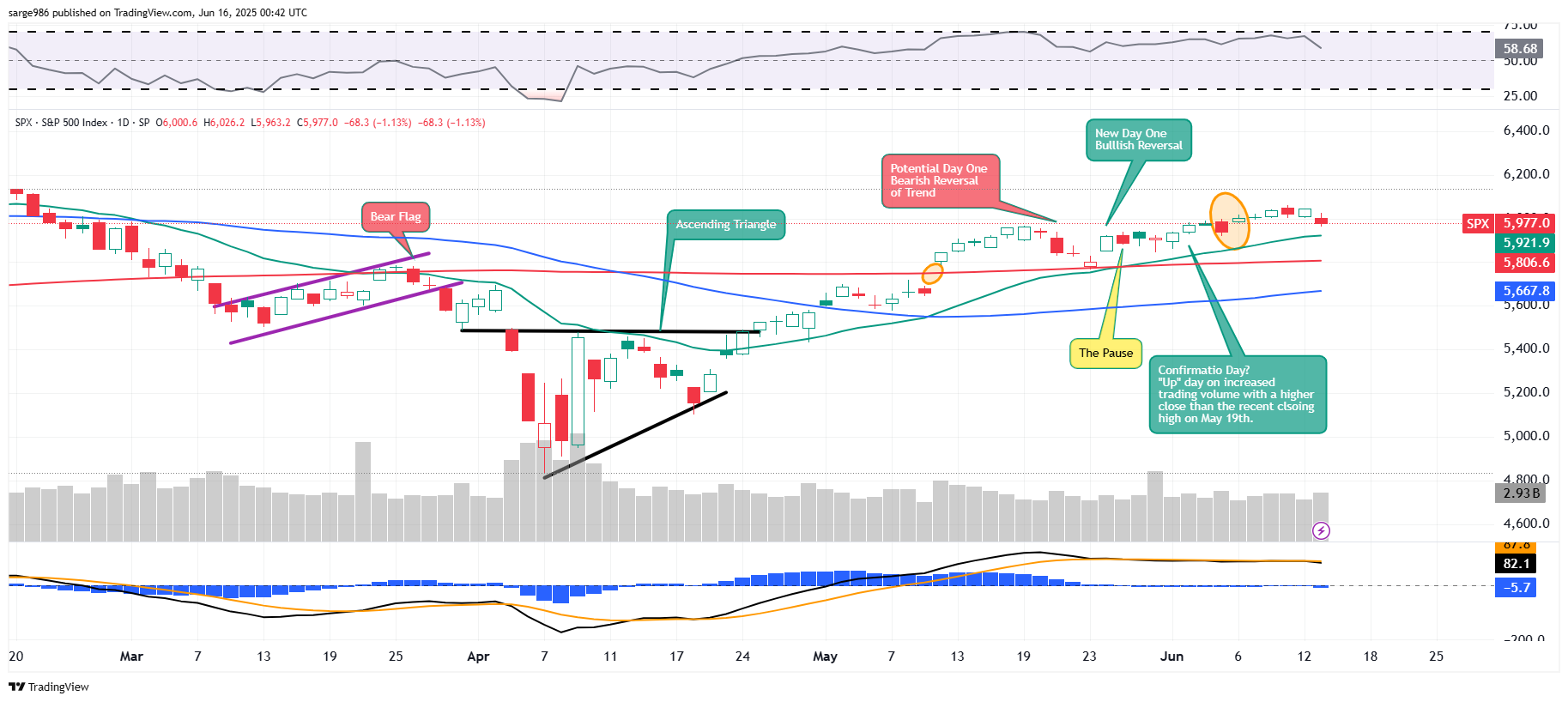
It's updated from a week ago, but that was a generally positive set up. Does the onset of war in the Middle East matter? Well, we can't take it lightly, can we? Let me show you what the rest of Wall Street will show you (after the fact) if there is some kind of awful event that forces a severe risk-off market response.
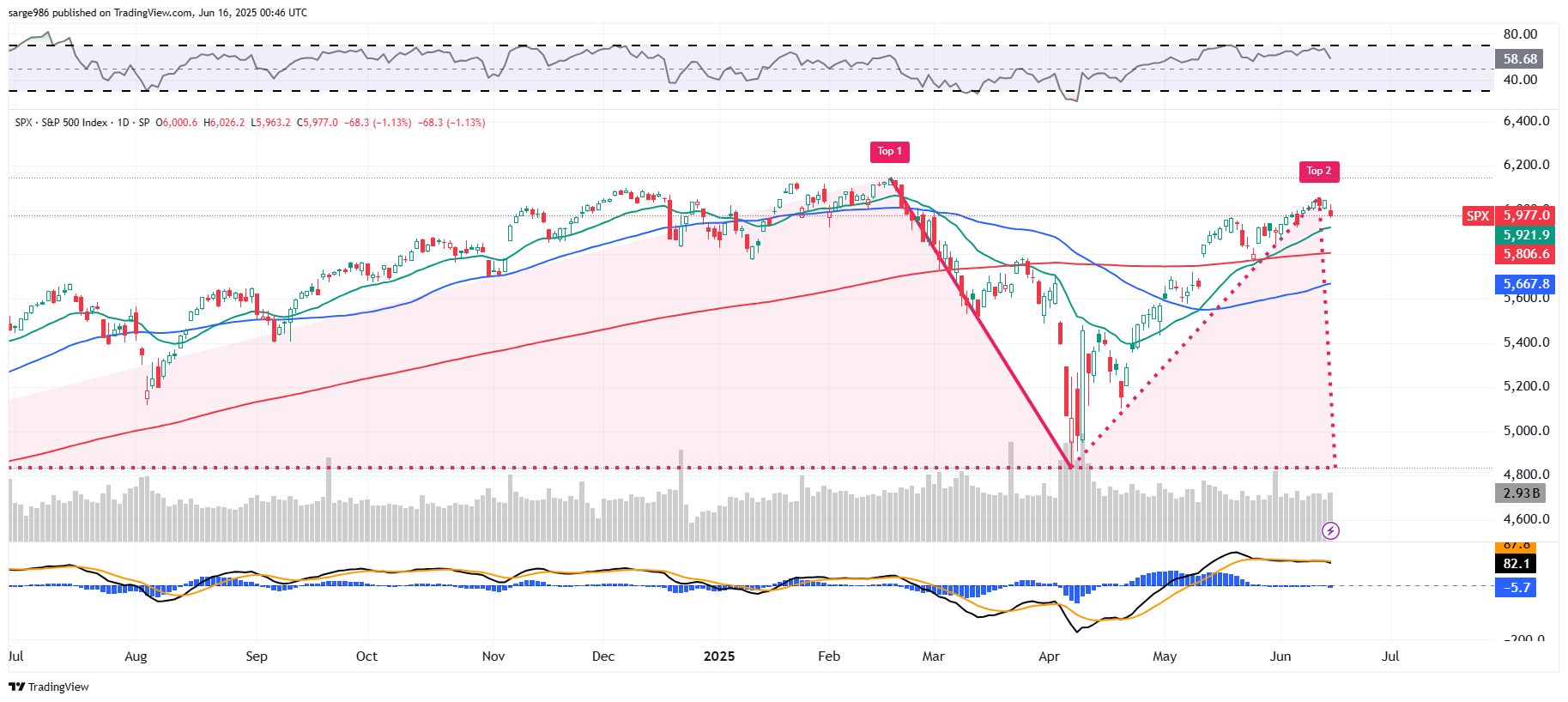
Now, that's a horse of a different color, isn't it? Nobody likes to see a Double Top pattern of bearish reversal appear to come to fruition while one nation bombs another nation's nuclear facilities while that second nation may or may not have the ability to shut off the flow of a third of the planet's liquified natural gas and a quarter of the planet's crude. To quote the fictional Alfred E. Neuman: "What, Me Worry?"
What's Ahead?
The week ahead, despite a lack of corporate earnings releases, will be an active one, despite the fact that there is a Federal holiday on Thursday and markets will not open that day.
- The domestic macroeconomic calendar remains hot this week. The headline events on the macro side will be May retail sales followed by May industrial production, both on Tuesday morning. May housing starts, which is also a high-level print, will hit the tape on Wednesday morning. Regional manufacturing surveys for the month of June will also be published this week by the New York and Philadelphia district branches of the Federal Reserve.
- Speaking of the Federal Reserve, the Federal Open Market Committee will hold its next policy meeting this week, beginning on Tuesday and culminating on Wednesday afternoon. This meeting will include both the official statement and press conference as all Fed policy meetings do, but this is also one of the four times per year that the FOMC revises its economic projections. Currently, Fed Funds Futures trading in Chicago are pricing in close to a 100% probability for no change to be made to monetary policy at this meeting as well as a 65% probability for half-percentage point worth of rate cuts over the balance of the year.
- The earnings calendar is extremely light this week, even lighter than last week. This week, we will hear from home-builder Lennar Corporation LEN on Monday afternoon, followed by Jab JBL on Tuesday morning. Then, finally, on Friday morning, Accenture ACN, CarMax KMX, Darden Restaurants DRI and Kroger KR will all report their numbers.
- Investors will want to keep an eye on the Paris Air Show this week. This annual showcase for mega-deals and aerospace performance opens on Monday under the cloud of the escalating war in the Middle East and the recent crash of a Boeing (BA) 787 Dreamliner in India. I would expect that the defense names may make the higher-profile news this week coming out of this show.
Economics (All Times Eastern)
08:30 - Empire State Manufacturing Index (Jun): Expecting -6.3, Last -9.2.
1:00 p.m. - Twenty-Year Bond Auction: $13B.
The Fed (All Times Eastern)
Fed Blackout Period.
Today's Earnings Highlights (Consensus EPS Expectations)
After the Close: LEN (1.94)
At the time of publication, Guilfoyle was long, NOC, LHX, RTX, GE equity.