Thinking About Amazon, Fed Decision Time, S&P Signals, Week Ahead
The one Mag 7 name I'm thinking about initiating is the one I just spent a year or so avoiding. Also, the Netflix story isn't over, the GDP game and much more.
You've reached your free article limit
You've read 0 of 1 free Pro articles.
Should I stay or should I go now?
Should I stay or should I go now?
If I go, there will be trouble
And if I stay, it will be double
So come on and let me know
- "Should I Stay or Should I Go", Joe Strummer, Mick Jones (The Clash), 1982
The Past Week
Monday morning. U.S. financial markets move into their second full week of December. Jingle, Jingle. Time flies. Doesn't it ever?
The past week was indeed volatile yet gave the appearance of equity market confidence as most of our mid-major to major indexes inched higher. This came despite some visible weakness from the belly of the U.S. Treasury debt securities yield curve on out to the deep end of the pool.
There was some good news. PCE inflation for the month of September was rather tame on a monthly basis as the core year-over-year print hit the tape below consensus view. You read about that somewhat cool September inflation print ahead of time in this column and probably nowhere else. Additionally, the University of Michigan's Consumer survey for December landed at weaker-than-optimal but better-than-expected levels. That survey showed a still warm-to-the-touch, but sharp contraction in inflation expectations for the coming 12 months.
There was bad news too. According to ADP, private sector employment unexpectedly fell into contraction in November as that series showed a loss of jobs for a third month in the past four.
Then there was corporate news. Netflix (NFLX) announced that the firm would acquire most of Warner Bros Discovery (WBD) in a heavily financed deal with an enterprise value of roughly $82.7 billion (see my take here). The announcement came despite a competitive offer for the whole company from Paramount Skydance (PSKY) .
It sounds to me like this story may not be over. Not only will Netflix face a rigorous regulatory review, but there is also always the chance that Paramount tries to take a hostile bid straight to WBD shareholders. Bloomberg News reported on Sunday that President Trump had said that there would have to be a federal review of the Netflix deal. Saw that one coming.
Decision Time
This week, the Federal Reserve Bank's FOMC (Federal Open Market Committee) will be the focus of all things financial. The committee will make their final policy decision of the year and it is broadly expected that the target range for the Fed Funds rate will be shaved by 25 basis points to 3.5%-3.75%. The focus, though, will be on the committee's forward-looking economic projections, which are updated quarterly and the post-release press conference as much as on the policy change.
While the dot plot, despite its obvious flaws, will continue to impact algorithmically driven trading for as long as the Fed publishes such nonsense, one has to wonder just how much of an impact on markets Fed Chair Jerome Powell's press conferences will continue to have. There is an unlikely chance that Powell will stay on at the Fed's Board of Governors until that term ends in 2028, but it is widely expected that the president will nominate someone else to chair the Fed when Powell's term as chair ends in May.
That nominee is now expected by most to be the president's director of the National Economic Council, Kevin Hassett. As there is no FOMC policy meeting in May, nor one in February, that would make this press conference Powell's fourth to last. While Fed Chairs do not usually stay on at the central bank after their time as leader has expired even if they do have time left on at the Board of Governors, these are not normal times. There will likely be political pressure on Powell to maintain his position among that finite group.
Thinking About Amazon
No, I have not yet made the initiation. As I have recently exited my long positions in both Microsoft (MSFT) and Alphabet (GOOGL) , though I am bullish overall going into year-end and into 2026, I am flat six of the seven names that comprise the "Magnificent Seven." Nvidia (NVDA) is now my only remaining "long" among that "mega-cap" bunch and even that name is only my ninth-largest position in terms of exposure.
The one Mag 7 name that I am thinking about initiating is the one that I just spent a year or so avoiding. While the S&P 500 is up 16.8% year to date, Amazon (AMZN) is up just 4.6%. Of all of the names across the Mag 7, due to the nature of its online retail business, which requires not only a massive delivery network but also a tremendous warehousing network as well, this had forced the firm into the unenviable position of maintaining labor-related overhead costs at levels not necessary at other mega-cap tech firms.
This also puts Amazon in the enviable position of being the most likely name among that group to benefit in substantial, measurable and sustainable ways as generative artificial intelligence moves out of its infancy. That very idea, unfortunately, means the loss of jobs at Amazon will almost certainly accelerate, but it also means that profit margins will accelerate as well.
On top of the news of Amazon's latest in-house custom chips announced last week, which will reduce reliance upon Nvidia, the firm could very well also benefit from a potential Anthropic IPO. The Financial Times has reported that Anthropic, is in talks to possibly launch one or the largest IPOs in history in early 2026. Amazon has a roughly $8 billion stake in Anthropic, which is the AI start-up that created the "Claude" chatbot. Closer cooperation between Anthropic and Amazon could potentially put AWS back on track to start retaking cloud-based, data-center services market share from Microsoft's Azure and Alphabet's Google Cloud.
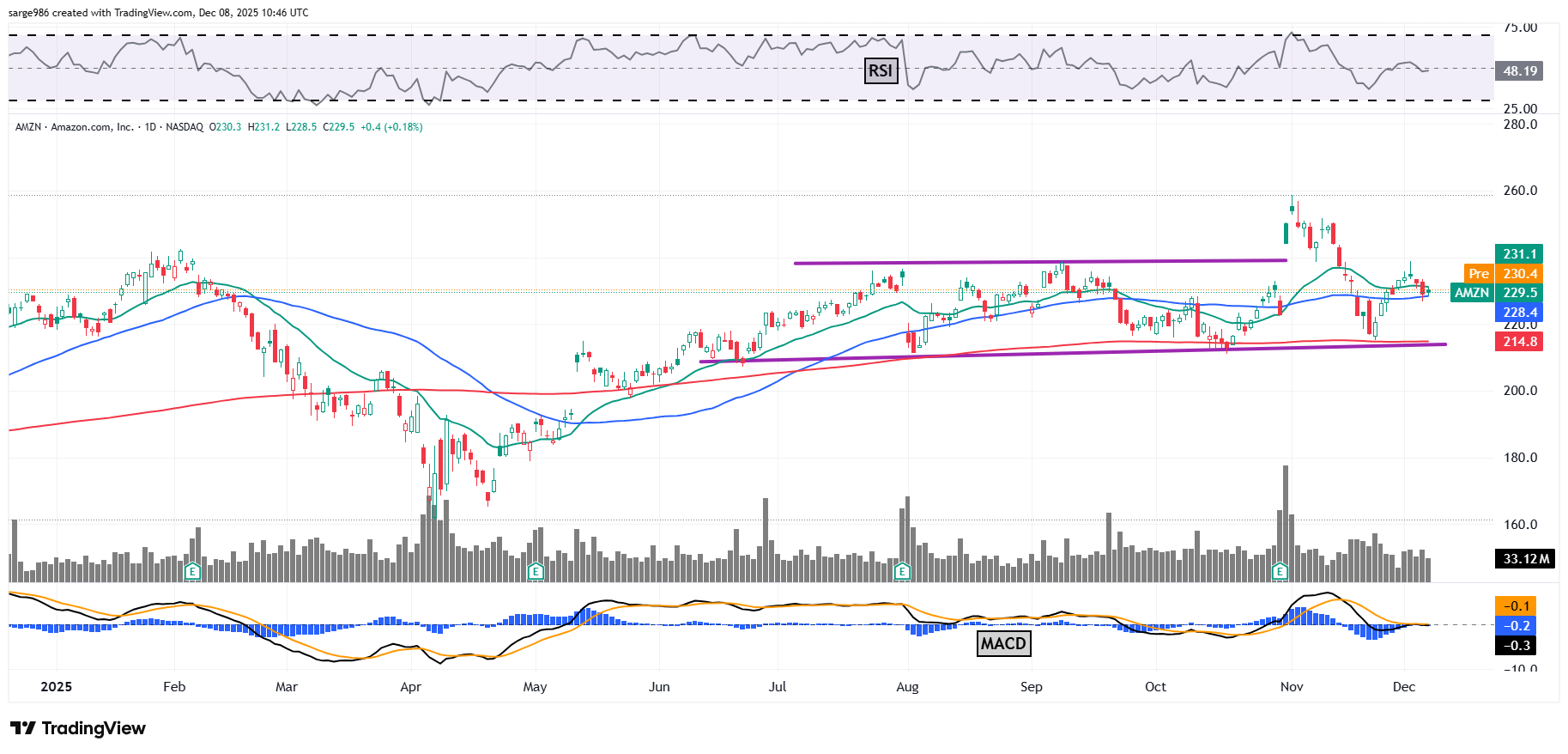
In the Amazon chart, above, readers will see a flat base that has already failed to develop a breakout, coupled with a reading for relative strength that is about as neutral as neutral gets and a daily MACD (moving average convergence divergence) that appears to be just as vanilla as that RSI (relative strength index) appears to be.
Look more closely. The line of support for that flat base continues along the stock's 200-day SMA (simple moving average). That potentially makes for some powerful professional interest. The stock is currently testing both its 21-day EMA (exponential moving average) and its 50-day SMA.
I would have to think that should the stock hold that 50-day SMA, professional managers will be forced to increase long side exposure. I would also have to think that should the stock hold its 21-day EMA, that the swing crowd could get behind the stock as well.
Put bluntly, I am close to placing a $285 price target on AMZN.
The Week That Was...
Equity markets rallied for the most part last week. The S&P 500 and Nasdaq Composite both posted their second consecutive winning weeks after suffering through some sloppy mid-November performance. That said, trading volume in aggregate increased each day from the day prior, but remained below pre-Thanksgiving holiday levels. Over the past week...
- The S&P 500 gained 0.19% on Friday and just 0.31% for the week.
- The Nasdaq Composite gained 0.31% on Friday and 0.91% for the week.
- The Nasdaq 100 gained 0.43% on Friday and 1.01% on the week.
- The Russell 2000 gave up 0.38% on Friday but gained 0.84% for the week.
- The S&P SmallCap 600 surrendered 0.16% but added 0.56% for the week.
- The S&P MidCap 400 gadded just 0.05% and 0.35% for the week.
- The Dow Transports gained 0.69% on Friday and soared 3.6% over the week.
- The Philly Semis gained 1.09% on Friday and a nice 3.84 for the week.
- The KBW Bank Index gained just 0.21% on Friday, but added 3.18% over the five days.
On Friday, five of the 11 S&P sector SPDR ETFs closed out the session in the green, easily led by Communication Services (XLC) , followed by Technology (XLK) . The losers were led by the Utilities (XLU) as growth outperformed and defensive sectors struggled.
For the week, six of the 11 S&P sector SPDR ETFs traded higher with Technology out in front followed by Energy (XLE) and Communication Services. The Utilities, again, were the big losers. Health Care (XLV) also badly underperformed.
The Chart...
Readers may remember that last Monday we pointed out that the S&P 500 had regained its 21-day EMA, 50-day SMA and the lower trendline of our Raff Regression model during the shortened Thanksgiving holiday week.
We then pointed out that, in our opinion, either an inverted head-and-shoulders pattern or a cup pattern had been under development. As explained here in this column at that time, whether or not a handle were to be added to the cup, both of those formations are patterns of bullish reversal.
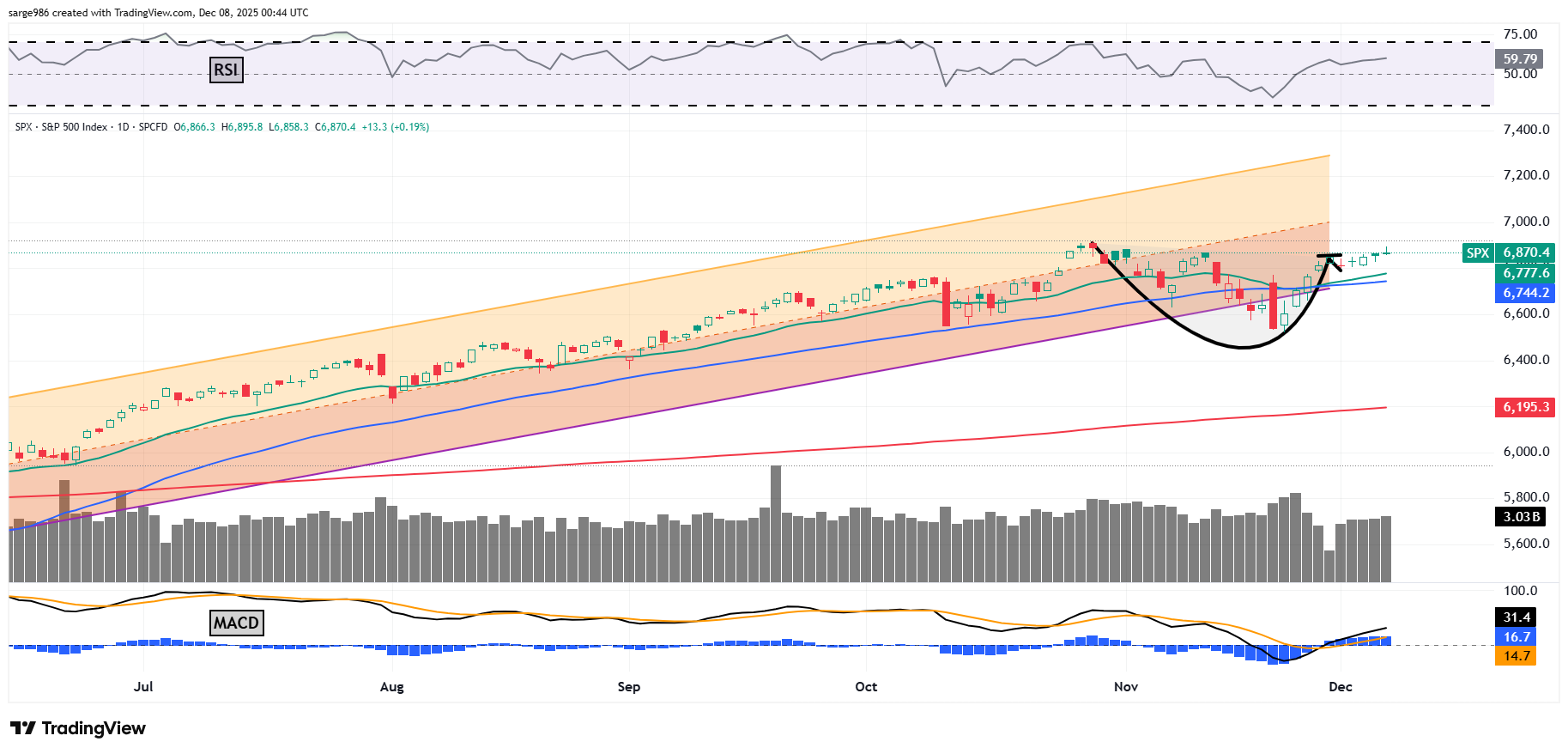
Bottom line? The cup pattern added a short lived and shallow handle last week. Of course this could change, but as the chart stood at week's end, the S&P 500 was still trying to break out of and hold a 6850 pivot.
As far as my most often relied upon indicators are concerned, relative strength (above the chart) has moved out of neutral territory and continues to work towards a more bullish posture. Below the chart, readers will see what I described last week as "a suddenly more bullish" daily MACD.
Within that indicator, the histogram of the 9-day EMA has crossed back into positive territory, and held that gain. This is a short-term bullish signal. On top of that, the 12-day EMA had crossed above the 26-day EMA (bullish) as both of those lines moved into positive territory. Those two lines continued to move higher last week as the 12-day held its lead over the 26-day. That too is a bullish signal.
Earnings
FactSet did publish an "Earnings Insight" report on Friday after taking a holiday break. As of December 5, according to FactSet, for the third quarter, with 99% of the S&P 500 having reported, 83% of those companies had pleasantly surprised on earnings while 76% of those companies had surprised to the upside on revenue generation.
For the third quarter, S&P 500 earnings growth ended at 13.5%, year over year, after starting at 7.9%. Third-quarter revenue growth landed at 8.4% after starting out at 6.3%. For the fourth quarter, still using data provided by FactSet, Wall Street sees earnings growth of 7.7% on revenue growth of 7.5%.
At the moment, Technology, at growth of 23.4%, is the only sector projected to experience double-digit earnings growth for Q4. Presently, two sectors (Discretionaries and the Industrials) are projected to suffer year-over-year earnings contraction while three others are seen growing earnings by less than 1%.
Valuation
Again, using data provided by FactSet, the S&P 500 ended last week trading at 22.4 times 12 months' forward-looking earnings, up from 21.5 times two week ago. This is well above the five-year average of 20.0 times for the index as well as well above its 10-year average of 18.7 times.
The S&P 500 also ended last week trading at 28.3 times trailing 12 months' earnings, up sharply from 26.9 times two weeks ago. That also stands well above the five-year (25.0 times) and 10-year (22.9 times) averages for the index.
Ten of the 11 sectors are still trading above their five-year average valuations, led by Consumer Discretionaries (28.6 times) and Tech (28.4 times). Only the REITs (at 17.4 times) are not historically overvalued relative to their five-year averages.
The GDP Game
Last week, the Atlanta Fed revised their GDPNow model for the third quarter down to 3.5% from growth of 3.9% (q/q, SAAR). Among other regional central bank district branches running close to real-time GDP models, the New York Fed's estimate for Q3 growth was left unrevised at growth of 2.31%. The Cleveland Fed's model for the third quarter was also left unrevised at growth of 2.05%. Finally, the St. Louis Fed again revised their model lower, to growth of just 0.14% from 0.47% last week.
Both the New York and Cleveland Feds are already running Q4 models. At this time, New York sees fourth-quarter GDP growth at 1.73% with Cleveland at growth of 2.83%. Do not expect Atlanta to publish an estimate for the fourth quarter before December 23.
Fed Funds Futures
Fed Funds futures trading in Chicago are now pricing in just an 88% probability for a 25-basis point rate cut this Wednesday, up from 86%, a week ago. At present, there are now 50 basis points worth of additional rate cuts fully priced in (71% chance, down from 78%) for all of calendar 2026. These markets are also now pricing in another rate cut for early 2027 followed by a rate hike later that year.
On The Docket
We are still in between earnings reporting seasons. Though fourth-quarter results won't start hitting the tape in earnest until mid-January, there will still be a few well-known names posting numbers this week. That said, this week will be more about the Fed and what happens on Wednesday than anything else.
-- The FOMC will come out of their media blackout period this Wednesday afternoon at the culmination of what will be a two-day policy meeting. On Wednesday, the committee will release their official policy statement at 14:00 ET alongside the groups' updated quarterly economic projections. Yes, those projections will include the now infamous and often unintentionally comical dot plot.
A half hour later, Fed Chair Jerome Powell will hold his press conference and will answer questions for the financial media. This press conference often has as much impact as does the statement. Given Powell's status as a short-timer, I would imagine the impact of these press conferences on financial market performance will start to wane as we approach the end of his term at the head of the U.S. central bank this May.
-- The macroeconomic calendar is actually rather light this week. Keyword-reading algorithms that force financial market price discovery will react to the JOLTs report on September and October job openings and job quits this Tuesday morning as well as the weekly version of the ADP Employment Report, also due Tuesday. Outside of that, with the exception of the U.S. Treasury Department auctions of $39 billion worth of new 10-Year Notes on Tuesday afternoon and $22 billion worth of new 30-Year Bonds on Thursday afternoon, it will pretty much be crickets from this corner of our universe this week.
-- As mentioned above, the earnings calendar will still produce some well-known names this week. On Tuesday morning, AutoZone (AZO) and Campbell Soup (CPB) will go to the tape followed by Casey's General Stores (CASY) and GameStop (GME) on Tuesday afternoon. Chewy (CHWY) will report on Wednesday morning, as Adobe (ADBE) , and Oracle (ORCL) report on Wednesday evening. That leads us to Thursday evening. That's when we'll hear from Broadcom (AVGO) , Costco (COST) , Lululemon Athletica (LULU) and RH (RH) , formerly known as Restoration Hardware.
Economics (All Times Eastern)
No significant domestic macroeconomic data scheduled for release.
The Fed (All Times Eastern)
Fed Blackout Period.
Today's Earnings Highlights (Consensus EPS Expectations)
After the Close: (TOL) (4.88)
At the time of publication, Guilfoyle was long NVDA equity.