There Are New Reasons to Fight the Fed as Rate Cut Becomes Inevitable
There's a rule of thumb that you should never fight the Federal Reserve, but it could soon be time to break that.
You've reached your free article limit
You've read 0 of 1 free Pro articles.
We have all learned over the year that you don’t fight the Fed.
It is a fairly simple rule of thumb, but is it entirely accurate advice?
The Fed is going to have to cut.
Last Friday’s job data was weak across the board — not just the obvious numbers, but everything under the hood. We are averaging around 30,000 jobs for the past three months (both the Household and Establishment surveys agree on that). The underemployment rate is moving higher, which is consistent with an economy that lost about 800,000 full-time jobs the past two months while creating about 850,000 part-time jobs.
The market is pricing under three rate cuts this year — I think that gets to three or even four and I would not be shocked to see 50 BPS cut at the next meeting.
Will the Fed and Treasury Work Together to Lower Longer-Dated Yields?
This to me is the bigger question.
I think we might be able to “fight the Fed” if all we get is rate cuts, but this administration wants longer-term yields lower. It wants mortgage yields lower, which are tied most closely to the 10-year yield. The administration is well aware that last September, after the Fed cut rates 50 BPS, long-end yields rose.
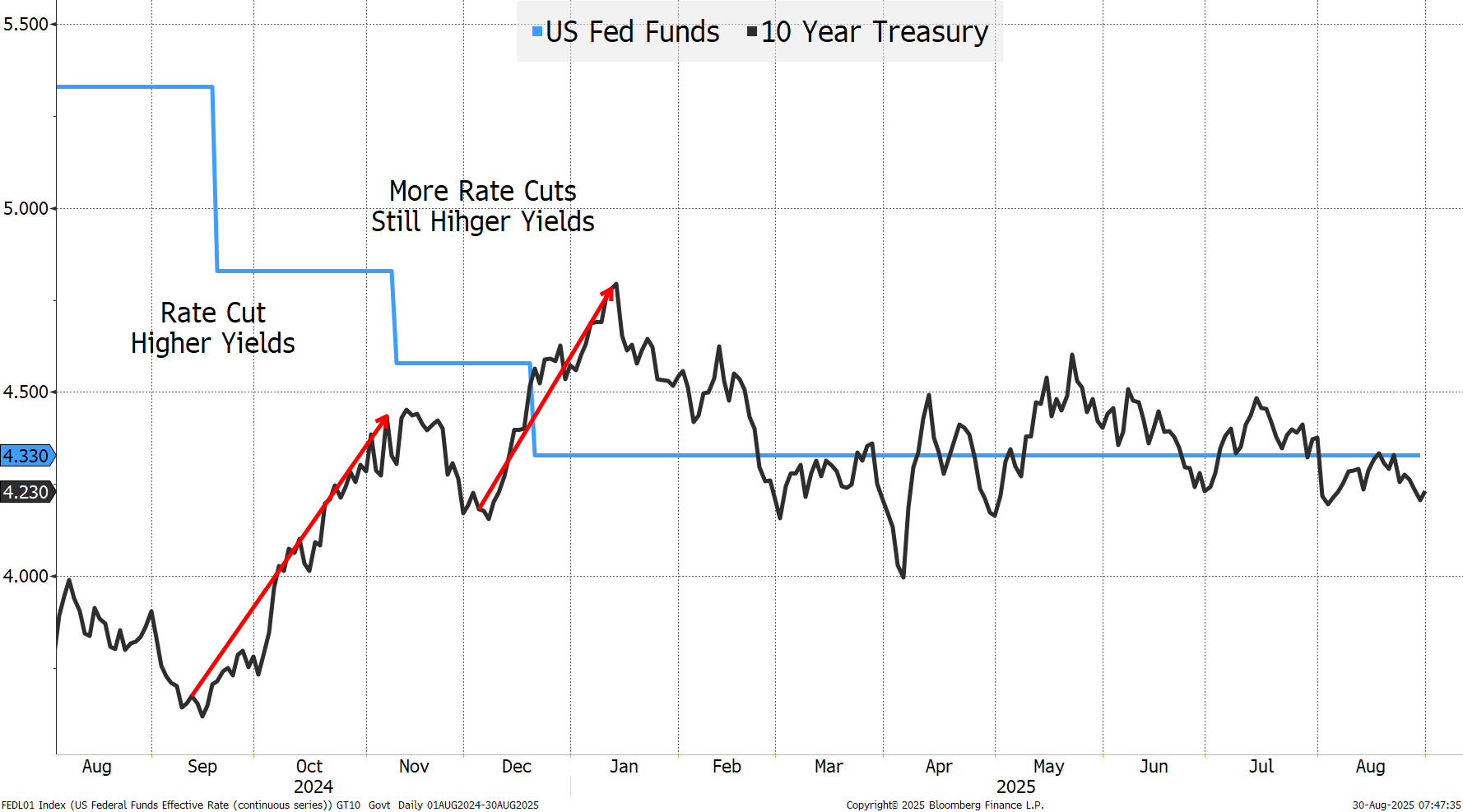
It does not want a repeat of that, and it has a lot of ability to achieve this if it wants!
The Treasury can further reduce issuance at the long end and issue more T-bills (which is somewhat helpful, but only mildly useful if only thing that is done).
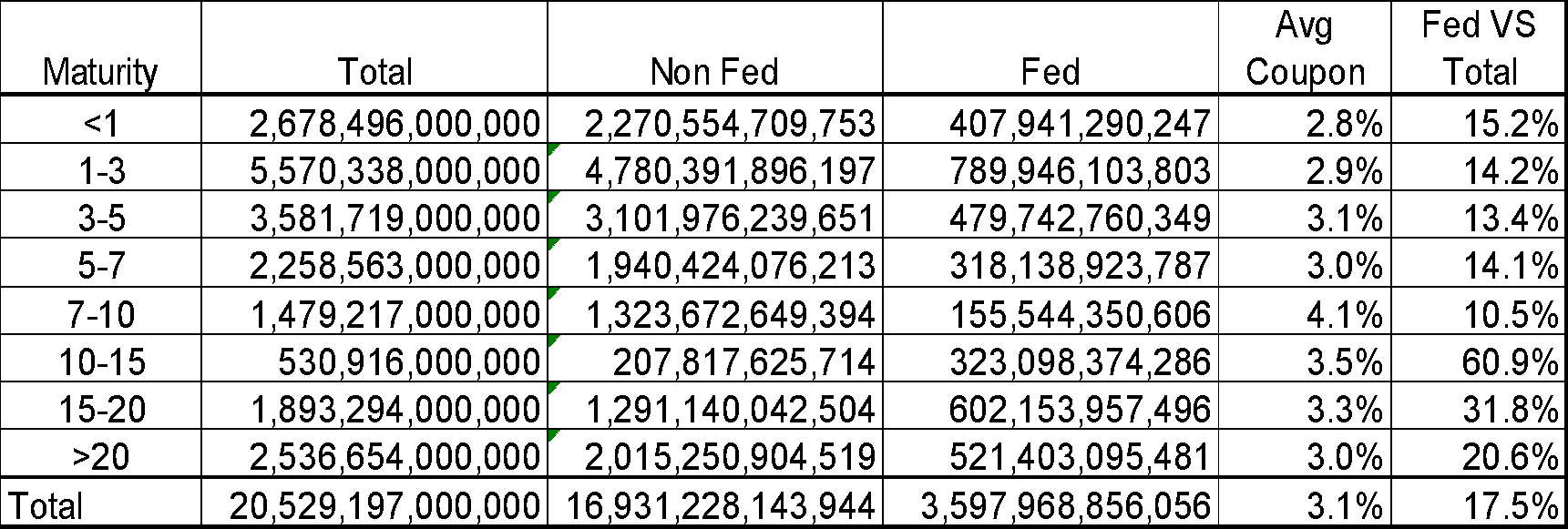
The Fed could begin an “operation twist” (which is technically not QE) by selling shorter-dated bonds on its balance sheet to buy longer-dated bonds. Its balance sheet is skewed toward the front end of the curve, so it could influence the long end by taking this step (works well in conjunction with a shift of issuance).
See the Fed’s Treasury holdings below:
Could the Fed buy more mortgages? This might be trickier, but it would be effective.
If we see a Fed that is willing to do its part to control the long-end, then I would fight the Fed.
So far we haven’t seen that.
Reasons to Fight the Fed
The cumulative effects of tariff policy are slowly, potentially showing up in some of the data (jobs and goods inflation).
Policy uncertainty in general (with tariffs at the forefront) continue to make it easier for companies to spend less rather than more.
Some of this may be applying to consumers, where the lower income consumers seem to be getting squeezed, at least a little.
Can the AI, Data Center, Chip and Electricity Production Spending Continue?
This combination has powered the economy and markets (literally and figuratively) all year. Yet more “reports” raise questions about whether the value being derived from the spending is worth it.
My “gut” is we are paying 2030 prices for 2025 technology and that has to normalize (spending coming down while technology improves). I do like the fact that the tech titans all had dinner with the president — that could be a very good sign even with my concerns about current valuations.
I like bonds across the board (my income portfolio is heavily skewed to closed-end municipal bond funds as I think that can capture my bond view very well).
I will remain cautious on equities here, until I see signs that the Fed will go above and beyond rate cuts — as I don’t think they will cut fast enough to beat the weakness that could be there. The other caveat to that is if we see the administration ramp up its “production for security” ethos with more investments, and even more importantly a lot of deregulation.
I have sold a lot of my Chinese equities in the past two weeks — I had been very overweight this part of the market (year-to-date, FXI is up 30% and 55% in one year versus 13% and 26% for the Nasdaq 100 — which seems to surprise a lot of people).
I am trying to figure out how I can best position myself for crypto and the potential growth encouraged by the genius act and easing of regulations (also the administration’s belief that USD stablecoins will create immense new demand for T-bills). For disclosure, I’m in the process of making an investment in a private crypto/blockchain fund.
The next few months should be very interesting as everyone on Wall Street is back to being fully staffed, the administration is continuing to launch new initiatives and tweak (or even radically alter) prior strategies, and, the cumulative effect of policies already in place should start creeping into the data.