The Three Witches Return to the Markets
It's triple witching time again ... Also, let's chart volatility and look at the market under pressure.
You've reached your free article limit
You've read 0 of 1 free Pro articles.
Double, double toil and trouble;
Fire burn and cauldron bubble.
Fillet of a fenny snake,
In the cauldron boil and bake;
Eye of newt and toe of frog,
Wool of bat and tongue of dog,
Adder's fork and blind-worm's sting,
Lizard's leg and howlet's wing,
From a charm of powerful trouble,
Like a hell-broth boil and bubble.
Double, double toil and trouble;
Fire burn and cauldron bubble.
Cool it with a baboon's blood,
Then the charm is firm and good.
- Song of the Witches (from MacBeth), William Shakespeare (1623)
Maybe Triple Toil?
You've already done "Fed Day" this week. Now let's do a "triple witching" expirations event. Why the heck not? You're tired. I know it. You know it. Let's get out on the playing field and earn the time off this weekend. Let's unsheathe our mighty, swift sword and wade into the abyss of the absurd process of what passes for price discovery in the year 2025 and come back with something more. More than we had entered the arena with. More than we knew we were capable of. So, it shall be. Rock & Roll.
This is the first "triple witching" expirations event of the year. What is a triple witching expirations event? This is an occasion, always on the third Friday of the third month, where single stock options, stock index futures and stock index options all expire on the same day. Yes, for a while, when single stock futures were still an actual thing in the U.S., this event was referred to as "quadruple witching."
If you hear someone use that term these days, you know that they really are not all that on top of things. The last exchange in the U.S. that listed single stock futures (One Chicago) closed in 2020 due to a lack of interest. Outside of the U.S., single stock futures still do trade.
Calculations to determine the notional value of contracts expiring today have been put as high as $4.7 trillion by analysts at Goldman Sachs GS and at $4.5 trillion by analysts at Citigroup C. Traders and investors can expect to experience much larger than usual trading volumes today, especially around the opening and closing bells that could potentially cause some price dislocation. This will likely be followed by a quieter day on Monday.
Some readers may find it interesting that while this will be the largest expiration event in three months, today's "festivities" amount to far less than the December triple witching expiration when a rough $6.6 trillion worth of options and futures contracts were either exercised or expired worthless.
Marketplace
After having rallied for three of the four trading days prior, and for four of six (without really accomplishing all that much technically), equities waffled on Thursday before trading lower ahead of Friday's expected huge trading volumes. The U.S. Ten Year Note paid 4.24% by day's end, which was roughly where it started on Thursday, while the yield on U.S. Two Year Note dropped two basis points to 3.97%. As late-night melts into early morning, I see that those two yields have dropped to 4.22% and 3.95% respectively. The U.S. Dollar Index has rallied into Friday as both gold and Bitcoin have traded off of their midweek highs.
As for equities, the S&P 500 gave back 0.22% on Thursday as the Nasdaq Composite surrendered 0.33%. Smaller stocks were hit a little harder as the Russell 2000 and S&P 400 gave up 0.65% and 0.74% in that order. Tech did not really have a nice day either. The Philadelphia Semiconductor Index lost 0.72% on Thursday as NXP Semiconductor NXPI and Broadcom AVGO each gave back 2.3%.
Breadth
Seven of the 11 S&P sector ETFs shaded red on Thursday, led lower by Technology XLK and Materials XLB on the stronger dollar. The Utilities XLU led the winners as defensive sectors regained their place on the daily performance tables. It should be noted that none of these eleven funds neither gained nor lost a full percentage point in value on Thursday. That's interesting. I'll show you why in a second.
Losers beat winners by a 7-to-5 margin across the street from George Washington (the NYSE) and by a rough 5 to 3 up by Father Duffy (at the Nasdaq). Advancing volume took a 48.3% share of composite Nasdaq-listed trade and just a 36.8% share of composite NYSE-domiciled activity.
Aggregate trade continued to be light, increasing just 0.3% on a day-over-day basis across NYSE stocks and contracting 3.2% day-over-day across Nasdaq stocks. The change in trading volume is essentially meaningless, as it has been for much of the week. It should be noted that the S&P 500 closed on Thursday up 0.42% for the week and is trying to break a four-week losing streak. The index has not posted a five-week losing streak since April into May of 2022.
Interesting
I just mentioned the lack of volatility on Thursday. What I found interesting is that Thursday's trading range for the S&P 500 (and for the Nasdaq Composite) fits neatly within Wednesday trading range for the index. The open and close on Thursday for the S&P 500 also fit inside the open close for that index on Wednesday....
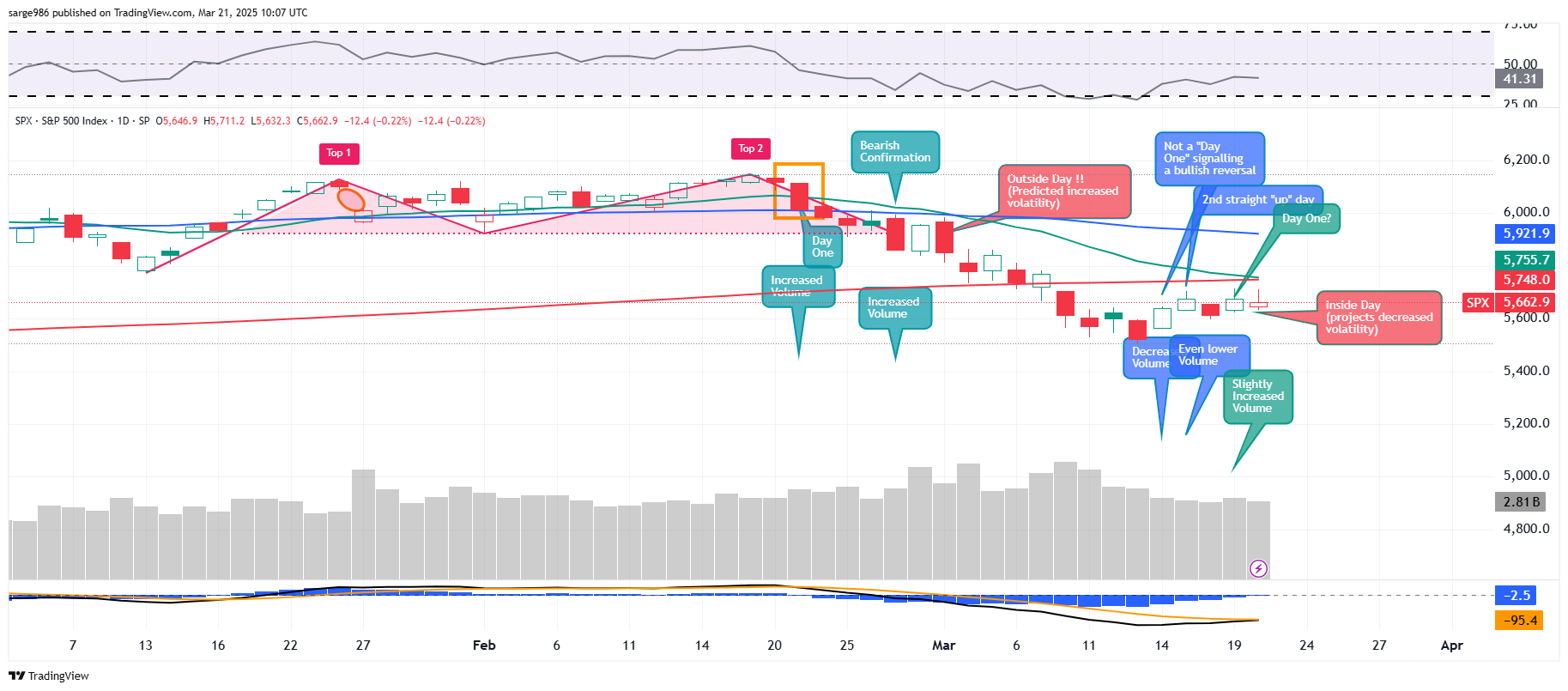
I had warned readers at the time that the "Outside Day" of March 3 very likely signaled a coming period of increased volatility and that was exactly what we got. Inside Days signal just the opposite, a coming period of reduced volatility. This "Inside Day" came one day ahead of a day where a sharp increase in trading volume is expected. That is what I find interesting. A Friday nothing burger? We should be so lucky.
Pressure...
They came from across an array of different industries. FedEx FDX, Lennar LEN, Micron MU and Nike NKE all reported quarterly earnings on Thursday evening. After some overnight volatility, I see in early trade... FDX down 7.1%, LEN down 4%. MU down 2.3% and NKE down 5.7%. That's why U.S. equity index futures were trading lower overnight. If Friday can overcome all of that, I would be impressed.
One Last Thing...
Expect the Trump administration to announce a major Air Force contract award on Friday for the Next Generation Air Dominance program. This program is expected to produce a still unnamed futuristic fighter aircraft that will replace the F-22 Raptor, which is primarily a Lockheed Martin LMT product built with some Boeing BA parts and Pratt & Whitney engines. Pratt & Whitney is a subsidiary of RTX RTX, which is the old Raytheon Technologies.
The contract is said to be worth as much as $20 billion with implications for follow-on projects with hundreds of billions over many years. The primary contractors under consideration are believed to be, obviously, Lockheed Martin and Boeing.
Economics (All Times Eastern)
1:00 p.m. - Baker Hughes Total Rig Count (Weekly): Last 592.
1:00 - Baker Hughes Oil Rig Count (Weekly): Last 487.
The Fed (All Times Eastern)
08:05 - Speaker: New York Fed Pres. John Williams.
Today's Earnings Highlights (Consensus EPS Expectations)
Before the Open: CCL (.02)
At the time of publication, Guilfoyle was long LMT, RTX equity.