The Secret to Getting Rich is Time
Article two of ten: Investing early harnesses the power of compound interest.
You've reached your free article limit
You've read 0 of 1 free Pro articles.
This is the second of ten articles in the Filthy Rich Animal Investing Basics Series.
If you like what you see and are not yet subscribed or would like to share with a friend, please visit this link to join us. It's free!
Many Gen Z-ers look at their elders and wonder why they have all the money.
The answer is simple: Old people have been investing longer.
Albert Einstein supposedly said that “compound interest is the seventh wonder of the world.”
There’s no real evidence that he said that, but the point remains: Compound interest, or compounding, is how the rich get richer over time, and so can you.
Here’s an example:
Let’s say you invested $100 in a stock that goes up by 10% every year.
- At the end of year 1, you will have made $10. Your investment will be worth $110!
- In year 2, your investment will increase by 10% again, but instead of earning $10, you will earn $11 and finish the year worth $121!
- It gets better each year. In year 3, since you start with $121 in beginning principal, your 10% gain now earns you $12.10, bringing you to $133.10.
- And a 10% gain off of year 4’s beginning principal of $133.10 is $13.31, increasing your principal to $146.41.
Each year begins from a higher level of principal (the value of your account), so you earn more and more money each year.
The Magic of Compounding
Compounding is a key source of long-term portfolio gains.
I understand. Your stock, or the broader market, won’t post gains every year. But that’s where it’s important to hang in there for the long haul.
Remember, investing is rigged in your favor!
One more point: If your stock pays a dividend, that can offset price declines, which also gives your portfolio a boost.
Here’s another example.
Let’s say your mom received a $100 gift when she graduated from high school in 1990.
She took that money and invested it in the S&P 500 stock index. Remember, the S&P 500 has returned about 10% per year, on average.
Today, her account would be worth about $2,555, when you factor in compounding and dividends.
Next, let's say she were to retire at her full Social Security retirement age of 67. That account would be worth about $10,672.
Now, let’s say that you get out of college and begin saving in a tax-advantaged plan called a 401k.
And you saved $10,000 per year ($833 per month) from age 23 until you retire at age 67.
However, you put some of your money in bonds, so that your portfolio was less risky. It returned a more conservative 7.5% per year. How much would you have?
$3 million.
Getting a Later Start
Maybe your best friend plans to start saving at age 35. They’ll save for 32 years vs. your 44 years. How much will they have when they retire?
$1.1 million.
Here’s a chart:
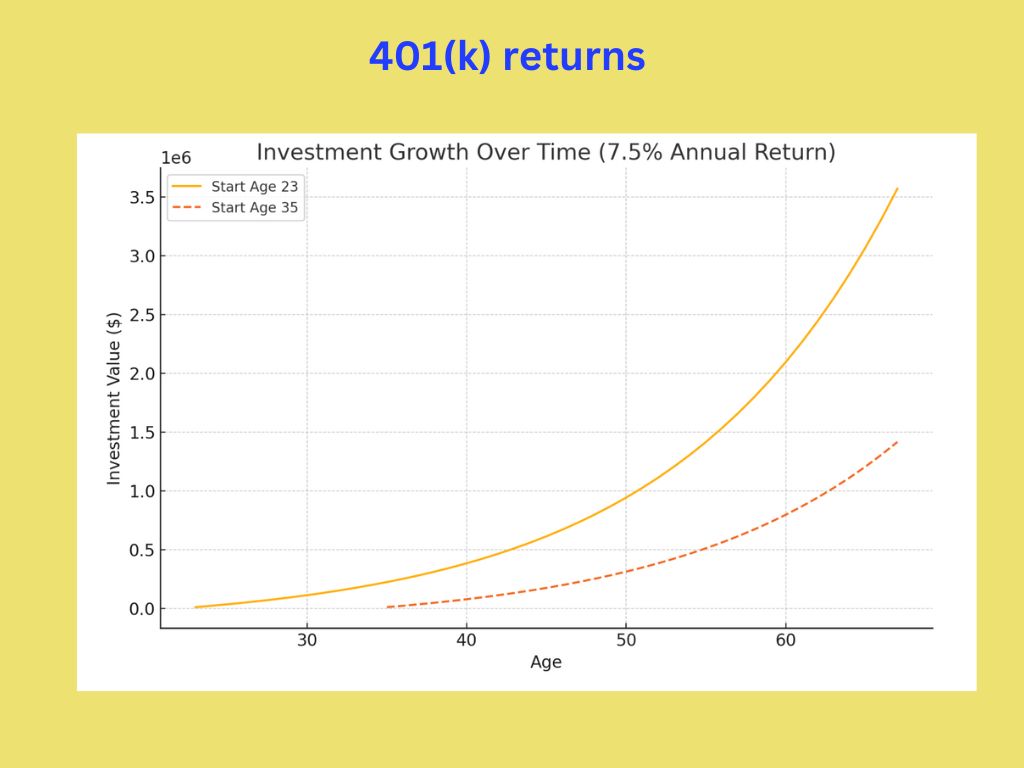
- Starting at age 23: Investing $10,000 annually from age 23 to 67 with a 7.5% annual return.
- Starting at age 35: Investing $10,000 annually from age 35 to 67 with the same 7.5% return.
Those extra 12 years really pay off. Start early.
Like what you see? Invite friends to subscribe.