The Market's Thin Red Line
We've got much to watch today, including U.S. Treasury debt securities as inflation worries grow, the latest war headlines, and the critical 200-day simple moving averages. Also, happy triple-witching day!
You've reached your free article limit
You've read 0 of 1 free Pro articles.
 Market_Recon_TSP1_KL
Good morning. Equity index futures are holding their own since the closing bell on Thursday afternoon. Actually, U.S. stocks rallied hard going into the final hour of play during Thursday's regular session and then held their own overnight. That was after what had been a tough opening and a tough five-plus hours. What's going on is both a technical reaction to where the S&P 500 is on the charts and an algorithmic reaction to headlines created by the never ending 24-hour news cycle.
Just look at the extreme volatility away from equities. Front-month WTI Crude futures traded as low as $92.41 a barrel early Wednesday morning and just below $101 per barrel before noon (ET) on Thursday. I currently see "black gold" trading with a $94 handle. How about actual gold? The yellow metal was still trading at a rough $5,000 per ounce on Wednesday morning, traded just above $4,500 on Thursday morning and is trading around $4,700 as I work through the zero-dark hours on Friday morning.
Perhaps most importantly, we come to U.S. Treasury debt securities. The U.S. Ten-Year Note has paid as much as 4.33% and as little as 4.17% over the past 48 hours. The range yielded by U.S. Two-Year paper over that same time frame is an even freakier 3.66% to 3.97%. I see the U.S. Two-Year paying 3.85% at the moment.
This is potentially a problem. When yields on short-term debt instruments rise noticeably faster than do their longer-term counterparts, that signals a fear that inflation could spike or that the nation's fiscal situation is spiraling out of control or both. The flattening on the curve, obviously makes it more difficult for lenders, aka... banks to maintain profitability as net interest margin is pressed.
Is the bond market trying to force the Fed to take short-term rates higher to fight inflation? Or is the bond market trying to force the Fed to take the Fed Funds rate lower to help re-establish a healthier looking curve? A healthier curve would not only promote economic growth, labor markets and credit creation, it also staves off the eventuality of inversion, which often precedes recession. We don't know yet. What we do know is that at least some investors are getting scared and do not really know where to go for safe haven.
Related: Investors Are Lost in the Fog of War As Hostilities Intensify
Behind the Glass
Those eyes say more than you know
Through a gust of wind, a veil of drenching rain
Angel placed carefully, echoes of long ago
Complexity, stress, pain, confusion, Energy drain
Sweet, golden child of light
Fear not, this strenuous trial by fire
Spirit rises, unknown futures are bright
Broken chains, thy wings fly higher
Two eyes
Behind the glass
The Stock Market
Let's talk about 200-day simple moving averages. How important are they? Really, really important. Portfolio managers tend to add and reduce long-side exposure at the 50-day and 200-day simple moving averages more so than any other moving averages in our technical universe. On a stock specific basis? Yes. On an index level, too? Again, yes.
Many of the large investment banks and broker-dealers employ risk managers in this modern era and these risk managers work closely with portfolio managers. While portfolio managers are charged with the creation of alpha across their holdings over a period of time, the risk manager is charged with tamping down aggregate beta across the book. The result is often less home runs, but also fewer catastrophic events, which is generally fine with upper management. The 50-day line matters greatly. The 200-day line matters more.
On Thursday, after a powerful rally saved the afternoon, the S&P 500 closed down just 0.27%, while the Nasdaq Composite gave up 0.28%. Not awful. The Russell 2000, the Dow Transports, and the Philadelphia Semiconductors closed out the day in the green. The semis were led by Lam Research (LRCX) , Advanced Micro Devices (AMD) and Intel (INTC) .
Breadth
Eight of the 11 S&P sector SPDR ETFs closed out the Thursday session in the red, led lower by the materials (XLB) and staples (XLP) . energy (XLE) , once again, led the winners. Losers beat winners at the NYSE by a rough four-to-three margin and by less than five-to-four at the Nasdaq. Interestingly, advancing volume took a 47.6% share of composite NYSE-listed trade as aggregate volume across NYSE-listing popped for a day-over-day increase of 13.2%.
That would be scary on its own, if not for the fact that this negativity did not extend to the Nasdaq. Advancing volume took a 50.2% share of composite Nasdaq-listed activity on aggregate trade that contracted by 8.3%. Aggregate trading volume increased across the membership of the S&P 500 as well, so a mixed Thursday at best.
The Charts
Yes, we have to watch headlines for where the keyword readers will go. When will the Strait of Hormuz open safely? According to the Wall Street Journal, that battle has been renewed with increased intensity while we slept. Have the U.S. and Israel really destroyed Iran’s ability to enrich uranium? Apparently, Benjamin Netanyahu thinks so. Iran continues to strike its neighbors.
Then, remember, this is a "Triple-Witching" expirations event Friday. This kind of expirations event occurs just four times a year when stock index options, stock index futures and single stock options all expire on the same day. The result is always a day of increased trading volumes and sometimes increased volatility.
Some traders and some in the financial media will incorrectly refer to this event as a "Quadruple-Witching" event. That is a relic of a bygone era when single stock futures would also expire on this day. Single stock futures stopped trading in the U.S. in 2020. It's been six years since we actually experienced a "quad-witch."
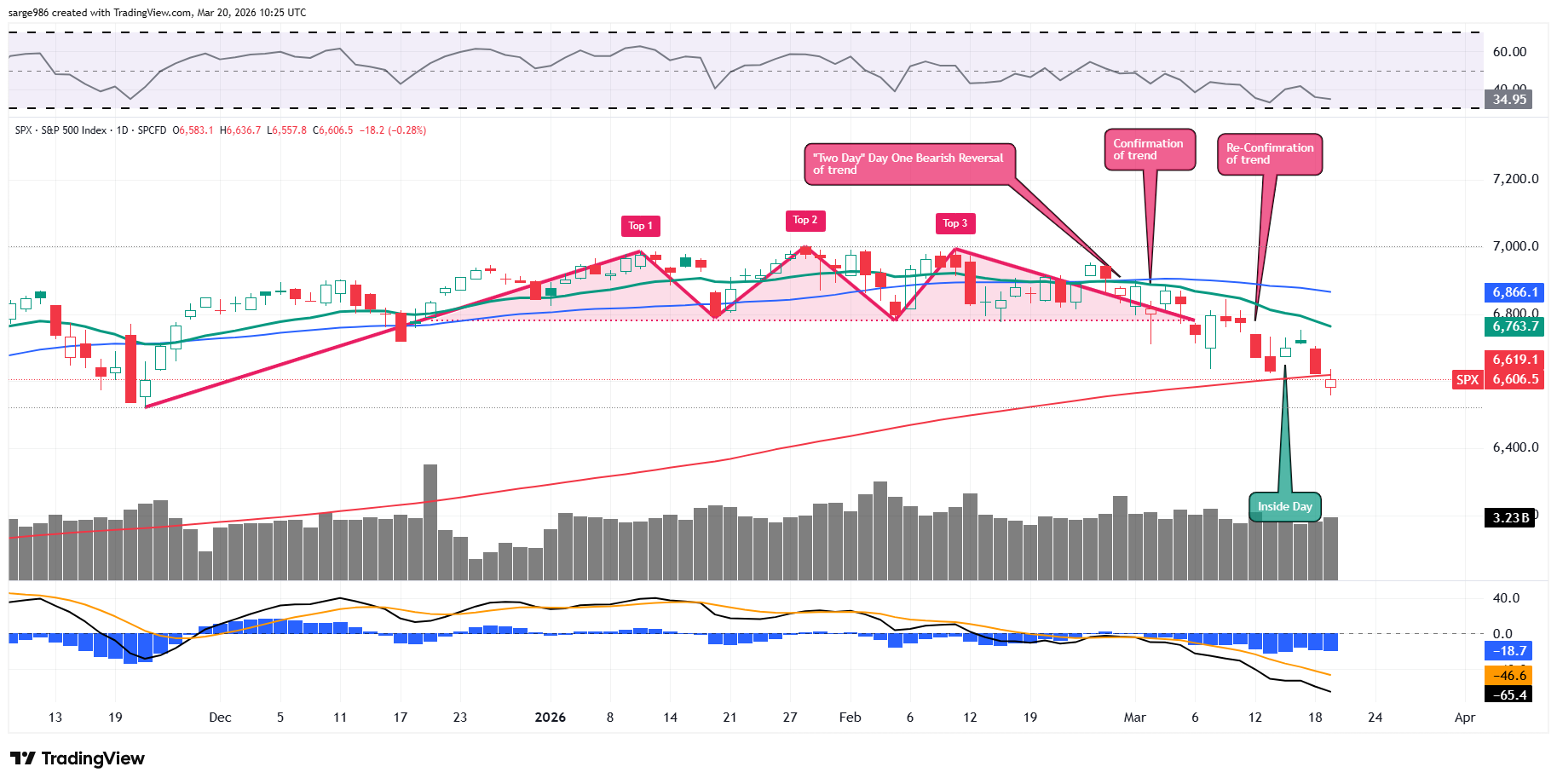
Readers will note that the S&P 500 closed below that all-important 200-day simple moving average on Thursday but maintained contact with that line. The S&P 500 will have to maintain contact with that thin red line going into the weekend in order to keep the wolves at bay. Both Relative Strength and the daily moving average convergence divergence are not allies for the long equity or buy and hold crowds at this time.
Note to Readers
Readers will likely see that I mention both AMD and Intel in this article, yet my disclosure states that I have no equity positions, at least in any vehicle that I manage myself. That is true. That is the result of my divorce settlement and is the reason I was unexpectedly off on Thursday and will be off for most of Friday. I have had to suddenly liquidate the Sarge-folio so it would stop changing in value.
This way, I could carve out the interest of my former spouse who had no interest of her own in simply halving my existing positions. The Sarge-folio will begin reconstruction shortly. Those festivities will begin if not later this afternoon, then early next week. Hey, "Stocks Under $10" crowd... Planet Labs (PL) , rock on.
Economics
(All Times Eastern)
1:00 p.m. - Baker Hughes Total Rig Count (Weekly): Last 553.
1:00 - Baker Hughes Oil Rig Count (Weekly): Last 412.
The Fed
(All Times Eastern)
No public appearances scheduled.
Today's Earnings Highlights (Consensus EPS Expectations)
No significant quarterly earnings scheduled.
At the time of publication, Guilfoyle had no position in any security mentioned.