The Market Is Giving You a Mulligan: This Is Your Chance to Manage Risk Better
Were you uncomfortable or angry in April? If so, you now have an opportunity to handle things better than you did earlier this year.
You've reached your free article limit
You've read 0 of 1 free Pro articles.
If you were uncomfortable with the paper losses that occurred in your investment portfolio in post-“Liberation Day” trade, now is your chance to do things differently. It isn’t often that we are given Mulligans in life, particularly so quickly after the undesirable event, but that is precisely what we are being presented with.
If you were losing sleep and complaining to friends and family about investment losses in April, you were likely over-exposed to risk. Nobody wants to see their savings and investment accounts lose value, but there is a reason that equities are called risk assets. If they posed no price risk, they would be T-Bills offering less profit potential. Without price risk, higher returns are not possible, thus, investors must decide how much risk they can handle, both emotionally and financially.
Charlie Munger used to say, "If you’re not willing to react with equanimity to a market price decline of 50% two or three times a century, you’re not fit to be a common shareholder, and you deserve the mediocre result you’re going to get." Yet, younger investors have been spared the wrath of this type of discomfort by aggressive economic and monetary policy aimed at avoiding the natural business cycle. We don’t yet know if natural market cycles will eventually be allowed, but we should always proceed and manage risk as if it is a possibility.
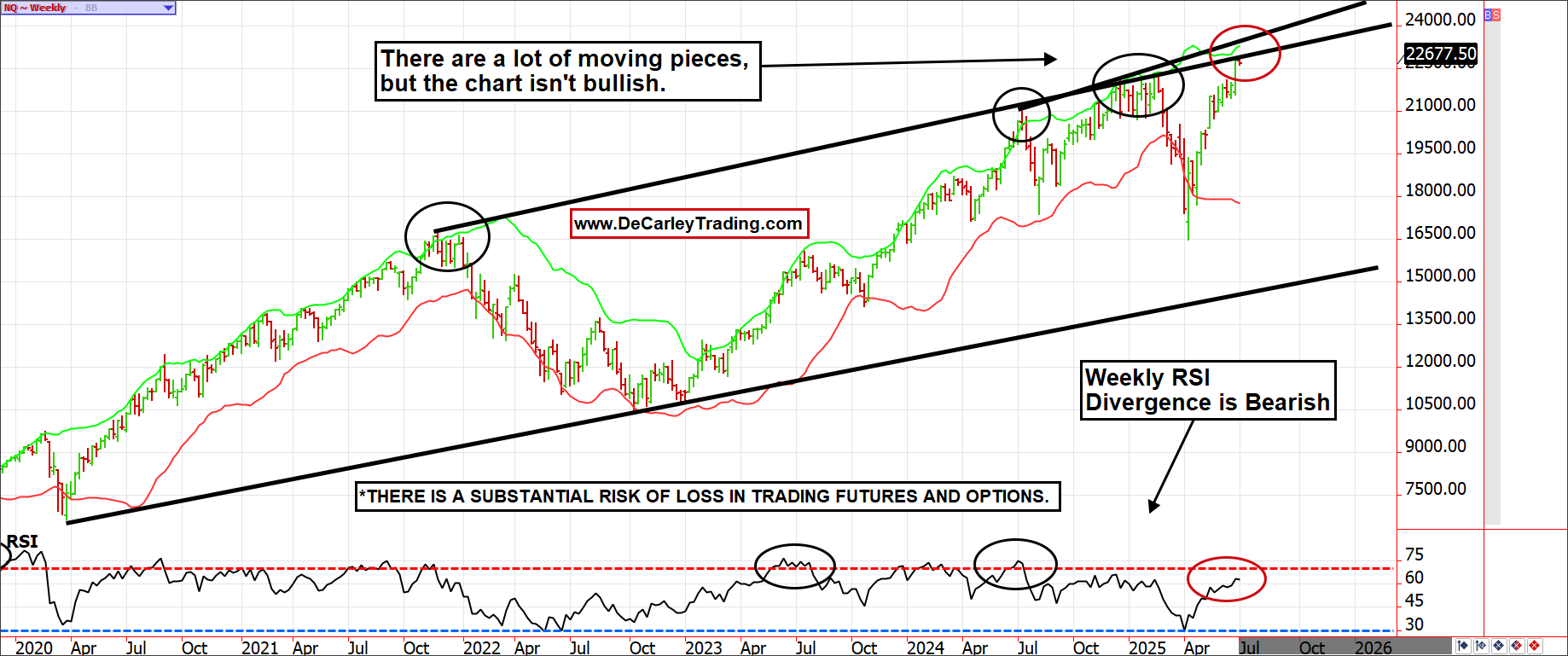
In our view, this is as good a time as any to acknowledge that there is, in fact, additional risk associated with holding stocks. More importantly, in recent years, the market has been primarily led higher by tech stocks and the Nasdaq 100, which is trading at levels that could trigger liquidation if investors are given a reason to sell.
Also, although we haven’t seen any signs of buyer fatigue yet, at some point, price and earnings might start to matter to investors. If so, the upside potential in the Nasdaq 100 is minimal relative to the downside risk.
The RSI, or Relative Strength Index, on a weekly chart (and monthly, for that matter), continues to show divergence between price and momentum. This means that as the market reaches new highs, the RSI does not. While this isn’t necessarily a reason to go short, it is a reason to question the rally and, more importantly, advance with caution.
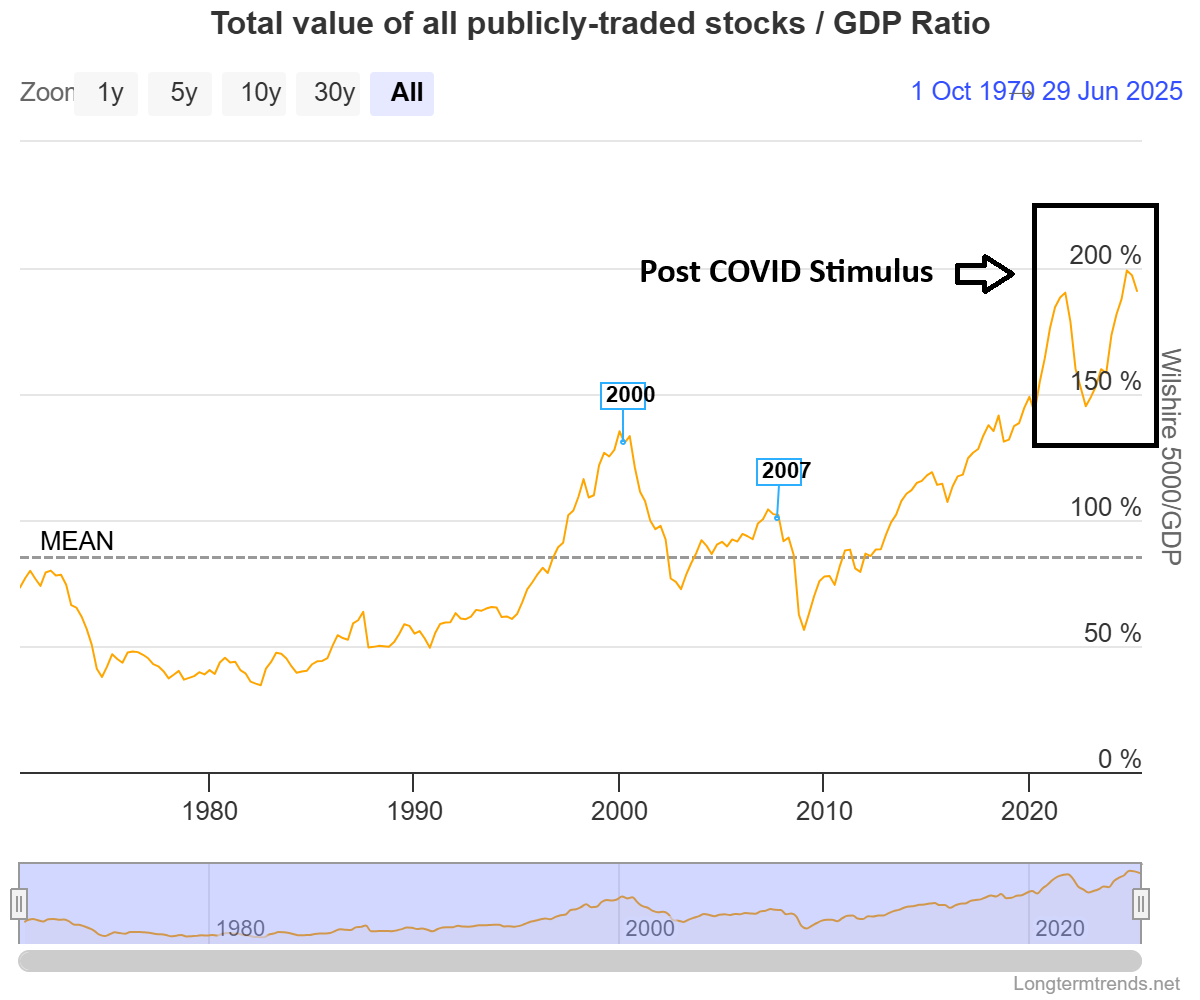
The Warren Buffett indicator compares the total stock market value to GDP; the ratio indicates whether the market is overvalued or undervalued based on actual domestic economic production. We are currently operating at a ratio of 200%, the most extreme valuation on record, and roughly double the 2007 valuation prior to the financial crisis. Even the dot-com bubble saw the ratio peak at under 140%.
As we often mention, the bazooka of stimulus and market liquidity shot into the veins of the global economy during the pandemic has allowed the Buffett indicator to remain obscenely overheated; however, we suspect there will eventually be an end to the euphoric valuation. It would be nice to have a crystal ball to predict when, but even without that tool, we know the risk is there, and flooring the gas pedal at extreme valuations probably isn’t the way to long-term prosperity.
Trying to time the market is complex and often leaves many investors worse off than they would have been otherwise. But not all of us should be fully allocated to equities at all-time highs and/or under-hedged.
My business tends to perform well when financial markets are doing well and underperform when they are struggling. Accordingly, I am less willing to tolerate equity market risk than others might because I get hit on both income and net worth when things go sour. Furthermore, I am getting to an age at which I might not have 10 or more years to ride out a rough patch. Thus, for me, it makes sense to aggressively hedge and allocate toward risk-off assets (mostly income-producing).
You might be in a different boat, but this is a comfortable time to ask yourself what makes the most sense to you. Were you uncomfortable or angry in April? If so, now is your chance to do things better for your circumstances the next time around.
If you aren’t interested in selling your risk assets for fear of missing out or to avoid a taxable event, the futures and options markets provide amazing opportunities to hedge price risk effectively. For instance, as the market ascends toward resistance levels and into overbought territory, as it usually does during July, it is a good time to consider using risk reversals to hedge portfolios. This strategy involves selling call options and using the proceeds to buy put options; in essence, a trader is using the market’s money to finance the purchase of portfolio insurance. We will likely be offering our brokerage clients a detailed recommendation of this sort in the coming weeks.