The Housing Sector Hasn't Seen the Worst of It Yet
February new homes sales are just the latest sign of a deteriorating sector weakness that appears to be spreading.
You've reached your free article limit
You've read 0 of 1 free Pro articles.
Equity markets have stabilized nicely over the past three trading sessions and stocks had a huge rebound rally to begin the week with the Nasdaq up better than 2.25% on Monday. The S&P VIX Index (VIX) is back down to the 17 level after surging over 25 two weeks ago. Some potential moderation around new tariffs is getting the lion’s share of the credit for the market’s recent reversal of fortune. However, this feels more like a relief rally than a true inflection point for the markets.
There continues to be an increase in worrying economic reports. I am especially concerned when it comes to real estate. Delinquency rates on commercial real estate loans have been moving significantly higher for some time now.
The situation in residential real estate is also deteriorating. Existing home sales for both 2023 and 2024 both came in at their lowest levels since 1995. A lot of that is due to homeowners being locked into low mortgage rates on their existing abodes. That weakness now appears to be spreading to other parts of the housing sector, which makes up between 15% to 18% of U.S. economic activity.
On Tuesday, February new home sales data hit the wires. Seasonally adjusted sales were up slightly from that of January and the month benefited from better weather in some regions of the country. New homes sales were also about 5% higher than the same month in 2024. However, there were some concerning data points contained within the report.
The first was that the median sales price of a home fell some 1.5% on a year-over-year basis. And that is misleading in some ways. Let’s say I am a homebuilder, and I sold a 3/2 townhouse in February 2024 for $450,000. In February of this year, I sold the identical model in the same community for $445,000. However, in order to close the sale this year I had to offer a 2/1 mortgage rate buydown and throw in $15,000 in free upgrades. Now in the new home sales report, it just looks like that townhome model proceeds fell just over one percent, but the "real" price of the home obviously had a much bigger decline.
The most disturbing part of the new home sales report was that new home inventory has now surged to nearly nine months' supply. Prior to the pandemic, there was less than a six-month supply of new homes. This fell to just over three months during the summer of 2020 as the Covid outbreak spread fully across the nation.
To put February's new home inventory level in perspective, outside a brief blip following the start of the Fed's monetary tightening in 2022, it is first time it has seen this level since the tail end of the Housing Bust in 2010.
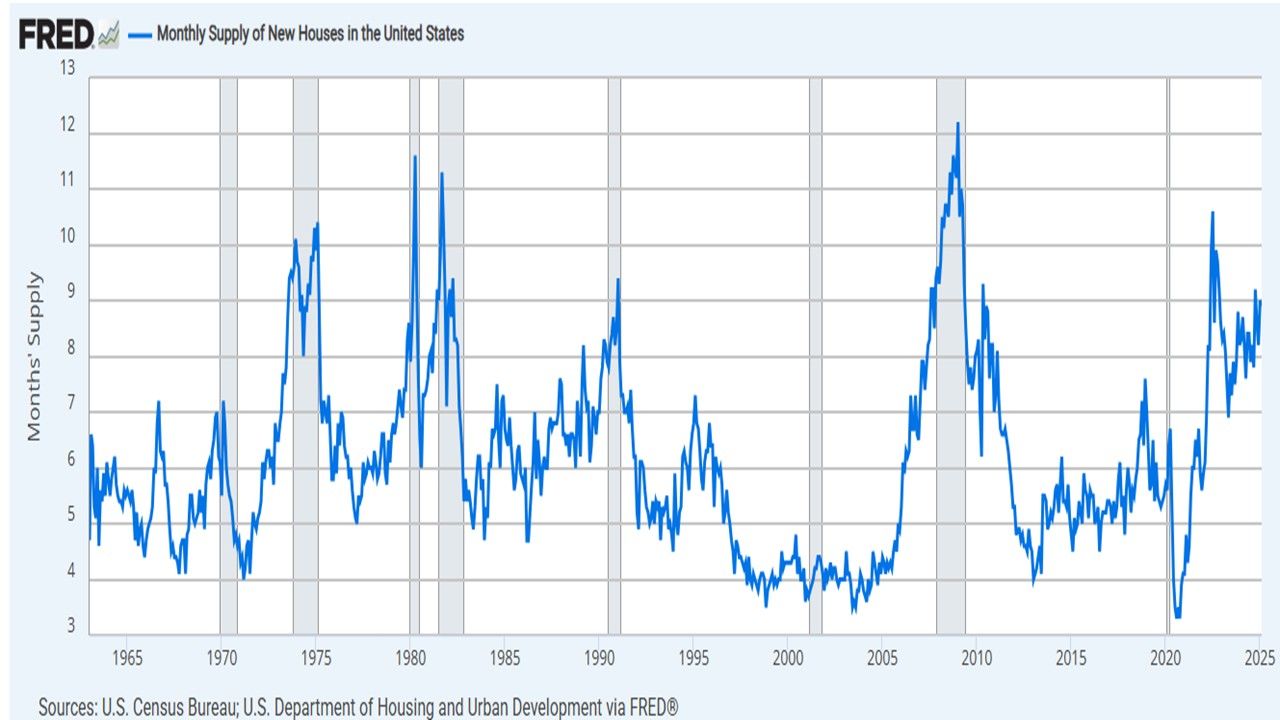
This weakness can be seen in the commentary following the quarterly earnings report from KB Home KBH that came out Monday after the bell. The large homebuilder's home sales per community fell sharply from the same period a year ago. Management also noted a weak spring selling season and that they were having to "adjust" pricing and incentives in February to move inventory. Leadership also trimmed FY 2025 guidance, noting housing affordability issues and increasing macroeconomic concerns. The stock fell just over 5% in Tuesday trading.
The SPDR S&P Homebuilders ETF XHB surged about 25% from the beginning of July to its recent peak just past the November election, largely on the hopes for lower mortgage rates. But this sector ETF has now given back all of that rally. However, this is not a buyable dip. Potential new tariffs on Canadian lumber are just the latest of a litany of headwinds the industry faces. Things are also likely to get worse before the sector eventually bottoms.
At the time of publication, Guilfoyle had no positions in any securities mentioned.