The Good and Bad on Jobs, Fannie & Freddie's Buying Spree, Semis Slapped
We do some 'Jobs Day' homework, take a hard look at the $200 billion in mortgage-backed securities purchases & check on semiconductors.
You've reached your free article limit
You've read 0 of 1 free Pro articles.
Did you enjoy your "time off?" Though this is the second Friday of the month, the first Friday came on the first trading day of the year. That makes this the first "normal" jobs day since the Bureau of Labor Statistics' August survey results were released on Sept. 5. All of the somewhat sketchy data in between has been released with what at times has been lengthy delays.
How important are today's December numbers? While easy to quantify, these numbers will be difficult to qualify. The headline number, which is the print for non-farm payrolls, has gone negative for three of the past six months when looked back upon. The nearly as high-profile unemployment rate has moved from 4.1% in June up to 4.6%. While 4.6% is still lower than what I was taught as a young man was full employment (we now know that was incorrect), that is a sharp rise in a short time.
What I find most alarming and perhaps best reflects the decreased demand for labor as 2025 wore on was the rise in the "underemployment rate," or what is also known as U-6 unemployment from 7.5% in January to 8.7% in November. This paints a picture, as far as I am concerned, of an economy where, even if losing employment has not yet become endemic, finding new employment, full-time employment in particular, is now difficult.
This decreased demand for labor is further identified for us by an average workweek (for full-time employees only) that has ranged between 34.2 hours and 34.3 hours really since early 2024. Not so long ago, normal was considered to be 34.4 to 34.5 hours. In addition, wage growth has slowed from 4.2% on an annual basis as recently as November 2024 to just 3.5% for November 2025.
Is there hope? There's always hope. As automation, robotics and artificial intelligence continue to progress, the "employment" subcomponent of the ISM Manufacturing Index (PMI) has printed in a state of contraction for 11 consecutive months. That said, the manufacturing sector employs only a rough 9% of the U.S. labor force. The ISM Non-Manufacturing Index (Services PMI) sports an employment subcomponent that finally printed in a state of expansion in December for the first time since May. Yes, despite the advance of AI.
Quantitative Easing, Executive Style?
On Thursday, Bill Pulte, who is Director of the Federal Housing Financing Agency, announced that Pres. Trump had authorized Fannie Mae (FNMA) and Freddie Mac to purchase $200 billion in mortgage-backed securities. Now, to be fair, Fannie and Freddie have bought and sold mortgage-backed securities on and off for many years to maintain conditions of liquidity and pressure spreads between those securities and U.S. Treasury debt securities.
The spread between interest rates on mortgage-backed debt and Treasury debt securities has been elevated and pressuring these spreads is a proven method that aims to and does drive down borrowing costs for potential homeowners, so it's hard to see this as an overall negative for younger households. Pulte described this move as the largest mortgage-related debt purchase in the history of the two firms but did not let on just how quickly or at what pace these purchases will be carried out.
So, is this quantitative easing? Well, it certainly won't be conducted by the Federal Reserve or end up impacting the Federal Reserve's balance sheet. That said, this will drive rates lower. This week, the Mortgage Bankers Association reported the average 30-Year fixed mortgage rate at 6.25%. This could definitely put a "5" handle on that rate and maybe even a mid-5 handle over several months.
My short answer is no; this is not quantitative easing nor is it the implementation of a monetary policy work-around. These purchases will come from the existing cash positions on the balance sheets of the two companies mentioned.
When the central bank purchases debt securities in order to pressure rates, it creates the cash out of thin air as needed, which increases both money supply and the monetary base. As we always knew, but many found out the hard way in the wake of the pandemic, the abuse of the money supply for political purposes will almost always lead to sharp upward fluctuations in both producer and consumer level inflation across multiple levels of the economy.
Mixed Bag
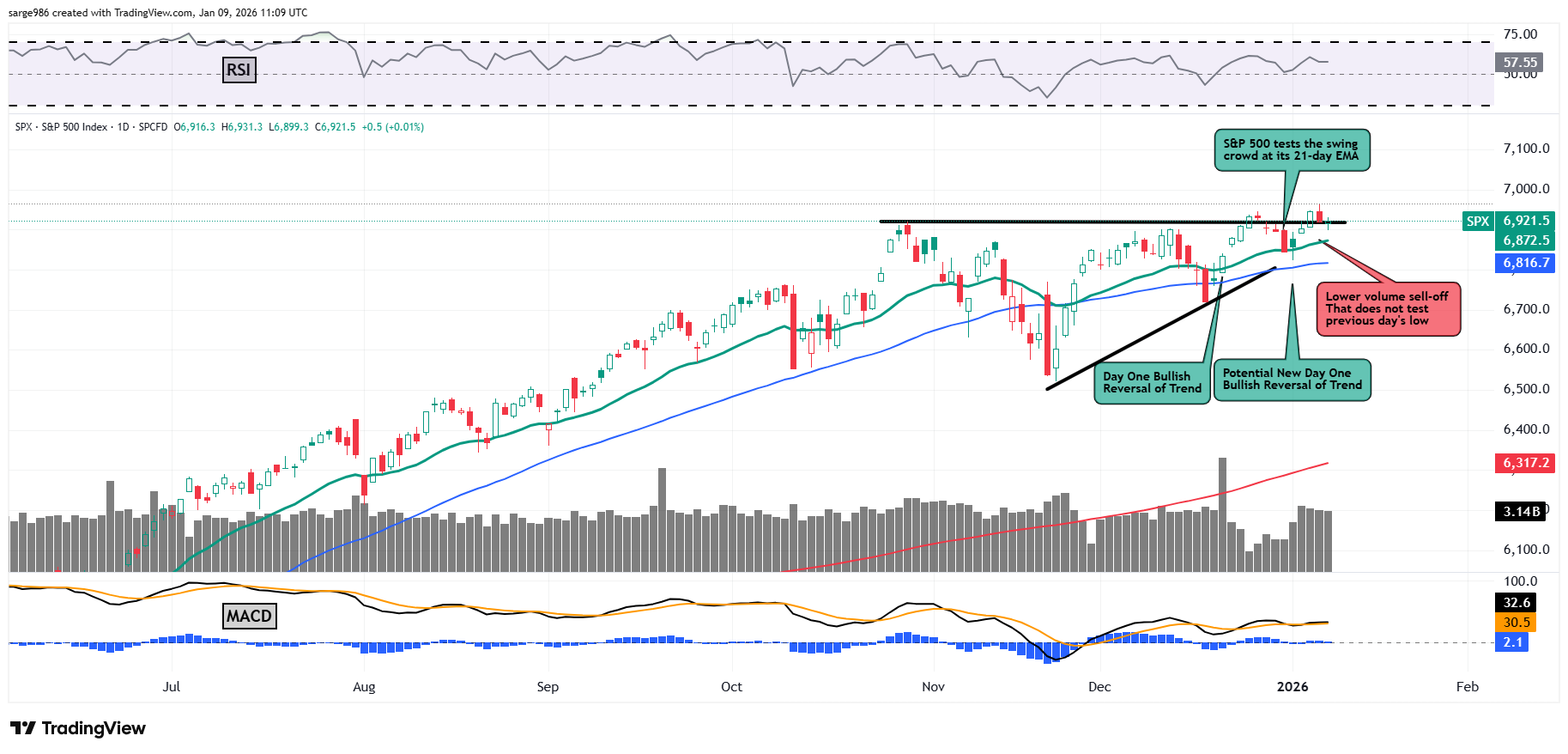
Thursday's markets were pretty solid really. Except for tech and I guess biotech. The S&P 500 essentially closed unchanged (+0.01%), while the Nasdaq Composite gave up 0.44%. Spreading out our view a bit, the Philadelphia Semiconductor Index was slapped around for a loss of 1.83%. Profit takers hit the memory / storage space ahead of Jobs Day as SanDisk (SNDK), Storage Technology (STX) , Western Digital (WDC) and Micron (MU) were all set back a few days.
On the bright side, the Dow Transports popped for a gain of 1.1% as small caps roared. The S&P 600 gained 1.41% as the Russell 2000 added 1.11%. Very quietly, "big data" and cybersecurity stocks suffered as those corners of the AI trade took a hit. Datadog (DDOG) , MongoDB (MDB) both surrendered more than 6% on the day as Zscaler (ZS) and CrowdStrike (CRWD) both gave up more than 3%. To be fair, CrowdStrike did announce a deal to acquire identity management start-up SGNL for a rough $740 million.
Minty Fresh
Despite the mixed results at the index level, breadth was minty fresh on Thursday. Nine of the 11 S&P sector SPDR ETFs ended the day in the green with Energy (XLE) and Staples (XLP) in the lead. Technology (XLK) ran out the session in last place. Overall, cyclicals out-performed Defensives and everyone out-performed growth.
Winners beat losers by more than a two-to-one margin at the NYSE and by a rough five-to-four at the Nasdaq. Advancing volume took a near-commanding 68.2% share of composite NYSE-listed trade and a still majority 51.1% share of composite Nasdaq-listed activity despite the losses across the tech space. Even more interesting, on a day-over-day basis, aggregate trade across NYSE-listings was up 2.3%, but down an even 8% across Nasdaq-listings. This backs up the idea that weakness across tech amounts to some "pre-Jobs Day" profit taking.
We now have a two-day pause coming after a three-day rally. The S&P 500 is right where it needs to be. That's how important this December jobs report is in the short to medium-term. The index will either confirm last Friday's Day One reversal or will fail at pivot. Either way, something technically significant will likely happen this morning.
In Other News...
- Seventeen Republican Representatives joined with all Democrats in the House to advance a three-year extension of the Affordable Care Act subsidies that expired at year's end. The final vote to pass the legislation was 230-196. The bill will now go to the Senate where a similar bill failed last month. The bill is expected to fail in the upper chamber of the U.S. legislative branch of government yet again.
- General Motors (GM) made clear on Thursday that the it will take an additional $7.1 billion charge tied to the scaling back of both the company's production of electric vehicles and its Chinese operations. This is in addition to the $1.6 billion charge that the company had already recognized for the September quarter. Of the $7.1 billion, $6 billion will include mostly non-cash impairments. The remainder will be tied to the restructuring of the firm's Chinese joint venture, SAIC General Motors Corporate Limited.
December Employment Situation (08:30 ET)
Non-Farm Payrolls: Expecting 57K, Last 64K.
Unemployment Rate: Expecting 4.5%, Last 4.6%.
Underemployment Rate: Expecting 8.8%, Last 8.7%.
Participation Rate: Expecting 62.6%, Last 62.5%.
Average Hourly Earnings: Expecting 3.6% y/y, Last 3.5% y/y.
Average Weekly Hours: Expecting 34.3, last 34.3 hours.
Other Economics
(All Times Eastern)
08:30 - Building Permits (Sep): Expecting 1.34M, Last 1.33M (SAAR).
08:30 - Building Permits (Oct): Expecting?
08:30 - Housing Starts (Sept): Expecting 1.31M, Last 1.307M (SAAR).
08:30 - Housing Starts (Oct): Expecting?
10:00 - U of M Consumer Sentiment (Jan-adv): Expecting 53.2, Last 52.9.
10:00 - U of M One-Year Inflation Expectations (Jan-adv): Expecting 4.2%, Last 4.2%.
10:00 - U of M Five-Year Inflation Expectations (Jan-adv): Expecting 3.1%, Last 3.2%.
1:00 p.m. - Baker Hughes Total Rig Count (Weekly): Last 546.
1:00 - Baker Hughes Oil Rig Count (Weekly): Last 412.
The Fed
(All Times Eastern)
10:00 - Speaker: Minneapolis Fed Pres. Neel Kashkari.
1:35 p.m. - Speaker: Richmond Fed Pres. Tom Barkin.
Today's Earnings Highlights
(Consensus EPS Expectations)
No significant quarterly earnings scheduled.
At the time of publication, Guilfoyle was long CRWD equity.