The Art of the Elusive Deal
We seem so close yet so far from so many agreements ... on trade and more. Also, a refresher on Nvidia, AMD and UNH and the chart of the S&P 500.
You've reached your free article limit
You've read 0 of 1 free Pro articles.
So Close Yet So Far (excerpt)
So close, yet so far from paradise
I hold you in my arms, in paradise
Is mine, then you slip away
Like a child at play, and here am I
So close, yet so far from paradise
- Joy Byers (Elvis Presley), 1965
So Close...
To peace in Eastern Europe? The Middle East? To a winding down of the recent market volatility? Or maybe it's just begun .... To a re-acceleration of consumer-level inflation? Or an ebbing of economic activity that suppresses demand and with it, consumer prices. Safety in gold? Sure. The U.S. dollar? Not so much. U.S. Treasury debt securities? What week is this? I'm not sure.
U.S. equity index futures opened lower on Sunday night. Within the hour, those losses would moderate somewhat. The Wall Street Journal reported before 7 p.m. ET on Sunday night that a series of Trump administration ideas on ending the war between that nation and Russia had been floated past Ukrainian leadership last week and that some kind of response might be expected as soon as later this week. I don't know if the fact that this Sunday night rally in U.S. equity index futures markets failed to truly materialize into anything significant is meaningful, but here we are.
This past Thursday, in Paris, France ... U.S. Sec. of State Marco Rubio, Special Envoy Steve Witkoff, and retired Lt. Gen. Keith Kellogg, who currently serves as an envoy to Ukraine, met with Ukrainian Defense Minister Rustem Umerov, Ukrainian Foreign Minister Andrii Sybiha and Andriy Yermak, who is a top aide to Pres, Volodymyr Zelenskyy. The group is expected to meet again this week in London, England.
What's On the Table?
According to the report in the Wall Street Journal, there was no "take it or leave it" ultimatum made, but Pres. Trump's group is looking for feedback on what, at this point, Ukraine would find acceptable. Then, a proposal can be made to the Russian leadership. Witkoff would likely then make another trip to Moscow should a solid offer be made.
It is believed that the proposal may include U.S. recognition of Russian control over the Crimean Peninsula, which has been occupied by Russian forces since 2014. It is also believed that these ideas may include the ruling out of Ukraine's eventual NATO membership, but that areas of Ukraine currently occupied by Russian forces that were taken as part of the 2022 invasion and its aftermath, would not be recognized. Another idea is that the area around the nuclear power plant at Zaporizhzhia would be declared "neutral" and would then come under U.S. control.
The plan is likely to fall short of what both sides have indicated that they would demand. That said, this is a serious starting point and will likely get at least a serious response. Senior European officials are being kept in the loop by the U.S. team.
Rally Attempt
Perhaps ... the attempted Sunday night rally failed due to rumors that Japan would reject what had been put forth during last week's trade negotiations with the U.S. and that Japan's ruling party was likely to make a counterproposal in short order. Perhaps that attempted rally failed as Beijing's Ministry of Commerce made a statement accusing the U.S. of "unilateral bullying" and that "China firmly opposes any party reaching a deal at the expense of China's interests. If this happens, China will not accept it and will resolutely take reciprocal countermeasures."
Despite what sounds like something of a threat against other U.S. trade partners, Bloomberg News is reporting that both South Korea and India plan to at least open trade negotiation with the U.S. this week. Readers may recall last week's report in the Wall Street Journal that the Trump administration was planning to pressure trade partners to consider reduced trade with Chinese businesses in return for reduced U.S. tariffs.
In Other News
In Rome, Italy, Pope Francis, the first Catholic pontiff in history from the western hemisphere, has passed at the age of 88. Born Jorge Mario Bergoglio, Francis succeeded Benedict XVI, who retired in 2013, and was both the first pope elected from the Jesuit order and the first non-European pope elected since Gregory III in the year 731.
Last Week
There were quite a few high-level events that impacted trade over the four-day business week completed last Thursday. The trade war between the U.S. and China escalated to a new level as both Nvidia NVDA and Advanced Micro Devices AMD revealed charges that these companies would have to take in the near-term future against inventories of what had recently been China-compliant higher-end AI-capable GPUs.
Additionally, UnitedHealth Group UNH suffered a 22.4% loss on Thursday in response to quarterly misses on both earnings and revenue generation as well as the insurer having to issue reduced full year guidance due to increased costs related to Medicare.
Lastly, Fed Chair Jerome Powell spoke form the Economic Club of Chicago last Wednesday and sounded quite hawkish, expressing concerns about what could be the greater than previously anticipated negative economic impacts of this administrations' trade policies. Powell overtly fretted over the possibility of the Fed having to prioritize either focusing on fighting potential inflation or supporting economic activity.
Pres. Trump publicly criticized the Fed Chair in response for being "too late" to act and opined on whether or not he could remove Powell from his position. The Wall Street Journal has reported that this president has privately discussed removing Powell for months. Bear in mind that this president was only sworn in three months ago yesterday.
Both the S&P 500 and Nasdaq Composite posted their seventh losing week in the past nine, as these trade policies and an uncertain future at the central bank have impacted investor sentiment.
The Numbers
What the major to mid-major U.S. equity indexes did as equity markets struggled through the holiday-shortened week just completed. Most of these indexes remain close to the midpoints of their ranges for the month of April.
- The S&P 500 gained 0.13% on Thursday but gave back 1.5% for the week.
- The Nasdaq Composite gave up 0.13% on Thursday and 2.62% for the week.
- The Nasdaq 100 essentially closed flat on Thursday, losing 2.31% for the week.
- The Russell 2000 gained 0.72% on Thursday and 1.1% for the week.
- The S&P Small Cap 600 gained 1.06% on Thursday, but just 0.87% for the week.
- The S&P Mid Cap 400 gained 0.83% on Thursday and just 0.8% for the week.
- The Dow Transports ran 2.4% on Thursday, posting just a 0.22% gain for the week.
- The Philly Semiconductors surrendered 0.64% on Thursday and 3.97% for the week.
- The KBW Bank Index gained 1.06% on Thursday and 1.89% for the week.
On Thursday, nine of the 11 S&P sector SPDR ETFs closed in the green, led higher by the Energy XLE, the Staples XLP and the REITs XLRE. Tech XLK and Health Care XLV closed lower for the session. For the week, eight of the 11 sector SPDR funds made gains. Energy was again the winner, with Discretionaries XLY mired in last place. There was no clear-cut outperformance among cyclical, and defensive sectors, but growth clearly fell behind.
Earnings
First quarter earnings season is now well under way. According to FactSet, with about 12% of the S&P 500 having reported, 71% of firms so far have beaten earnings expectations while 61% of firms so far have beaten expectations for revenue generation.
On a year-over-year basis ... the S&P 500 is running at a Q1 blended (earnings & expectations) growth rate of 7.2% for earnings, down from 7.3% last week. Revenue growth is still running at 4.3%. Most interestingly, the outlook for the second (current) quarter is falling out of bed. Consensus for Q2 earnings growth is down to 7.2% from 8.2% a week ago and from 9.1% two weeks ago. Q2 revenue growth is currently seen at growth of 4.2%, down from 4.5% last week and 4.6% the week prior to that.
For that first quarter, Health Care is currently expected to show earnings growth of 34.5%, with Technology a distant second place at growth of 14%. Four sectors are expected to post Q1 earnings contractions led lower by Energy (-14.5%) and the Materials (-11.5%).
For the full year 2025, Wall Street now sees earnings growth of 10% even, down from 10.6% a week ago, and 11.3% two weeks ago. Expectations for full year revenue growth have fallen from 5.4% to 5.1% over those same two weeks.
As far as valuation is concerned, the S&P 500 went into this past weekend trading at 19.0-times forward looking earnings, same as a week ago and 23.7-times 12-month trailing earnings, up from 23.7-times a week back. These valuations both remain well below their five-year averages of 19.9-times forward looking earnings and 24.7-times trailing 12-month earnings, respectively.
The GDP Game
Last week, the Atlanta Fed revised their GDPNow model for the first quarter up to "growth" of -2.2% (q/q, SAAR) last week from -2.4% the week prior. Ex-the gold trade, Atlanta sees a Q1 GDP of -0.1%, up from -0.3%. As most readers probably well know by now, there is absolutely no consensus in regard to this economic contraction.
Among other regional central bank district branches running close to real-time GDP models, the New York Fed's estimate for Q1 growth now stands at 2.58%, down from 2.59%, while the Cleveland Fed continues to leave its model unrevised at growth of 1.86% (... starting to wonder if this model is being updated). Interestingly, The St. Louis Fed's model was revised slightly lower over the weekend to growth of a still surprisingly strong 2.83% from 2.87%.
Where is my trusted Hedgeye Nowcast Model? If you're a reader of mine, you know that I trust their work enough to pay for it, because I have outsourced the need for retaining a staff in this way. Hedgeye remains mildly contractionary on a quarter over quarter, seasonally adjusted, annualized basis for the first quarter.
The S&P 500 Chart...
Just take a look at the recent behavior of the S&P 500. It has become very difficult to technically confirm anything...
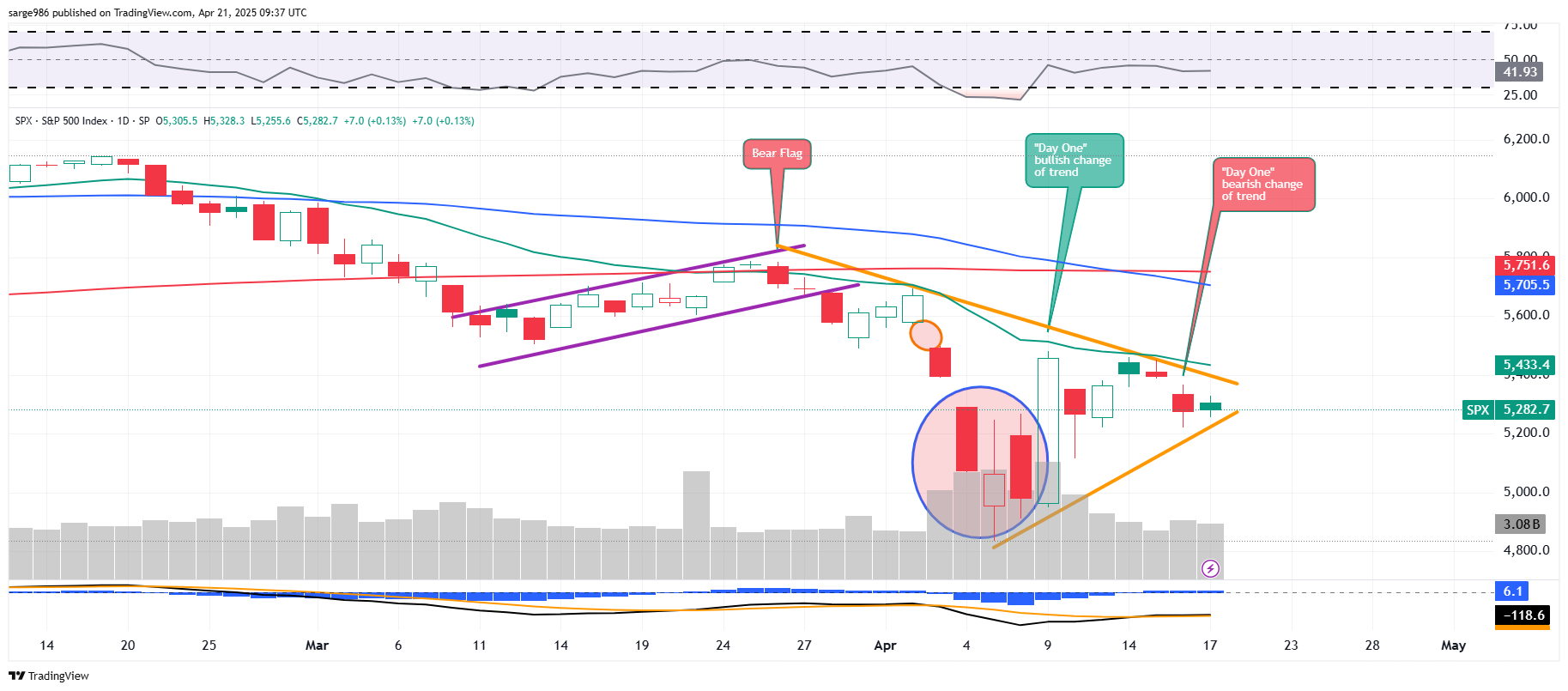
Readers may recall the bullish "day one" change of trend the Wednesday prior to last that we wrote of last week at this time. Of course, that "day one" went unconfirmed due to a lack of trading volume during the "up" days that followed. This past Wednesday, of course, we had a "day one" bearish change of trend as the sell-off that day did come on increased trading volume and technically in response to failure at the 21-day exponential moving average.
We are also facing contrary indicators concerning forward-looking volatility. The closing pennant pattern that began a couple of weeks ago continues to develop. This pattern typically signals a violent move to come. On the other hand, Thursday presents itself as an "inside day." An "inside day" is a one-day pattern where the entire trading range of the session fits neatly inside of the range of the day prior as the open and close of the day also fit inside the open and close of the prior day. This typically signals reduced volatility in the short-term.
Coin Flip?
Not really. Whether or not volatility persists will not come down to the flip of a coin. The Trump administration has been touting the number of nations calling to try to begin trade negotiations. The markets need to see serious progress. The president supposedly can fire the Fed Chair for cause, but not for differences in opinion on policy. Does he have cause? I have no idea. The market story, however, will come down to trade deals with large trading partners.
I find it less than encouraging at zero dark thirty on Monday morning that all of my top performing names overnight are exchange-traded funds that hold precious metals, ETFs that hold short-term Treasuries and defense contractors.
What's Ahead?
- No holidays this week. Proprietary traders and commission brokers rejoice! In this environment, five days are needed to create a week's wages. Trying to do it in four is asking a lot.
- The domestic macroeconomic calendar is not especially heavy this week. The highlight will be March Durable Goods Orders on Thursday. The key data-point within that release will be the number for Core Capital Goods Orders, which is a proxy for business spending. March New Home Sales will be released on Wednesday ahead of that report, while March Existing Home Sales (the largest slice of the housing pie) will cross the tape later on Thursday morning. Lastly, the University of Michigan will revise its April survey on consumer sentiment and inflation expectations on Friday morning.
- Right now, I am tracking at least nine public speaking appearances scheduled for this week by Fed officials. So far, Vice Chair Philip Jefferson is the headliner. He speaks on Tuesday morning. Oddly, I see nothing so far set for this Friday, which is the group's last day ahead of their media blackout period going into the May 7th policy decision. The Fed will publish the latest version of its Beige Book this Wednesday afternoon.
- The earnings calendar finally starts to get truly busy this week. Key companies reporting this week will be 3M MMM, Danaher DHR, GE Aerospace GE, Lockheed Martin LMT, Northrop Grumman NOC, RTX RTX, and Tesla TSLA on Tuesday. On Wednesday, we'll hear from AT&T T, Boeing BA, Chipotle Mexican Grill CMG, IBM IBM, ServiceNow NOW, and Lam Research LRCX. Then, on Thursday, Bristol Myers Squibb BMY, Merck MRK, PepsiCo PEP and Procter & Gamble PG will report in the morning followed by Alphabet GOOGL and Intel INTC after the closing bell. AbbVie ABBV reports on Friday morning.
Economics (All Times Eastern)
10:00 - CB Leading Indicators (Mar): Expecting -0.6% m/m, Last -0.3% m/m.
The Fed (All Times Eastern)
08:30 - Speaker: Chicago Fed Pres. Austan Goolsbee.
Today's Earnings Highlights (Consensus EPS Expectations)
Before the Open: CMA (1.13)
At the time of publication, Guilfoyle was long NOC, RTX, LRCX equity.