Tesla's Loss Is Chinese EV Makers' Gain
Although Tesla’s sales inside China are still rising, that comes at a cost, as we see fierce price competition in the world’s largest EV market where it's survival of the fittest.
You've reached your free article limit
You've read 0 of 1 free Pro articles.
Tesla’s TSLA loss is the gain of the major Chinese electric-vehicle makers. That’s true in sales as much as is it is the stock market.
Today we are seeing the share price of Nio NIO (HK:9866) rise 2.5% in Hong Kong trade, with rival Li Auto LI (HK:2015) also up 2.3% by the close of trade Friday.
That’s after Tesla stock fell 6.1% on Wall Street on Thursday, as the company reported its first annual decline in sales to date. It delivered 1,789,226 vehicles around the world in 2024, shy of the 1,808,581 that it sold for 2023.
The good news is that Q4 was the best yet for Tesla. The bad news, however, is mounting.
BYD BYDDY (HK:1211), the largest electric vehicle maker in China, has just announced that it sold 1,764,992 purely electric vehicles last year. It has at times surpassed Tesla’s quarterly sales, and also makes hybrids as well as commercial electric vehicles such as buses and trucks.
All told, BYD sold 4,272,145 vehicles for 2024, an increase of 41.3% over the previous 12 months. While passenger EV sales rose 12.1%, passenger plug-in hybrids shot up 72.8%.
Notably, BYD stock did not move ahead today. it closed essentially flat, with a 0.1% dip into the red. The company’s mobile-phone and electronic-goods spinoff BYD Electronic BYDIY HK:0285 saw a gain of 2.7% instead.
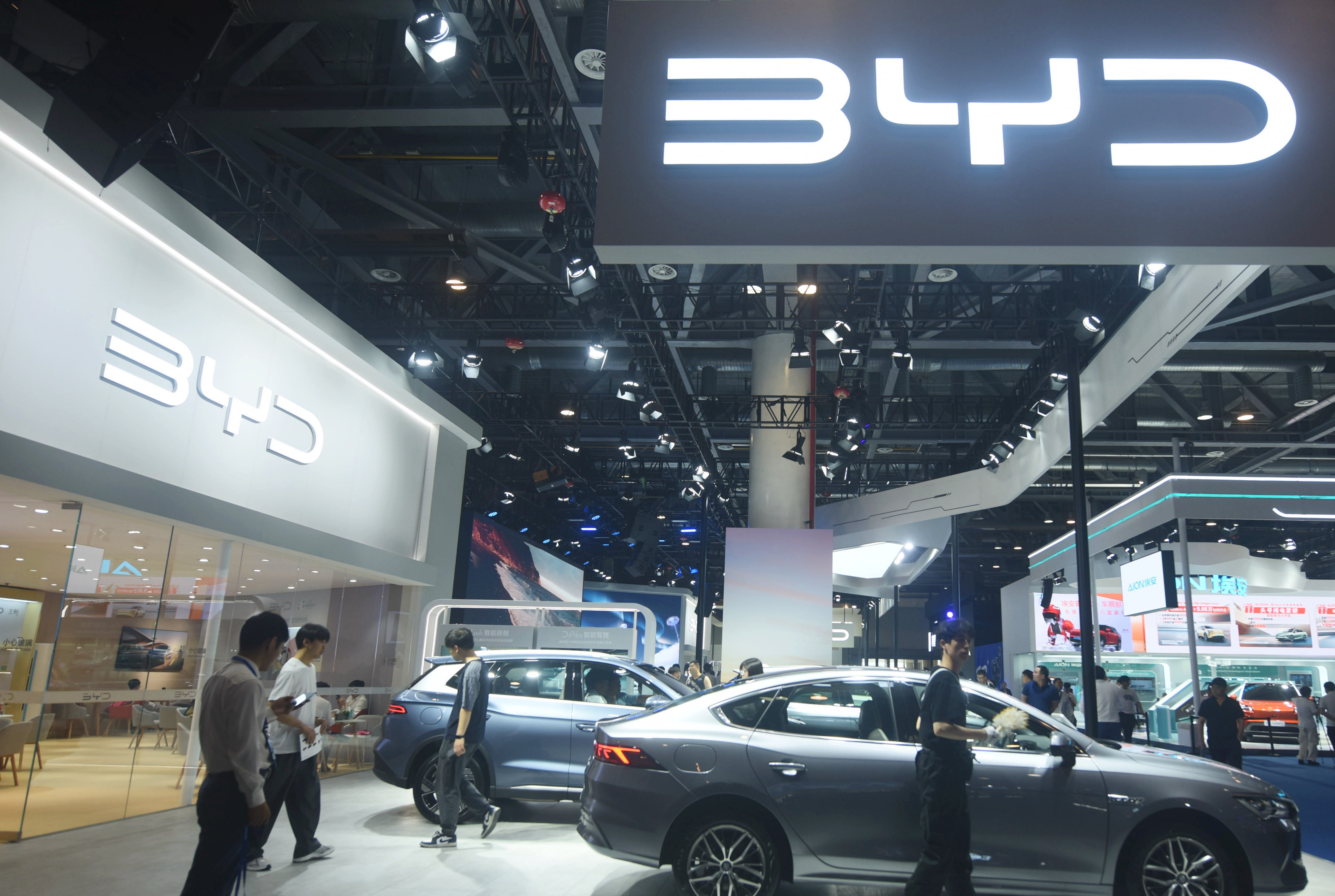
Tesla does say that its sales in China, its second-largest market, are rising. They climbed 8.8% to 657,000 cars, or 36.7% of worldwide sales.
CEO Elon Musk, however, had predicted slight growth for last year. And the sales in China come at a cost, where the company is engaged in a fierce price war, offering discounts and zero-cost financing for up to five years on some models.
China accounts for more than two-thirds of the world’s EV and hybrid sales, and almost all of the growth.
BYD says its international shipments rose 71.9%, making up just under 10% of its total sales. But its rapid expansion into Europe faces a headwind of a 17% tariff imposed by the European Union.
Tesla has been making cars in China to ship into Europe, so it is also subject to higher freights. But the EU dropped its tariff on Tesla vehicles to 7.8%.
The issue is that such extra duties eat up virtually all the profit that Tesla makes on China-produced vehicles. BYD, with lower production costs, can still stomach the 17% tariff and turn a greater profit than it can on sales inside China.
Although we’re seeing temporary adjustment in the Tesla share price, the fierce price war is still hurting Chinese manufacturers more than their foreign rival.
Nio shares are down 46.5% over the last 12 months as it risks losing out on the rapid growth in the China market if it can’t deliver new models on time.
Li Auto, which specializes in SUVs and higher-end models, has still seen its share price slip 29.9% in the last 12 months.
An Asia-focused fund manager friend of mine here in Hong Kong cautions that some of the Chinese EV brands will likely falter, or even collapse amid the competitive pressure.
I have my largest position in BYD, which I’m confident can survive, given its early mover advantage, marketing mass, and backing from Warren Buffett.
I have smaller positions in Li Auto and Xpeng XPEV, which are still in the green given my entry point. But I sold almost all my position in Nio, which I believe is most likely to lose out if brands do fall too far behind.
Tesla doesn’t face that risk, given its strong position in the United States. But it too can’t afford to drop the ball inside China, and risk that one-third of global sales.
We need to watch how sales progress in 2025 to see if Tesla does see sales taper off in China, where it no longer has the cachet and name-brand recognition that it once had.
Critics joke that the Chinese EVs are “smartphones on wheels.” But the jest holds some truth.
Cell-phone giant Xiaomi XIACY (HK:1810) has introduced its first EV, a four-door sedan called the SU7, taking orders as of last March. The base model sells for just over $30,000, undercutting the Tesla Model 3.
While analysts estimate Xiaomi is losing some $10,000 on the initial models, companies in China tend to pile into an industry with heavy discounts to score market share. Only the strongest survive.
And how is Xiaomi’s stock faring today? It’s up 5.3% in Hong Kong, leading the benchmark Hang Seng index, which edged to a 0.7% advance.
Tech and car-company plays held sway on a day that saw Chinese property stocks sink. It’s early days yet in 2025, but I’ll be watching to see if Chinese EV makers can continue their sales inroads, and their stock-market advance.
At the time of publication, Alex Frew McMillan was long BYD, Li Auto and Xpeng.