Supreme Court Could Shake Up Market, Bitcoin Takes a Bumpy Trip
The Supreme Court weighs in on tariffs, I make a Palantir move as it slides, Bitcoin's chart shows a suspicious pattern that we've seen before.
You've reached your free article limit
You've read 0 of 1 free Pro articles.
Good morning. Today is the day. Spooky? It has nothing to do with Halloween. It may, though, have something to do with Tuesday's brutal selloff across tech stocks or really anything speculative in nature. It has to do with tariffs. The U.S. economy has become comfortable with tariffs. Tariffs have to some degree, eased the fiscal crisis in D.C., while not really forcing all that much consumer-level inflation. All while gross domestic product has ramped higher throughout the year, at least until the government was shut down.
Later on Wednesday, the U.S. Supreme Court will hear roughly 80 minutes worth of oral arguments regarding Pres. Trump's use of tariffs. The deal? Tariffs have been used as a tool of trade. Deals and preliminary agreements have been made. Lower courts have ruled that the Trump administration had exceeded its authority in the use of the International Economic Emergency Powers Act. At stake would not only be the punitive tariffs used to combat the flow of illicit fentanyl into the U.S., but also the reciprocal tariffs against most U.S. trading partners that had begun to level what had not previously been a very fair playing field for U.S. exporters.
The problem for the Trump administration and by extension, the U.S. Treasury Department would be that the Constitution gives the Legislative Branch of government, not the Executive Branch, authority over tariffs, levies, duties and taxation. In the administration's favor, however, there is some understanding that Congress had delegated this responsibility to the president.
Potential Outcomes
Should the Supreme Court rule against the administration and find these tariffs to be unlawful, there will almost certainly be volatility in bond and currency markets. An expectation for a less than complete victory in this case for the administration may have already contributed to the volatility experienced across equity markets this week. Billions of dollars would have to be refunded.
In October alone, the fiscally strapped U.S. Treasury collected more than $34 billion in tariff money and is on pace to collect more than $400 billion for the year. Psst... that more than pays for the big, beautiful bill that everyone was so concerned about. This would also force more of the fiscal onus to address the federal deficit back toward taxation.
There is a possibility for some kind of compromised outcome. Some tariffs could be found to be lawful while others are found not to be. Limits could be imposed. The president does have the authority to use tariffs in cases where national security is involved. In the case of fentanyl, that would certainly seem to be the case. Are reciprocal tariffs a national security issue? Probably, with some trading partners more so than with others.
This may be a very close decision, and I think financial markets are more than a little concerned. As I mentioned above, though it would seem that many businesses would like to see tariffs either reduced or done away with, the economy appears to have adjusted and adapted far more easily than anyone could have predicted, and these tariffs are easing other problems. Going into the hearing, Treasury Sec. Scott Bessent was confident that the Supreme Court would back the administration. I really am not so sure.
Marketplace
Unless one found a cave to spend the day in, then one is well aware that equities had their worst day on Tuesday since the selloff of Oct. 10. Was it just time to take profits where profits were, across the AI / quantum / high-tech space? That is where the extended valuations have been. It probably also had something to do with the above-mentioned uncertainty concerning tariffs and the nation's fiscal stability. It may also have had a little something to do with the expected election of a socialist as mayor of the nation's most heavily populated city. There is a reason why southern Florida is now known as Wall Street South. Oh, did I mention a government shutdown, now of record length?
Speaking of Wall Street, comments made by a couple of Wall Street's heavyweights also put pressure on stock prices on Tuesday. Goldman Sachs (GS) CEO David Solomon said that it was "likely there'll be a 10% to 20% drawdown in equity markets sometime in the next 12 to 24 months." I know that he gave those words a lot of wiggle room, but for someone who has to know how high-speed, keyword-reading trading algorithms behave, that was reckless. Or maybe intentional? Piling on the quarterback after he was down, Morgan Stanley (MS) CEO Ted Pick chimed in, "We should also welcome the possibility that there would be drawdowns, 10% to 15% drawdowns that are not driven by some sort of macro cliff event." Thanks for the help, fellas.
Day One?
The short answer is "no." I know, my beloved Palantir Technologies (PLTR) took a 7.9% beating on Tuesday and is trading lower overnight. By the way, last night I bought back the shares that I had sold the night prior. I am back to my pre-earnings position size on that name. More broadly, The Nasdaq Composite was slapped around for a loss of 2.04% on Tuesday, pressured by a 4.01% loss across the Philadelphia Semiconductor Index. Micron (MU) was sacked for a loss of 7.1%, followed by a 6.04% loss by Qorvo (QRVO) . Advanced Micro Devices (AMD) was stuffed at the goal line for a 5.1% loss and is trading lower overnight after reporting after the closing bell.
The S&P 500 gave up 1.17% on Tuesday, as every equity index on my screen, with the exception of the Dow Transports turned pink. The transports were supported by a 10.8% gain made by Expeditors International of Washington (EXPD), a global air and maritime logistics company. Seven of the 11 S&P sector SPDR ETFs closed in the red on Tuesday, led lower by Tech (XLK) at -2.6%, followed by the Discretionaries (XLY) , Industrials (XLI) and Energy (XLE) all of whom lost at least 1% for the session.
Breadth
Losers beat winners across the Nasdaq by better than 3 to 1 and at the NYSE by better than 2 to 1. Advancing volume took a 33% share of composite Nasdaq-listed trade and just a 23.2% share of composite NYSE-listed trade. Was there a silver lining? There most certainly was.
Aggregate trading volume was down 1.3% on a day-over-day basis across Nasdaq-listed securities. Aggregate trade was down 5.4% across NYSE-listings. Aggregate trading volume was not just noticeably lower across the membership of the S&P 500 after two higher-volume green candle sessions but was indeed the lowest it had been in a week.
Hence, we experienced a selloff for a number of reasons, but we did not experience a "Day One" reversal of trend to the downside. I am not saying we are out of the woods. Far firm it. It's just not a technical reality yet. The election in New York was not business friendly. The Supreme Court could make a decision that hurts the market further. Wall Street heavyweights could keep running at the mouth when maybe they should use their heads. In short, game on.
Bitcoin
Bitcoin bottomed at $98,260 per token on Tuesday. There has been a bit of a rally overnight. I see the world's best-known cryptocurrency trading above $101,000 as I write. So, is the carnage over? Maybe. Maybe not.
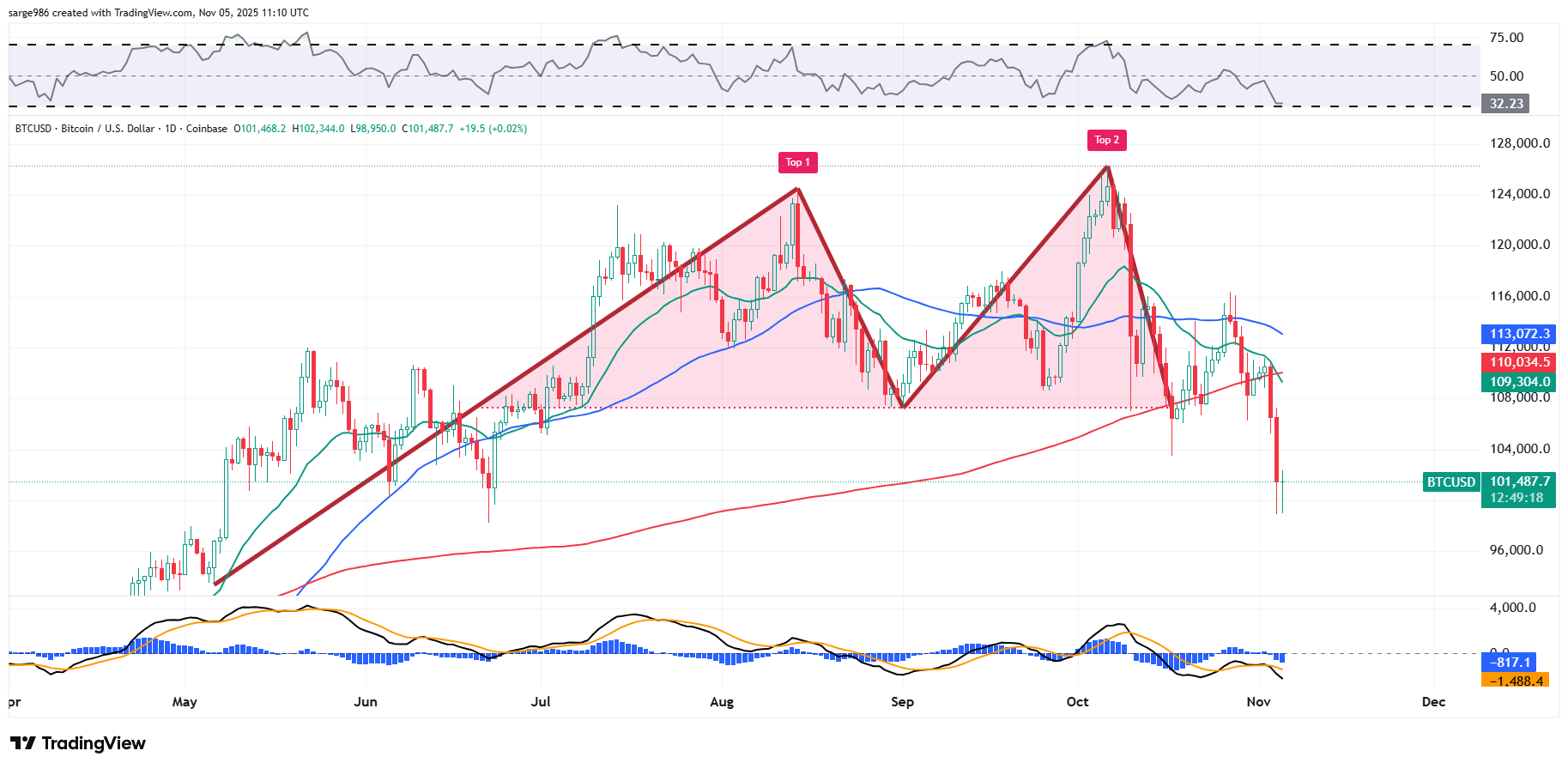
Readers will see that Bitcoin both lost its 200-day simple moving average this week as well as losing a $107,000 downside pivot created by that ominous Double Top pattern of bearish reversal. The last time that Bitcoin developed a well-defined Double Top pattern like this, it gave up a rough 18% after losing the pivot. Something similar would put Bitcoin close to $88,000 before finding its footing. Of course, past results and future outcomes are not symmetrical. In fact, the way Bitcoin trades is probably more fractal in nature than are other asset prices. We shall see.
Economics
(All Times Eastern)
07:00 - MBA 30 Year Mortgage Rate (Weekly): Last 6.3%.
07:00 - MBA Mortgage Applications (Weekly): Last 7.1% w/w.
08:15 - ADP Employment Report (Oct): Expecting 27K, Last -32K.
09:45 - S&P Global Services PMI (Oct-F): Flashed 55.2
10:00 - ISM Non-Manufacturing Index (Oct): Expecting 50.9, Last 50.0.
10:30 - Oil Inventories (Weekly): Last -6.858M.
10:30 - Gasoline Stocks (Weekly): Last -5.941M.
The Fed
(All Times Eastern)
No public appearances scheduled.
Today's Earnings Highlights
(Consensus EPS Expectations)
Before the Open: (HUM) (2.83), LMND (-.71), (MCD) (3.33)
After the Close: (APP) (2.49), (ARM) (.33), (DASH) (1.25), (BROS) (.17), (FTNT) (.63), (IONQ) (-.20), (LYFT) (.31), (MCK) (9.05), (QCOM) (2.87), (HOOD) (.61)
At the time of publication, Guilfoyle was long PLTR, MU, AMD equity.