Still Time for a Christmas Gift for Wall Street?
Seasonality is still playing out, but the second half of the month is what to watch. Also, a look at my Broadcom buy, the Fed, a new pot policy and the charts.
You've reached your free article limit
You've read 0 of 1 free Pro articles.
It's Not Love
It's not love
That left you standin'
It's not love
That left you cold
It's not love
Misunderstandin'
Only a mistake
There's nothing left to take
- Brown, Dokken, Lynch, Pilson (Dokken), 1988
The Sugar Plum Fairy?
Or the evil Mouse King? Jingle, Jingle. The S&P 500 closed on Friday down 0.32% month to date. Merry December. Happy Holidays! The Nasdaq Composite? Down 0.73% December to date on top of a November that gave up 1.51%. The more elite Nasdaq 100 is now down 0.94% this month after losing 1.64% in November. The Russell 2000 is in the green for both months, by the way.
Tis' the season? Since 1950, the S&P 500 has closed the month of December in the green a rough 73% of the time for an average return of about 1.4%. Now, this is important. I'm not sure we need to worry about this as much as we seem to be. I could be wrong. I am not all that confident that what we see is a mirage, but traders need to be fully cognizant of the fact that historically, December is not positive for the S&P 500 on average through Dec. 15.
While December is, based on seasonal trends, one of the strongest months of the trading year, the first half of December is, based on those same trends, one of the worst "half-months" of the year. The average return for the S&P 500 for the first half of December is right around 0%. The S&P 500, historically generates all of its December gains after the 15th. So grab yourself a candy cane and enjoy the show. Maybe.
The Past Week
Monday morning. U.S. financial markets move into their second full week of December. Our marketplace seems to be caught in a game larger than we are. Opposing forces are engaged in a giant "tug of war" between the economic enthusiasm created by the idea of a dovish Fed coupled with lower taxes and deregulation and an anxiety created through uncertainty.
The uncertainty itself has been generated through immense AI-focused capital expenditures, that at best has driven down cash on hand for the largest players and at worst has driven higher corporate debt burdens. Will there be an AI-generated return on investment? More specifically, will that AI-driven return match the time, effort and money spent?
Last week, Oracle (ORCL) made investors wonder and Broadcom (AVGO) left doubts. By the way, I did buy that dip in AVGO as I wrote that I would on Friday. At zero dark-thirty on Monday morning, I'm up 0.64% on that trade. Party on, Garth. I wouldn't touch ORCL with your money even if you made fun of my dog.
So, do these doubts over the pace of AI-focused investment linger into the second half of December? Is the broadening out of equity market wealth a net positive? Regardless, we can and will adapt and we will take advantage of the environment we exist in, not try to change said environment. That's how excellence is won. We expect to excel. That never changes.
A pro-cyclical environment can be just as positive for those who understand it as is a pro-growth environment. We want to stay away from anything that leaves us favoring the defensive. That's what happens when the economy goes awry and the good citizens run for cover. It is in that kind of environment where outperformance can still leave one in the red.
Not a Done Deal
On Friday, Pres. Trump indicated that after an interview earlier in the week that former Fed Gov Kevin Warsh had moved toward the top of the list as a finalist for a nomination to the Fed Chairmanship. It's no secret that when his term as Fed Chair expires in may that Jerome Powell will not be re-nominated. Powell's term on the Fed's Board of Governors does not expire until 2028. Powell's intentions in regard to remaining at the central bank in that capacity is unknown.
National Economic Council Director and longtime Trump economic advisor Kevin Hasset had become the recent favorite after Bloomberg News had reported the president to be leaning his way. On Friday, the president said, "I think you have Kevin and Kevin. They're both - I think the two Kevins are great." Pres. Trump was quick to add, "I think there are a couple of other people that are great."
In addition to Kevin Warsh and Kevin Hassett, current Fed Govs. Christopher Waller and Michelle Bowman are believed to be serious candidates for nomination to the Fed's leadership position as is Rick Rieder who manages the fixed income side of BlackRock (BLK) . The Kalshi website currently shows Hassett with a 50% probability for being nominated, and Warsh close behind at 41%. After that, Kalshi shows Waller at 6%, current Treasury Sec. Scott Bessent at 4%, Rieder at 2%, Bowman at 1%, current Fed Gov Stephen Miran at 1% and all others at less than 1%.
Today?
"I smoke a little pot every day, and I'm as healthy as can be."
- Tommy Chong, 2016
CNBC reported on Friday that Pres. Trump was soon expected to sign his highly anticipated executive order that will reclassify marijuana as a less dangerous drug. An expected reclassification to Schedule III of the Controlled Substance Act from Schedule I would group pot with such drugs as Tylenol with codeine and move it out of its current grouping, which includes drugs like heroin.
My thoughts? If we can regulate it so that it's safe and tax it, I have no problems with it. I enlisted at 17 and we were tested monthly so this is nothing I ever became interested in or even tried, but I couldn't care less if someone else uses this drug for recreational or especially medical purposes. The ETFs to watch are AdvisorShares Pure US Cannabis (MSOS) , AdvisorShares Pure Cannabis (YOLO) and Amplify Seymour Cannabis (CNBS).
The Week That Was...
Equity markets for the most part, sold off on Friday. Looking at the week on the whole, a rotation out of the AI trade and big tech was evident, though other, more-value oriented parts of the marketplace rallied nicely. Truly a rotation? Or a broadening out of the AI-focused trade as competition intensifies and any number of industries face probable and significant gains in productivity. Over the past week...
- The S&P 500 gave up 1.07% on Friday but just 0.63% for the week.
- The Nasdaq Composite gave back 1.69% but just 1.62% for the week.
- The Nasdaq 100 surrendered 1.91% on Friday and 1.93% on the week.
- The Russell 2000 gave up 1.51% on Friday but gained 1.19% for the week.
- The S&P Smallcap 600 surrendered 1.09% but added 2.02% for the week.
- The S&P Midcap 400 backed up 1.3% on Friday but gained 0.93% over the week.
- The Dow Transports gave up 0.66% on Friday, still adding 1.87% for the week.
- The Philly Semis lost a nasty 5.1% on Friday and a gnarly 3.58% for the week.
- The KBW Bank Index gave up 0.54% on Friday, but added an impressive 3.57% for the week.
On Friday, five of the 11 S&P sector SPDR ETFs closed out the session in the green, led by the Staples (XLP) and Discretionaries (XLY) . The losers were easily led by Technology (XLK) as growth struggled.
For the week, six of the 11 S&P sector SPDR ETFs traded higher with the Materials (XLB) and the Financials (XLF) out in front. Again, Technology was the big loser.
The Charts...
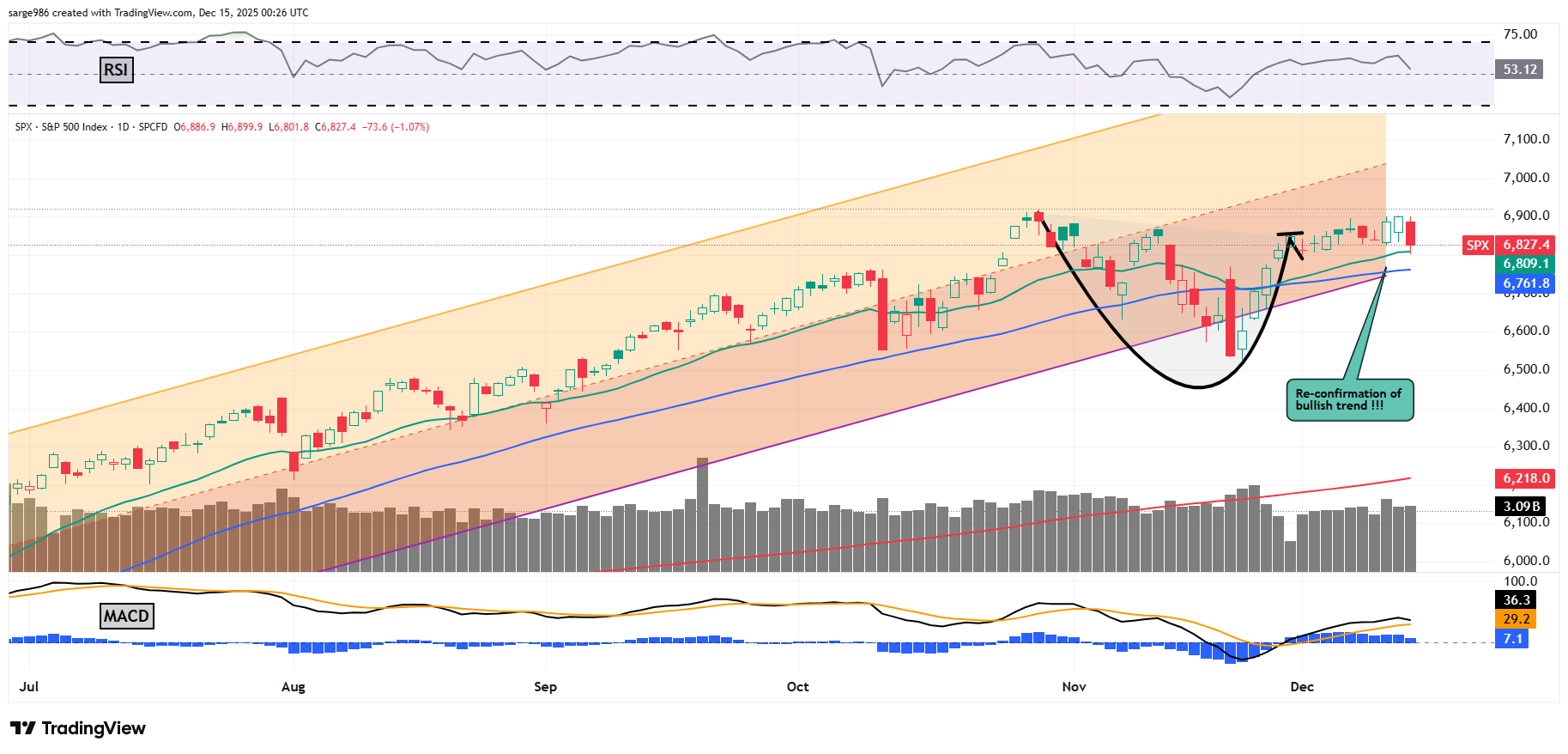
Readers will likely recall that last week, we pointed out that after the S&P 500 had earlier regained its 21-day exponential moving average, 50-day simple moving average that the index had posted a 'reconfirmation of bullish trend on Wednesday. Now we have some mixed messages. Take a look and see what I mean...
After Thursday's activity supported that thesis, Friday presents as negative. Yes, support was again found at the 21-day EMA. Yes, Relative Strength is still better than neutral. Yes, the daily Moving Average Convergence Divergence is still postured bullishly, even if less so. The question is: Was Friday a "Day One" bearish reversal of trend. On this chart, I don't think so. Trading volume simply was not decisive enough and the index did close above Wednesday's low.
Now, this is where it gets tricky and I become a little unsure of myself. No, I am not unsure of my ability. I am unsure of what the charts are telling me. I normally don't like to call a reversal of trend unless the S&P 500 and Nasdaq Composite agree and they do not agree. That said, we do have to acknowledge what the Nasdaq Composite is telling us:
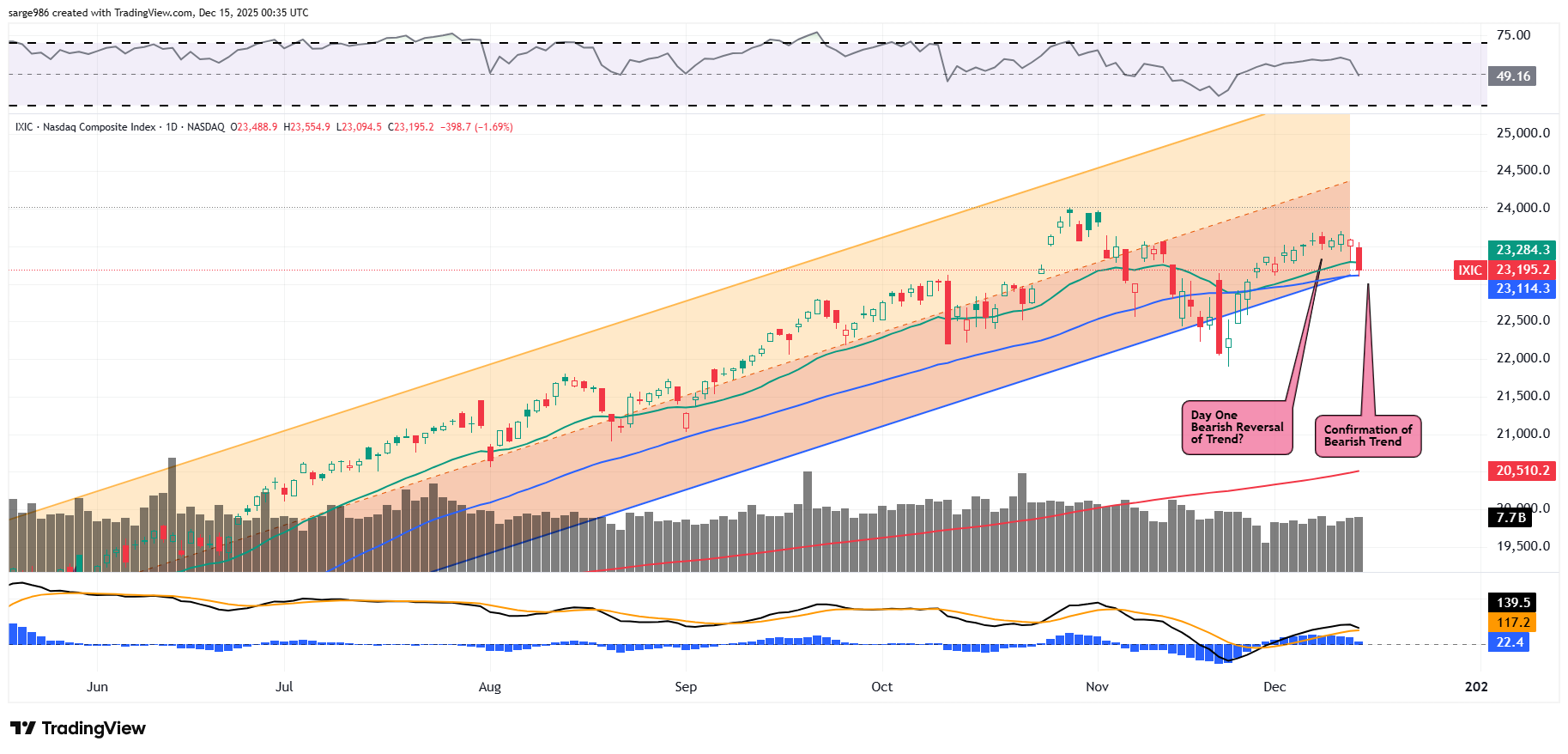
In isolation, the Nasdaq Composite posted a Day One bearish reversal of trend on Wednesday and a Day of bearish confirmation on Friday. Relative Strength has sunk to a neutral reading as the daily Moving Average Convergence Divergence is very close to exhibiting a bearish cross-under of its 26-day EMA by its 12-day EMA.
Interestingly, I have four problems with actually calling this reversal, though I am not 100% sure that I am correct in dragging my feet. I don't hide when I am in doubt.
One, trading volume increased on Friday across the Nasdaq Composite from Thursday, but not dramatically so.
Two, I have already stated that I do not like to isolate these indexes when making these calls.
Three, the index was supported at its 50-day SMA, which is where crucial support had to show its face.
Four, both the Bearish Day One and Day of Bearish Confirmation are less pronounced on a daily chart of the Nasdaq 100. One would think that if a rotation out of big tech were driving a change in trend that this would not be the case.
Earnings
As of Dec. 12, according to FactSet, for the fourth quarter, Wall Street projected year-over-year earnings growth for the S&P 500 of 8.1%, up from 7.7% a week ago. Wall Street also sees revenue growth of 7.5%, unchanged from the week prior. For the full year (2025), the street now sees earnings growth of 12.1% (up from 11.9%) on revenue growth of 6.9%.
At the moment, Technology at growth of 24.9% and Materials at growth of 10.5% are the only sectors projected to experience double-digit earnings growth for the fourth quarter. Presently, two sectors (Discretionaries and the Industrials) are projected to suffer a year over year earnings contraction while three other sectors are seen growing earnings by less than 1%.
Valuation
Still using data provided by FactSet, the S&P 500 ended last week trading at 22.5-times 12 months' forward-looking earnings, up from 22.4 times a week ago. This is well above the five-year average of 20.0 times for the index as well as well above its ten-year average of 18.7 times.
The S&P 500 also ended last week trading at 28.5 times trailing twelve months' earnings, from 28.3 times a week ago. That also stands well above the five-year (25.0 times) and ten-year (22.9 times) averages for the index.
Nine of the 11 sectors are still trading above their five-year average valuations, led by Consumer Discretionaries (28.8 times) and Tech (28.5 times). Just the Utilities (at 18 times) and the REITs (at 17.4 times) are not historically overvalued relative to their five-year averages.
The GDP Game
Last week, the Atlanta Fed revised its GDPNow model for the third quarter up to 3.6% from growth of 3.5% (q/q, SAAR). Among other regional central bank district branches running close to real-time GDP models, the New York Fed's estimate for Q3 growth is final at growth of 2.31%. The Cleveland Fed's model for the third quarter was also left unrevised at growth of 2.05%. Finally, the St. Louis Fed revised their model higher, from growth of just 0.14% to 0.42% last week.
Both the New York and Cleveland Feds are already running Q4 models. At this time, New York sees fourth quarter GDP growth at 1.81% with Cleveland at growth of 2.83%. Do not expect Atlanta to publish an estimate for the fourth quarter before Dec. 23.
Fed Funds Futures
Fed Funds futures trading in Chicago are now pricing in just a 24% probability for a quarter-point rate cut on Jan. 28 when the FOMC next meets on policy. The FOMC will look different at that time as Boston, Chicago, St. Louis and Kansas City will lose voting rights as part of the Fed's regular annual rotation. Cleveland, Philadelphia, Dallas and Minneapolis will gain voting rights for 2026.
At present, there is a half point worth of additional rate cuts fully priced in (70% chance, down from 71%) for all of calendar 2026. These markets are no longer fully pricing in another rate cut for calendar 2027 (37% likelihood).
On The Docket...
We are still in between earnings reporting seasons. The large banks will start reporting their fourth quarter financial results in mid-January. That said, there are almost always at least a few well known names that report out of season. For the week ahead, investors, traders and economists can look forward to...
.... The Federal Reserve will not be out in force this week as Chanukah has already started and the Christmas holiday looms just ten days away. I only have six public appearances on my radar this week, including two by Fed Gov Stephen Miran this morning. We'll hear from NY Fed Pres John Williams twice this week as well.
.... The macroeconomic calendar is rather heavy this week. The highest profile releases will come on Tuesday morning when the Bureau of Labor Statistics publishes as much labor market survey related data as they have collected for the months of October and November. October Retail Sales will also be released on Tuesday morning. In addition, this Thursday morning, and perhaps nearly as high in profile, November CPI will hit the tape.
Aside from all of that, both the New York and Philadelphia Feds will release regional manufacturing-focused survey results for December this week. On top of that, the University of Michigan releases its revisions to its surveys covering both consumer sentiment and inflation expectations for December.
.... As mentioned above, the earnings calendar will still produce some well-known names this week. On Wednesday morning, General Mills (GIS) and Jabil Circuit (JBL) will report, followed by Micron Technology (MU) that evening. On Thursday morning, we'll hear from Cintas (CTAS) and Darden Restaurants (DRI) ahead of the open, followed by FedEx (FDX) and Nike (NKE) after the close. Conagra (CAG) , Paychex (PAYX) and Carnival (CCL) will all report on Friday morning.
Economics
(All Times Eastern)
08:30 - Empire State Manufacturing Index (Dec): Expecting 10.2, Last 18.7.
The Fed
(All Times Eastern)
09:30 - Speaker: Reserve Board Gov. Stephen Miran.
10:30 - Speaker: New York Fed Pres. John Williams.
11:00 - Speaker: Reserve Board Gov. Stephen Miran.
Today's Earnings Highlights
(Consensus EPS Expectations)
No significant quarterly earnings scheduled.
At the time of publication, Guilfoyle was long AVGO equity.