South Korean Stocks Suddenly Sparkle on Global Market
Chipmakers in Asia are surging as investors, reassured by an easing of tensions in the Middle East, buy into growth and Asia tech.
You've reached your free article limit
You've read 0 of 1 free Pro articles.
South Korean stocks are surging today, leading an Asian charge higher, despite the geopolitical uncertainties after the U.S. attack on Iranian nuclear facilities.
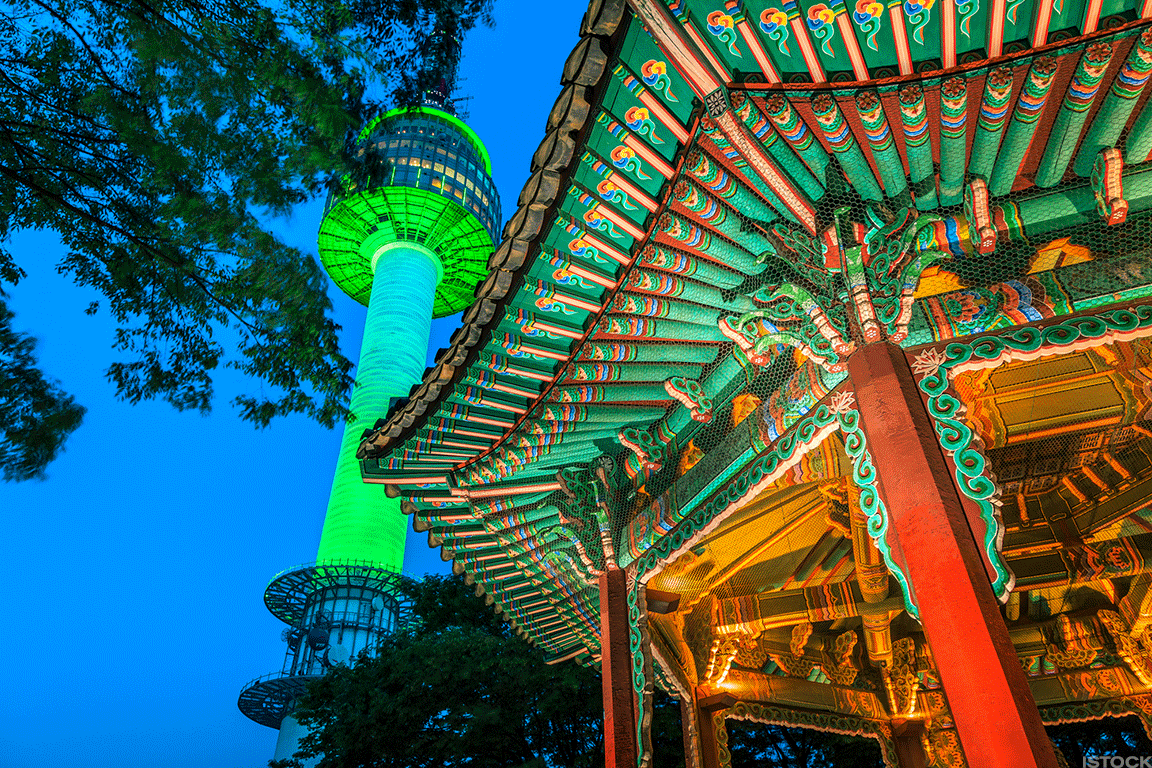
The benchmark Kospi in Seoul is back above the 3,000 mark for the first time since December 2021. Today, it crossed 3,100, to end Tuesday at 3,103.64.
The Kospi is up 3.0% on Tuesday alone, adding to a recent strong run that has seen South Korean equities add 36.5% since the dip in early April caused by the threat of stringent U.S. import tariffs.
Chipmaker Charge
Chipmakers are leading the advance, with South Korean heavyweight Samsung Electronics SSNLF (KR:005930) up 4.3% on Tuesday.
Rival Korean chipmaker SK Hynix HXSCL (KR:000660) is up a whopping 7.3% for today. Investors have punished Samsung for its overemphasis on cheaper DRAM chips, which have faced a glut of supply, and have rewarded Hynix for a more concerted push into the kind of high-end chips that power Artificial Intelligence.
In Taiwan, market heavyweight Taiwan Semiconductor Manufacturing Co. TSM (TW:2330) has gained 2.9% today. That’s lifting the Taiex benchmark, which finished Tuesday on a 2.1% gain.
The strong gains in Asian tech come as investors rotate out of the oil and defense plays that attracted interest due to the tensions in the Middle East. Traders appear eager to take on greater risk with U.S. Pres. Donald Trump declaring a ceasefire with Iran, even if Iran and Israel both accuse each other of violating such suspensions of hostilities.
Standout Showing in 2025
The Kospi has been Asia’s standout index in 2025. It is up 29.3% for the year so far, ahead of the next-best 23.2% advance for the Hang Seng index in Hong Kong.
The fact that mainland Chinese stocks, in the form of the CSI 300, are only just showing gains for the entire year, up just 2.2% in 2025, so far shows that international investors have rotated into Asian equities. They tend to do that in Hong Kong since the Shanghai and Shenzhen markets captured by the CSI 300 are only accessible to the very largest investment banks, and only then if they secure a quota to trade mainland A shares.
In South Korea, investors have been reassured that a period of political chaos is over, after the successful presidential election at the start of this month that brought Lee Jae-myung to power. He replaces the impeached Yoon Suk Yeol, who declared martial law for a matter of hours last December. It proved what political analysts dub a case of “career suicide” for a politician who was under pressure due to a string of corruption scandals surrounding himself and his wife.
Global Investors Buy In
Global investors have been buying in the Korean market, too. Seoul stocks show no sign of slowing so far. Pres. Lee told a conference today that South Korea and the United States will be able to achieve a “mutually satisfactory outcome” on trade negotiations. Higher tariffs would certainty hurt Korea’s largest chaebol conglomerates.
Samsung shares may have further to run as they reclaim lost ground. The electronics conglomerate is still 30.5% lower than its level last July, and at 60,500 won as of today is almost one-third off its all-time high close of 88,800 won set in early 2021.
Hynix, by contrast, continues to forge ahead, setting all-time highs over the course of the last week, including today.
TSMC in Taiwan has not enjoyed much joy this year, leaving it down 1.4% in 2025, but has nevertheless recovered impressively from the tariff-induced low in early April. Besides higher tariffs for tech exports it is also contending with restrictions on high-end chips, attempting to appease its Chinese customers while keeping U.S. and European regulators happy that it has cut off supply of its top-end chips.
South Korean automakers such as Hyundai Motors HYMTF (KR:005380), down 2.6% in 2025, have not joined in this year’s bull run in Seoul. Affiliate Kia KIMTF (KR:000270) is down 4.6% for the year so far.
The gains are concertedly in the tech sector. Korean stocks are also benefiting from the stronger currency, with the Korean won up almost 10% against the weakening U.S. dollar since early April.
At the time of publication, Alex Frew McMillan had no position in any security mentioned.