Shutdown Shakeup, Pharma Tariff Rx, TikTok Takeover, Rocket Lab Update
Let's look at why the threat of another shutdown is making the markets wobbly, a new pharma tariff plan, and my quick take on this Stocks Under $10 favorite.
You've reached your free article limit
You've read 0 of 1 free Pro articles.
Pres. Trump posted to his Truth Social account on Thursday: "Starting October 1st, we will be imposing a 100% Tariff on any branded or patented Pharmaceutical Product, unless a company IS BUILDING their Pharmaceutical Manufacturing Plant in America."
The president made similar posts regarding 50% tariffs on kitchen cabinets, and bathroom vanities, 30% tariffs on upholstered furniture and 25% tariffs on heavy trucks.
How big a deal are these new tariffs? Well, markets obviously don't love tariffs in the first place, but to date have learned quite well to adjust and adapt to those already in place. Consumers, fortunately, have not yet been impacted to a significant degree. The facts regarding this new tariff on imported pharmaceuticals is this... according to the Wall Street Journal, about nine of 10 drug prescriptions filled in the U.S. are currently filled using generic drugs. Those products are not impacted by these tariffs.
Additionally, such drug makers as Eli Lilly (LLY) , AstraZeneca (AZN) , Roche (RHHBY) and GSK (GSK) have already announced new construction within the U.S., pledging more than $350 billion in aggregate toward those projects. The president's post states that no tariff will be placed upon the imported products of any pharmaceutical company that has already "broken ground" on these projects. I have not been able to discern at this time if these announced tariffs would stack on top of or replace the 15% tariffs already placed upon pharmaceuticals imported from the European Union.
Shutdown Looms!
Wonder why financial markets are getting a bit wobbly? This is anecdotal of course, but it does seem like markets tend to struggle going into either a government shutdown or a threatened government shutdown, even though we are used to it. Where are we on a potential shutdown? Right now, if nothing changes, the federal government will run out of funding and have to shut down at midnight this coming Tuesday or Wednesday evening as the clock strikes midnight. Non-essential federal workers will be told to stay home.
The divide in our legislature might as well be a chasm. Republican lawmakers are trying to pass a seven-week extension at current spending levels. Democrat party legislators are trying to seize the opportunity to leverage the need for some of their party votes to increase spending on healthcare by hundreds of billions of dollars.
Last week, the House, where the GOP has a slight majority, narrowly passed a bill that would extend funding to operate the government. This bill, however, failed in the Senate where 60 votes are what is needed for passage. Republicans hold a slight majority in the Senate as well, but still need as many as seven senators to cross the aisle as long as all 53 Republican Senators stay aligned.
House leaders then announced that they would return to work after the funding deadline next week in an effort to force the Senate's hand. Senate minority leader Chuck Schumer of New York has said that he plans to hold his ground this time around and demand discussion on the issues at hand after he had been accused of caving by his colleagues back in March.
Good News Is Bad News
It also did not help financial markets that the macroeconomic data that did hit the tape on Thursday, looked surprisingly strong. You know the old saying. When it comes to markets and monetary policy, what's good is bad and what's bad is good. First, the weekly report on Initial jobless claims printed at 218,000, down from 232,000 the week prior and well below expectations. Continuing claims also dropped from the week prior for the fourth week in the last five and are down more than 2% since late July.
Secondly, August durable goods orders were surprisingly strong. At the headline durable goods orders were up 2.9% month over month, up 0.4% ex-transportation and up 1.9% ex-defense. The most important part of the report, core capital goods orders, which is considered to be a proxy for business investment, were up 0.6% from July after July had shown a 0.8% pop from June.
That's back-to-back solid growth in business spending, and a third strong month in four. That does some damage to the weaker economy, weaker labor market narrative that had propelled the Fed to cut rates last week. This also, in the eyes of some traders, damages probabilities for a deeper cycle of easier monetary policy.
GDP
In addition, though this is dated material, the Bureau of Economic Analysis, in its second revision to second-quarter gross domestic product, took the quarter up to growth of 3.8% from 3.3% (q/q, SAAR) in what was a rather large revision. This was in part due to a huge upward revision to personal consumption expenditures. From the first revision to the second personal consumption expenditure moved from growth of 1.6% to growth of 2.5% (q/q, SAAR), suggesting that the U.S. consumer was never anywhere close to as weak during the second quarter as economists had thought.
Yes, a huge drop in imports is still largely responsible for such an impressive print statistically, but there are some other items that matter here and do suggest a much better environment than had been understood. For one, GDI (gross domestic investment) printed at growth of 3.8%.
Readers will remember that in the past I have explained (because the financial media failed to) that GDI was considered by the Fed to be a check on GDP and that the two prints cover the same economic material, essentially one from the perspective of the seller and one from the buyer. Over the past few years, on a regular basis, GDP printed much higher than GDI, and the media would report only on GDP. I would ask why the two were so far apart when in theory, they were supposed to be equal. Nobody cared. Well, now, finally after several years of wonky looking economic data, GDP equals GDI as it is supposed to. For the first time in years, the math actually works!
Finally, the number that I, as an economist, consider to be the organic print for economic activity, is labeled as "Final Sales to Domestic Purchasers" (or Line 32 on Table 1 if you're following along). This number omits the impact of exports and imports on the headline print and just considers activity. This number was revised up to growth of 2.9% from 1.9% (q/q, SAAR). That's huge. No economy can be considered even close to weak when organic economic activity is growing at an annualized 2.9% rate.
Markets
It wasn't truly ugly on Thursday, but it was undeniably negative. Treasuries were sold off by bond traders. A U.S. Seven-Year note auction did not go as well as did last week's auctions. The S&P 500 gave up 0.5% as did the Nasdaq Composite. No clear rout, but the weakness was broad. All of the small- to mid-cap indexes traded between 0.61% and 0.985 lower. The Dow Transports and Philly Semiconductors both sold off small.
Ten of the 11 S&P sector SPDR exchange-traded funds ended the day's regular session in the red, led lower by Health Care (XLV) , Consumer Discretionaries (XLY) and Materials (XLB) . All three of those funds surrendered at least 1.3%. Only Energy (XLE) finished the day in the green.
Here is what is important. Losers beat winners by an 11-to-four margin at the NYSE and by a rough three-to-one at the Nasdaq. Advancing volume took a 43.2% share of composite Nasdaq-listed trade and just a 34.5% share of composite NYSE-listed activity. In addition, the trading volume was higher on a day over day basis across the board.
On a day-over-day basis, aggregate trading volume was up 8.5% across Nasdaq-listed securities, and up 7.6% across NYSE-listed names. Additionally, across the membership of the S&P 500, Thursday was the most heavily traded day (outside of Friday's Triple Witching expiration) since July 31st.
The Chart Answer Is 'Yes'
The answer is "yes." Thursday, though appearing as the third day of an in-progress sell-off / potential correction, technically, this is a Day One Bearish Reversal of Trend as this is the first day that all of the stars that we discuss on the regular all lined up. What the market needs now, is a pause before there can be a confirmation of trend.
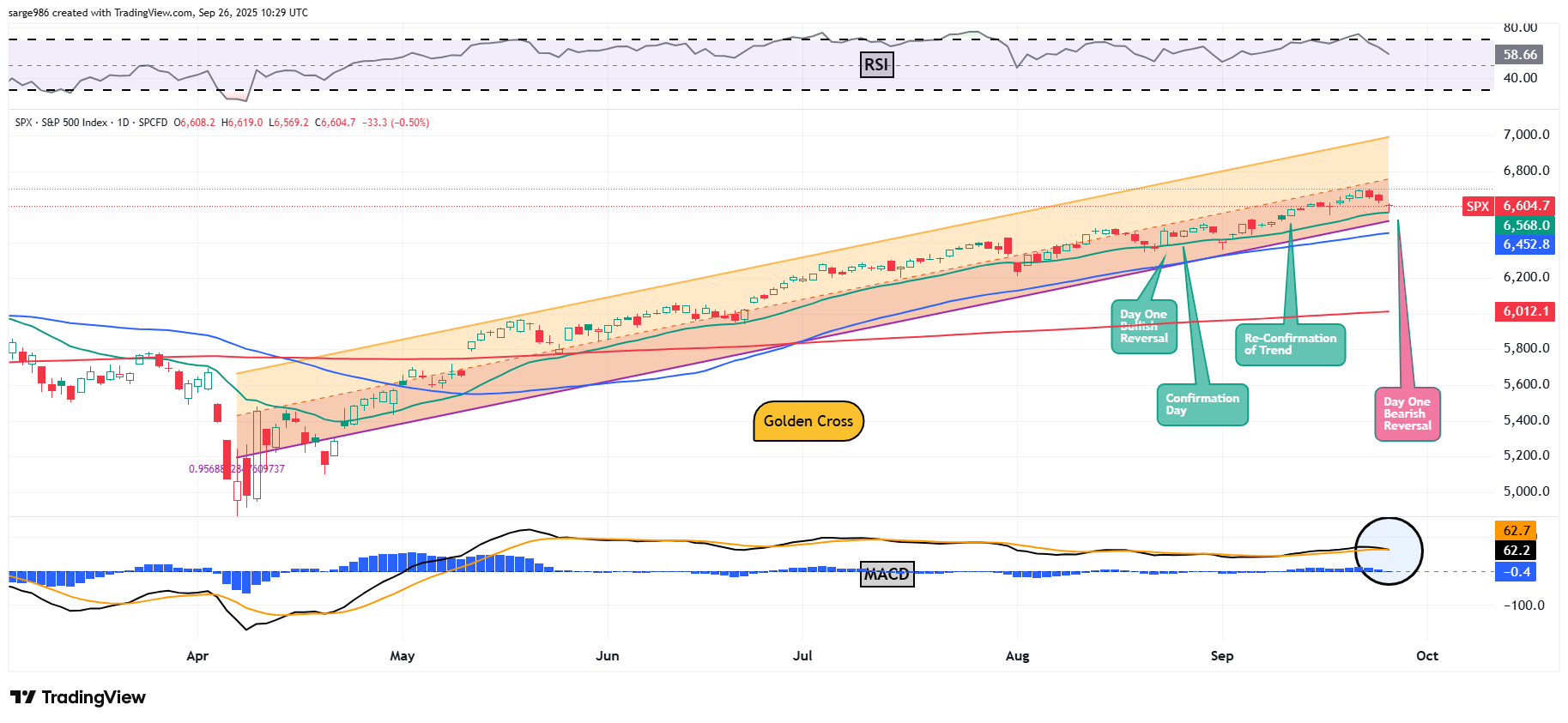
So, if the market rallies on Friday, but in a lackluster fashion, that may very well be the pause and not an actual rally. I'd be careful on the Friday ahead of a potential government shutdown. Especially with data on income, spending and inflation due this morning. Readers should note that within the daily Moving Average Convergence Divergence for the S&P 500, the 12-day exponential moving average crossed below the 26-day EMA. Unless there is a quick uncrossing of those lines this morning, that will be seen by some traders as a short to medium-term bearish signal.
TikTok Executive Order!
Maybe I'll get a TikTok account. I had avoided doing so while the social media app was under foreign control. The president signed an executive order on Thursday that will allow for a deal between the U.S. and China. The president confirmed that Larry Ellison of Oracle (ORCL) , Michael Dell of Dell Technologies (DELL) and Rupert Murdoch of Fox Corp ( (FOX) , (FOXA) ) and News Corp (NWS, NWSA) are involved in the deal. China's ByteDance will remain a minority owner. The deal will value TikTok at about $14 billion.
Acquisition
I won't be writing a "Stocks Under $10" piece today. Therefore, I will inform readers here that Sarge-fave and core Stocks Under $10 holding Rocket Lab (RKLB) has entered into an agreement to acquire German laser communications developer Mynaric for about $75 million. The deal provides additional post-closing payouts to the sellers based on revenue targets for this year, next year and 2027. What Rocket Lab is acquiring is scalable laser communication terminals for air, space and mobile applications to enable high-speed, long range data transmission.
Economics
(All Times Eastern)
08:30 - Personal Income (Aug): Expecting 0.3% m/m, Last 0.4% m/m.
08:30 - Consumer Spending (Aug): Expecting 0.5% m/m, Last 0.5% m/m.
08:30 - PCE Price Index (Aug): Expecting 0.3% m/m, Last 0.2% m/m.
08:30 - Core PCE Price Index (Aug): Expecting 0.2% m/m, Last 0.3% m/m.
08:30 - PCE Price Index (Aug): Expecting 2.8% y/y, Last 2.6% y/y.
08:30 - Core PCE Price Index (Aug): Expecting 3.0% y/y, Last 2.9% y/y.
10:00 - U of M Consumer Sentiment (Sep-F): Flashed 55.4.
10:00 - U of M One-Year Inflation Expectations (Sep-F): Flashed 4.8%.
10:00 - U of M Five-Year Inflation Expectations (Sep-F): Flashed 3.9%.
1:00 p.m. - Baker Hughes Total Rig Count (Weekly): Last 542.
1:00 - Baker Hughes Oil Rig Count (Weekly): Last 418.
The Fed
(All Times Eastern)
08:00 - Speaker: Cleveland Fed Pres. Beth Hammack.
09:00 - Speaker: Richmond Fed Pres. Tom Barkin.
1:00 p.m. - Speaker: Reserve Board Gov. Michelle Bowman.
1:30 p.m. - Speaker: St. Louis Fed Pres. Alberto Musalem.
6:00 - Speaker: Atlanta Fed Pres. Raphael Bostic.
Today's Earnings Highlights
(Consensus EPS Expectations)
No significant quarterly earnings scheduled.
At the time of publication, Guilfoyle was long RKLB equity.