Shutdown Hits. Now It's Homework Time.
Let's look at how to read the government closure; also a look at the tech trade, Oklo and Nvidia.
You've reached your free article limit
You've read 0 of 1 free Pro articles.
As expected by nearly everyone, after our legislators failed to reach any kind of a deal that would provide for even short-term funding of the federal government, the government went into shutdown mode at 12:01 this morning. Happy October! Happy federal fiscal 2026! Good health to you and yours. How long will this last? Hopefully not long, but I have a feeling that both sides are dug in pretty well this time around. The partial shutdown of 2018/2019 lasted for 34 days. This is a full shutdown, more similar to the shutdown of 2013. That one lasted 16 days.
What happens now? Simply put, federal employees that are furloughed will go without a paycheck until there is a meeting of the minds in D.C. Only those employees deemed to be essential will be at work. That means somewhere between 750,000 to 900,000 federal employees won't work today. On top of that, the president has threatened to actually lay-off some employees seen as non-essential. It goes beyond that, though. Businesses that rely on government contracts will likely slow down and, should this go on, will end up putting their employees on furlough as well.
Essential federal employees, while working, will still go unpaid for the duration. Unpaid workers do not spend money. Travel will slow down. Consumption will slow. As all of us who survive in the financial markets well know, the release of many federal macroeconomic data-points will slow substantially. Estimates show that the 34-day partial shutdown six years ago shaved 0.4% off of the first-quarter 2019 gross domestic product growth, while the 16-day full shutdown of 2013 put 0.6% dent in GDP.
In theory, this growth is then made up, once those furloughed receive their back pay, but that's a little pollyannaish in my view. A family that does not go out to eat this week or month due to budget constraints, will not go out to eat twice or three times as often once paid, so some of that lost economic activity cannot be made up.
Government contracts in certain areas such as national defense might be made up, but those who provide certain items such as office supplies will not see those sales made up. The food trucks that line the streets of our nation's capital on weekdays, catering to federal employees and tourists will not sell twice as many burritos and bubble teas (whatever those are) once those workers and tourists return.
The Fed
Our nation's central bank will remain open and will remain fully operational. They will have to follow alternative sources of data to try to make informed decisions, but that will not stop them. Fortunately for us, we know that the headline data used by the Federal Reserve to make decisions over the past few years has been anything but accurate and that the decisions made by the Federal Open Market Committee, due to these inaccuracies, had already been far from "informed."
Hence, the Fed Funds rate is currently running an approximate percentage point above where the elusive "neutral rate" likely is. The longer this shutdown goes on, the more likely the mispriced short end of the yield curve is to damage the economy. The FOMC is not scheduled to make its next policy decision for four weeks.
An emergency meeting to address the 4% to 4.25% overnight rate at a time when a large number of workers find themselves out of work is not likely unless our central bankers actually see the distress in the data, but they won't see all that much data. In place of this Friday's Bureau of Labor Statistics labor market survey results for September, which will not likely be released on time, the Fed will have to get creative as will we.
This morning's ADP Employment Report for September private sector job creation now takes on greatly increased importance. The Fed will also be relying on, if they actually have the work ethic, on other sources of information provided by private sector businesses such as Indeed's job-listings index, which is updated daily. There will also be state-level unemployment data which is updated weekly. On top of that, the Fed will see credit card usage data as well as labor market surveys and modeling provided by the economics departments of both national and regional banks. Homework? Yes, this will require some homework and maybe longer hours. I know, to many public sector and academic economists that sounds absolutely terrifying.
Looking Into the Futures ...
Equity index futures are trading lower as the zero-dark hours pass on Wednesday morning. That said, Treasury debt markets are not moving all that much, but the U.S. dollar is weaker this morning vs. its reserve currency peers. This has forced investors and traders to chase both gold and bitcoin last night into this morning.
Some Quarter
Markets were truly quiet on Tuesday. The S&P 500 gained 0.41% for the session as the Nasdaq Composite added 0.3%. The banks sold off as did Energy stocks (XLE) . Health Care (XLV) had a nice day, supported by gains made by big pharma and biotech in response to the president's deal with Pfizer (PFE) . That stock gained 6.83% to lead the group closely followed by Merck (MRK) at +6.81%. Seven of the eleven S&P sector SPDR ETFs closed out the day in the green, but advancing volume was close to taking just a 50% share of composite trade for names listed at both exchanges and aggregate trade was light.
Now that the dust has settled, the third quarter of 2025 was the best third quarter for equities in the broad sense since the late year comeback of the pandemic impacted year of 2020. For the third quarter, the Nasdaq Composite gained 11.2% for the three-month period followed by the S&P 500, which showed a gain of 7.8%. For those that were wondering, the small caps won the quarter as the Russell 2000 tacked on an even 12% for the period.
From a sector perspective, Technology (XLK) won the quarter at +11.45%, followed by the Discretionaries (XLY) and Communication Services (XLC) at +10.46% and +9.45% respectively. Within tech, the Dow Jones U.S. Semiconductor Index gained 17.35%, led by Intel (INTC) , Lam Research (LRCX) and Micron Technologies (MU) . Those three stocks were up 49.78%, 37.83% and 35.88% for the period in that order.
From a trading perspective, I was in and out of Intel briefly, missing most of the move, I caught the entire move and more in Lam Research and I caught the tail end of the move made by Micron. The Staples (XLP) at -2.55% were the only one of the sector SPDRs to close in the red for the quarter, as distillers, personal products, the brewers and tobacco, all took it on the chin. The staples were a real disaster during a quarter where making money was about as easy as it's ever going to get. I know that I heard several pundits on FinTV pushing staples this past quarter. I won't out them because some of us go back many decades. Wonder if we'll see any hands raised.
A Look at Oklo ...
Those who saw my appearance at Fox Business with Liz Claman on Monday saw me follow Oklo (OKLO) CEO Jacob DeWitte and heard me mention his company in a positive light as I told Liz I was trying to time an initiation into that name as I see a bright future but had been cautious due to the stock's recent volatility.
On Monday, OKLO sold off a rough 4.2% after a downgrade at the Bank of America to "Neutral" from a "Buy." Bank of America did take its target price for OKLO up to $117 from $92. The deal is this, keyword reading algorithms run our marketplace. The B of A analyst wrote that the sharp re-rating across the entire small modular reactor group "leaves the near-term risk / reward skewed negative."
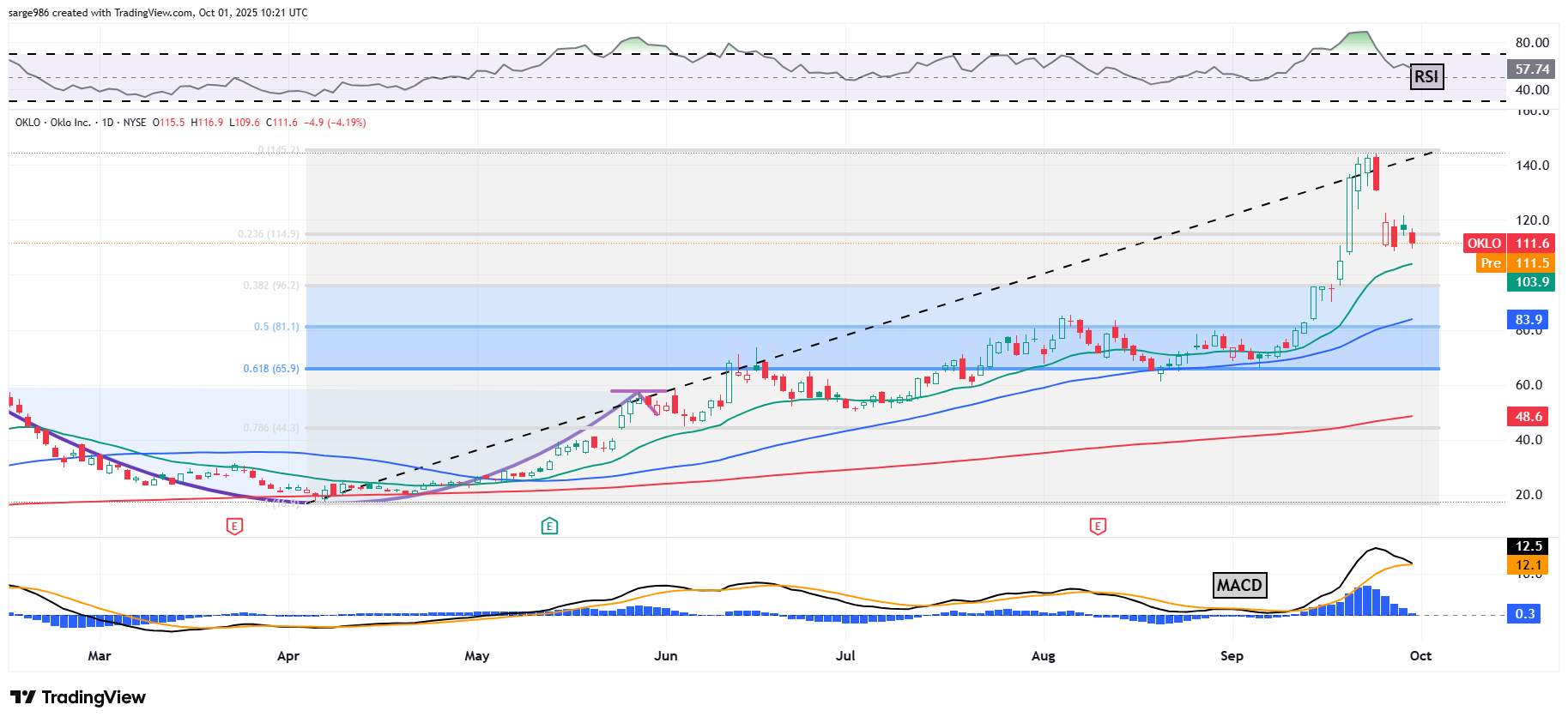
Well, no spit, cowboy. anyone can see what the stock just did. The fact is that OKLO is one of a few key participants in the Department of Energy's "Reactor Pilot Program" and the government wants test reactors up and running by June of next year. There is a need for clean, nuclear power like never before and that demand is only going to increase. I am not in this stock just yet, but I am really close to pulling the trigger as the stock approaches some key moving averages and key Fibonacci retracement levels.
I'll keep you up on this one but realize this: What the financial media did not tell you and what those algorithms that feed on momentum won't ever care about is this... Bank of America analyst Dimple Gosai is rated at zero stars out of five at TipRanks. Gosai is also ranked as the 9.989th best analyst of the 10,050 covered by TipRanks.
According to TipRanks, over the past 12 months, Gosai's picks have returned an average of -35.9%. So, stick that in your pipe and smoke it. I think I'll stick to doing my own homework, thank you. Dan Ives of Wedbush, currently rated at five stars by TipRanks, still has a "buy" on OKLO with a $150 target. Ives' picks over the past twelve months have returned an average of 15.6%.
A Threat to Nvidia...
Cerebras Systems, which is an AI semiconductor chip designer directly competing against Nvidia (NVDA) and to a lesser degree Advanced Micro Devices (AMD) , announced on Tuesday that it had raised $1.1 billion in new funding in a round that values the still private company at $8.1 billion. Cerebras, based in Sunnyvale, California, has filed to go public, but did not provide an update toward that eventual IPO. It claims that its inference solutions are 20 times faster than Nvidia's GPUs on both open-source and closed source models.
Economics
(All Times Eastern)
07:00 - MBA 30 Year Mortgage Rate (Weekly): Last 6.34%.
07:00 - MBA Mortgage Applications (Weekly): Last 0.6% w/w.
08:15 - ADP Employment Report (Sep): Expecting 41K, Last 54K.
09:45 - S&P Global Manufacturing PMI (Sep-F): Flashed 52.0.
10:00 - ISM Manufacturing Index (Sep): Expecting 49.1, Last 48.7.
10:00 - Construction Spending (Aug): Expecting -0.1% m/m, Last -0.1% m/m.
10:30 - Oil Inventories (Weekly): Last -607K.
10:30 - Gasoline Stocks (Weekly): Last -1.08M.
The Fed
(All Times Eastern)
No public appearances scheduled.
Today's Earnings Highlights
(Consensus EPS Expectations)
Before the Open: (AYI) (4.84), (CAG) (.33), RPM (1.88)
At the time of publication, Guilfoyle was long LRCX, MU, NVDA, AMD equity.