Shutdown Hangover, Hammer Doji's Impact, SoFi ... Breaks Out?
Let's see the after-effects of the longest shutdown, how the Dow made a record (and do we care?), chart the market and check out SoFi's move.
You've reached your free article limit
You've read 0 of 1 free Pro articles.
The U.S. government is again open for business. Late Wednesday, the House of Representatives passed the same spending package that passed in the Senate on Monday. Even later Wednesday night, Pres. Trump signed the legislation into law, ending the record-long, 43-day shutdown of the federal government. After eight Democrat party senators crossed the aisle in the Senate to create a 60/40 filibuster-proof majority for the Republican effort to reopen the government, the House voted 222 to 209 to do the same. In the House, two Republican party representatives crossed the aisle, while six Democrat party representatives defected in the other direction.
The bill, now law, extends funding to most of the government through Jan. 30 with a caveat for full-year funding for the Department of Agriculture, the Legislative Branch of government and military on-base housing. The bill guarantees a reversal of the layoffs of federal employees initiated during the shutdown and grants those laid off and furloughed employees back pay. A moratorium on future layoffs was granted as well.
Partisan politics was alive and well after the vote. Speaker Mike Johnson of Louisiana said, "Voters are going to remember which political party played games with their lives," while referring to the shutdown as "utterly pointless and foolish." Minority Leader Hakeem Jeffries countered, "Republicans in the House have continued to act like a wholly owned subsidiary of the corrupt Trump cartel. This fight is not over."
The fight that Jeffries refers to are the emergency-level, pandemic-era additional subsidies to the ACA (Obamacare) that will expire at the end of December. The Republican party plan has been to scale those subsidies back to pre-pandemic levels as the Democratic party plan has been to extend or normalize that level of federal spending.
The problem is that insurance premiums, which have been rising aggressively every single year regardless, would rise even more so without the extended subsidies, likely leaving many households with no insurance at all. The president has proposed paying households rather than insurance companies as an alternative. Democratic party senators have been promised a vote on these extensions in the upper chamber of the legislature by the second week of December.
What does a 43-day shutdown do to the U.S. economy? In all likelihood, this could shave as much as 1.5% from the annualized pace of U.S. economic growth for the fourth quarter. That said, as federal employees-led households receive back pay after having had to watch their budgets for a month and a half, this could play into an artificially active holiday season. In short, there could be a late-year pop across certain swaths of the economy driven by those households that don't merely have to play catch up on paying off their creditors.
No Soup for You!
The Bureau of Labor Statistics, not that its data is even considered close to accurate, has not yet made a statement on when the agency plans to start catching up on the backlog of key economic reports. Hence, the difference between the private and public sectors. When they are off or not being paid in the public sector, they really don't work. Can you even imagine a major corporation not having a publicly available recovery plan in place for the media after some kind of serious high-profile event that impacted the business? Especially when the coming end of said event was obvious to all for three or four days.
In fact, October data or at least estimates for consumer-level inflation and job creation are likely never to be released. White House press secretary Karoline Leavitt told reporters on Wednesday, "All of that economic data released will be permanently impaired, leaving our policymakers at the federal Reserve blind at a critical period."
Truth be told, I think the effort has to be made, even if the process is laborious, to put together at least some kind of best estimates for October. For, without October, how can we have month-over-month data for November?
On top of that, year-over-year data will be impacted next year. Though the month of November is nearly half over, there will have to at least be every effort made to publish semi-accurate November levels across the entire spectrum of federal economic data-point releases. We'll need published November over September numbers reflecting the pace of growth or contraction relative to 2024 comparable September to November trajectories.
Clearly, that can't be too difficult. These are academic economists. I get that. They may not be a bunch of fire-eating, go-getters, but this is their function. They are not like Wall Street or private sector economists that often have multiple balls in the air at any given time. Those guys have to put together estimates and plans for various alternative outcomes. Federal agency staff economists, for the most part, do not have all that on their respective plates. Nose to the grindstone, kids.
Sorry to See You Go, Bostic
Atlanta Fed Pres. Raphael Bostic announced on Friday that he would retire at the end of February when his current five-year term expires. Bostic is 59, and was eligible to hang on another six years if appointed to another term. That said, I guess enough is enough and only you know when that is. I have not always agreed with Bostic on policy. For instance, right now, he is making a hawkish stance on a December rate cut, while I think another half to three-quarters of a percentage point worth of rate cuts is warranted to get close to the neutral rate.
That said, Bostic has always done his homework and could always explain his positions in a thoughtful, easy to understand manner. He also often showed his ability to change his mind, which was something I liked about former St. Louis Fed Pres James Bullard. The financial media will often knock the Fed heads who go back and forth on policy, seeing them as indecisive. Is that not far better than the Fed officials that we are so often subject to that are either perma-doves, perma-hawks, or worse, driven by partisan politics? Though he could frustrate me at times, as an economist, Bostic is a good economist, whose voice at the central bank will be missed.
Marketplace
The Dow Jones industrial average closed on Wednesday at a record high. Whoopee. The last trader / investor that actually followed the DJIA retired in 1996. No professional money even tracks the index. Why the financial media still pretends that a 30-stock "blue chip" index has any meaning at all in 2025 is beyond me. Way, way beyond me.
Then S&P 500 eked out a 0.06% gain on Wednesday, while the Nasdaq Composite surrendered 0.26%. The Dow Transports rallied, the small cap indexes were down small. The real winners were the semiconductors, though. The Philadelphia Semiconductors popped for a gain of 1.47%, easily led by Advanced Micro Devices (AMD) . That stock ran an even 9% on Wednesday coming out of the company's analyst day on Tuesday and supported by CEO Lisa Su's interview with Liz Claman at Fox Business.
I know I have some bias here. I have been a Lisa Su fan since she arrived on the public scene in 2014 and I have been a Liz Claman fan since I've known her, which is longer than that. Bias aside, this was the most professionally done business conversation between an anchor and a chief executive that I think I have ever seen. If you are in AMD or just in the semis and by extension, the AI trade, go find this interview. Your intellect will thank you.
Breadth
Six of the 11 S&P sector SPDRs traded higher on Wednesday, led by Health Care (XLV) , and followed by the Financials (XLF) . Energy (XLE) placed at the bottom of the daily performance tables. Interestingly, there was not one kind of sector fund that appeared to either do well or do poorly. The cyclicals, the defensives and growth stocks were fairly well scattered from top to bottom.
Winners beat losers by a smidgen across the NYSE as losers beat winners by a crumb across the Nasdaq. Advancing volume took a majority share of composite NYSE-listed and composite Nasdaq-listed trade. Aggregate trading volumes were higher across the board on a day over day basis, but that was somewhat artificial as the banks and the bond market had been closed on Tuesday.
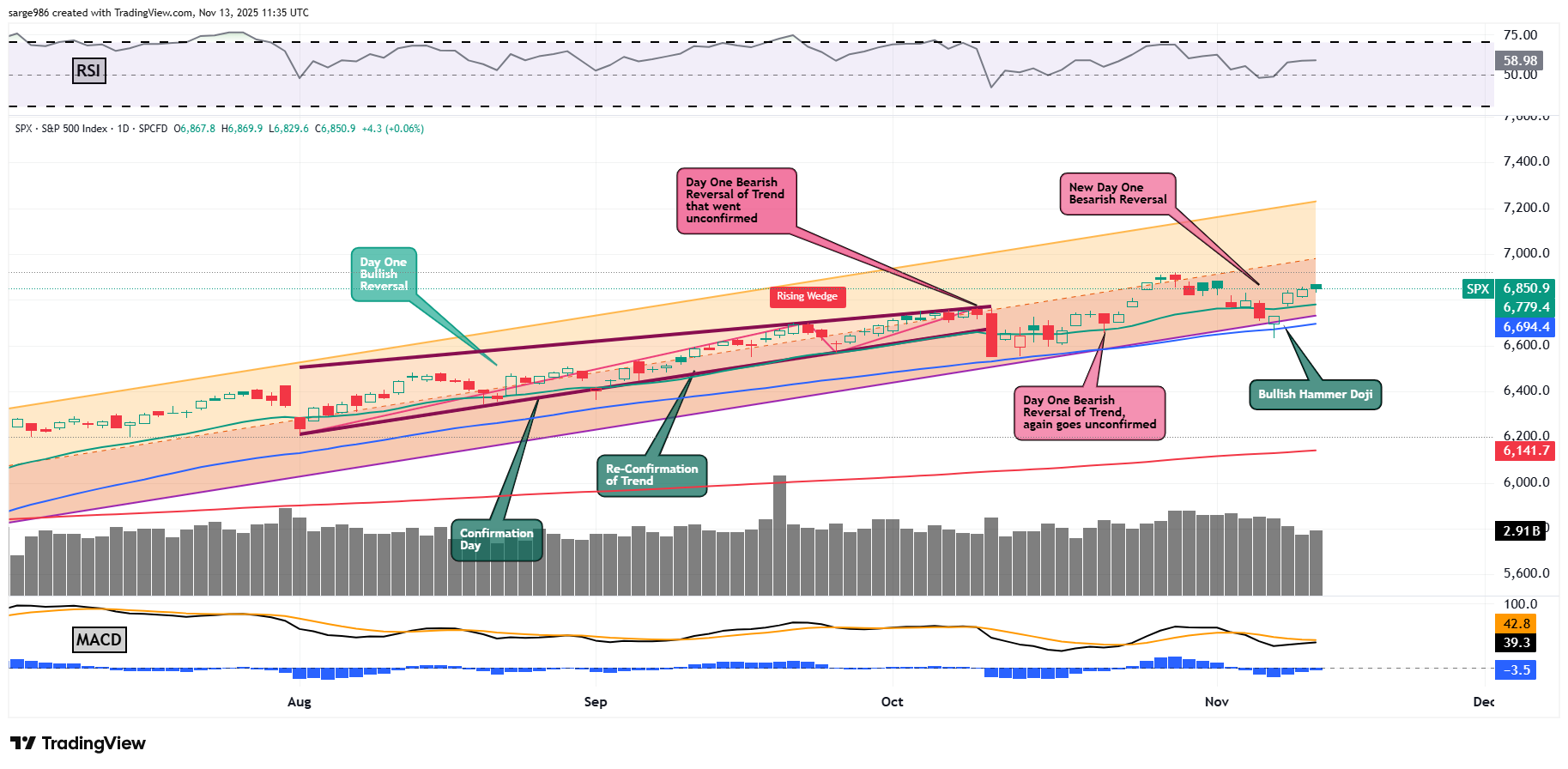
I am still impressed with how powerful that Hammer Doji was this past Friday. Just look at what that intraday reversal unleashed. Yes, equity markets more or less marked time on Wednesday, but you see that daily Moving Average Convergence Divergence. Equity index futures bare lower overnight? Yes. I see that. We'll see.
The daily MACD for the S&P 500 shows a 9-day exponential moving average about to go positive (a short-term bullish indicator) and a 12-day EMA poised to move above the 26-day EMA with both of those lines above the zero-bound. That would be a short to medium-term bullish indicator and would support our upside thesis for equities through the balance of 2025.
Uninteresting Ten-Year Auction?
The U.S. Treasury went to market on Wednesday with $42 billion worth of new Ten-Year paper. The results of the auction were "meh." The sale priced at a high yield of 4.074%, which tailed the "when issued" by 0.6 basis point. We'd rather see a "trade through" but not the end of the world. Bid to cover was 2,433. Not strong. Not weak. The internals were "OK."
Indirect Bidders (foreign accounts) took down 67% of the issuance. This was up from October. Average these days would be about 70, but it is possible that the shutdown may have hurt foreign demand. Direct Bidders (domestic accounts) went home with 22.55% of the auction leaving Dealers with a 10.5% slice of the pie. This was the largest portion of this series that Dealers were stuck with since the summer, but this is not an alarming number.
SoFi Breakout?
Remember this chart from Monday's "Stocks Under $10" column on SoFi (SOFI) ? I noted on Monday, the depth of the Cup's handle, which had been extended. I told readers that this could act as a slingshot, which possibly could increase velocity when and if the stock approaches its pivot point. Well, kids...
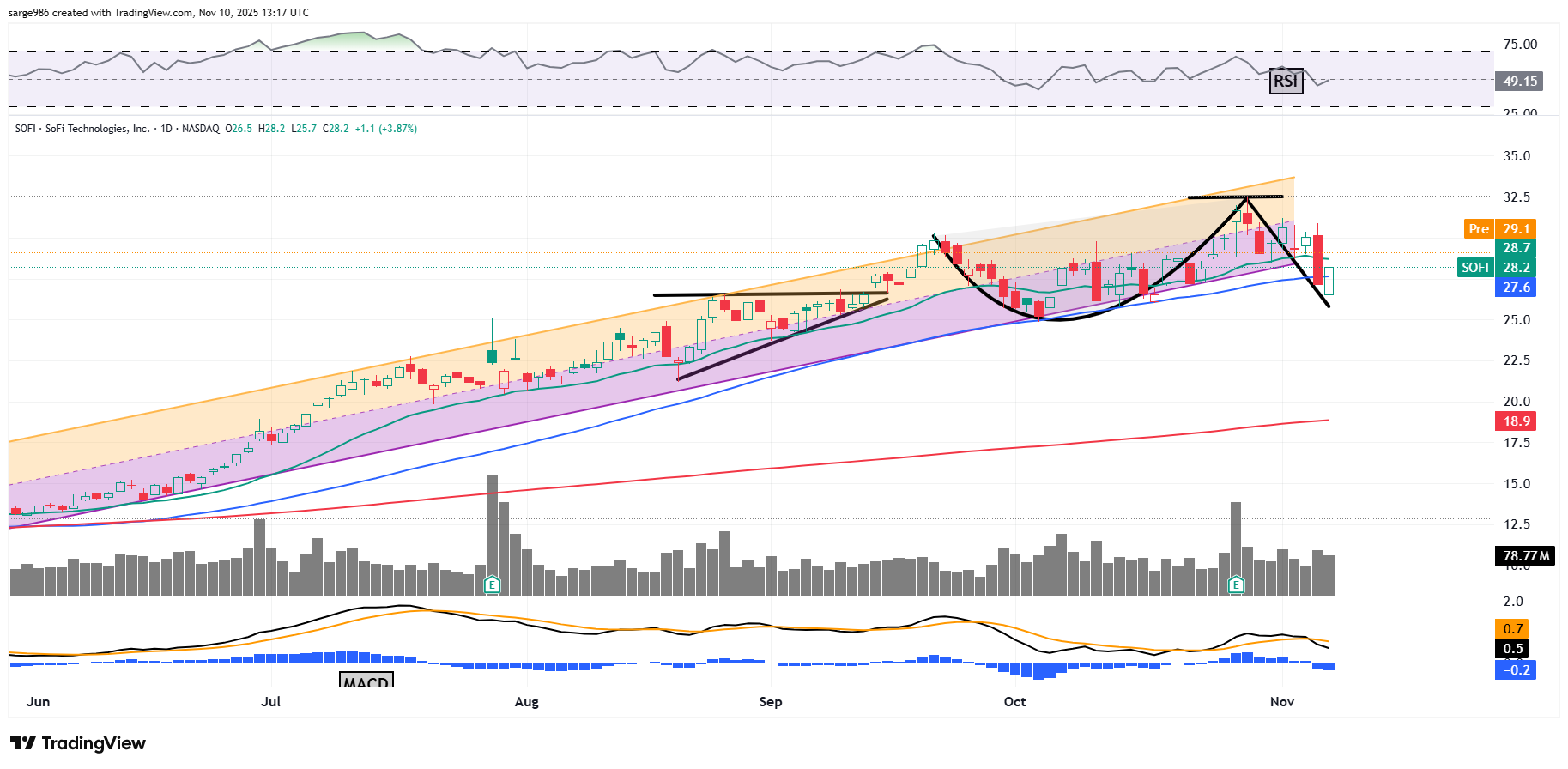
SOFI has reached pivot. It's showtime, gang.
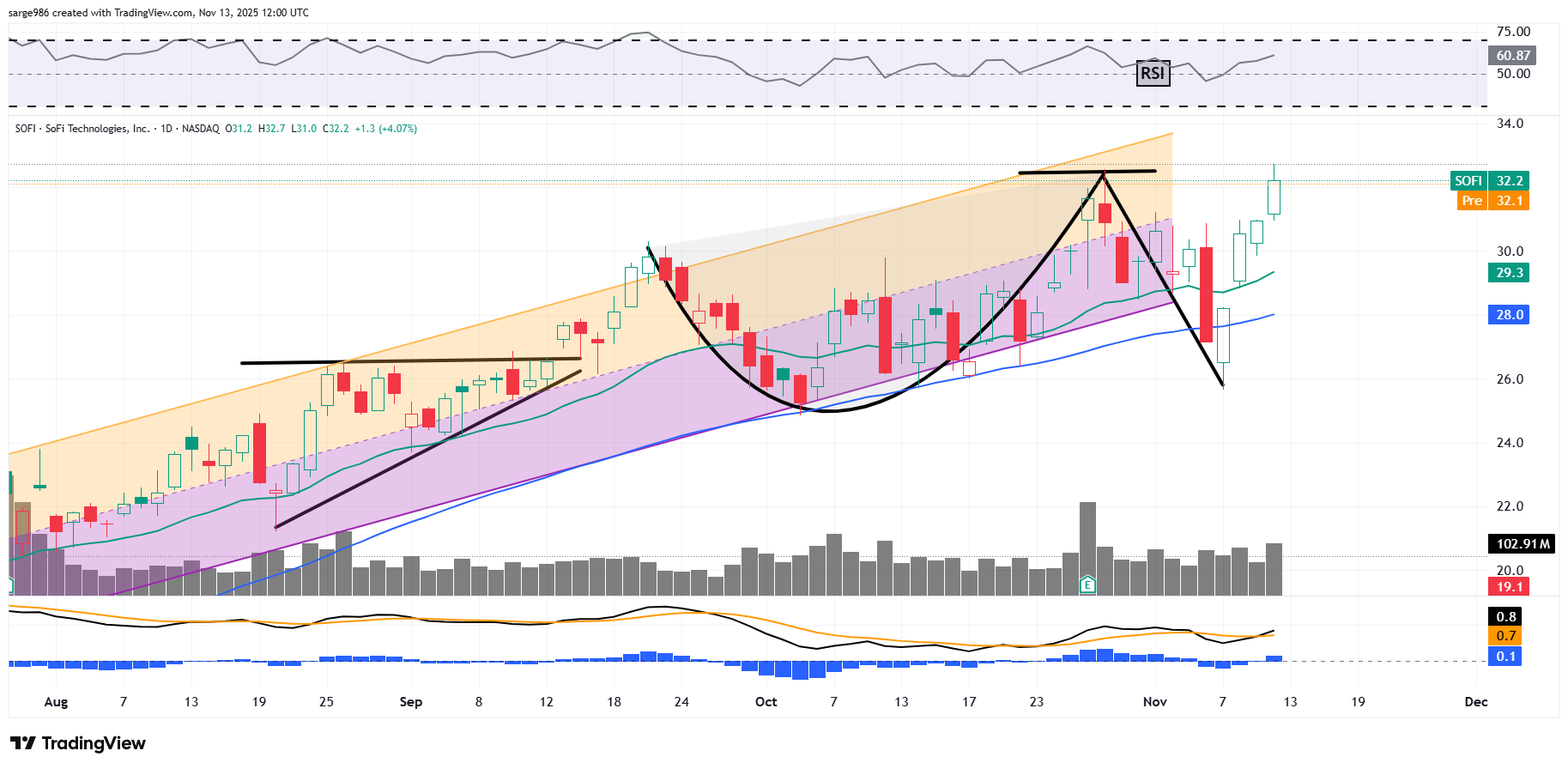
My target price, if you missed that Monday piece, is $40. That Is easily the highest target for this stock on Wall Street. Rock & Roll.
Economics
(All Times Eastern)
12:00 p.m. - Oil Inventories (Weekly): Last +5.202M.
12:00 - Gasoline Stocks (Weekly): Last -4.73M.
1:00 - Thirty-Year Bond Auction: $25B.
The Fed
(All Times Eastern)
12:20 p.m.- Speaker: Cleveland Fed Pres. Beth Hammack.
Today's Earnings Highlights
(Consensus EPS Expectations)
Before the Open: (DIS) (1.02)
After the Close: (AMAT) (2.10)
At the time of publication, Guilfoyle was long AMD, SOFI equity.