September's Market Forecast Looks Partly Sunny, GDP 'Good' News, Trading CrowdStrike
Those trades in Nvidia, AMD and CRWD appear to be paying off; Fed's Waller talks rate cuts and GDP revised to better than bad.
You've reached your free article limit
You've read 0 of 1 free Pro articles.
Morning found us calmly unaware
Noon burned gold into our hair
At night, we swim the laughin' sea
When summer's gone
Where will we be?
- Morrison, Densmore, Krieger, Manzarek (The Doors), 1968
Labor Day Weekend
Already? Really? I am beyond amazed by the pace of time as it flies. For there seems to no longer be the need to add "when you're having fun." Fun is nice, but no longer a requirement to witness the speed of life. I was just "the young guy." I was just in high school. Can't complain. No. I can't do that. Not all of my classmates, not all of my siblings ... were fortunate enough to grow old.
This is more of an observation than a complaint, as another summer ends, another season passes, baseball season winds down, football season begins anew. We'll now head into what on average, for investors, is the toughest season of the year. Citing Adam Turnquist at Investing.com who did the work, since 1950, September has returned an average of -0.7% to the S&P 500.
Making matters worse, September, since 1950, has only posted a gain for the period on 44% of those years. The second worst month in terms of positivity frequency is February at 54%. That's some gap between numbers one and two. For the S&P 500, when September is negative, the index has surrendered an average of 3.8%. That said, there may be no reason to run for the hills. Let me explain.
As Turnquist points out, when the S&P 500 enters September above its 200-day Simple Moving Average, as it is now, the month's positivity rate rises to 60% and its average return improves to 1.3%. When the S&P 500 enters September below its 200-day Simple Moving Average, the month's positivity rate for the period drops to just 15% and its average return drops to -4.2%.
The good news this morning? Equity index futures might be trading lower as the zero-dark hours pass, but the S&P 500 could lose almost 9% today and still enter September above its 200-day SMA. Rock and Roll. Oh, good thing we never, ever run into anything crazy in October.
Better Than Bad?
The Bureau of Economic Analysis released its first revision of, or second estimate (of three) for second-quarter gross domestic product. The headline number improved from a quarter-over-quarter, seasonally adjusted, annualized rate of 3% to 3.3%. Readers will recall that back in late July, the BEA released its first estimate for the second quarter and that most economists were surprised to see growth with a "3" handle. That improvement was, to a significant degree, thanks to a drop in imports (related to increased tariffs) and not because of such tremendous growth in economic activity.
That said, the revision released on Thursday was also surprising. This time, the improvement was due to a large upside revision to economic activity, despite the fact that federal spending during the period had contracted even more than first thought. The number within the report that I (and a lot of economists) look at as the best representative of economic activity is labeled "Final Sales to Private Domestic Purchasers." That number, for those readers who like to follow along, is found at line 32 of table 1 on page 6 of the full release.
That line was revised up to growth of 1.9% (q/q, SAAR) from an initial estimate of 1.2%. Incredibly, federal spending was revised down to -4.7% from -3.7%. Contracting federal spending counts against GDP, so growing the economy, despite negative growth in federal spending, is a big deal. For the full year of 2024, GDP grew 2.8%, supported by 2.6% growth in federal spending and 3.0% growth in final sales to private domestic purchasers. For 2023, headline GDP grew 2.9%, supported by 2.9% growth in federal spending and 2.5% growth in final sales to private domestic purchasers.
When all ironed out and formulated into what we finally see in those headline numbers, government consumption to include states and municipalities added 0.6% to both the 2.9% growth for 2023 and the 2.8% growth in 2024. But reduced government consumption actually shaved Q1's headline deceleration of -0.5% by -0.1% and shaved Q2's rate of 3.3% growth by -0.03%. How much of that 3.3% was actually personal consumption? The answer is 1.07%, revised up from 0.98%. For the full years of 2023 and 2024, that number was 1.72% and 1.87% respectively.
Four conclusions. One: The economy is nowhere near recessionary territory. Reporting such rubbish is reckless journalism. Two: The consumer is indeed weaker than in recent years past, but not as weak as previously thought. Three: The federal government has brought spending down substantially without broadly damaging the economy. At least not yet. Four: Without the change in the balance of trade, actual economic activity is probably growing at slightly below a 2% annualized pace.
Waller: Quarter Point Cut Supported
On Thursday, Fed Gov. Christopher Waller, who is currently the betting favorite to replace Jerome Powell as Fed Chair this May, spoke at an event in Miami. Waller said, "Based on what I know today, I would support a 25-basis point cut" at the upcoming policy meeting that will culminate on Sept. 17. Readers should be cognizant that Waller was one of two Fed Governors that dissented at the July 30 meeting in favor of a rate cut.
Waller explained, "While there are signs of a weakening labor market, I worry that conditions could deteriorate further and quite rapidly, and I think it is important that the FOMC not wait until such a deterioration is under way and risk falling behind the curve in setting appropriate monetary policy."
Most importantly, Waller finished with this: "The time has come to ease monetary policy and move it to a more neutral stance." He then informed his audience that he feels that the neutral rate is around 3%. That would mean a series of cuts that would total between 125 and 150 basis points over a series of policy meetings.
Marketplace
Thursday was another positive session on some iffy trading volume. That said, there looks to be some profit taking overnight as traders who are at work try to get ahead of the BEA's Friday morning release of July data on Both Personal Income and Personal Spending as well as PCE consumer prices. Now that we are past the earnings portion of the week, this is that set of data-points that could upset the equity apple cart.
On Thursday, the S&P 500 gained 0.32%. closing at yet a new all-time record high. The Nasdaq Composite added 0.53% for the session. Nothing else really moved all that much. The Philly Semiconductors tacked on 0.49% as the Dow Transports gained 0.11%. Interestingly, the Russell 2000 gained 0.19%, but the S&P 600 gave up 0.15% despite the fact that both claim to present an overview of small cap equity performance.
Winners beat losers by just a pinch at the NYSE and by a rough 6 to 5 at the Nasdaq. Advancing volume took a 62.7% share of composite Nasdaq-listed trade, but just a 53.7% share of composite NYSE-listed activity. Trading volume was down small on a day over day basis across NYSE-listings and up small across Nasdaq-listings.
Once again, the four defensive sector SPDR ETFs finished in the bottom four slots on the daily performance tables. The Utilities XLU and the Samples XLP were the weakest. Technology XLK led the winners. Tech itself was led by the Dow Jones U.S. Software Index (+1.05%), which in turn was led by Snowflake SNOW and Datadog DDOG.
U.S. Treasuries had rallied on Thursday, dropping yields a few basis points across the slope of the curve despite another rather sloppy auction. This time, the U.S. Treasury sold $444 billion worth of new Seven-Year paper. But those gains appear to have reversed while your local raccoons went through your trash and left a mess in your driveway.
Trading
I told readers on Thursday morning that I was buying weakness in Nvidia NVDA, Advanced Micro Devices AMD and CrowdStrike Holdings CRWD. NVDA and AMD both rallied off of those weaker levels nicely, but CRWD really took the cake. After being down sharply overnight into Thursday morning, that stock closed up 4.59% for the session. Take a look at this:
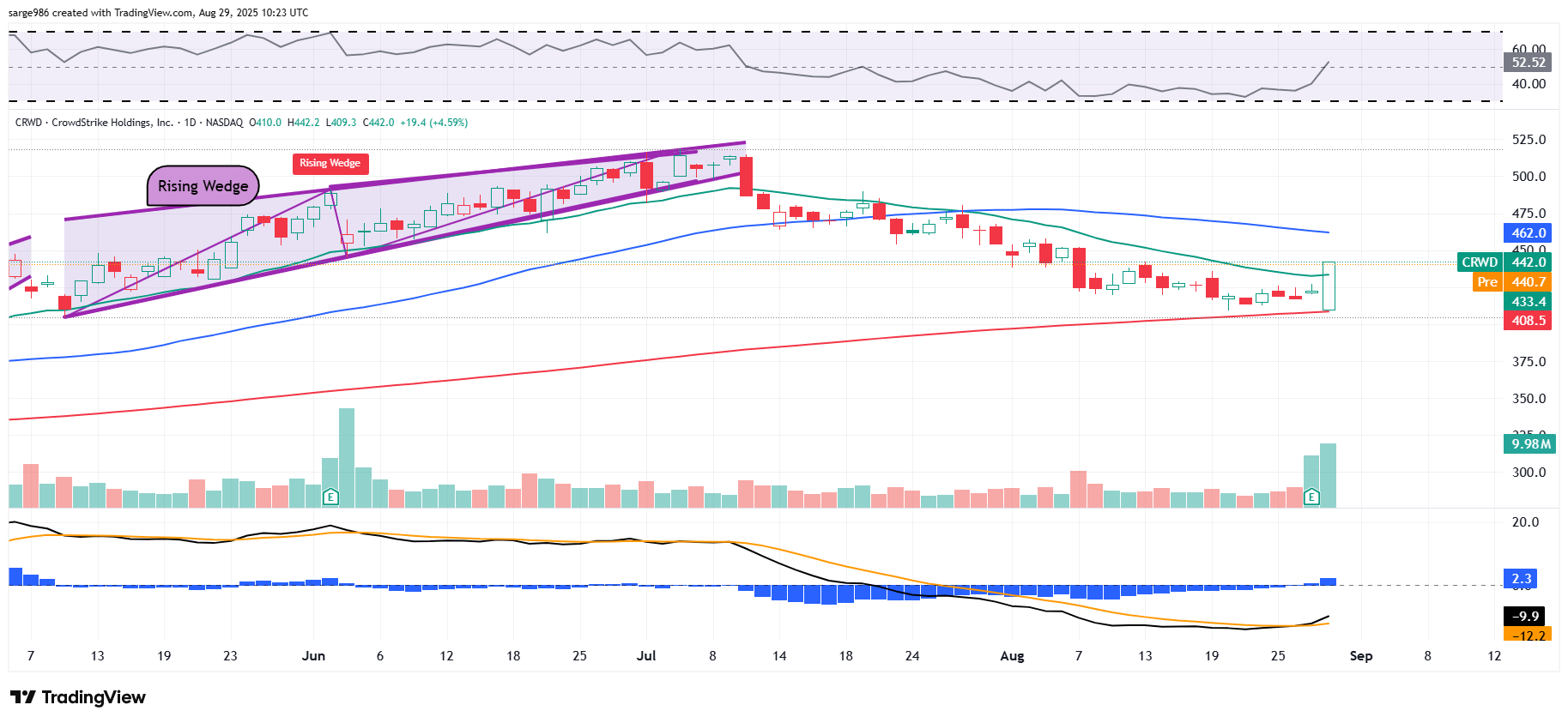
Yes, we've discussed the Rising Wedge pattern of bearish reversal in the past and it did do its job. That said, look at the support that this stock has found at its 200-day Simple Moving Average not just on Thursday, but for the week ahead of that earnings release. The stock gained its 21-day Exponential Moving Average, which probably brought some swing trades on board.
It will be interesting to see, with the market under early pressure this morning, if those swing traders defend that line, or if they are even at work today. Readers should also notice the sudden improvements in CrowdStrike's reading for Relative Strength as well as in its daily Moving Average Convergence Divergence. This set-up just became notably more bullish.
Economics
(All Times Eastern)
08:30 - Personal Income (Jul): Expecting 0.4% m/m, Last 0.3% m/m.
08:30 - Consumer Spending (Jul): Expecting 0.5% m/m, Last 0.3% m/m.
08:30 - PCE Price Index (Jul): Expecting 0.3% m/m, Last 0.3% m/m.
08:30 - Core PCE Price Index (Jul): Expecting 0.3% m/m, Last 0.3% m/m.
08:30 - PCE Price Index (Jul): Expecting 2.6% y/y, Last 2.6% y/y.
08:30 - Core PCE Price Index (Jul): Expecting 2.8% y/y, Last 2.8% y/y.
08:30 - Goods Trade Balance (Jul): Last $-84.85B.
09:45 - Chicago PMI (Aug): Expecting 45.7, Last 47.1.
10:00 - U of M Consumer Sentiment (Aug-F): Flashed 58.6.
10:00 - U of M One-Year Inflation Expectations (Aug-F): Flashed 4.9%.
10:00 - U of M Five-Year Inflation Expectations (Aug-F): Flashed 3.9%.
1:00 p.m. - Baker Hughes Total Rig Count (Weekly): Last 538.
1:00 - Baker Hughes Oil Rig Count (Weekly): Last 411.
The Fed
(All Times Eastern)
No public appearances scheduled.
Today's Earnings Highlights (Consensus EPS Expectations)
Before the Open: FRO (.55)
At the time of publication, Guilfoyle was long NVDA, CRWD, AMD equity.