Sell in May? (If You Did, Well, Sorry About That!)
Last month proved the old saying ... pretty wrong. Let's take stock of May, the week, chart the markets and look at what's ahead.
You've reached your free article limit
You've read 0 of 1 free Pro articles.
Sell in May? Maybe they meant the end of May -- or when the S&P 500 actually peaked for the month, on the 19th. Let's hope "they" didn't sell "their" longs or get net short at the start of the "go away" month. If they did, they surely lost a bundle. Maybe two bundles. After three consecutive "down" months, the S&P 500 gained 6.15% for May and landed just 4% shy of it's all-time high set just before the wheels came off in mid-February.
The S&P 500 would not bottom until it was 21.3% off of that winter top on April 7, five days after Pres. Trump's "Liberation Day." At Friday's closing bell, the index had climbed 22.3% off of that bottom. Many well-maintained portfolios had reclaimed record highs by Mid-May even if the index had not, through aggressive risk management, and not passive investment (opinion). The game now becomes more about the ability to hold on to and even grow from these levels.
The Nasdaq Composite gained a whopping 9.56% in May but had also squeaked out a winning month in April, so the "Nazzy" has a two-month winning streak going at this time. Still, though, the Nasdaq Composite needs to tack on another 5.7% to match its mid-December record high.
The Fun to Come...
Friday came and Friday went. A rather mixed session that leaned lower but seemed almost directionless. There would be no real monthly mark-up or pension fund rebalancing to speak of. The real fun and games associated with rebalancing and reconstitutions will come later this month as June closes out the second quarter, and the first half.
S&P Dow Jones Indexes will announce the coming reconstitutions of the S&P 400, S&P 500 and S&P 600 this coming weekend, with the actual changes to be made on Saturday, June 21. That means that the close of business on Friday, June 20 will likely turn into absolute mayhem. The Russell Index Reconstitution will take place the following Friday, June 27, and is considered to be by many, the busiest trading day of the year.
The Week That Was...
The highlight of the week past, from a macroeconomic perspective, was the ice-cold reading for April personal consumption expenditures price index inflation on Friday. On a month-over-month basis, both headline and core PCE inflation printed as expected at growth of 0.1%. On a year-over-year basis, which is what the Fed and most economists I know are watching, headline PCE dropped to just 2.1% from 2.3% in April, despite having to overcome at least some of the initial impacts of the president's tariffs. Core PCE dropped from 2.7% in April to 2.5%.
Sticking to the macro, on Tuesday, as last week was a four-day, holiday-shortened set, Durable Goods Orders printed in a state of steep decline, but still beat expectations. What was most alarming was the -1.3% monthly print for core capital goods orders, which is seen by many as a proxy for business spending. On Thursday, the BEA revised Q1 gross domestic product higher, but just to -0.2%, q/q, SAAR. We had told you in this column to anticipate an upward revision. I would not have bothered you if I had realized that the revision would be so slight in stature. My math had it approaching the 0.0% mark. My apologies.
On a brighter note, for May, both the Conference Board's Consumer Confidence Survey and the University of Michigan's revision to its Consumer Sentiment Survey surprised sharply to the upside. The University of Michigan survey also showed a striking decrease in consumer inflation expectations both over the next year and the next five years.
The big earnings releases for the week came from Nvidia NVDA and Salesforce CRM. The Nvidia release, while generally received as positive, foretold of brewing tensions with China that may or may not be resolved in a constructive way. Both Treasury Sec. Scott Bessent and Pres. Trump expressed some dissatisfaction toward the end of the week with how talks between the world's two largest economies are progressing. Bessent made the Sunday news show circuit this weekend and opined that a call between Presidents Trump and Xi would be necessary to "iron out" some issues.
So... Time to Cut Rates?
With the Fed's inflation target essentially met and inflation expectations now in a state of decline, is it time for the Fed to cut short-term interest rates. Apparently not. Fed Chair Jerome Powell met with Pres. Trump last week and, by all accounts, "did not discuss his expectations for monetary policy."
Powell did say that the Fed could face difficult trade-offs (between the central bank's dual mandates), adding that the path of policy would be determined solely on incoming economic information. Does it matter that the FOMC cut the Fed Funds Rate by 50 basis points last September when PCE dipped to growth of 2.1%? Apparently not.
Does it matter that the FOMC cut the Fed Funds Rate by another half percentage point over the next two months, even as the PCE increased to 2.6%? Apparently not. Does it matter that even the South China Post is reporting that 65% of U.S. tariffs on Chinese imports will likely have to be eaten by Chinese producers to maintain access to the U.S. consumer? Apparently not. I do not think that Powell has been as awful a Fed Chair as do many others. On rates, though, he cannot claim two things. He cannot claim to be anything remotely close to consistent, and he cannot claim to be governed by his own rules.
Just an FYI: Fed Gov. Christopher Waller, speaking from South Korea over the weekend, did say that he sees a path toward multiple rate cuts this year. Auditioning for a new role?
The Numbers
What the major to mid-major U.S. equity indexes did last week to close out a strong month of May as U.S. Treasury debt securities also had a nice week.
- The S&P 500 gained 1.88% for the week, and 6.15% for May.
- The Nasdaq Composite gained 2.01% for the week, and 9.56% for May.
- The Nasdaq 100 gained 2.03% for the week, and 9.04% for May.
- The Russell 2000 gained 1.3% for the week, and 5.2% for May.
- The S&P Small Cap 600 gained 1.36% for the week, and 5.07% for May.
- The S&P Mid Cap 400 gained 0.8% for the week, and 5.25% for May.
- The Dow Transports gained 1.04% for the week, and 7.67% for May.
- The Philly Semiconductors gained 1.18% for the week, & a whopping 12.48% for May.
- The KBW Bank Index gained 1.45% for the week, and 8.15% for May.
For the week, ten of the eleven S&P sector SPDR ETFs traded higher, led by the REITs XLRE at +2.68% and followed by the Financials XLF and Technology XLK. Only Energy XLE closed out the week in the red.
For May, similarly, ten of these 11 funds showed gains, with Tech up 9.97% and the Industrials XLI up 8.84%. Five of these funds gained more than 4.5% for the month. Only Health Care XLV showed a monthly loss, at -5.57%.
Earnings
The tail end of the first quarter earnings season continues to drag on, with a few names still to report. This has been a much stronger season than had been expected. According to FactSet, with about 98% of the S&P 500 having reported, 78% of firms so far have beaten earnings expectations while 64% of firms so far have beaten expectations for revenue generation.
On a year-over-year basis, the S&P 500 is now running at a first-quarter blended (earnings & expectations) growth rate of 13.3% for earnings, up from 12.9% last week, but up from 7.2% several weeks ago. Revenue growth is still running at 4.9%, up from 4.8% three weeks ago. Interestingly, as mentioned previously in this column, it appears that the first quarter may have pulled economic activity forward from the second quarter. Consensus for Q2 earnings growth is down to 5.0% from 9.1% almost two months ago. Q2 revenue growth is currently seen at growth of 4.0%, down from 4.6% at that time.
For the first quarter, Health Care ran way ahead of the pack, with earnings growth of 43%. Communication services came in a very distant second place with growth of 28.9%. Three sectors posted first-quarter earnings contractions, led in the wrong direction by Energy (-12.7%) and the Staples (-6.3%). For the full calendar year of 2025, Wall Street now sees earnings growth of 9.1%, down from 11.3% almost two months ago. Expectations for full year revenue growth have fallen from 5.4% to 4.9% over that same period.
As far as valuation is concerned, the S&P 500 went into this past weekend trading at 21.3-times forward looking earnings, up from 21.1 times a week ago and 25.9-times 12-month trailing earnings, up from 25.6-times just last week. These valuations are both now well above their five-year averages of 19.9 times for forward looking earnings and 24.8 times for trailing twelve-month earnings, respectively.
The GDP Game
Last week, the Atlanta Fed revised its GDPNow model for the second quarter up sharply to growth of 3.8% (q/q, SAAR) from 2.4% last week due to a significant upward tweak to the input for net exports. There is still no estimate for Q2 GDP ex-the gold trade at this time, so we'll assume that for now, this will not be an issue for the current quarter. Among other regional central bank district branches running close to real-time GDP models, the New York Fed's estimate for Q2 growth now stands at 2.42%, down from 2.43%, while the Cleveland Fed still sees Q2 growth of 1.97%. The St. Louis Fed increased its estimate for Q2 GDP from growth of 2.44% to growth of 2.71% last week. All of this pretty much shatters what had started to look like a consensus view across all of these models. Where is my trusted Hedgeye Nowcast Model? Hedgeye is the only one, I might add, that has been consistently close, not just on GDP, but also on inflation, which is why I pay the firm. After literally nailing the initial BEA estimate for Q1 GDP, Hedgeye's model for the second quarter is now running just above 1.6%.
The Chart
Readers will see quite a few mixed signals in this chart of the S&P 500. We see the bullish Day One change of trend on Tuesday followed by the pause that we all looked for on Wednesday. Then came an up day on light volume followed by a slight down day on increased trading volume. I am seeing Thursday and Friday as a continuation of the pause.
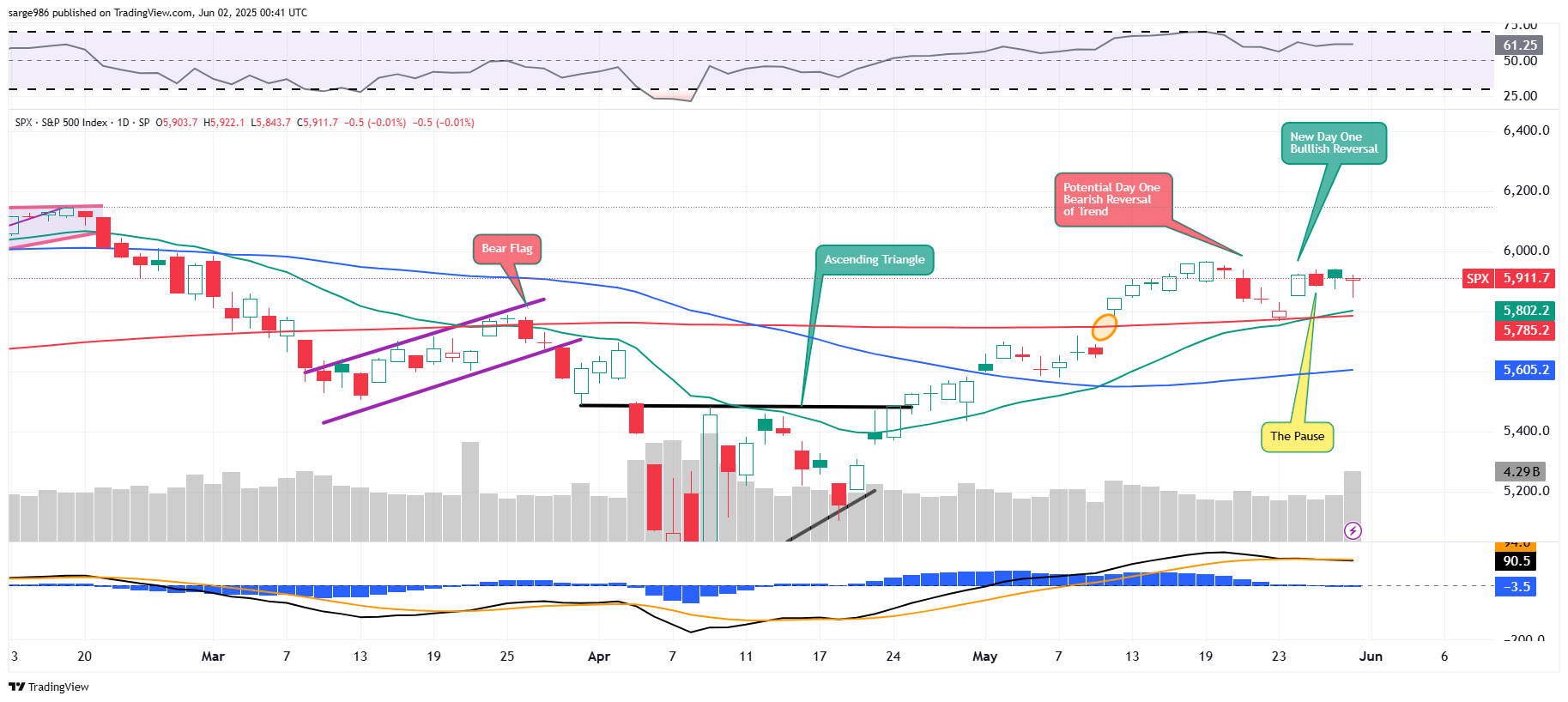
Relative Strength is still quite robust, and the 21-day exponential moving average did cross above the 200-day simple moving average, which is bullish. That said, look below the chart, at the daily Moving Average Divergence Convergence. The histogram of the 9-day exponential moving average has moved into negative territory. That is short-term bearish. Additionally, the 12-day EMA has crossed below the 26-day EMA. Both are still in positive territory, so it could be worse, but seeing the 12-day line below the 26-day line often leads to a period of profit taking by professional portfolio managers.
Words of Steel
President Trump told U.S. steelworkers in West Mifflin, Pennsylvania that he would "bring it from 25% to 50%, the tariffs on steel into the United States of America." The president said that these increases would "further secure the steel industry" and added "At 25%, they can sort of get over that fence. At 50%, they can no longer get over the fence."
This came after the president had gotten behind a merger between Nippon Steel and US Steel X where there will be no U.S. layoffs and the U.S. government will have a "golden share" allowing it to decide on a number of board seats. Organized labor obviously cheered the news. We'll see how much the markets like it when the opening bell rings in a few hours.
What's Ahead?
Well, a five-day workweek lies to your direct front. At least we have that. The week ahead will be light on earnings, have a few Fed speakers mixed in, but most all, this is May "Jobs week." Enough said.
- The domestic macroeconomic calendar kicks off with the ISM Manufacturing PMI on Monday morning to be followed by the ISM Services PMI on Wednesday. For the most part, though, this week will be about jobs. The April JOLTs report will hit the tape on Tuesday and could show less job openings than available workers for the first time in many years. Then comes the May data which will be watched very closely by Jerome Powell and company. The ADP print for private sector job creation lands on Wednesday morning to be followed by the results of the BLS surveys on Friday morning.
- The Federal Reserve will be out and about again this week. Right now, I am tracking at least nine public appearances made by Fed officials through Thursday. The headliner of the group will obviously be Fed Chair Jerome Powell himself on Monday afternoon. The Fed will also release its updated Beige Book on Wednesday afternoon.
- The earnings calendar is again rather light this week. Again, there will be a few market-moving names reporting. This morning, we'll hear from Campbell's Soup CPB, to be followed on Tuesday by Dollar General DG, and CrowdStrike Holdings CRWD. On Wednesday morning, Dollar Tree DLTR will report to be followed on Wednesday afternoon by MongoDB MDB. Finally, Thursday afternoon will bring with it results from Broadcom AVGO and DocuSign DOCU.
Economics (All Times Eastern)
09:45 - S&P Global Manufacturing PMI (May-F): Flashed 52.3.
10:00 - ISM Manufacturing Index (May): Expecting 49.0, Last 48.7.
10:00 - Construction Spending (Apr): Expecting 0.3% m/m, Last -0.5% m/m.
The Fed (All Times Eastern)
10:15 - Speaker: Dallas Fed Pres. Lorie Logan.
12:45 p.m. - Speaker: Chicago Fed Pres. Austan Goolsbee.
1:00 p.m. - Speaker: Federal Reserve Chair Jerome Powell.
Today's Earnings Highlights (Consensus EPS Expectations)
Before the Open: CPB (.66)
After the Close: CRDO (.27)
At the time of publication, Guilfoyle was long NVDA, CRWD equity.