Scott Bessent’s Teachable Moment
The Treasury Secretary is a legendary currency trader, so why is he so wrong about the dollar?
You've reached your free article limit
You've read 0 of 1 free Pro articles.
What if the Treasury Secretary of the United States made a statement that can’t possibly be true? That’s what happened on May 23, when Scott Bessent made the following statement to a reporter:
“I wouldn’t necessarily characterize it as a weak dollar. I think a lot of this is other countries’ currencies strengthening as opposed to the dollar weakening.”
- Treasury Secretary Scott Bessent, to Bloomberg, May 23, 2025
Bessent has very impressive credentials. As a partner at Soros Fund Management (SFM) in London, he participated in legendary trades involving the British pound (the Black Wednesday crisis of 1992) and the Japanese yen (2013) that grossed SFM over $1 billion each.
These facts alone place Bessent in the highest echelon of currency traders. In the currency trading world, he is royalty. That's what makes the above statement so puzzling.
Consider the chart below. On the left, we see the U.S. Dollar Index. This is the most widely used measuring stick for the dollar. This index measures the dollar vs. a basket of currencies.
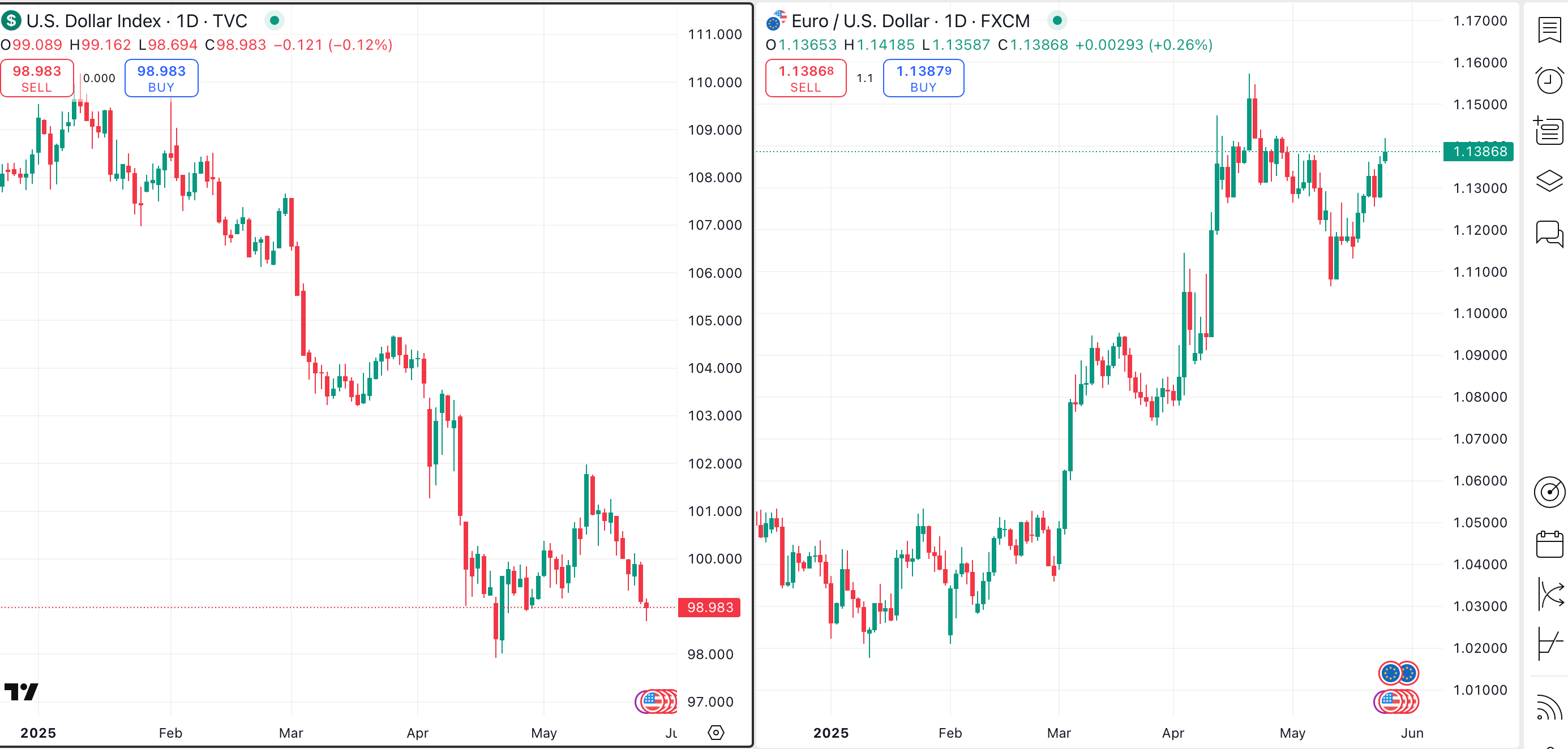
On the right, we see the euro simultaneously rising as the U.S. dollar falls. Both charts begin at the start of this year. Notice how the two charts have a strong negative correlation, and understand that this has always been the case.
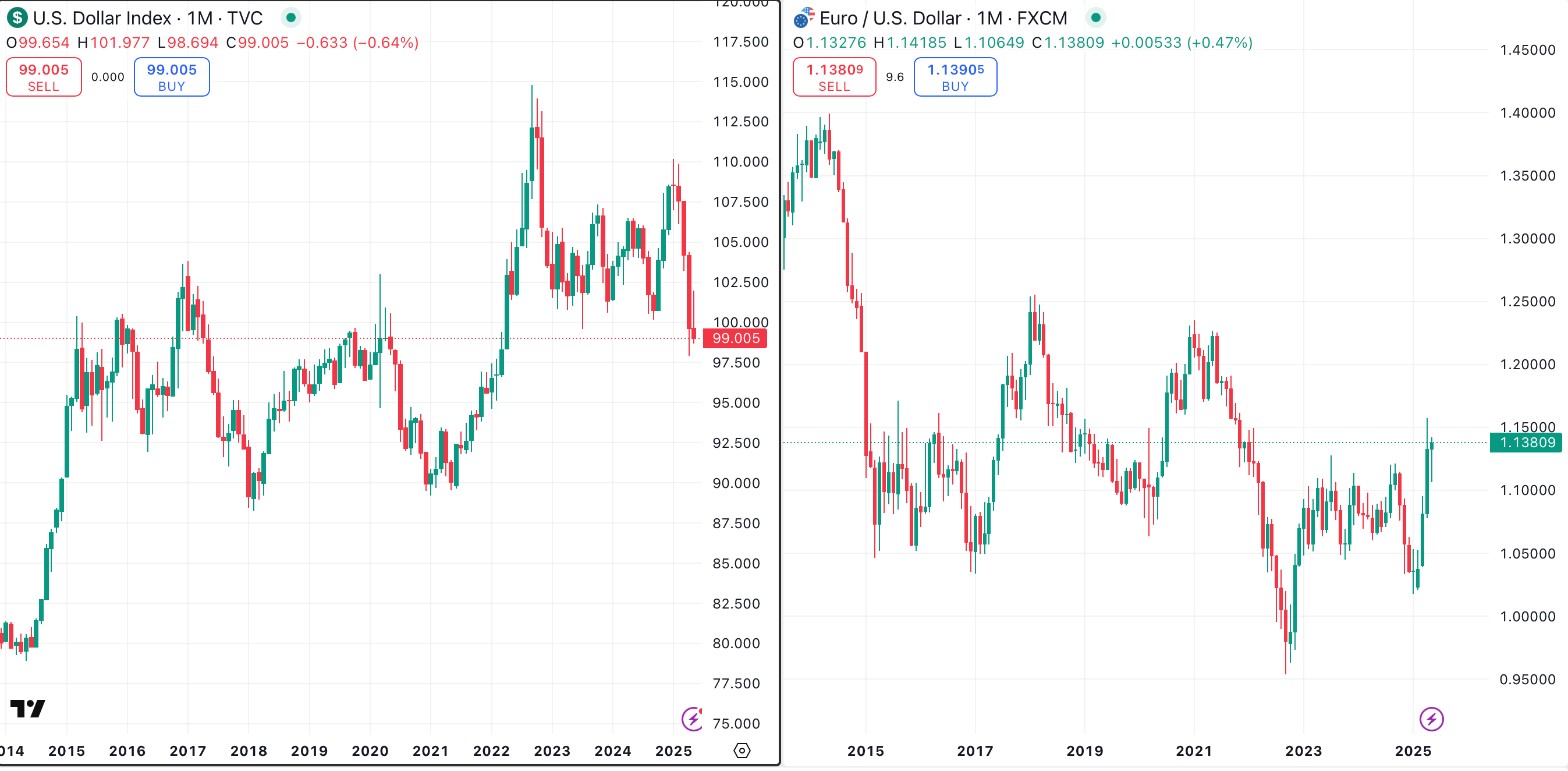
Below, we see the same two instruments over a 10-year period. Notice that the strong negative correlation remains intact:
To understand why Bessent’s statement could be considered inaccurate, consider the following.
Here in the U.S., we value nearly everything in terms of U.S. dollars. A share of stock, a barrel of oil, and an ounce of gold, all have a fluctuating value that is expressed in dollars.
The one financial instrument that isn’t valued in terms of dollars is the U.S. dollar.
One dollar is always worth one dollar. One euro is always worth one euro, and so on. Because of this, currency traders have always expressed currency values in terms of other currencies. This is done via currency pairs, like EUR/USD, or currency indexes, like the U.S. Dollar Index.
Think of a see-saw. When one side goes up, the other side goes down. That’s how currency exchange rates are expressed, and every currency trader is aware of this. So why is Bessent claiming that one side of the see-saw is rising, while denying that the other side is falling?

My guess is, Bessent didn’t want to publicly admit what every currency trader already knows — that the dollar is falling due to concerns over government spending. This is also why gold has been rising, as well as Treasury yields.
It’s still early in the game, but the desired results of Bessent's policies haven’t materialized yet. Perhaps a scaled-down version of the so-called Big Beautiful Bill would help alleviate the market's concerns about excessive spending and inflation.