Risks Ahead: Oil, Iran, Stagflation, China's Economy
As global confusion spreads, let's check the war on Iran, oil prices, jobs worries, the danger to China's economy ... and chart the market.
You've reached your free article limit
You've read 0 of 1 free Pro articles.
 Market_Recon_TSP1_KL
Land of Confusion
Ooh, Superman, where are you now
When everything's gone wrong somehow?
The men of steel, the men of power
Are losing control by the hour
The is the time, this is the palace
So, we look to the future
But there's not much love to go 'round
Tell me why this is a land of confusion
- Rutherford, Banks, Collins (Genesis), 1986
Mayhem
Zero dark-thirty, Monday morning. Financial markets appear to be reflecting the geopolitical situation in the Middle East and elsewhere as much as anything else. Crude oil prices surged overnight despite continued U.S. dollar strength. Why? Investors and traders, globally, sought safe haven while simultaneously trying to price in a certain level of scarcity whereas energy-focused commodities are concerned.
Brent crude ran. WTI Crude, also known as the "sweet stuff" ran as well. As I try to wrap this piece up, WTI Crude is trading close to $103 per barrel. up more than 13% since late Friday. I have seen front-month WTI trade at more than $119 per barrel since futures markets opened on Sunday evening. U.S. Treasuries are selling off, not seeing any value as a safe haven. I see the U.S. Ten-Year Note paying more than 4.19% on Monday morning and have seen that yield spike above 4.21% overnight.
Asian stocks were hammered on Monday. The Nikkei 225 (Japan) gave up 5.2%, while the KOSPI (South Korea) lost almost 6%. European stocks opened on weakness. I currently see the CAC 40, IBEX 35, FTSE MIB and DAX all down between 2% and 3%. U.S. equity index futures are taking a licking as well.
Not only has transport of crude and liquefied natural gas in the CENTCOM region slowed to a crawl, but over the weekend, Iranian drones struck a refinery in Bahrain, as the Israeli Air Force targeted Iranian oil storage depots. In addition, Iraq, Kuwait and the United Arab Emirates (UAE), all OPEC members and large producers / exporters of crude, have been forced to cut that production due to a lack of storage space because transport has slowed so significantly.
Markets are also reacting to the selection in Iran of the deceased Ayatollah Ali Khamenei's son, Mojtaba, seen as an anti-U.S., anti-Israel hardliner, as that nation's new supreme leader. The selection, though it's hard to know just how much internal influence the regime in place still has, signals that perhaps Iran is nowhere near announcing the "unconditional surrender" that U.S. Pres. Donald Trump is seeking.
The Financial Times is reporting that G7 finance ministers will discuss later on Monday, the possibility of a joint release of petroleum from their strategic reserves in a move that would be coordinated by the International Energy Agency. There are 32 nations that are members in the IEA if this could be agreed to. This is at least part of why markets are off of their worst levels.
A Real Concern...
As the war in and around Iran moves into its second week, fears of stagflation have entered into the economic conversation, not just here in the U.S., but globally. I mentioned U.S. Treasuries, but sovereign debt securities are taking a hit around the planet, forcing borrowing costs higher for most of the developed world.
Here at home, the energy price shock will hurt consumer-level demand for goods and services as headline inflation rears its ugly head. You all saw what regular unleaded gasoline went for this weekend. That price will be even higher when you head out this morning. Here in the U.S., this price shock is hitting an economy already showing more than just signs of labor market weakness.
According to the Bureau of Labor Market Statistics, the U.S. economy either lost a net 161,000 employed positions in February or 185,000 employed persons, depending on whether one has more faith in either the establishment or household survey for the month. Either way, job seekers were hit in the mouth. Several investment banks and economic think tanks have already made estimates on the impact of this energy shock to the pace of U.S.-based economic activity.
While the U.S. is expected to weather this storm better than most as the U.S. is s net exporter of crude, the crude produced here is not exactly the kind best refined into gasoline. So, we still have to trade to get what we need. Either that, or refinery costs will rise. The general consensus (and these are just estimates) seems to be that a 10% rise in crude oil prices could take headline consumer price index between 0.2% and 0.4% higher.
Every $10 increase in the price of oil, if sustained for more than a brief period, is likely to shave at least 0.1 percentage point from the pace of gross domestic product growth. We know that Q4 GDP ran at q/q SAAR growth of 1.4%, so we don't have a lot of "tenths' to spare. Lastly, several economists have mentioned that should WTI Crude prices reach $150 per barrel, this could trigger an outright contraction in US economic activity. A recession would be two consecutive quarters of economic contraction.
The Week That Was...
As U.S. financial markets were pummeled last week as investors focused on the Middle East...
- The S&P 500 gave up 1.33% on Friday and 2.02% for the week.
- The Nasdaq Composite lost 1.59% on Friday, and 1.24% for the week.
- The Nasdaq 100 gave back 1.51% on Friday and 1.27% for the week.
- The Russell 2000 surrendered 2.33% on Friday and a nasty 4.07% for the week.
- The S&P Small Cap 600 lost 2.28% on Friday and 3.85% for the week.
- The S&P Midcap 400 gave up 2.38% on Friday and an ugly 4.61% for the week.
- The Dow Transports were hit for 3.52% on Friday and pasted for 6.24% for the week.
- The Philly Semis were bashed for 3.93% on Friday and humbled for 7.21% for the week.
- The KBW Bank Index was punished for a loss of 2.48% on Friday and 3.59% for the week.
On Friday, nine of the 11 S&P sector SPDR exchange-traded funds closed out the session in the red, led lower by technology (XLK) , the materials (XLB) and the discretionaries (XLC) . The staples (XLP) and energy (XLE) were the only winners.
For the week, 10 of the 11 S&P sector SPDR ETFs traded lower, with the Materials easily leading the losers on U.S. dollar weakness. Energy, for obvious reasons, was the lone and runaway winner.
The Chart
Readers will see that the S&P 500 lost the lower support level on Friday, for the basing period (or rectangle) that we discussed in detail last week.
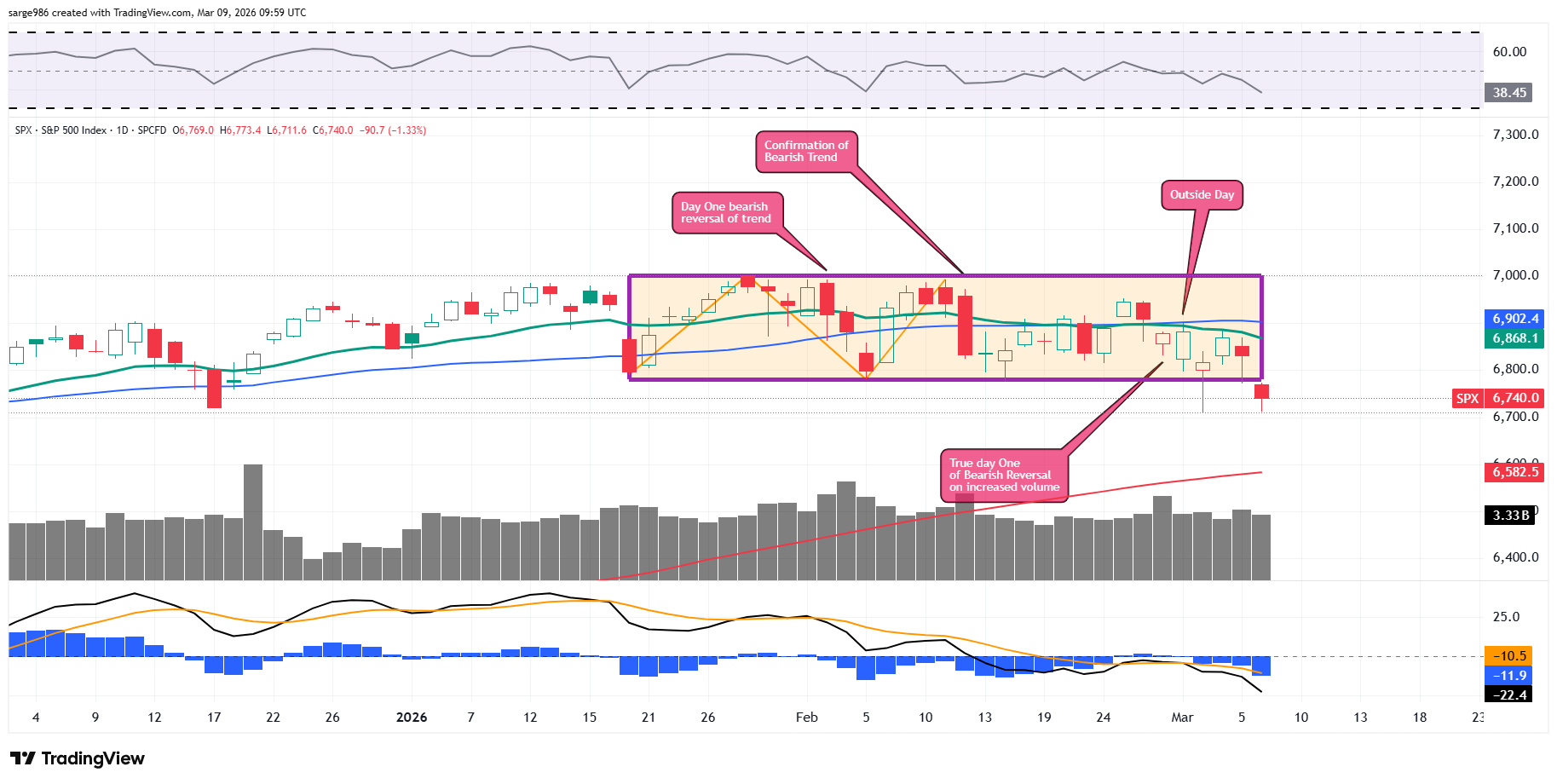
The index has hit resistance twice in recent days, at its 21-day exponential moving average, suggesting that swing traders have been net sellers. Without a re-engagement with the 50-day simple moving average, which would happen if an end to hostilities were announced, professional money will not be tempted to increase long-side exposure, and many will see the 200-day simple moving average as a potential destination.
Looking at the indicators, relative strength continues to weaken but is not yet close to being technically oversold. A positive? Either that, or there's more too to run to the downside. The daily moving average convergence divergence continues to exhibit an overtly bearish posture as all three components are sending ugly signals and all three are still moving in a negative direction.
Fed Funds Futures
Fed Funds futures trading in Chicago are currently pricing in just a 3% probability for a quarter-point rate cut at the next FOMC policy meeting on March 18, down from 5% a week ago. The next rate cut is now priced in for Sept. 16 (68% probability), out from July 29 last week at this time. At present, there are just a quarter points worth of additional rate cuts fully priced in (83% chance) for all of calendar 2026, down from 5-basis points last week at this time.
On The Docket...
This will likely be another highly volatile week for U.S. financial markets....
.... The war in the Middle East is the most important item facing financial markets this week. Energy prices are already ripping past Wall Street and impacting Main Street, U.S.A. It's not just the U.S. China imported more than 80% of inexpensive, illegal Iranian oil to support its economy. More than 50% of all Chinese oil imports pass through the Strait of Hormuz. The Chinese economy is close to resembling a house of cards should this war persist. A Chinese economic crash would be felt around the world.
.... Our central bankers will not be very active early this week. We'll hear from Fed Gov. Michelle Bowman twice this week. While Bowman is respected and considered to be influential, I have no other Fed officials on my radar.
.... The macroeconomic calendar will be hot as heck this week. On the inflation front, both February consumer price index on Wednesday and January personal consumption index on Friday, will cross the tape. Friday will be an especially busy day, economically. As PCE inflation prints, so will January durable goods orders, January Personal Income & Spending, January JOLTs job openings and job quits and the advance release of the University of Michigan's Consumer Sentiment survey.
.... The earnings calendar will slow sharply this week. Among the few well-known names posting quarterly results this week will be Hewlett Packard Enterprise (HPE) later today followed by Oracle (ORCL) on Tuesday evening. Campbell's (CPB) will hit the tape on Wednesday morning and then we'll hear from Dick's Sporting Goods (DKS) , Dollar General (DG) , Lennar (LEN) and Ulta Beauty (ULTA) on Thursday.
Related: Oil Services Built a Textbook Base. Has the Ensuing Energy Bull Run Its Course?
Economics
(All Times Eastern)
No significant domestic macroeconomic data scheduled for release.
The Fed
(All Times Eastern)
No public appearances scheduled.
Today's Earnings Highlights (Consensus EPS Expectations)
Before the Open: (CASY) (2.98)
After the Close: (HPE) (.59)
At the time of publication, Guilfoyle had no position in any security mentioned.