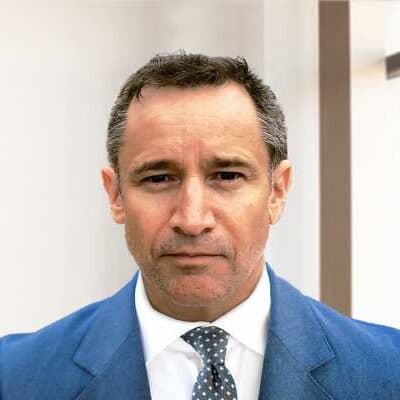
Remembering David Webb, Hong Kong's Shareholder Champion
The legendary investor, who exposed a web of dubious Hong Kong listed companies, died after a long battle with cancer.
You've reached your free article limit
You've read 0 of 1 free Pro articles.
Amid the positives for TSMC, Advantest and the markets in East Asia, I want to make mention that Asia has, sadly, lost one of its earliest and most vocal shareholder advocates, with the death on Tuesday of David Webb.
I was lucky enough to interview Webb on several occasions, as well as to attend his “Farewell Fireside Chat” at the Foreign Correspondents’ Club in Hong Kong when he gave an address and fielded audience questions last May. You can find the FCC’s short news piece on the event here, as well as the entire presentation and conversation on YouTube here.
British-born Webb started investing while studying mathematics at Oxford University, then moved into investment banking. He moved to Hong Kong in 1991, working for what’s now Barclays Capital Asia and then as an in-house adviser to Wheelock & Co., a property developer descended from one of Hong Kong’s original “hong” trading companies.
Early Shareholder Activist
Webb did so well for himself that he “retired” at the age of 32, then shifted his attention full-time to shareholder advocacy, setting up the site webb-site.com to shine a light on the shadier practices of the Hong Kong and Asian stock markets. He, as of 2001, started serving as a board member of the takeovers panel of the Hong Kong Securities and Futures Commission, the city’s stock watchdog.
Hong Kong, like many Asian markets, has its fair share of insider trading, sweetheart deals where subsidiaries are spun off by a company at cut-rate prices to its controlling shareholder, and deliberately complex holding structures where founding families control a network of companies through just the right number of voting shares. Webb called out such practices and pushed for corporate reforms.
Enigma Network Painfully Researched
One of his most-notable efforts started with his 2017 report “The Enigma Network: 50 Stocks Not to Own.”
In a highly detailed and meticulously researched report, Webb outlined how a network of 50 Hong Kong-listed companies were seeing their share prices driven higher by cross-holdings among the companies. The small-cap companies were structured to hold small stakes in each other such that they did not have to declare “significant” investment in each other, normally around 5%, while controlling shareholders could direct the companies while avoiding the mandatory offer those controlling shareholders must normally make for the rest of the shares, if they control more than 30% of the voting rights in a company.
You can find an archived version of the research here. One look at the spider web of a chart outlining the various cross-holdings will tell you all you need to know. I wrote a story for TheStreet Pro explaining the details of the Enigma Network in 2017 after Webb exposed it.
The initial market response was a shrug of the shoulders. But many of those Enigma Network companies saw their stocks routed weeks after Webb’s report, when investors had time to digest the implications. Companies with a market capitalization of at least $22 billion were ultimately suspended from trading in Hong Kong. The small-cap Growth Enterprise Market or GEM in Hong Kong sank to a record low.
I wrote about the fallout in 2019, when regulators finally got around to prepping charges against 60 companies and individuals involved in what regulators belatedly called a series of “nefarious networks.” The first charge was against Roy Cho Kwai-chee, a medical doctor who Hong Kong’s corruption watchdog alleged acted as a “shadow director” of the company Convoy Global Holdings, holding 50% of Convoy and causing it to buy an investment company he himself owned for $11 million.
Pain in the Side of Hong Kong Powers-That-Be
Webb was also a vocal critic of the for-profit Hong Kong Stock Exchange, noting that the nature of its business gives it a conflict of interest in terms of market supervision. He in 2003 became a popular independent director on the board of the stock exchange’s parent, Hong Kong Exchanges and Clearing (HK:0388). He quit in 2008 in protest at how the company was run, his reasons explained here.
You can find more about Webb’s legacy, and how he changed the nature of investing in Asia here, in the free Hong Kong newsletter put out by Bloomberg. He was awarded the Member of the Order of the British Empire (MBE) designation last June by King Charles III.
Webb declared in 2020 that he had been diagnosed with aggressive prostate cancer. He said he would work and operate webb-site.com as long as he was able, then arranged for the archiving of his research and public records.
Writing When Able
While taking cancer treatment, he continued to write when able, criticizing the many wayward policies of the Hong Kong government, which now operates without any political opposition. One of his last posts came after he turned 60, and posted a story and photo of himself riding public transport for HK$2 per trip (26 cents), regardless of financial means. He called the subsidy “fiscal madness,” with almost one-third of the city eligible for virtually free public transit.
“Somehow I survived my cancer long enough to reach 60 on August 29, 2025, and formally become ‘elderly’ by this definition,” he wrote. “While I can’t get out much any more, I made a special effort the day after my birthday and took my first Joy Ride.”
Every resident he knew had claimed the benefit if able.
“It’s economically irrational not to,” he noted.
Webb has finally succumbed, but his legacy will live on. The need for shareholder activism is just as great as when he took up his crusade in the 1990s, if not more so, given the lack of oversight for the Beijing loyalists hand-picked to govern Hong Kong.
Farewell, David. Yours was a life well lived, cut sadly short. But your legacy will live on.