Reading Between the Fed's Lines
I spotted a subtle yet significant statement on inflation; also, let's check the markets, the latest in the China chip spat, and Meta's chart.
You've reached your free article limit
You've read 0 of 1 free Pro articles.
Thursday morning. All is clear. The late January Federal Open Market Committee policy decision has come and gone with little fanfare. The target range for the Fed Funds rate was left where it was, as expected. The press conference was conducted carefully, as if meant to keep the committee out of trouble one way or the other. That too, was as expected. The official statement was kept short, as has been the way the FOMC has operated of late. The majority of this statement was a "cut and paste" job taken from previous statements with two exceptions.
The most glaring exception was the lack of any change made to the policy rate itself. Perhaps more important was the subtle change in the way the committee set up that decision on short-term rates and the way current economic conditions were described. On Wednesday, in the first paragraph of that statement, we heard:
"The unemployment rate has stabilized at a low level in recent months, and labor market conditions remain solid. Inflation remains somewhat elevated."
This is a change from December 18th's statement, "Since earlier in the year, labor market conditions have generally eased, and the unemployment rate has moved up but remains low. Inflation has made progress toward the Committee's 2 percent objective but remains somewhat elevated."
There are two implications made in this subtle turn. One is that labor markets have found support at current levels and the second is that progress on inflation has started to falter. I think most of us who watch economic data closely would agree with the change in the statement. An issue for the markets on Wednesday, not "the" issue but an issue, would be that this is a slightly more hawkish statement than the one released six weeks ago.
In addition, during the press conference, Fed Chair Jerome Powell said that he did not feel that labor markets had been a source of significant upward inflationary pressure. More notably, Powell said that there would have to be "real progress on inflation or some weakness in the labor market" before the FOMC could even consider resuming the dovish trajectory of its policy over the final third of 2024.
On That Note...
The Cleveland Fed's CPI Nowcasting model is sporting a projection for January headline consumer price index growth of 2.85% and an estimate for January core CPI growth of 3.13%. Cleveland is projecting a slowdown from the December actual growth of 2.9% and 3.2% respectively. That's interesting.
On the other hand, the Hedgeye Monthly Inflation Nowcast for January, which is something that I pay for, so I won't give away their business for free in my work, still shows a furthering of the trajectory of renewed acceleration for headline CPI in January. In fact, not just Hedgeye's base case, but the lower bound of its range of probability is above what Cleveland is currently showing.
More Significantly: The Chip Battle ...
What may have weighed more upon financial markets on Wednesday afternoon, more than a slightly more hawkish Fed, ahead of the plethora of Magnificent 7 earnings that were released after the closing bell, were some headlines. Bloomberg News reported that the Trump administration was considering placing further restrictions upon high-tech semiconductor chips to China, beyond where the Biden administration had already gone. This is what pressured Nvidia's NVDA share price on increased trading volume late in the regular session.
I will admit to adding to my existing long position in NVDA on weakness for a second time this week. That position began the week rather small relative to its historical placement on my book. Nvidia is still not a major allocation, now the 18th largest long position in my most active portfolio, actually falling one slot after other positions have performed better, despite the additions.
Marketplace
The trading volume was subdued on Wednesday as it often is on Fed Day, at least until the statement is released. This statement and Chair Jerome Powell's press conference put a slightly negative aura on U.S. financial markets on Wednesday afternoon, but did not create the kind of volatility that they sometimes can. Treasury securities really did not move much, nor did dollar valuations.
As for equities, the S&P 500 gave up 0.47%, but still closed up nicely from Monday's low, and formed an inside day relative to Tuesday, which is a sign of decreasing volatility. The last two sessions have also disrupted what could have been the development of a double top bearish reversal after last week's high. The index appears to have found substantial support at its 50-day simple moving average. The Nasdaq Composite gave back 0.51% on Wednesday, also finding help at its 50-day SMA, also disrupting the development of a double top pattern and also forming a soothing "inside day." Small to mid-cap indexes as well as the Dow Transports all performed in line with the majors on Wednesday.
Four of the 11 S&P sector SPDR exchange-traded funds gained ground on Wednesday led by Communication Services XLC, though none of these funds even gained half of 1% for the day. The REITs XLRE took a beating of 1.16%, easily leading the losers as there was no clear-cut separation in performance across growth, cyclical and defensive sector funds.
Concerning breadth, losers beat winners by a rough 7 to 4 at the NYSE and by about 4 to 3 at the Nasdaq. Advancing volume took a 46% share of composite NYSE-listed trade and a 39.3% share of composite Nasdaq-listed activity. Though, this is bearish looking breadth, aggregate trade was down 8+% on a day over day basis across names domiciled at both of New York's exchanges.
Meta's Chart Is Instagram-Ready
Meta Platforms META will try to break out of what has been the uptrend of uptrends this morning. The trend has been in place since late 2022, and this morning may present as the stock's first attempt to break out beyond the model's upper trendline of that since a sustained attempt last year at this time that lasted a couple of months.
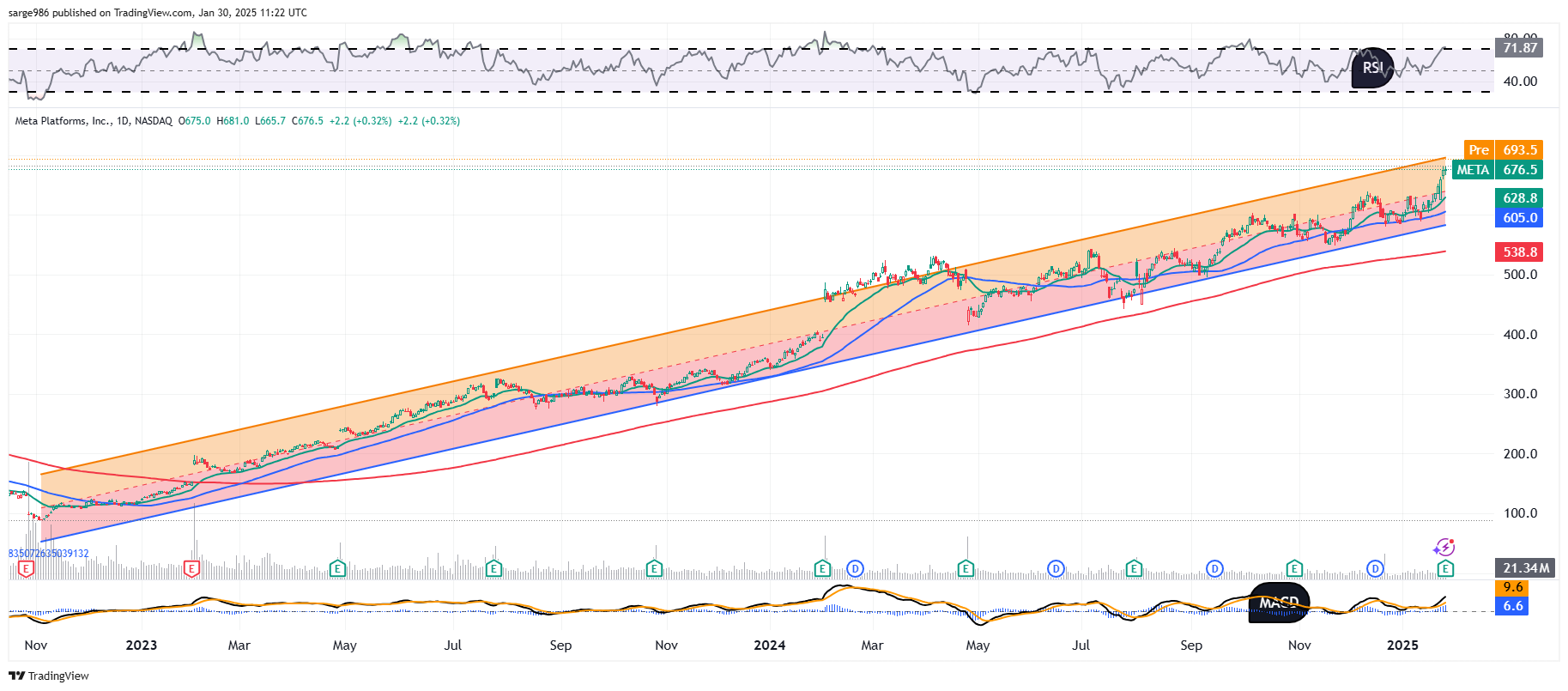
The company absolutely crushed estimates for both top and bottom-line performance for its fourth quarter, but the guidance for current quarter revenue was notably soft. The firm also predicted significant growth in full year capex spending. Can this breakout hold? We'll know shortly.
Economics (All Times Eastern)
08:30 - Initial Jobless Claims (Weekly): Expecting 223K, Last 223K.
08:30 - Continuing Claims (Weekly): Last 1.889M.
08:30 - GDP Growth Rate (Q4-adv): Expecting 2.7% q/q, Last 3.1% q/q SAAR.
10:00 - Pending Home Sales (Dec): Expecting -0.9% m/m, Last 2.2% m/m.
10:30 - Natural Gas Inventories (Weekly): Last -233B cf.
The Fed (All Times Eastern)
No public appearances scheduled.
Today's Earnings Highlights (Consensus EPS Expectations)
Before the Open: MO (1.28), BX (1.46), CAT (5.04), CMCSA (.86), LHX (3.42), MA (3.69), NOC (6.35), TMO (5.95), UPS (2.53)
After the Close: AAPL (2.35), INTC (.12), KLAC (7.76), X (-.26), V (2.66)
At the time of publication, Guilfoyle was long NOC, INTC, NVDA equity.