Powell's Favored Replacement Is a Good Fit, But the Fed Is Headed for a Rate Cut Mistake
The Federal Reserve might not be looking at the best data set as it makes decisions on interest rates.
You've reached your free article limit
You've read 0 of 1 free Pro articles.
On the betting apps, it looks like Rick Rieder has become the odds-on favorite to win the job of Federal Reserve chair.
I like the idea of mixing things up at the Fed and I think that having a market practitioner in charge would be an interesting change. If he gets the nomination, expect more of a focus across the yield curve (our view all along of how the Fed will operate in 2026). The balance sheet is less likely to be used as a blunt, lumbering tool (prescribed amounts for well-telegraphed time periods), but rather something to shape the curve to fit policy more frequently.
The Fed: Coordination Should Be Encouraged, Not Feared
I think coordination and cooperation between the Fed, U.S. Treasury and the Trump administration is good. It doesn’t defeat “independence” and has happened in the past.
Typically, in times of stress, with COVID being the most recent example. I continue to believe the announcement that the Fed would buy fixed-income ETFs changed the trajectory of the corporate bond market overnight.
For those of you following the T-report, you know I strongly believe in the "ETF spiral," where ETFs trading at a discount to NAV help create more selling pressure. It might seem counterintuitive, but that is a hill I will stand on and fight on to the end (and have a few times).
At the time, even (VCSH) (a short-dated corporate bond ETF) was trading at a large discount to NAV (more than 3%, if I remember correctly). That ETF Spiral was adding to the problems at the front-end of the corporate bond market. When the announcement came that the Fed would buy these ETFs, the problem corrected itself quite literally overnight, and the corporate bond market began to heal, rapidly.
The morals of the story are:
- Coordination should be welcomed and does not eliminate the independence of the Fed
- The balance sheet is an incredibly powerful tool, and taking a new approach to its usage could unlock some interesting new ways to shape the curve
The Fed Won’t Cut, But Should
The bond market is pricing in a 0.03% chance of a cut in January (which is also, sadly, the realistic probability of the Buffalo Bills ever winning a Super Bowl). So, we will not get a cut this week. We are also unlikely to see a cut slated for the meeting in March.
I think the case that the “neutral rate” is lower than where the Fed seems to think it is, is a strong one. Stephen Miran surprised me with that argument, but I actually like it and agree.
January jobs could be strong. We continue to believe the data overstates jobs in January/February and understates jobs in the summer, as the seasonal adjustments no longer reflect seasonal reality. Construction has shifted from Northeast-centric to Southern-centric. The “gig” economy has shifted how “seasonal” workers are hired, which along with the earlier start of shopping (especially online, where “Black Friday” sales start before Thanksgiving) means the BLS adds too many jobs back in January. In any case, I will admit, I expect a strong jobs report for January, but it will be “adjustment” driven more than reality driven, and my case for cutting depends on other arguments.
The ”crowd-sourced” data doesn’t paint a pretty picture.
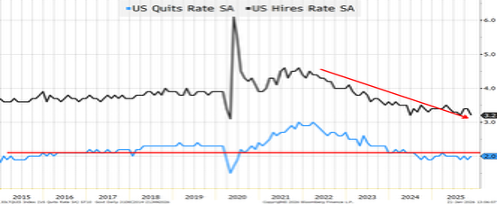
The QUITS rate in the JOLTS data remains weak. It has improved a smidge and has been affected by the government shutdown (in terms of preparation of the data), but is still below the average of the past decade. This just tells me that people with the sorts of jobs that can say “take this job and shove it” aren’t saying that. They are keeping their head down and keeping their job because they know how difficult it is to find another job.
While I think the jobs data warrants attention and gives the Fed the ammunition it needs to at least look for cuts, I think it is stuck in some mythical world of higher inflation.
Again, many of these committee members were in camp “transitory” which turned out not to be transitory. Many of the people on this Fed were still doing QE when they were already talking about hiking rates. QE does not need to be well telegraphed. For the life of me, I cannot understand why we would be doing QE when hikes are on the table.
Finally, for those who manage risk, you often have “stop losses” because when something goes wrong on a view, it is difficult to change your mind. You don’t necessarily think well. So, stop losses force change. Corporations tend to see “heads roll” if a major strategic blunder occurs. I still do not think anyone from “team transitory” lost their job.
So, we are stuck, I believe, with a Fed that is fighting its own past mistakes. It is too worried about being wrong to act.
Why Does OER Still Exist?
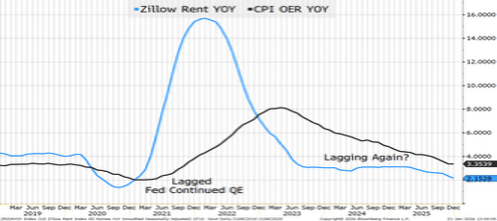
Had the Fed just looked at Zillow Rent, we would have cut off QE much sooner and probably started hiking sooner. Maybe, with the shutdown, and being forced to look at alternative data, the Fed will be more holistic in its choice of data to be dependent on?
OER is fraught with issues. (Only a portion of the market is evaluated each month, and the premise that most rentals are single family homes, is now ludicrous). Even the Cleveland Fed has developed a real-time rent estimate. Why not rely more heavily on that? Housing in CPI is currently overstated and will certainly come down in the next few quarters (that's just math). So, cut now, rather than waiting for this particularly bad data set to conform to reality.
Maybe Truflation Is onto Something?
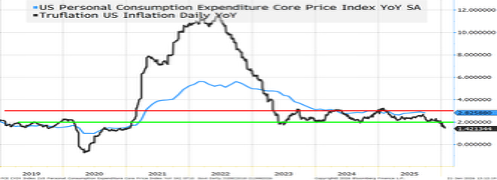
Truflation only attempts to capture part of the inflation story. But, wow, it is telling a very different story than core PCE (the Fed’s preferred measure).
I wouldn’t pay attention, except truflation showed more inflation, sooner than CPI did back during the time of “transitory.” Again, had the Fed given this data set some serious consideration, we would have stopped QE earlier and hiked sooner.
The Fed should cut, but they won’t.