Never Ending Dramas: Tariffs, Iran, GDP
Let's track the president's latest trade move and how the markets are taking it all, chart the S&P, check on Iran, and digest that new GDP data. Plus, what to expect this week.
You've reached your free article limit
You've read 0 of 1 free Pro articles.
By now, everyone knows that on Friday, in a landmark 6-3 decision, the Supreme Court ruled that Pres. Trump had no authority, under the International Emergency Powers Act (IEEPA) of 1977, to unilaterally impose what had been sweeping global tariffs on imports from nearly every nation that trades with U.S. businesses. Justices Brett Kavanaugh, Clarence Thomas and Samuel Alito dissented, siding with the administration on this issue. Of course, that means that Justice Neil Gorsuch and Justice Amy Coney Barrett, who are both Trump appointees to the nation's highest court, did not side with the administration.
Financial markets, for the most part, reacted well to the news, though in reality, the landscape left behind for international trade involving the U.S. is perhaps less certain than ever. First, there is the question of refunds. The Court did not provide for a mechanism to return what could be as much as $175 billion dollars in tariffs collected from importers. That issue itself is likely to wind up in litigation and that litigation could go one almost endlessly.
Then, there is the president's reaction to this news. Pres. Trump signed an order on Friday to enact a new 10% global tariff on all trading partners that would go into effect this Tuesday (tomorrow). To do this legally, the president relied upon Section 122 of the Trade Act of 1974. Over the weekend, this tariff was increased from 10% to 15% and supposedly went into effect immediately. Section 122 tariffs are limited to 150 days.
Unlike with the IEEPA tariffs, Pres. Trump would need legislative support to either extend or codify these tariffs. The administration is also initiating accelerated investigations under Section 301 of the Trade Act of 1974 and Section 232 of the Trade Expansion Act of 1962 to re-impose nation and industry-specific tariffs related to national security concerns and / or perceived conditions of unfair trade.
The Market's Reaction...
The market seems to be taking this news almost in stride as night approaches morning. U.S. equity index futures are trading at a discount to late Friday prices, but not close to the ugly levels seen overnight. The situation is fluid and extremely dangerous economically as the E.U. has frozen the ratification of its trade agreement with the U.S. and India has delayed the completion of what were believed to be nearly agreed upon trade talks. Officials from the U.K., China, Japan, South Korea and others have all expressed concern or have announced that they are studying the Supreme Court's decision in order to decide what to do next.
Iran, Mexico ...
- The Trump administration is, according to the New York Times, considering a targeted strike on the regime in Iran that could be followed up by a larger attack. The implication could be that Pres. Trump is open to disposing of the current leadership in Iran if a deal concerning nuclear weapons cannot be reached. Talks between the U.S. and Iran are scheduled to resume in Geneva this Thursday.
- Mexico's military has apparently killed one of that nation's most powerful drug cartel leaders. Under pressure from the U.S. to slow the illicit drug trade, Mexico took out Nemesio "Mencho" Oseguera, who is said to have led the Jalisco New Generation Cartel. The action has reportedly resulted in widespread gang violence, especially in the city of Guadalajara. The U.S. Embassy in Mexico had advised American citizens in the country to seek shelter and minimize unnecessary movement.
Shocking GDP Estimate?
Not really. The Bureau of Economic Analysis posted its first estimate for Q4 U.S. gross domestic product on Friday. The number hit the tape at growth of 1.4% (quarter over quarter, seasonally adjusted, annualized rate or "SAAR" for short). Expectations had been for growth of 2.8%. The 43-day federal government shutdown back in October and November was the primary culprit for the slowdown, though one would wonder why the heck that had not been adjusted for in that "professional" consensus.
The BEA estimates that the shutdown took a full percentage point off of the number that did cross the tape. The president himself put that impact at "at least two points." There is some truth to that as Federal Spending did print at -16.6% (q/q, SAAR) for the quarter, which for those doing the math, contributed -1.15% toward the +1.4% result. Exports and the consumption of goods were also net negatives, so there were other issues as well. But, in fairness, if one does do the math, excluding the federal government, the rest of the economy grew at a 2.5% to 2.6% pace.
Lines Written in Early Spring
Through primrose tufts, in that green bower,
The periwinkle trailed its wreaths;
And 'tis my faith that every flower
Enjoys the air it breathes
The birds around me hopped and played,
Their thoughts I cannot measure: -
But the least notion which they made
It seemed a thrill of pleasure.
The budding twigs spread out their fan,
To catch the breezy air;
And I must think, do all I can,
That there was pleasure there.
- William Wordsworth (1798)
(A few readers could use this one right now)
The Week That Was...
Last week, after several weeks of sideways to lower price action for the major U.S. equities, there was some positive technical progress made across our marketplace. Of course, that positive progress does appear to be at risk this morning. This is how equity markets performed over the past, holiday-shortened week...
- The S&P 500 gained 0.69% on Friday and 1.07% for the week.
- The Nasdaq Composite gained 0.9% on Friday, and 1.51% for the week.
- The Nasdaq 100 added 0.87% on Friday and 1.13% for the week.
- The Russell 2000 lost just 0.05% on Friday but gained 0.65% for the week.
- The S&P Small Cap 600 added 0.53% on Friday but just 0.5% for the week.
- The S&P Midcap 400 gained 0.61% on Friday and 1.22% for the week.
- The Dow Transports gained 1.78% on Friday and an impressive 2.57% for the week.
- The Philly Semis gained 1.07% on Friday and 1.51% for the week.
- The KBW Bank Index added 0.93% on Friday and 1.68% for the week.
On Friday, nine of the 11 S&P sector SPDR ETFs closed out the session in the green, led by communication services (XLC) and discretionaries (XLY) . Only energy (XLE) and health care (XLV) ended the day in the red.
For the week, seven of the 11 S&P sector SPDR ETFs traded higher, with both growth and cyclical type sectors clearly outperforming the defensives. Communication services, the industrials (XLI) and the financials (XLF) led the winners, while the materials (XLB) and staples (XLP) brought up the rear.
The Chart
Readers will see the triple top pattern of bearish reversal that developed the week before last and that I showed you last Tuesday. Readers will also see that the S&P 500 closed in the green on three of the four trading days last week and on four of the past five trading days overall. Most interestingly, the index managed to retake its 21-day exponential moving average and 50-day simple moving average on Friday after falling to do so on Wednesday.
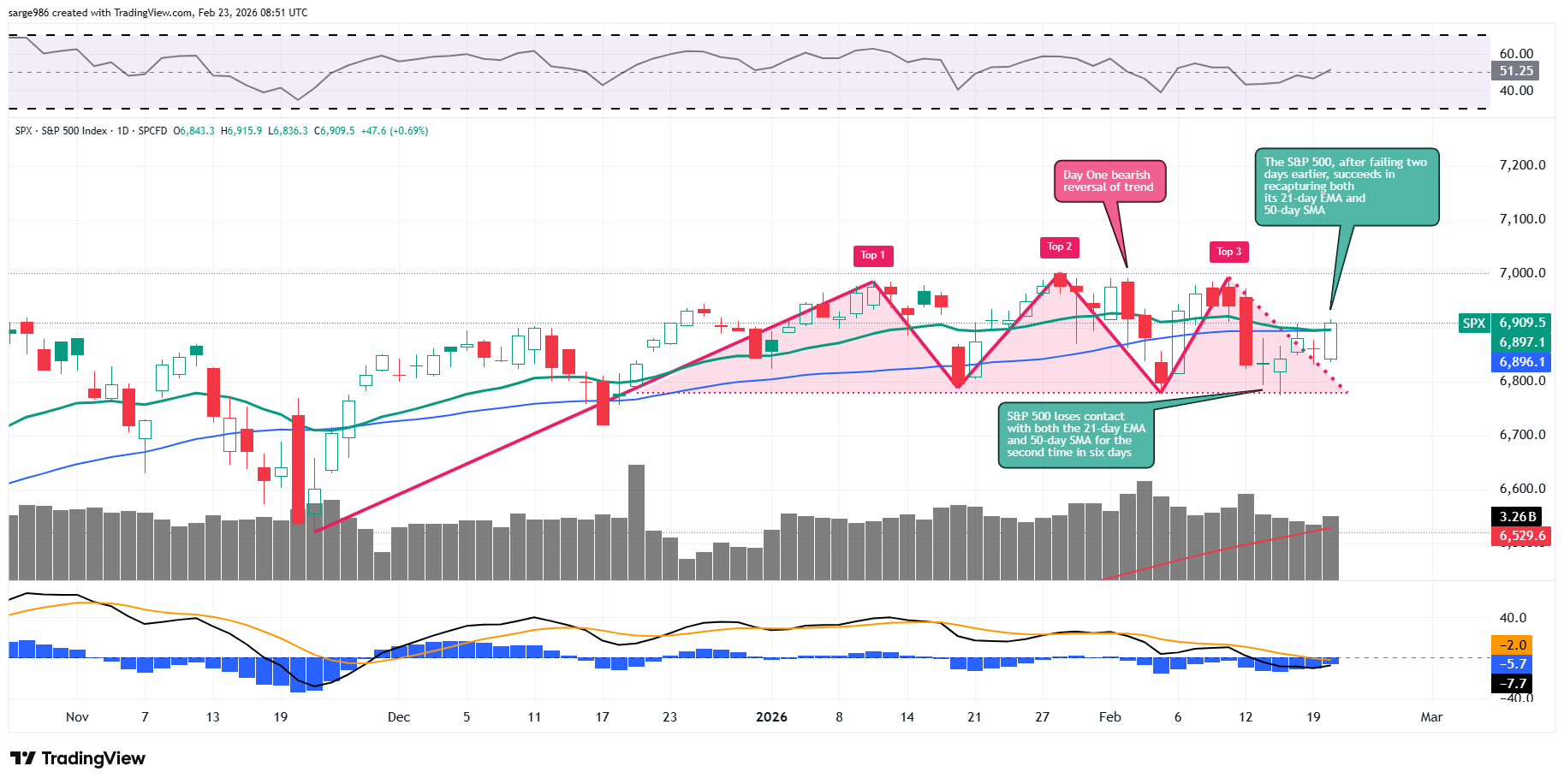
That would be technically significant if not for the fact that that move and this morning's negative action across U.S. equity index futures markets were and are being driven by tariff-related headlines as much as anything else. Looking at the indicators, Relative Strength for the S&P 500, on Friday, moved just above a neutral reading. That said, the daily moving average convergence divergence is still postured rather bearishly, though within that indicator, the 12-day exponential moving average has made upward movement towards the 26-day exponential moving average. A crossover of that gold line by that black line would be a market positive.
The GDP Game
On Friday, the BEA posted a surprisingly weak growth rate of 1.4% (q/q, SAAR) for the U.S. economy for the fourth quarter. Expectations had been for twice that pace. Looking ahead, Last week, the Atlanta Fed initiated their GDPNow model estimate for Q1 economic growth at 3.1% (q/q, SAAR). Among other regional central bank district branches running close to real-time Q4 gross domestic product models, the New York Fed's Q1 model shows growth of 2.37%. The Cleveland Fed's Q1 model sports estimated growth of 3.14%, while the St. Louis Fed is showing current quarter growth of 3% flat.
Fed Funds Futures
Fed Funds futures trading in Chicago are currently pricing in just a 4% probability for a quarter-percentage point rate cut at the next Federal Open Market Committee policy meeting on March 18, down from 10% a week ago. The next rate cut is priced in for July 29 at this point (69% likelihood), pushed out from June 17 a week ago at this time. At present, there is still a half percentage-point worth of additional rate cuts fully priced in (72% chance, up from 70%) for all of calendar 2026.
On The Docket...
Let the final week of February begin. I know that many folks reading this morning note have probably had enough of Old Man Winter this morning. This is what's on deck for the week ahead....
.... Our central bankers will be very active early this week. We'll hear from Fed Gov. Christopher Waller this (Monday) morning. Then, Tuesday, all heck breaks loose with this group. Currently, I have at least seven public appearances to be made tomorrow by Fed officials. Fed Govs. Waller and Lisa Cook are the only two on the schedule that I see that hold policy voting rights for 2026. After Tuesday, the Fed looks to quiet down a bit, though Fed Gov. Michelle Bowman, certainly a headliner, will speak publicly on Thursday morning.
.... The macroeconomic calendar will quiet down this week from the torrid pace that we have seen over the past few weeks. Key events for the week include data on December home prices on Tuesday morning, followed by the results of the Conference Board's February survey on Consumer Confidence an hour later. Friday morning will bring data for January on producer / wholesaler level inflation as well as Construction Spending for both November and December.
.... The earnings calendar will be active again this week, but unlike the past week, there will be more high-end, headline-quality names reporting. Among the more well-known names that will post results will be Home Depot (HD) on Tuesday followed by a heavy earnings day on Wednesday. That day, Lowe's (LOW) and TJX (TJX) will release their results ahead of the opening bell. After the close on Wednesday, we'll hear from Nvidia (NVDA) , Salesforce (CRM) , Snowflake (SNOW) and Zoom Communications (ZM) . On Thursday, CoreWeave (CRWV) , Dell Technology (DELL) , Rocket Lab (RKLB) and Zscaler (ZS) will all go to the tape.
Economics
(All Times Eastern)
10:00 - Factory Orders (Dec): Expecting 0.6% m/m, Last 2.7% m/m.
10:30 - Dallas Fed Manufacturing Index (Feb): Expecting -3.5, Last -1.2.
The Fed
(All Times Eastern)
08:00 - Speaker: Reserve Board Gov. Christopher Waller.
Today's Earnings Highlights (Consensus EPS Expectations)
Before the Open: (DPZ) (5.38)
After the Close: (KTOS) (.15)
At the time of publication, Guilfoyle was long TJX, NVDA, RKLB equity.