More Than Just Tariffs? Looking Beyond the Obvious With Gundlach and Dalio
What are the factors that could be moving this market as the trade war with China unfolds?
You've reached your free article limit
You've read 0 of 1 free Pro articles.
There’s no question that tariffs have roiled the markets, but what other factors might be in play?
With every move in the market, whether bullish or bearish, investors are laser-focused on tariffs as the source. While there’s no question that the trade war has created violent shifts in the markets, some notable names in the investment industry are looking beyond the obvious.
In addition to tariffs, what are the factors that could be moving this market?
Spending
Jeffrey Gundlach, founder of DoubleLine Capital, a hedge fund with $91 billion in assets, believes excessive spending could be to blame for the selloffs in stocks and bonds.
Gundlach posted the following on social network X on Thursday evening:
“Halfway through fiscal year 2025, the U.S. budget deficit increased by $1.3 trillion…a $2.6 trillion annual rate. That rounds up to an incredible 9% of GDP.”
Normally, an exodus from stocks would drive bond prices higher — and yields lower.
Instead, bonds are selling off, and there is a relentless inflow into gold. That’s the behavior of investors who are concerned about rampant spending, and potential currency devaluation.
"The fit is hitting the shan," added Gundlach.
The Big Cycle
Ray Dalio is the chief investment officer of Bridgewater Associates, and the author of The Changing World Order. Dalio believes
While Dalio acknowledges the significance of the tariff issue, he believes that we are witnessing a breakdown of the monetary/economic order, the type of which has been repeated for centuries.
“Anyone who has studied history knows that such risks under such circumstances have repeatedly led to the same sorts of problems we’re seeing now,” writes Dalio.
Essentially, Dalio believes that U.S. economic dominance has been in decline for decades. Dalio explained his view of the U.S./China dynamic in an interesting video he released several years ago.
Greenback Under Attack
Another factor that may be driving chaos in the markets is the weakness of the U.S. dollar.
Normally, when stocks sell off, money flows into "risk-off" safe havens like the dollar. This happened in 2008, when stocks, and particularly banks, were under enormous pressure.
Not this time. Instead, the dollar is being crushed.
In January, the U.S. currency reached a two-year high (point A). On Friday morning, the dollar hit a two-year low (point B). That’s a particularly violent turnaround, in a market that isn’t known for its volatility.
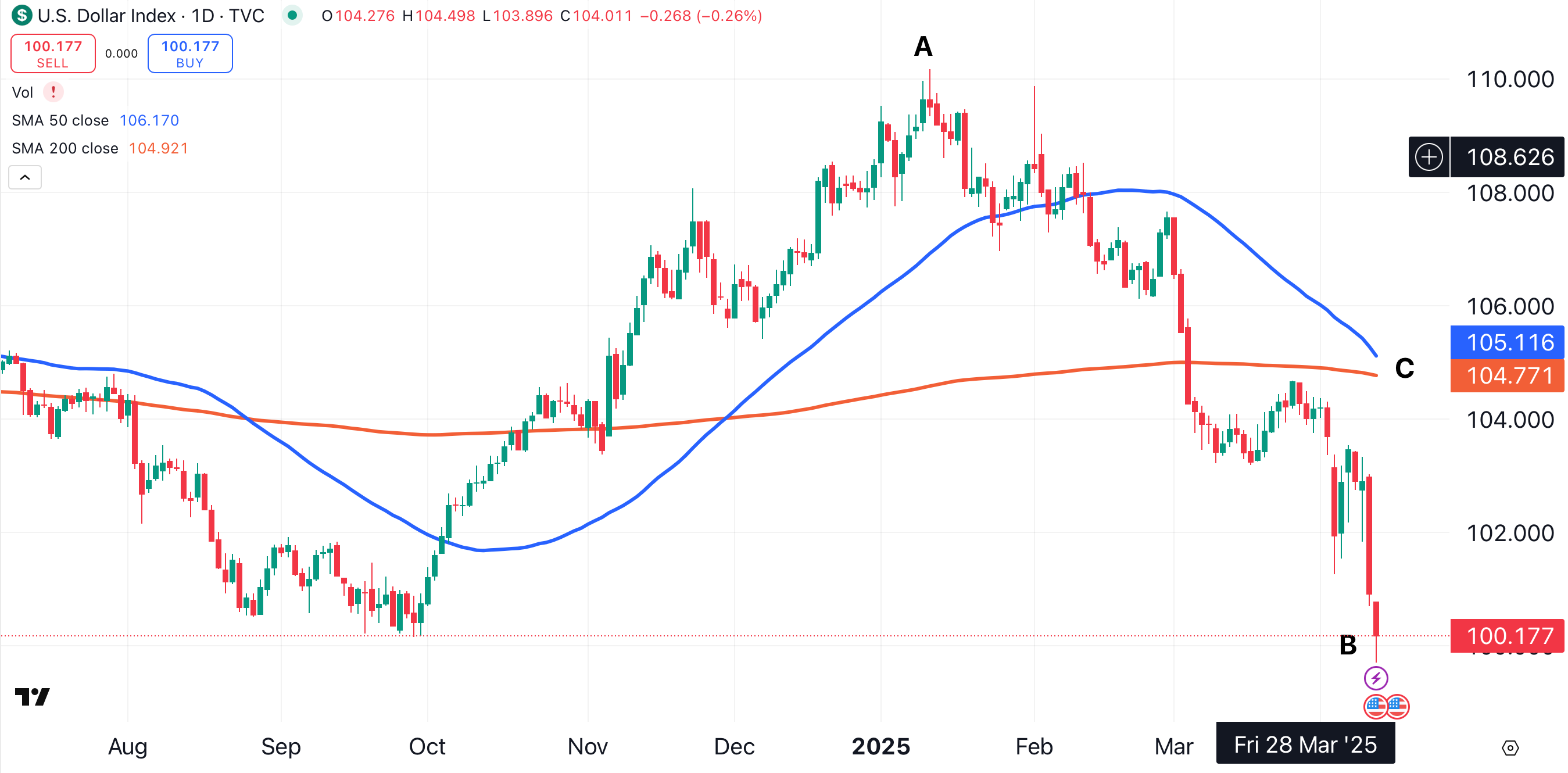
The currency’s falling 50-day moving average (blue) appears ready to cross its falling 200-day moving average (red), setting up a potential Death Cross (point C).
For decades, the dollar has been the ultimate safe haven. If the greenback loses that status, the repercussions would be far-reaching.
Both Gundlach and Dalio acknowledge the effects tariffs are having across the markets. but neither seem to believe that they exist in a vacuum. Instead, they are the latest chapter in an unfolding story of a battle for economic dominance.
At the time of publication, Ponsi had no positions in any securities mentioned.