Markets Face Realities of War, Both in Cost and Defense Stocks
Energy and transport prices, as well as costs to taxpayers, climb as RTX, Lockheed & Northrop Grumman become opportunities for investors; also a plan for the Strait of Hormuz...
You've reached your free article limit
You've read 0 of 1 free Pro articles.
 Market_Recon_TSP1_KL
Zero dark-thirty. Friday morning. On Thursday, the S&P 500 closed down for the week, despite a strong showing on Monday. The Nasdaq Composite closed down for the week, despite posting green candle days on Monday, Tuesday and Wednesday. U.S. equity index futures are trading lower as well with sunrise still a few hours off. For those of you who stayed up through the overnight session, yes, these futures were trading in the green well after midnight (on the East Coast of North America) before nervous investors started hitting bids again.
The Strait of Hormuz remains closed to commerce and markets are starting to price in a longer-term impact as this disruption to global trade becomes more than mere inconvenience. On Thursday, new Iranian supreme leader, Mojtaba Khamenei, or someone in the regime posing as him, released a statement vowing to continue fighting, despite rumors that the new leader had been severely wounded.
There are several economic realities now staring at investors and investors are having to make decisions based on the potential for less-than-pleasant outcomes. For one, the risk of energy-driven inflation has emerged as this war has progressed. While Iran has largely been rendered defenseless by U.S. and Israeli military forces, Iran does retain a certain level of at least regional offensive capacity.
Not only does this create an increased potential for scarcity, but this will cause higher prices for everything from transportation to goods and other services. In addition, the spending required for the U.S. to maintain its offensive and replenish its arsenal, will exacerbate an already imbalanced fiscal situation that could result not only as another upward force on inflation, but one that will also force interest rates higher. On Thursday, the U.S. Ten-Year Note went out paying 4.26% (+3 bps), but the Two-Year Note yielded 3.75% (+9 bps) at quitting time.
Related: The Biggest Market Obstacle: Oil Is Still Too Cheap
About That Arsenal...
Earlier this week, the Pentagon informed the U.S. Senate that the first six days of this war had cost taxpayers more than $11 billion. This rapid depletion of critical munitions includes and may very well be focused upon the use of Tomahawk Cruise missiles. Tomahawks, which are extremely accurate and most often carry a 1,000-pound warhead, are manufactured by RTX Corp (RTX) , which is the old Raytheon Technologies. This is a long-time Sarge-folio holding that I have written positively on within the past two week. My target price remains $247.
These missiles cost the taxpayers about $3.6 million a piece and the Department of Defense / War has only purchased 322 of these over the past five years including 2026. The U.S. Navy had only expected to purchase 57 Tomahawks this year. That sounds like a lot, but one must keep in mind that in 2024 and 2025 alone, the U.S. military fired at least 124 Tomahawks at Iran's nuclear facilities and the Iranian regime's proxies in Yemen.
This is why the Pentagon is expected to shortly submit a formal request to the Trump administration and to Congress for an additional $50 billion in military spending. This will cause a battle in the U.S. legislature that will make headlines of its own and likely put pressure on the president to look for ways to spend less or find an off-ramp as the war carries on.
The Republicans hold a razor-thin advantage in the House of Representatives and increased spending on the war will likely find opposition on both sides of the aisle. Democratic party lawmakers have been critical of this war from the start while fiscal conservatives, who are almost all Republican, will not easily accept placing increased burden on the taxpayer or further ramping up the already out of control federal deficit. In the meantime, it probably makes sense to add any combination of Lockheed Martin (LMT) , Northrop Grumman (NOC) and General Dynamics (GD) to RTX if one has the dry powder.
'Strait' Plan
Treasury Secretary Scott Bessent told Sky News on Thursday that the U.S. Navy will begin escorting tanker ships and other cargo ships through the Strait of Hormuz as soon as "militarily possible." Bessent also implied that in addition to the Navy, "an international coalition" could be escorting oil tankers through.
As part of the plan to encourage the resumption of commercial shipping in the region, Chubb (CB) will act as the lead underwriter for issuing policies for eligible vessels. This will be the main incentive program created by the federal government's $20 billion Maritime Reinsurance Plan.
The Fed to the Rescue?
Fed Gov. Michelle Bowman, who is highly respected and is the U.S. central bank's top regulator, spoke publicly from the Cato Institute in D.C. on Thursday. Bowman outlined plans to change the way that an extra capital buffer is calculated in the U.S. that would lead to a "modest decrease" and more than offset plans to adopt Basel III Endgame rules that had been agreed to by global regulators.
In 2023, the Fed announced plans to implement the Basel Endgame reforms that would have resulted in a 19% increase in minimum capital requirements for large U.S. banks. (What the heck were they thinking at the time? That alone should have gotten people fired.) Instead, the extra capital required by the eight most systemically important U.S. banks will be reduced by lowering the component that accounts for risk associated with short-term funding. This requirement will also be adjusted for inflation and economic growth so that it does not rise as balance sheets grow.
Bowman said, "Continuously increasing capital levels without a specific purpose imposes real economic cost. This "constrains credit availability, pushes activity into the less-regulated nonbank sector and layers on complexity and costs without meaningfully enhancing safety and soundness."
Investors would have to consider this a victory for the likes of JP Morgan Chase (JPM) , Bank of America (BAC) , Citigroup (C) , Goldman Sachs (GS) , Morgan Stanley (MS) and Wells Fargo (WFC) .
Marketplace
The Ugly Stick was out and about on Friday as investors continue to price in the hits to commerce and inflation mentioned above. Of all of the major and mid-major indexes that I track closely, the S&P 500 was the top performer on Thursday at -1.52%. Yes, a loss of a percentage point and a half was good enough to lead the league in batting average on Thursday. The Nasdaq Composite gave up 1.78% for the day, which was lousy enough to turn that index red for the week, despite three green-candle sessions.
The small- and mid-cap indexes all gave up between 1.86% and 2.12%. The Dow Transports were slapped around for a loss of 2.98% and the Philly Semiconductors were taken out to the woodshed for a beatdown of 3.43%. Ugly.
Moving on to breadth, it does not get any better. Nine of the 11 S&P sector SPDR exchange-traded funds closed out the day in the red with six of these funds giving up at least 1.48% and both the Industrials (XLI) and Discretionaries (XLY) losing more than 2.3%. It's never a positive when the cyclicals are pummeled. Energy (XLE) again led the winners but gained just 0.93%.
Losers beat winners by a 15-to-four margin at the NYSE and a 10-to-three margin at the Nasdaq. Advancing volume took just a 24.1% share of composite NYSE-listed trade and a nearly as weak 26.9% share of composite Nasdaq-listed activity. Aggregate volume increased by 1.7% on a day-over-day basis across Nasdaq-listings and by a more impressive 14.2% across NYSE-listings. Volume grew across the membership of the S & P 500 as well.
What Does That All Mean?
I now see what I had been seeing as a basing period of consolidation as a triple-top pattern of bearish reversal.
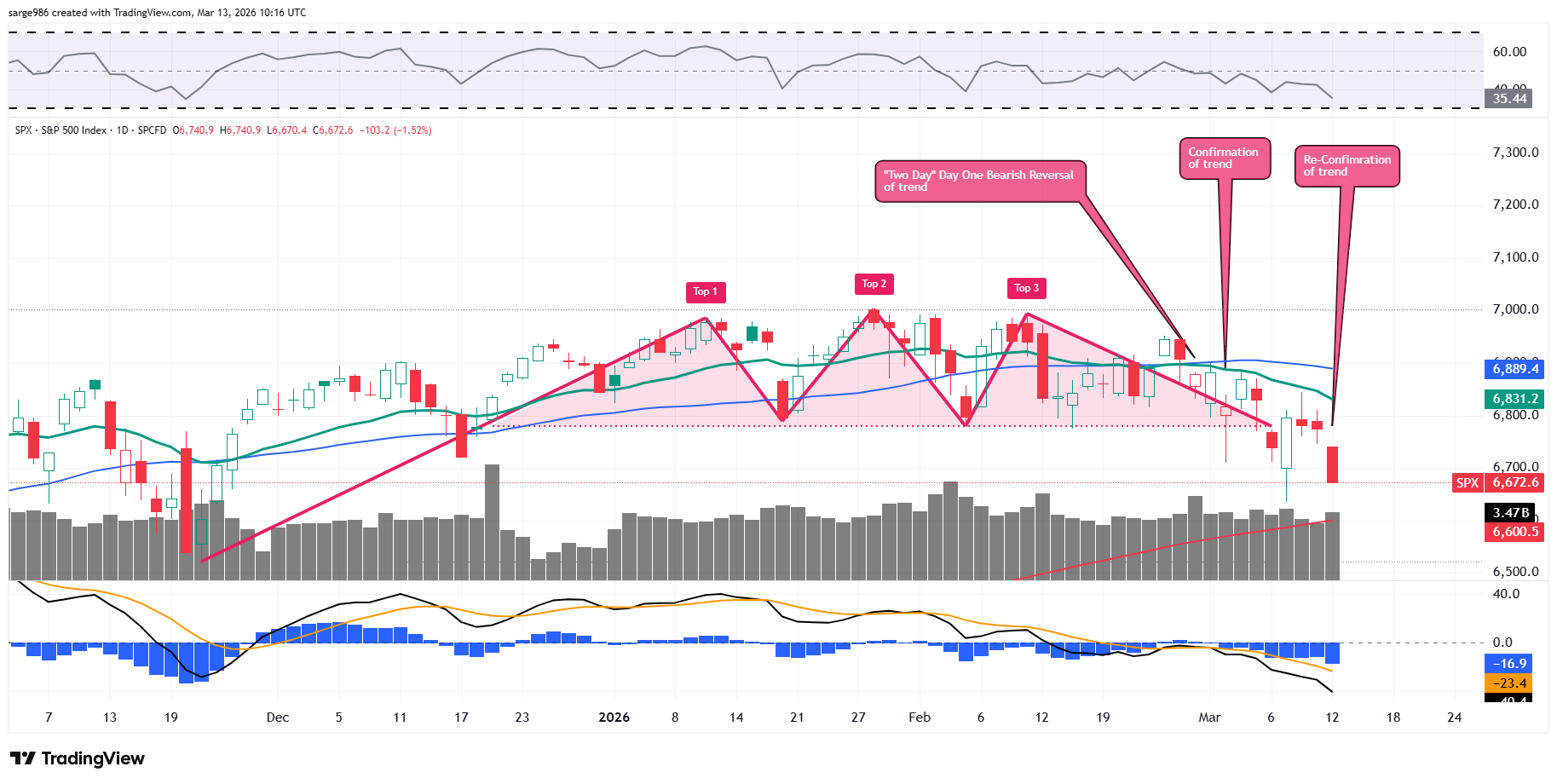
That fits better with the reversal of trend experienced on Feb. 26 & 27, followed by a Day of Trend Confirmation on 3 March. Yesterday, March 12, this trend was re-confirmed by volume. Both relative strength and the daily moving average convergence divergence now support this technical thesis. What could change this? A rapidly improving geopolitical situation. Not much else.
Ghost Riders in The Sky
Their brands were still on fire, and their hooves were made of steel
Their horns were black and shiny, and their hot breath he could feel
A bolt of fear went through him as they thundered through the sky
For he saw the riders coming hard, and he heard their mournful cry
Yippie yi oh, yippie yi aie
Ghost rider in the sky
Their face is gaunt, their eyes were blurred, their shirts all soaked with sweat
They're ridin' hard to catch that herd, but they ain't caught 'em yet
Cause they've got to ride forever on the range up in the sky
On horses snorting fire and they rise on, hear them cry
- Stan Jones (1948), performed by many
Economics
(All Times Eastern)
08:30 - PCE Price Index (Jan): Expecting 0.3% m/m, Last 0.4% m/m.
08:30 - Core PCE Price Index (Jan): Expecting 0.4% m/m, Last 0.4% m/m.
08:30 - PCE Price Index (Jan): Expecting 2.9% y/y, Last 2.9% y/y.
08:30 - Core PCE Price Index (Jan): Expecting 3.0% y/y, Last 3.0% y/y.
08:30 - Durable Goods Orders (Jan): Expecting 0.8% m/m, Last -1.4% m/m.
08:30 - ex-Transportation (Jan): Expecting 0.5% m/m, Last 0.9% m/m.
08:30 - ex-Defense (Jan): Expecting -0.4% m/m, Last -2.5% m/m.
08:30 - Core Capital Goods (Jan): Expecting 0.4% m/m, Last 0.6% m/m.
08:30 - GDP Growth Rate (Q4-rev): Flashed 1.4% q/q, SAAR.
08:30 - Personal Income (Jan): Expecting 0.4% m/m, Last 0.3% m/m.
08:30 - Consumer Spending (Jan): Expecting 0.3% m/m, Last 0.4% m/m.
10:00 - JOLTs Job Openings (Jan): Last 6.542M.
10:00 - JOLTs Job Quits (Jan): Last 3.204M.
10:00 - U of M Consumer Sentiment (Mar-adv): Expecting 55.7, Last 56.6.
10:00 - U of M One-Year Inflation Expectations (Mar-adv): Expecting 3.9%, Last 3.4%.
10:00 - U of M Five-Year Inflation Expectations (Mar-adv): Expecting 3.4%, Last 3.3%.
1:00 p.m. - Baker Hughes Total Rig Count (Weekly): Last 551.
1:00 - Baker Hughes Oil Rig Count (Weekly): Last 411.
The Fed
(All Times Eastern)
No public appearances scheduled.
Today's Earnings Highlights (Consensus EPS Expectations)
Before the Open: (BKE) (1.51)
At the time of publication, Guilfoyle was long RTX, JPM equity.