Market Swings High as the Data Swing ... All Over the Place
S&P and Nasdaq hit record closes Friday, but the economic data get pretty weird as GDP revisions feel like a gut-punch.
You've reached your free article limit
You've read 0 of 1 free Pro articles.
We started to talk about this last week. On Friday, it finally happened. The S&P 500 and Nasdaq Composite both, ahead of the weekend just ended, notched all-time record high closes after setting all-time intraday trading highs. There was a lot to like, even if some of the macro looked a bit sloppy. For starters, the "12-Day War" between Israel and Iran came to a rapid conclusion after US B-2 Bombers appeared to total Iran's ability to enrich uranium or produce nuclear weapons. That alone worked to improve sentiment on a global level.
On top of that, the U.S. and China finalized "the framework" of a trade agreement where tensions eased and both nations got something they needed. It barely mattered on Friday afternoon that Pres. Trump announced that all trade discussions with Canada had ended after Canada had imposed a digital services tax on American technology companies. The president implied that Canada will be informed after his July 9 deadline what level of tariffs that nation will be hit with. As it turns out, that news in regard to trade with Canada really did not matter, as Canada did a u-turn overnight and will now not impose that digital services tax on U.S. companies.
The Fed also played a hand in pushing equities higher and Treasury debt security yields lower last week. It wasn't really anything that Fed Chair Jerome Powell said when he testified before both the House Financial Services and Senate Banking Committees last Tuesday and Wednesday. Powell reiterated his "wait and see" approach on policy which runs completely contrary to his own behavior last year ahead of the election when there was a much weaker case for cutting short-term rates.
How the Fed actually helped push markets higher last week was in the fact that so many Fed officials came out of the woodwork in opposition to Powell's current stance. From the Board of Governors, both Christopher Wallace and Michelle Bowman, (who are first-term Trump appointees) spoke of the July meeting as likely being live as far as consideration for a short-term rate cut is concerned. In addition, Chicago Fed Pres Austan Goolsbee and Kansas City Fed Pres. Jeffrey Schmid, both as tactfully as possible, distanced themselves from Powell's approach and embraced the idea that the time for rate cut consideration might be growing near.
The Numbers
What the major to mid-major U.S. equity indexes did last week as all-time records fell and market sentiment continued to improve:
- The S&P 500 gained 0.52% on Friday and 3.44% for the week.
- The Nasdaq Composite gained 0.52% on Friday and an impressive 4.25% for the week.
- The Nasdaq 100 took back 0.39% on Friday and a nice 4.2% for the week.
- The Russell 2000 added just 0.02% on Friday but an even 3% for the week.
- The S&P Smallcap 600 gained 0.24% on Friday and 3.1% for the week.
- The S&P Midcap 400 gained 0.27% on Friday and 2.56% for the week.
- The Dow Transports popped for 1.06% on Friday and 4.94% for the week.
- The Philly Semis gained just 0.06% on Friday but added a whopping 6.4% for the week.
- The KBW Bank Index added just 0.14% on Friday but screamed up 5.61% for the week.
On Friday, eight of the 11 S&P sector SPDR exchange-traded funds closed out the session in the green, led higher by the Discretionaries XLY, followed by Communication Services XLC. Energy XLE led the losers for the day.
For the week, nine of the 11 S&P sector SPDR exchange-traded funds traded higher, led by Communication Services and Technology XLK. Those two funds were up 4.96% and 4.43% respectively over the five-day period. DoorDash DASH and Spotify SPOT led large-cap internet stocks for the week, gaining 9.91% and 9.21% in that order.
Among the Semis, Arm Holdings ARM and Advanced Micro Devices AMD were the leaders at +14.08% and +12.14% respectively. Energy was down 3.36% over the course of the week in response to the cessation of hostilities between Israel and Iran.
One Little Problem ...
As mentioned above, the macro reported mostly hit the tape a bit on the wonky side last week. It's true that May durable goods orders were strong, but May wholesale inventories slid into contraction on a month-over-month basis. June consumer confidence ebbed just a bit from where it had been in May, but June consumer sentiment showed some strength.
Most interesting was the Personal Consumption Expenditure inflation data for May, which printed a bit on the warm side. Headline May PCE prices hit the tape up 0.1% from April as expected. Headline prices were up 2.3% year-over-year, as expected, but April was revised to growth of 2.2% from the 2.1% that had originally been reported.
Core prices accelerated to growth of 0.2% in May from 0.1% in April, and above expectations for growth of 0.1%. The core year-over-year print landed at growth of 2.7%, which was above both the consensus view for growth of 2.6% and the revised print of 2.6% for April.
Does this mean that Powell has a point? I wouldn't go that far, yet, but this is an acceleration at a time when an acceleration is most certainly unwelcome. The Cleveland Fed's Inflation Nowcast model shows June headline PCE prices accelerating further from 2.3% to 2.46%. That model does however, show June core PCE prices fading ever so slightly from 2.7% growth to 2.68%.
The GDP Game
This past Thursday, the Bureau of Economic Analysis posted its third and final (for now) estimate for first-quarter gross domestic product. The result was like a punch in the guts. While many of us were looking to see the revision take the result out of contractionary territory, that revision went the other way instead. The final GDP print for the first quarter landed at -0.5% q/q SAAR, down from the previous estimate (guess) of -0.2%.
Last week, the Atlanta Fed revised its GDPNow model for the second quarter down to growth of 2.9% from growth of 3.4% (q/q, SAAR). There is still no estimate for Q2 GDP ex-the gold trade at this time, nor do I expect that there will be one for the period. Among other regional central bank district branches running close to real-time GDP models, the New York Fed's estimate for Q2 growth now stands at 1.72%, down from 1.91%, while the Cleveland Fed still sees Q2 growth of 1.97%. As mentioned last week, this estimate has not budged in a number of weeks.
The St. Louis Fed also took its estimate for Q2 GDP lower from growth of 1.46% to growth of just 1.02%. As readers can see, there is still nothing even remotely close to a consensus view across the regional Federal Reserve Q2 GDP models available to us, but one thing is sure: They are all moving in the same (wrong) direction, with the exception of Cleveland Fed's and I am thinking of dropping that one from the models I follow. I am just not sure anyone in Cleveland is paying attention.
Rate-Cut Expectations Now
Fed Futures markets trading in Chicago are pricing in an 82% probability that no rate changes come out of the July 30 Federal Open Market Committee policy meeting. There is, however, a 76% likelihood being priced in that a quarter-percentage point rate cut is implemented on Sept. 17; a 66% probability for a second quarter-point rate cut on Oct. 29; and a 56% probability priced in for a third quarter-point rate cut by year's end. This amounts to a total of three-quarters of a percentage point of cuts by year's end, up from a view toward a half-point total over that time frame last week.
The Chart: Bullish Posturing
Not a lot has changed since I showed you this chart on Friday, despite the new record highs. Monday served as a "sort of" Day One bullish reversal after those three consecutive down days the week prior. That's because that Friday had been a "Triple-Witching expirations event. Therefore, the true volume-focused comparison on trading volume for the past Monday, had to be the Thursday prior.
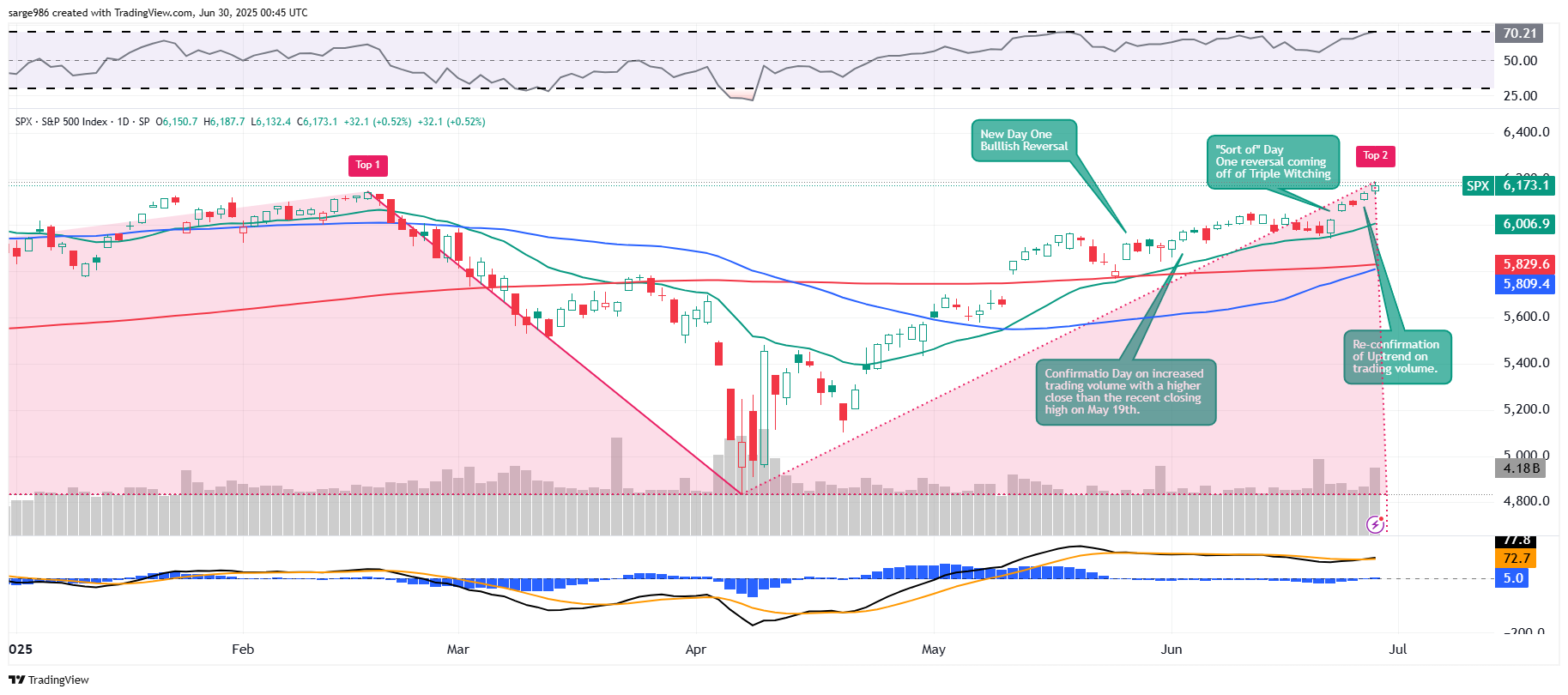
On Wednesday, the S&P 500 gave us the necessary pause that must precede a day of technical confirmation. Then came last Thursday. That was an impressive upside move on increased day over day trading volume. Confirmation Day. On Friday, markets benefited from the algorithmic response to this re-confirmation of an upside trend.
Above the chart, readers will see that Relative Strength just barely kissed technically overbought territory on Friday. Below the chart, readers will see that within the daily Moving Average Convergence Divergence of the S&P 500, the histogram of the 9-day exponential moving average moved above the zero-bound as the 12-day EMA overtook the 26-day EMA. This is undeniably bullish posturing.
What's Ahead?
The week ahead will be an active one, despite the fact that there will be almost no corporate earnings releases and despite the fact that there are only four business days ahead of the July 4 holiday on Friday:
- The focus this week moves from the geopolitical to the political. President Trump's all encompassing "big beautiful" or "big ugly" (depending on who one listens to) bill will dominate the news cycle this week. The Senate managed to move the bill toward open debate over the weekend and that's where we are now. A failure to pass the bill would likely result in a nasty risk-off market response across financial markets.
- The domestic macroeconomic calendar remains active this week, but all eyes will be on one key item. The Bureau of Labor Statistics will release employment surveys for June this Thursday. Wage growth, the unemployment and underemployment rates as well as participation will all be what Fed watchers will be keying on.
- The Federal Reserve will not be as visible this week with a holiday coming up. That said, Fed Chair Jerome Powell will speak from the ECB Forum on Tuesday morning. Ahead of that, Chicago Fed Pres. Austan Goolsbee will speak on Monday afternoon. Chicago does vote this year and Goolsbee did come very close to openly disagreeing with Powell last week.
- The earnings calendar is extremely light again this week. In fact, it's lighter than light. Constellation Brands STZ will report on Tuesday evening and is probably the highest profile firm on the entire docket this week. On the corporate calendar, away from earnings, Tesla TSLA is expected to post the firm's second-quarter deliveries on Wednesday.
- Last, but not least, today is the last trading day of the quarter. Look for some more quirkiness at or near the close. Friday was the Russell rebalancing that took a hatchet to the Palantir Technologies PLTR share price. While we look for a rebound there, we'll also be watching for some pension fund rebalancing this afternoon.
Economics (All Times Eastern)
09:45 - Chicago PMI (Jun): Expecting 42.7, Last 40.5.
10:30 - Dallas Fed Manufacturing Index (Jun): Expecting -11, Last -15.3.
The Fed (All Times Eastern)
10:00 - Speaker: Atlanta Fed Pres. Raphael Bostic.
1:00 p.m. - Speaker: Chicago Fed Pres. Austan Goolsbee.
Today's Earnings Highlights (Consensus EPS Expectations)
After the Close: PRGS (1.30)
At the time of publication, Guilfoyle was long AMD, PLTR equity.