Market Salvation?
Let's try to make sense of what just happened on Wall Street Friday -- was that a bottom, or what? And a look at what's ahead.
You've reached your free article limit
You've read 0 of 1 free Pro articles.
St. Patrick's Breastplate... (excerpt)
I arise today, through,
The strength of Heaven,
The light of the sun,
The radiance of the moon,
The splendor of fire,
The speed of lightning,
The swiftness of wind,
The depth of the sea,
The stability of the earth,
The firmness of rock.
I realize that I have a broad readership, and that not all follow the same path as I, nor are all of Irish Catholic origin as am I. Hence, I have chosen perhaps the least overtly religious section of what is a lengthy prayer for protection to lead my morning column today. That said, I think we and our loved ones all could use some protection in not just these markets, but in this world. Hence, this ancient Christian prayer is easy enough to look up for those interested.
For this is not just a day to recognize a fifth century Christian leader who famously drove the "snakes" (converted the pagan clans) out of Ireland, but this is also the "Unit Day" for the Fighting 69th New York Infantry Regiment, now of the Army National Guard, and also the last remaining, continuously serving regiment of the U.S. Army's "Irish Brigade" that served with the Second Corps of the Army of the Potomac. The regiment will lead New York City's parade later today as they have done every year (except when deployed abroad) since the 1840s.
So... Happy St. Patrick's Day to all who celebrate. May the luck of the Irish and my grandparents, who are buried on that Emerald Isle be with you today and always. Éire go brách!
Salvation?
It finally happened. Stocks rallied quite broadly on Friday. A turnaround? That was the question asked repeatedly across financial media outlets on Friday evening. The major equities suffered yet another "down" week, the fourth in a row for the S&P 500 and the Nasdaq Composite, not to mention the Nasdaq 100, Russell 2000, Dow Transports, and Philadelphia Semiconductor Index. That's pretty ugly. The further one gets out in the weeds, the worse it gets. The S&P Small Cap 600 and S&P Mid Cap 400 both currently have seven week losing streaks going.
So, why can't Friday be a "bottom" or a turning point? Well, the truth is that anything is possible and those of us that study these markets professionally do make mistakes. It could have been a bottom. Why can't a day where the S&P 500 gains 2.13% and is outrun by the Nasdaq Composite that was up 2.61%, at least be the foundation of something better? Heck, the S&P 500 fell into correction territory (10% off its apex) this past Thursday, which is really a much more momentous occasion for those who have never traded anything than it is for those who must hunt and gather every day.
I don't trust what happened Friday. Period. Oh, we may get some "follow-through" that could last for days...and yes, we should try to make some dough on such a move. What I am saying is this, don't forget to trade around your core positions. Safe to assume, most of you reading this ended last week long more shares than you were when the week started. Take some short-term profits, even if you think the market heads higher, even much higher. That's risk management 101, my friends.
Strong Day, Down Week
What the major to mid-major U.S. equity indexes did while I was prancing around Disney World last week:
- The S&P 500 rallied 2.13% on Friday but lost 2.27% for the week.
- The Nasdaq Composite gained 2.61% on Friday but lost 2.43% for the week.
- The Nasdaq 100 gained 2.49% on Friday but lost 2.46% for the week.
- The Russell 2000 gained 2.53% on Friday but gave back 1.51% for the week.
- The S&P Small Cap 600 gained 2.48% on Friday but surrendered 2.68% for the week.
- The S&P Mid Cap 400 rallied 2.4% on Friday, giving up 2.01% for the week.
- The Dow Transports gained 1.71% on Friday but lost a stunning 6.19% for the week.
- The Philly Semiconductors rallied 3.27% on Friday, escaping with just a 0.67% weekly loss.
- The KBW Bank Index gained 2.98% on Friday but lost 2.75% for the week.
On Friday, all 11 S&P sector SPDR ETFs closed in the green, led higher by Technology XLK and Energy XLE. For the week, nine of the eleven S&P sector SPDR ETFs closed in the red, led lower by the Discretionaries XLY and the Samples XLP or basically anything to do with the consumer.
Issues...
What I see wrong with Friday's rally immediately, is this: The day was undeniably strong. A little short covering going into the weekend? Probably. Relief that there would be no shutdown of the federal government at this time? Definitely. We still have slowing economic growth, which is in my opinion a necessity after fiscal policy imbalances had been kept at such unsustainable levels for so long. Regardless, austerity hurts even if done for the right reasons. Even if necessary.
Consumers are in a scary place, at least according to Friday's University of Michigan survey. Then again, once one looks into that survey, they see immediately how bifurcated the results were. The Consumer Sentiment Index fell to 57.9 from 64.7 in January, which was the weakest headline print since November 2022. Interestingly, though.... When broken out by political party, that 57.9 becomes just 41.4 for consumers who vote Democrat and a whopping 83.9 for consumers who vote Republican. How interesting is that? Sure, makes me doubt the results, as the number released really represents almost nobody.
We did get good news on inflation with last week's releases of February consumer price index and producer price index data. We did tell you that inflation was slowing in February when the Fed and the financial media were running around as if the sky was falling. Guess what? Inflation is slowing further in March. Headline CPI could print below 2.5% year over year.
So, what's the deal, Sarge?
Freaky Friday
So powerful. On Friday, winners beat losers at the NYSE by a rough 16 to 3, and at the Nasdaq by about 3 to 1. Advancing volume took a commanding 90.1% share of composite NYSE-listed trade and an almost as impressive 80.8% share of composite Nasdaq-listed activity. The deal is this: Aggregate trade dropped 3.1% on a day-over-day basis across NYSE-domiciled names on Friday and contracted 0.8% on a day-over-day basis across Nasdaq names. The simple reality is that there was less conviction in Friday's rally than there was in any of the recent "down" days. As a matter of fact, this past Friday was the quietest day of trade across the membership of the S&P 500 since Thursday, Feb. 20, more than three weeks earlier.
Readers will see that much of what we have described here in this space has worked to precision over the past few weeks. The "double top" pattern of bearish reversal was a prescient warning of things to come for sure. The "Day One" on Feb. 21 followed by the "Confirmation Day" on Feb. 27 were also spot on as was the "Outside Day" on March 3. That foretold increased volatility, and it was all laid out as it happened here at the Market Recon column at TheStreet PRO.
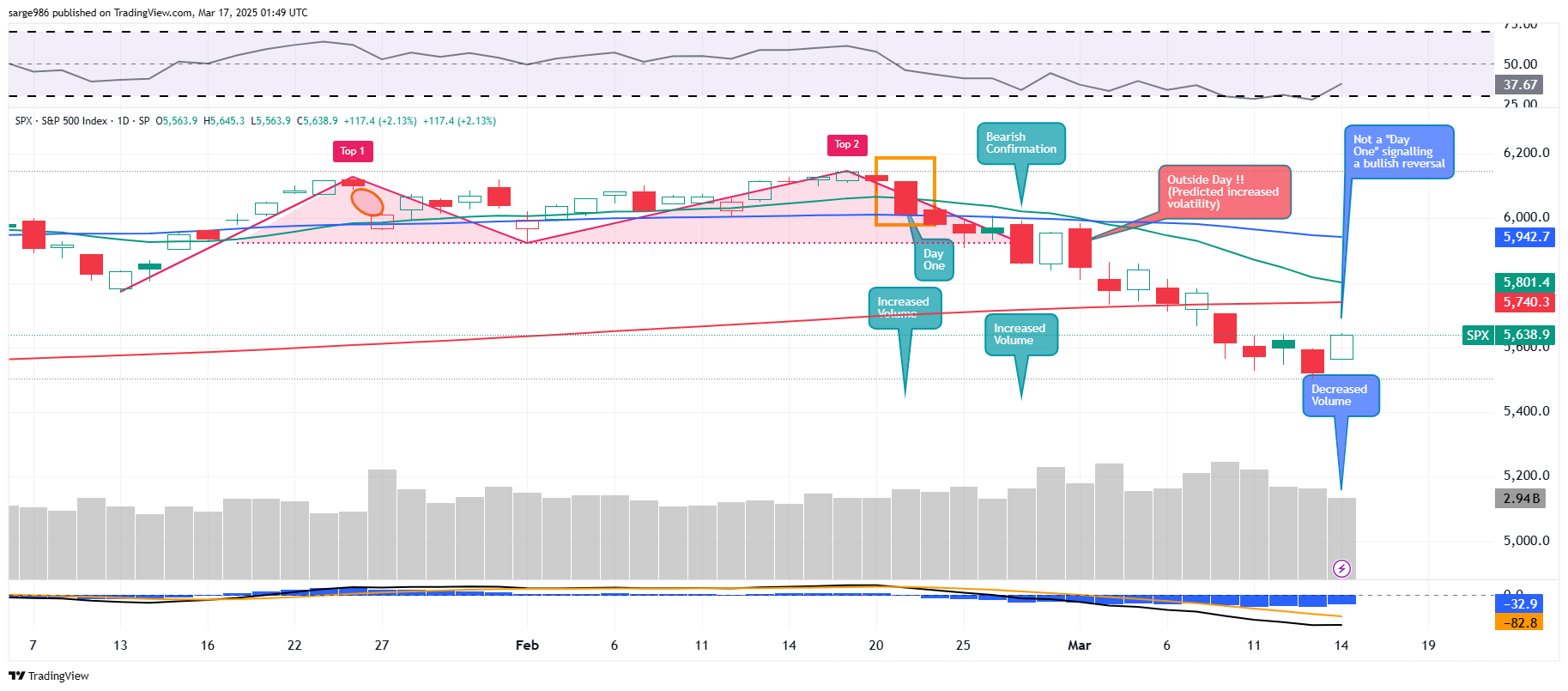
So, now we have a "faux" Day One on light trading volume where the S&P never made a serious run at retaking its 200-day simple moving average. We really don't know anything with the S&P 500 or the Nasdaq Composite trading below that key level. Without the major indexes even making a run at the 21-day exponential moving average, much of the swing crowd will remain on the sidelines.
The market may rally from here. Like I said, anything is possible. Facts are facts, though, and the flow of capital will rule the day. Portfolio managers will not plow back into the marketplace until they think the 200-day line can be taken and held. The same for the swing crowd. Some of them may now use shorter averages, but they still need those averages taken and held. I use the 21-day exponential moving average, but I am older, and the younger crowd sometimes shortens that horizon. For those wondering, the S&P 500 closed on Friday a rough 37 points below the seven-day EMA. Still not so attractive.
Earnings
We are now in between earnings seasons. Readers will see that expectations for corporate earnings are drifting lower and that trend is being priced into markets. According to FactSet, for the fourth quarter, on a year-over-year basis ... the S&P 500 reported earnings growth of 18.3% on revenue growth of 5.3%. Financials knocked the cover off of the ball, with earnings growth of 55.9% followed by Communication Services and Consumer Discretionaries at growth of 29.6% and 27.3% respectively. Only Energy at -26.4%, among the eleven S&P sectors, finished the quarter in a state of earnings contraction.
For the current quarter (Q1, 2025), still according to FactSet, consensus view for the S&P 500 is for earnings growth of 7.1%, down from expectations for growth of 11.2% a few weeks ago, all on revenue growth of 4.2%, down from expectations for growth of 4.4%.
Still looking at the current quarter, just two sectors, Health Care and Technology are expected to grow earnings in double digits (percentagewise) as opposed to six sectors doing so for Q4 2024. Three sectors, the Staples, Materials and Energy are all expected to post negative (contractionary) earnings growth with a fourth and fifth... the Discretionaries and the REITs really sitting on the fence. For the full year 2025, Wall Street sees earnings growth of 11.5% (down from 14.8% over a few weeks) on revenue growth of 5.4%, down from 5.5%.
As for valuation, the S&P 500 went into the weekend trading at 19.9 (down from 21.2 over two weeks) times 12-month forward looking earnings and 24.5 (down from 26.1 two weeks ago) times 12-month trailing earnings. These ratios both remain above their respective five-year and ten-year averages but are now within a whisker of their-respective five-year averages, which are 19.8-times and 24.5-times. In short, equity markets are getting close to not being so absurdly overvalued.
Last Week
- Palantir Technology PLTR announced a plethora of new deals at AIPCon 6 last week with a number of firms including Qualcomm (QCOM). The stock closed up 1.57% for the week after rallying 12.9% off of the week's low last Monday.
- GE Aerospace GE was awarded a firm-fixed price $5 billion five-year ceiling contract by the Air Force for engines for F110 Foreign Military Sales. The work, to be completed by December 31st, 2030, will be performed in Cincinnati, Ohio and San Antonio, Texas. The stock closed out the week up 1.68% and up 5% from the week's low.
What's Ahead?
- The Fed is on deck this week. The group's media blackout period will end this Wednesday afternoon with the release of the FOMC's latest statement on monetary policy, the FOMC's latest edition of their quarterly economic projections and Fed Chair Jerome Powell's press conference. This will likely be the forced upon economic event of the week. Will there be hints of a "Fed put" now that inflation has finally started to slow? Maybe not yet. We'll see.
- The Macroeconomic calendar will obviously be active early in the week. Monday morning brings us February Retail Sales, and January Business Inventories as well as the March edition of the Empire State Manufacturing Index. This will be followed up on Tuesday by February Industrial Production and February Housing Starts. After that, the schedule thins out. On Thursday, the Philadelphia Fed will release their March manufacturing index, and we'll get a look at February Existing Home Sales.
- The earnings calendar is also light this week. That said, there are a few higher profile names reporting. General Mills GIS and Williams Sonoma WSM will report on Wednesday morning. Thursday will bring us FedEx FDX, Lennar LEN, Nike NKE and Micron Technology MU all in the afternoon.
- Nvidia NVDA will be in focus this week as the high-end chip designer will hold its annual GTC conference that will last from Monday through Friday. CEO Jensen Huang will deliver his keynote address on Tuesday and the firm will hold a special meeting with Wall Street sell-side analysts on Monday to be hosted by Huang and CFO Collette Kress.
Economics (All Times Eastern)
08:30 - Empire State Manufacturing Index (Mar): Expecting 1.9, Last 5.7.
08:30 - Retail Sales (Feb): Expecting 0.6% m/m, Last -0.9% m/m.
08:30 - Core Retail Sales (Feb): Expecting 0.4% m/m, Last -0.4% m/m.
10:00 - Business Inventories (Jan): Expecting 0.3% m/m, Last -0.2% m/m.
10:00 - NAHB Housing Market Index (Mar): Expecting 43, Last 42.
The Fed (All Times Eastern)
Fed Blackout Period.
Today's Earnings Highlights (Consensus EPS Expectations)
Before the Open: TXT (1.16)
At the time of publication, Guilfoyle was long PLTR, NVDA equity.