Let's Unpack Friday's Rally
My take on the jobs report was not good, but the 'big, beautiful bill' has a shot at passing and a trade deal with China looks ... possible ... maybe.
You've reached your free article limit
You've read 0 of 1 free Pro articles.
Markets roared on Friday. OK, let me correct that. Equity markets roared on Friday (Treasury markets most certainly did not roar), closing out another strong week as several key indexes went into the weekend at their highest levels since this past February. Markets were nudged higher more by de-escalating conditions between the U.S. and China than anything else. Some folks saw some strength in the Bureau of Labor Statistics jobs market report for May that hit the tape on Friday morning, but anyone who read my piece at TheStreet Pro on Friday afternoon, knows darn well that I saw it differently.
Sure, for May, the BLS reported non-farm payroll growth of 139,000 seasonally adjusted jobs, which was indeed above the consensus view for something close to 124,000. The financial media seemed to just gloss over the fact that the April print was revised lower by 30,000 jobs and that the March print was revised lower by 65,000 jobs. How does a net non-farm payrolls gain of just 44,000 jobs compare to that projection of 124,000 jobs created? Not well.
So, was Friday's selloff in the bond market a response to the "solid" jobs report? Obviously not. The Household survey showed 696,000 jobs lost in May and 625,000 individuals giving up and leaving the labor force. Seems like optimism just bubbling over to me, said no economist worth his or her salt on Friday. The employment to population ratio dropped from 60% to 59.7%, as participation dropped from 62.6% to 62.4%. In fact, participation among 25- to 54-year-olds dropped from 83.6% to 83.4%. So, did equities take off because the Fed will have to react to a tougher labor market sooner rather than later? Nope.
Markets have been on the rise for more than two months now but really heated up toward the end of last week for two reasons. Neither of these reasons, for the moment, had much to do with labor or short-term interest rates.
So, What's Up?
Two things actually. One, the U.S. is inching its way closer, in all likelihood, to passing the "big, beautiful bill." Now, the bill the way it is, undeniably has problems, and those problems are largely fiscal in nature. Hence, the bond market weakness on Friday that unwound much of the strength exhibited across that market earlier last week. This is also why the U.S. dollar has been weakening. Now, just imagine what happens to the stock market should this bill fail to pass, and the 2017 tax cuts expire?
Yikes. Now, throw in a lot of the increased tax cuts aimed at the middle and lower classes such as no tax on overtime and tips and there is some pro-growth policy in there, growth in headline Gross Domestic Product and growth in deficit spending. That alone makes Friday's rally across equities make sense. That alone also makes Friday's 12 basis point run for the yield paid by the U.S. Ten-Year Note make sense.
The "big, beautiful bill," however, was not the main driver of the markets on Friday, at least not on the equity side. Trade was. The president's July 8 deadline for trade deals with other nations looms large. Ninety deals in ninety days? So far, we're still stuck at one ... and counting. Thank goodness for the U.K. The thing is, though, that China has been reprioritized by the Trump administration. This market story is really that tale.
Love / Hate Relationship
I've long felt that the U.S. and China could have, maybe even should have, a symbiotic relationship. They need Americans to buy their goods. The U.S. needs, or at least would love, China to buy its debt. As the Chinese economy continues to stumble around, this becomes a serious issue for Beijing. As the U.S. considers the potential for growing fiscal deficits ever larger, everything from managing borrowing costs to the ability to keep kicking "the can" down the road requires increasingly urgent attention.
A few weeks ago, Pres. Trump accused China of violating the temporary trade truce that the world's two largest economies had agreed to in Geneva. Beijing returned the accusation. Going into last week, Treasury Secretary Scott Bessent, who has been the lead negotiator for the U.S., had said that talks between the U.S. and China had stalled and that he felt that direct communication between Pres. Trump and Pres. Xi could jump-start the process.
On Thursday, Pres. Trump was reported to have reached out to Pres. Xi and called what happened a "very good phone call." Trump was invited to China and Xi was invited to the U.S. Trump also announced that a next round of trade talks between the two powers would take place on June 9 (today) in London.
On top of that news, Reuters reported on Friday that China had granted temporary export licenses for Chinese rare earth suppliers to ship to the top three U.S. automakers. Chinese export controls over rare earths, as U.S. export controls over high-technology products, have been flashpoints in these negotiations.
Just an FYI here: Overnight, China's CGAC reported a 34.5% year-over-year decrease in exports to the U.S. for May. Wow.
The Numbers
What the major to mid-major U.S. equity indexes did last week as several indices hit almost four-month highs.
- The S&P 500 gained 1.05% on Friday and 1.17% for the week.
- The Nasdaq Composite gained 1.2 % on Friday and 2.18% for the week.
- The Nasdaq 100 gained 0.99% on Friday and 1.97 for the week.
- The Russell 2000 ran 1.66% on Friday and an impressive 3.19% for the week.
- The S&P Small Cap 600 gained 1.24% on Friday and 2.14% for the week.
- The S&P Mid Cap 400 gained 0.99% on Friday and 1.66% for the week.
- The Dow Transports gained 1.62% on Friday, flipping the week for a gain of 1.3%.
- The Philly Semiconductors gained just 0.54% on Friday but soared 5.88% for the week.
- The KBW Bank Index popped for 2.06% on Friday and 2.46% for the week.
On Friday, all eleven S&P sector SPDR ETFs closed out the session in the green, led by Energy XLE at +1.88%, and followed by the Discretionaries XLY and Communications Services XLC. Defensive type sectors finished in three of the four bottom slots on the daily performance tables.
For the week, eight of the 11 S&P sector SPDR ETFs traded higher, led by Technology XLK at +3.23%. followed by Energy and Communication Services. Defensive sectors lagged for the week, with the Staples XLP in last at -1.38% and the Utilities XLU in tenth place at -0.89%.
Earnings
First quarter earnings season is now considered to be complete. According to FactSet, for the quarter, 78% of companies in the S&P 500 beat earnings expectations while 64% beat expectations for revenue generation. On a year-over-year basis, the S&P 500 earnings growth for the first quarter ran at 13.3% on revenue of 4.9%. On March 31, consensus for the quarter was for earnings growth of 7.2% on revenue growth of 4.3%. Excellent quarter, plain and simple.
Consensus for second-quarter earnings growth for the S&P 500 is down to 4.9% from 9.1% about two months ago. Q2 revenue growth is currently seen at growth of 4.1%, down from 4.6% at that same time. For the first quarter, Health Care ran way ahead of the pack, with earnings growth of 43%. Communication services came in a very distant second place with growth of 28.8%. Three sectors posted first-quarter earnings contractions, led in the wrong direction by energy (-12.7%) and the staples (-6.1%). For the second quarter, communication services are seen leading earnings growth at +29.4% followed by technology at +15.9%. Four sectors are currently seen sporting contracting earnings for the period with Energy in last place at -25.9%.
For the full calendar year of 2025, Wall Street now sees S&P 500 earnings growth at 9.1%, down from 11.3% about two months ago. Expectations for full year revenue growth have fallen from 5.4% to 4.9% over that same period.
The GDP Game
Last week, the Atlanta Fed revised their GDPNow model for the second quarter down sharply to growth of 3.8% (q/q, SAAR) from 4.6% earlier in the week. There is still no estimate for Q2 GDP ex-the gold trade at this time, and I do not expect that there will be one. Among other regional central bank district branches running close to real-time GDP models, the New York Fed's estimate for Q2 growth now stands at 2.33%, down from 2.42%, while the Cleveland Fed still sees Q2 growth of 1.97%.
The St. Louis Fed decreased their estimate for Q2 GDP from growth of 2.71% all the way to growth of 1.59% last week. As readers can see, there is nothing remotely close to a consensus view across the regional Federal Reserve models available to us. Where is my trusted Hedgeye Nowcast Model? They are the only ones, I might add, that have been consistently close, not just on GDP, but also on inflation, which is why I pay them. After literally nailing the initial BEA estimate for Q1 GDP, Hedgeye's model for the second quarter is now running just above 1.6%.
The Chart
Readers will see that on this chart of the S&P 500, we are literally in "no man's land" right now. The selloff on increased trading volume on Thursday effectively put an end to the technically confirmed uptrend that we had only identified earlier in the week. Remember that Thursday was not a "Day One" bearish reversal in trend because losers did not outnumber winners across NYSE-listings that day. Friday was nice but look at the drop in trading volume for that session. That leaves us with a battleground that could really go either way.
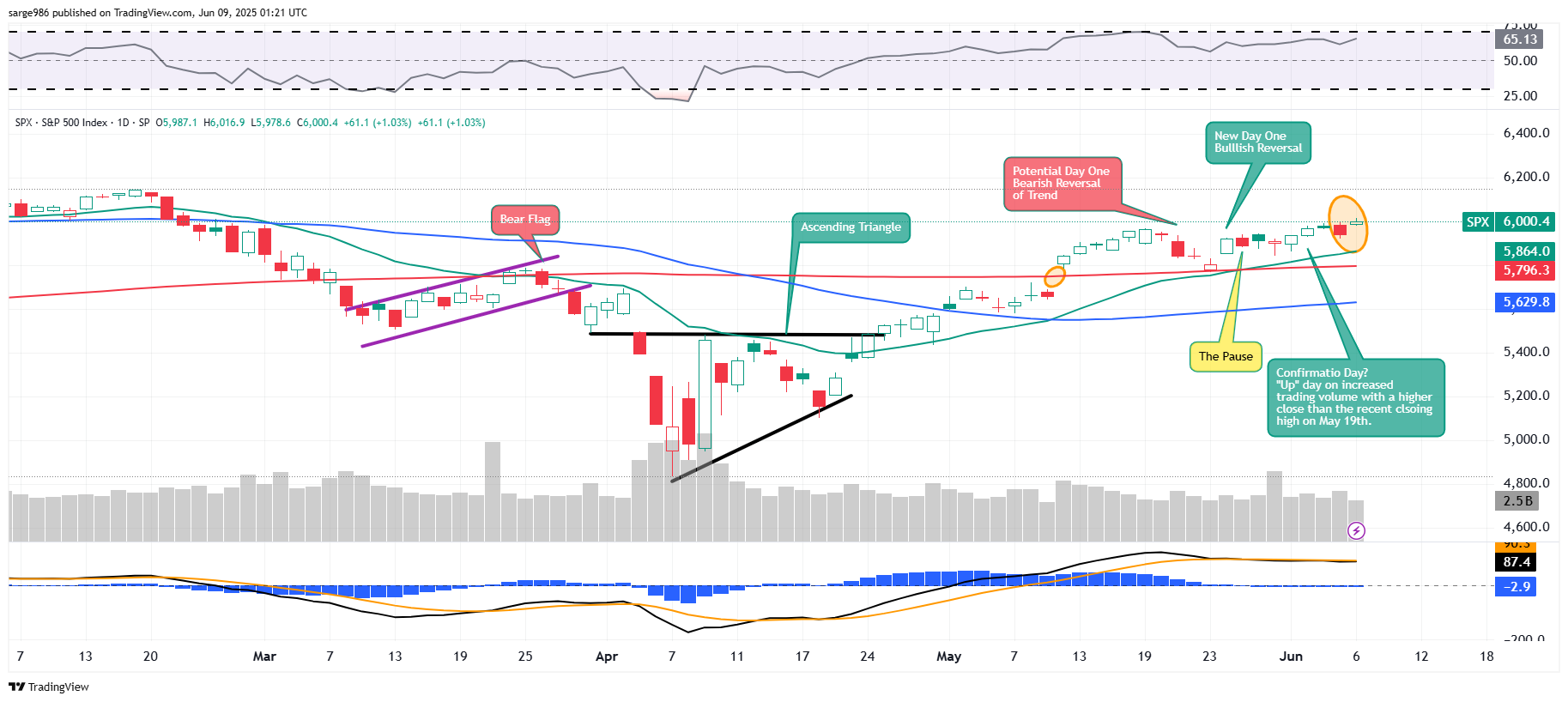
That makes sense as the news that comes out of the U.S. / China trade talks on Monday could be very positive, very negative or something in between. We'll know more when we know more. Relative Strength remains quite robust, but not quite technically overbought. The daily Moving Average Convergence Divergence has gone quite neutral itself. The histogram of the 9-day exponential moving average has moved into negative territory, which is short-term bearish. On top of that, the 12-day exponential moving average has crossed below the 26-day exponential moving average, with both still in positive territory. This makes what we take away from this indicator something of a jump-ball.
What's Ahead?
The week ahead could have been a quiet one. It won't be. Earnings releases are going to be few and far between. You won't be hearing from anyone at the Federal Reserve. The macroeconomic calendar is light, except for... May inflation data. Oh, and there are a few other items out there this week...
- The most important item on the calendar this week is today's meeting on trade in London between the U.S. and Chinese delegations. The U.S. team will be led by Treasury Sec. Scott Bessent, Commerce Sec. Howard Lutnick, and Trade Rep. Jamieson Greer.
- The domestic macroeconomic calendar really does not get hot this week until Wednesday when the BLS releases its May consumer price index data on consumer prices. On Thursday morning, the BLS will put its PPI data on producer prices to the tape. Finally on Friday, the University of Michigan will release the preliminary version of its June survey on consumer sentiment and inflation expectations. Additionally, on Wednesday afternoon, the U.S. Treasury Department will auction off $39 billion worth of new U.S. Ten-Year Notes.
- The Federal Reserve will be quiet this week. Our central bankers have gone into their media blackout period ahead of the June 18th policy decision. Currently, Fed Funds Futures are pricing in close to a 100% probability for no change to be made to monetary policy at that meeting.
- The earnings calendar is extremely light this week. Of course, there are almost always a few well-known names reporting during any given week. This week, we'll hear from GameStop GME on Tuesday afternoon, Oracle ORCL on Wednesday afternoon, and then finally both Adobe ADBE and RH RH on Thursday afternoon. RH is the old Restoration Hardware.
- Speaking of London, Tech Week 2025 kicks off in that city this morning and will go on through Friday. Speakers will include Nvidia's NVDA Jensen Huang, as well as representatives from Microsoft MSFT, Amazon's AMZN AWS and Alphabet's GOOGL Google Cloud.
- Apple AAPL will hold the firm's annual WWDC (Worldwide Developers' Conference) this week as well, in Cupertino, California. The event begins this afternoon and will last through Friday. This has to be the least excited that I have seen the financial media over this event in years.
Economics (All Times Eastern)
10:00 - Wholesale Inventories (Apr-F): Flashed 0.0% m/m.
The Fed (All Times Eastern)
Fed Blackout Period.
Today's Earnings Highlights (Consensus EPS Expectations)
After the Close: CASY (1.94)
At the time of publication, Guilfoyle was long NVDA, MSFT equity.