Largest Stock Listing of 2025 Shocks With Strong Start While Shunning U.S. Investors
This lithium-ion battery maker raised as much as $5.2 billion in Hong Kong, and saw its shares close near their daily high.
You've reached your free article limit
You've read 0 of 1 free Pro articles.
The largest stock offering worldwide so far this year is off to a strong start in Hong Kong, as lithium-ion battery maker CATL (HK:3750) (SZ:300750) sees shares bounce as much as 18%.
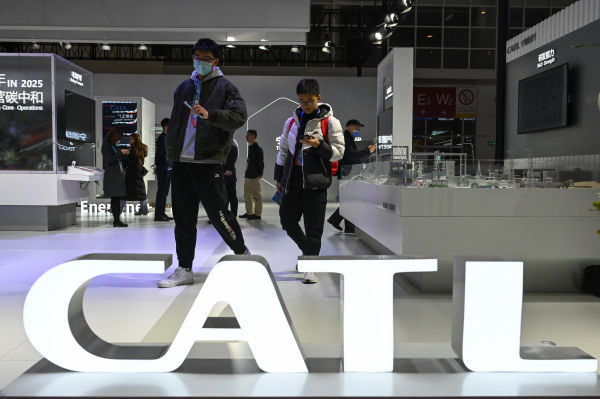
CATL, which counts Tesla TSLA among a long customer list for its electric-vehicle (EV) batteries, has raised as much as $5.2 billion (or $41.0 billion in Hong Kong dollars) with today’s offering in Hong Kong. It now has a market capitalization equivalent to $172 billion.
The company – full name Contemporary Amperex Technology Co. Ltd. – intends to use the offer proceeds to fund a major expansion in Europe, where it is building an $8 billion factory in Hungary.
Bang a Gong (Get It On)
Founder Robin Zeng struck a gong to mark the start of Hong Kong trading today. He says the company is “not just” a battery component supplier, and is instead “committed to becoming a zero-carbon technology company.”
CATL is best-known, however, for its car batteries. It claims 37.9% of the global market for EV batteries, supplying parts for Tesla Model 3 and Y vehicles as well as EVs made by BMW BMWYY, Mercedes-Benz DDAIF, Stellantis STLA, Volkswagen VWAGY and Ford Motor F.
Inside China, it fights a fierce competition with BYD BYDDY (HK:1211), which makes its own batteries for largely lower-end vehicles that can sell for less than $10,000. That’s why CATL stresses that it supplies 72% of the “high-end” market for vehicles priced over the equivalent of $35,000, counting SAIC Motor (SH:600104), Geely Automobile GELYF (HK:0175), Nio NIO (HK:9866), Li Auto LI (HK:2015) and Xiaomi XIACY (HK:1810) among its domestic customers.
CATL, based in the port city of Ningde about half-way up China’s coast, also makes batteries for e-trucks and e-buses, not to mention non-vehicle purposes such as lighthouses.
The stock sold at HK$263, raising an initial HK$35.7 billion (or about $4.6 billion in U.S. dollars). The total rises to about the equivalent of $5.2 billion from 155.9 million shares on sale, if the overallotment is exercised. It surely will be, since the offering was heavily oversubscribed. The shares touched HK$311.40, up 18.4%, before closing on a first-day gain of 16.4%.
Slim Discount to Shenzhen
The Hong Kong shares priced at a relatively slim 6% discount to their Shenzhen value. Stocks in mainland China tend to trade at higher multiples than their equivalents in Hong Kong due to the limited pool of companies.
I mentioned in my last column previewing the listing of CATL that I had applied for a small number of shares. I’m disappointed. I got the notice yesterday that I’d missed out on any kind of allocation.
I wasn’t alone. The allotment results show there were 310,827 valid applications for the stock here in Hong Kong, with only 69,891 of them successful. That’s odds of one in around 4.5.
The international portion of the offering went to far bigger investors than retail punters like me. There were 23 cornerstone investors, as planned, a system Hong Kong uses where institutions take up a guaranteed block of stock, led by the Kuwait Investment Authority sovereign wealth fund and the Hong Kong arm of the oil giant Sinopec HK:0386.
The offer screened out U.S. investors unless they were able to access the listing via an offshore vehicle. That was a voluntary move by the management team, but aims to cut off future geopolitical tensions before they build to a head.
CATL voluntarily made the Hong Kong stock sale a “Reg S” offering, pledging no “directed selling efforts” within the United States. Nevertheless, Los Angeles-based Oaktree Capital Management participated as one of the cornerstone investors.
Political Pressure to Avoid Sale
The House Select Committee on China wrote to U.S. investment banks JPMorgan Chase JPM and Bank of America BAC, urging them to withdraw from participating in the CATL offering. But the Wall Street banks nevertheless went ahead as joint sponsors alongside two Chinese brokerages, with Goldman Sachs GS and Morgan Stanley MS also among the bookrunners.
CATL was in January placed on a Pentagon list of “Chinese military companies,” alongside media conglomerate Tencent Holdings TCEHY (HK:0700), a designation both companies called a “mistake,” as I explained at the time. That doesn’t have any immediate concrete effect, although the Pentagon would be barred from sourcing goods from such companies as of June 30 next year.
But it does hint at the political pressure heaping up on Chinese companies either listed on Wall Street or doing business in the United States. The Treasury Department also maintains a separate sanctions list that bars U.S. investors from holding any assets of such companies in the “Chinese military-industrial complex.”
Smartphone maker Xiaomi in 2021 succeeded in its efforts to get off the Pentagon list. Both Tencent and CATL say they’re negotiating such an outcome. But it’s far more likely to my mind that Tencent would succeed since it runs the WeChat superapp as well as making videogames and streaming music. It is not hard to imagine that CATL batteries find their way into Chinese state-owned enterprises and even military applications.
Future Submarine Use?
The House letters warn that Chinese submarines might in the future switch to using CATL’s lithium-ion batteries, even if they aren’t right now. The House Committee also points to CATL acting as a supplier to a paramilitary unit in Xinjiang province that’s subject to U.S. sanctions for operating forced-labor camps targeting China’s Uighur minority population.
So Zeng and the CATL executive team are warding off future issues by walling off the offer from U.S. investors. It proves complex and costly for a listed stock or index provider to attempt to exclude U.S. investors once a stock starts trading.
CATL listed in Shenzhen in 2018, on the ChiNext market, a would-be Nasdaq with a tech focus. But such mainland “A shares” listed in Shenzhen and Shanghai are available only to investors inside mainland China, bar the very few international investment banks able to secure a quota to trade them.
Listing in Hong Kong gives CATL instant access to a global investment base. There are no currency controls or limits on how much or what stock an investor can buy in Hong Kong. So Hong Kong is where the bulk of international investors get their China exposure.
CATL has its eye on Europe, where Chinese EV makers are able to achieve fatter margins than they can claim at home inside China, where price competition is fierce. CATL intends to use 90% of the offer proceeds for the Hungary factory. The company has committed to invest up to the equivalent of $8.2 billion for the facility in the city of Debrecen, a plant that aims to start production this year even if it takes a full five years to complete.
Although it has had a smaller factory in Germany since 2018, CATL intends to supply Mercedes, BMW, Stellantis and Volkswagen from the Hungary facility. It also has a joint venture with Stellantis in Spain.
At the time of publication, Alex Frew McMillan was long BYD and Li Auto shares.